PSA Density & Prostate Volume: What Your Numbers Mean
A normal PSA in a big prostate is not the same as a normal PSA in a small one. PSA density is how I separate the men who need a biopsy from the ones who can safely wait.

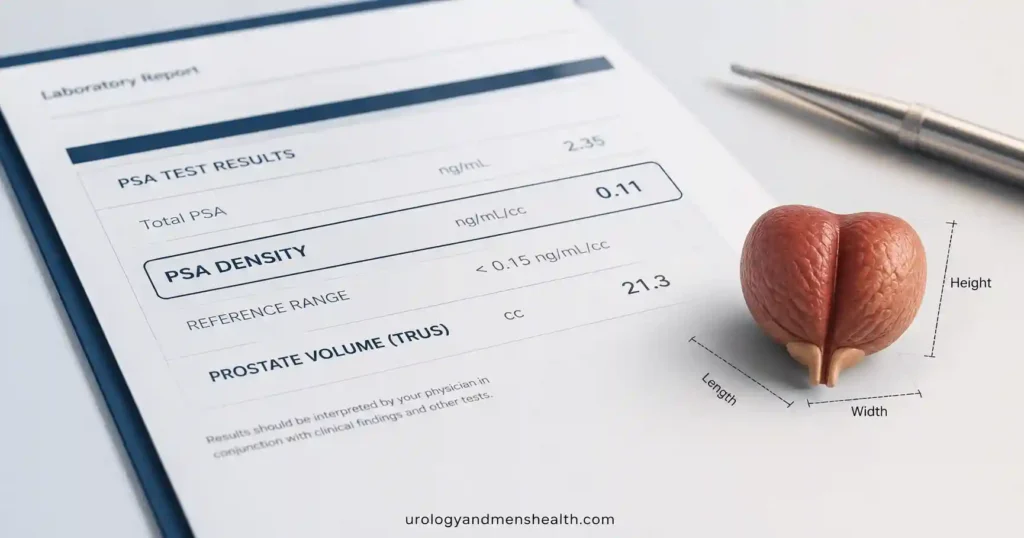
PSA density is the one number that explains why two men with an identical PSA result can walk out of the same clinic with completely different advice — one reassured, one booked for a biopsy. It ties your PSA to the size of your prostate, and that single step changes how worried you should be. A PSA of 5 ng/mL means something very different in a 25 cc prostate than in an 80 cc one. In the small gland, that PSA is hard to explain away; in the large gland, the extra tissue alone can account for it. I use this calculation in clinic every week to decide who genuinely needs a biopsy and who can safely keep watching. For the wider picture of prostate testing, see our Prostate Health Hub. This article covers what prostate volume is, how it is measured, how PSA density is calculated from it, and what your number actually means for your cancer risk.
Key Takeaways
- PSA density is your PSA divided by your prostate volume in cc. A value of 0.15 ng/mL/cc or higher raises the suspicion of clinically significant prostate cancer.
- A “normal” PSA in a large, benign prostate is reassuring; the same PSA in a small prostate is not — that is the entire point of the calculation.
- Prostate volume is estimated with the ellipsoid formula (length × width × height × 0.52) from an ultrasound or MRI report, and MRI tends to be more accurate than transrectal ultrasound.
- Combined with your MRI (PI-RADS) score, PSA density helps your urologist decide whether a biopsy is worth it — especially for the uncertain PI-RADS 3 lesions.
What Is Prostate Volume — and What Counts as Normal?
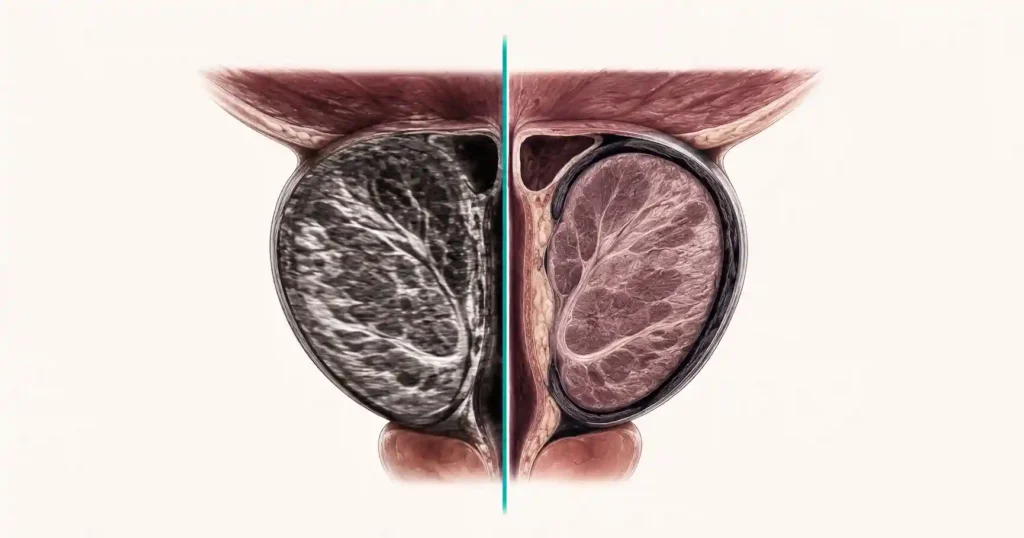
Prostate volume is simply how much space the gland takes up, measured in cubic centimeters (cc, the same as mL). Because prostate tissue is close to the density of water, that volume number is almost identical to the gland’s weight in grams. In a healthy man in his twenties or thirties, the prostate is usually around 20 to 30 cc — roughly the size of a walnut.
From about age 40 onward, the gland slowly enlarges in most men. This is benign prostatic hyperplasia (BPH) — non-cancerous growth — and it is why a 65-year-old’s prostate can reach 60, 80, even over 100 cc. Volume matters in its own right: it drives urinary symptoms and decides which BPH treatments fit you, since smaller glands suit medications and office procedures while large ones often need laser enucleation or Aquablation. But volume’s quieter job is the one most men never hear about — it is the denominator in your PSA density.
How Prostate Volume Is Measured (The Ellipsoid Formula)
Your prostate is not a neat box, so we estimate its volume by treating it as an ellipsoid — an egg-like shape. The formula is the same one used in radiology departments and referenced by both the AUA and EAU: length × width × height × 0.52. The 0.52 (technically π/6) converts three straight-line measurements into a rounded volume.
Those three dimensions come straight off your imaging report. If a transrectal ultrasound or MRI says your prostate measures 4.0 × 3.5 × 3.2 cm (about 1.6 × 1.4 × 1.3 inches), the math is 4.0 × 3.5 × 3.2 × 0.52 = roughly 23 cc. One honest caveat: ultrasound tends to underestimate true gland size by around 17%, because the prostate is closer to a bullet shape than a perfect egg [3]. MRI is generally more accurate and reproducible. The number is an estimate, not a ruler reading — but it is consistent enough to drive real decisions. You can run your own report through our prostate volume calculator to get the figure without doing the arithmetic by hand.
What PSA Density Is — and How to Calculate It
PSA density answers a simple question: is your PSA higher than your prostate’s size can explain? The calculation is one step — your PSA divided by your prostate volume in cc. Every bit of prostate tissue, cancerous or not, leaks a small amount of PSA into the blood, so a big benign gland naturally pushes out more PSA than a small one. Dividing by volume strips that benign explanation away.
Take two men, both with a PSA of 5 ng/mL. The first has a 25 cc prostate: 5 ÷ 25 = 0.20, a number that demands an explanation. The second has an 80 cc prostate: 5 ÷ 80 = 0.06, comfortably reassuring. Same PSA, opposite stories. This is exactly why a raw PSA in the 3 to 10 ng/mL grey zone can be so misleading on its own. To go from your report to your risk band in seconds, our PSA density calculator handles both the volume estimate and the division.
Facing a PSA result you do not fully understand? Download Dr. Khalid’s PSA & Prostate Cancer Decision Guide.
Enter your email below to receive Dr. Khalid’s complete PSA & Prostate Cancer Decision Guide as a free, printable PDF.
What Your PSA Density Number Actually Means
PSA density is a gradient of risk, not a pass-fail line. The bands most urologists work with, drawn from EAU risk-stratification data, run like this: below 0.10 is low risk, 0.10 to 0.15 is intermediate-low, 0.15 to 0.20 is intermediate-high, and above 0.20 is high [2][4]. The number everyone watches is 0.15 ng/mL/cc — the AUA flags a density at or above this as a marker for clinically significant cancer [1].
Read it as a dial, not a switch. A density of 0.12 does not mean “no cancer” and 0.18 does not mean “cancer” — they mean your odds are lower or higher, and that shifts how aggressively your urologist investigates. The value is greatest precisely when your raw PSA is ambiguous: it turns a confusing single number into a probability you can actually act on.
In My Practice
I look after two men whose PSA results would look almost identical on paper. The first came in alarmed by a PSA of 5.8, but his prostate was a generous 92 cc — a density near 0.06 — and his MRI was clean, so we have simply kept watching, no needles involved. The second had a lower-looking PSA of 4.2, but in a tight 24 cc gland that worked out to 0.175. His MRI and targeted biopsy found a Grade Group 2 cancer we could treat early.
The PSA numbers nearly matched; the prostate volumes told me which man to leave alone and which one to chase.
How PSA Density Guides the Biopsy Decision
On its own, PSA density is useful. Paired with an MRI, it becomes one of the sharpest tools we have for avoiding unnecessary biopsies. Both the AUA and EAU now combine the PI-RADS score from your MRI with your PSA density to decide who needs a needle [1][2]. A clearly suspicious lesion (PI-RADS 4 or 5) usually warrants biopsy regardless. The hard cases are the in-between PI-RADS 3 scans — and that is where density earns its keep.
A PI-RADS 3 lesion with a low PSA density can often be watched rather than biopsied, sparing a man an invasive test. The same PI-RADS 3 lesion with a density above 0.15 tips the balance toward proceeding. This is the exact logic behind the modern MRI-before-biopsy pathway, and the same density trend is tracked over time in men on active surveillance to catch a cancer that starts to stir. PSA density does not replace your urologist’s judgment — it makes that judgment more precise.
Related: what else belongs on a man’s screening checklist after 40Where PSA Density Can Mislead You
A reassuring density is a reason to relax, not a reason to ignore other warning signs. PSA density is one input among several, and it has real blind spots:
- A low density never rules cancer out — some aggressive tumors make relatively little PSA.
- An abnormal rectal exam — a hard nodule your doctor can feel — overrides a comfortable density. Get it evaluated regardless.
- The number is only as good as the volume measurement. A rushed or poorly measured ultrasound can skew it.
- If your PSA is climbing year over year or you have a strong family history, push for an MRI within weeks even if today’s density looks fine.
Frequently Asked Questions
What is a normal PSA density?
A PSA density below 0.10 ng/mL/cc is considered low risk, and 0.10 to 0.15 is intermediate. The number that makes a urologist pay attention is 0.15 ng/mL/cc or higher, which the AUA links to a greater chance of clinically significant prostate cancer. Above 0.20, the suspicion is strong enough that most men should have a biopsy discussion.
Why does a bigger prostate lower your PSA density?
Every part of the prostate leaks a small amount of PSA into the blood, so a large, benign gland naturally produces more PSA than a small one. Dividing your PSA by your prostate volume corrects for that extra tissue. A PSA of 5 in an 80 cc gland gives a reassuring density near 0.06, while the same 5 in a 25 cc gland gives 0.20 — a number that needs explaining.
Can you have prostate cancer with a low PSA density?
Yes. PSA density lowers the probability of significant cancer, but it never reaches zero. Some aggressive tumors produce relatively little PSA, and a normal density can still sit alongside a suspicious nodule on examination or a worrying spot on MRI. A low number is a reason to relax, not a reason to skip an MRI or biopsy your urologist recommends for other reasons.
How do I calculate PSA density from my own report?
Find your prostate volume in cc on your ultrasound or MRI report, then divide your most recent PSA by that volume. If the report only lists three dimensions in centimeters, multiply them together and by 0.52 to get the volume first. Our PSA density calculator does both steps and shows which risk band you fall into.
Is PSA density better than PSA alone for deciding on a biopsy?
For men with a PSA in the 3 to 10 ng/mL grey zone, yes — density adds context that a raw PSA cannot. Both the AUA and EAU use PSA density alongside the MRI score to decide who needs a biopsy, especially for uncertain PI-RADS 3 lesions. It is one input, not a verdict, but it consistently sharpens the decision.
Does PSA density matter during active surveillance?
It does. A rising PSA density over time can be an early signal that a cancer being watched is becoming more active, prompting a repeat MRI or biopsy. A stable, low density is one of several reassuring signs that surveillance can safely continue. Your urologist tracks it alongside your PSA trend and imaging.
References
- American Urological Association / Society of Urologic Oncology. Early Detection of Prostate Cancer: AUA/SUO Guideline (2023; amended 2025). AUA
- European Association of Urology. EAU Guidelines on Prostate Cancer: Diagnostic Evaluation. 2024. EAU
- Rodriguez E Jr, Skarecky D, Narula N, Ahlering TE. Prostate Volume Estimation Using the Ellipsoid Formula Consistently Underestimates Actual Gland Size. J Urol. 2008;179(2):501-503. PubMed
- Schoots IG, Padhani AR. Risk-adapted biopsy decision based on prostate MRI and PSA density for enhanced biopsy avoidance in first prostate cancer diagnostic evaluation. BJU Int. 2021;127(2):175-178. PubMed
Dr. Muhammad Khalid
MBBS · FCPS (Urology) · MCPS (General Surgery) · CHPE · CRSM · IMC #539472
Specialist urologist with 11+ years of clinical experience across tertiary teaching hospitals. Trained at Lady Reading Hospital and Khyber Teaching Hospital, Peshawar. Author or co-author of five peer-reviewed international publications, including in Cureus and the World Journal of Surgery. Procedural expertise: URS, PCNL, RIRS, TURP, TURBT, and major open urological surgery. Full profile →
This article is for educational purposes only and does not constitute medical advice. Always consult your physician or urologist for diagnosis and treatment decisions specific to your condition.