Does Masturbation Prevent Prostate Cancer? The Evidence
Patients ask me if "cleaning the pipes" lowers their cancer risk. The honest answer: the data leans yes, but the effect is modest, far from proven, and never a reason to skip a PSA test.

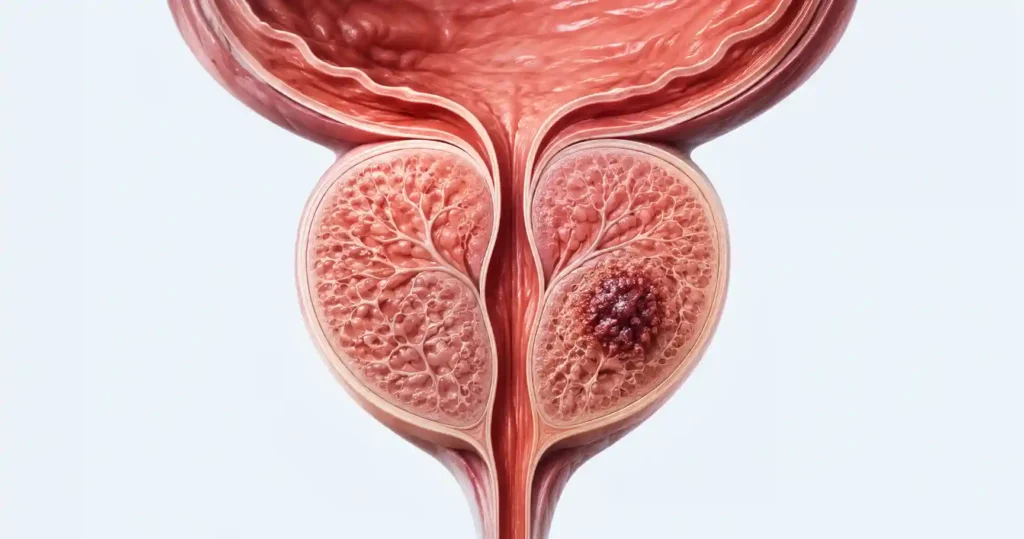
Does masturbation prevent prostate cancer? It is one of the questions men quietly type into a search bar at midnight, and one I am asked in clinic more often than you might expect — usually with a nervous half-smile. The real answer is more interesting than a clean yes or no. Frequent ejaculation has been linked to a modestly lower risk of prostate cancer in some very large studies, but the phrase “linked to” is carrying a lot of weight there. These are observational findings, not proof that the act itself protects you. In this article I will walk through what the research actually found, the biological theory behind it, why it falls short of evidence you can bank on, and — most importantly — what truly moves the needle on your prostate cancer risk. The things that matter most, it turns out, are the ones you cannot change by adjusting your habits in the bedroom.
Key Takeaways
- In the largest study to date, men who ejaculated 21 or more times a month had roughly a 20% lower prostate cancer risk than men at 4 to 7 times a month.
- This is an association, not proof — the data cannot separate ejaculation from the healthier lifestyles that often come with it.
- At least one well-run study found the opposite pattern in younger men, so the evidence is genuinely mixed.
- Nothing about ejaculation frequency replaces PSA testing; age, family history, and ethnicity drive your real risk.
What the research says about ejaculation and prostate cancer
The headlines come from one place: Harvard’s Health Professionals Follow-up Study, a long-running project tracking tens of thousands of men over decades. In 2004, researchers first reported a statistically significant inverse association between how often men ejaculated and their later prostate cancer risk, across 29,342 men [2]. That finding was striking enough that they returned to it twelve years later with another decade of data.
The 2016 update is the one most people have heard about, even if they do not know its name. Following 31,925 men, the team found that those reporting 21 or more ejaculations per month had a 19% lower risk of prostate cancer when measured in their 20s, and a 22% lower risk when measured in their 40s, compared with men ejaculating just 4 to 7 times a month [1]. The link held even among men who had undergone PSA screening, which helps rule out the simplest explanation — that sexually active men simply get tested more.
If you want the bigger picture on what does and does not affect prostate health, our prostate health hub pulls the screening, treatment, and risk topics together in one place.
The prostate stagnation hypothesis: why “cleaning the pipes” might matter
So why would ejaculation frequency change anything? The leading idea is the prostate stagnation hypothesis — the notion that regularly clearing prostatic fluid flushes out potentially harmful substances before they sit around long enough to damage cells.
The prostate’s job is to produce part of the fluid in semen. That fluid can concentrate various compounds, including some potential carcinogens. The theory goes that fluid which is expelled regularly spends less time in contact with the gland’s cells, lowering their cumulative exposure. It is a tidy, intuitive mechanism, which is part of why it gets repeated so confidently.
Here is the problem: a plausible mechanism is not the same as a proven one. We have a story that fits the data, but no one has shown in humans that flushing the prostate is what drives the lower risk seen in those studies. A good-sounding explanation can be completely wrong, and in medicine they often are.
Facing a PSA result you do not fully understand? Download Dr. Khalid’s PSA & Prostate Cancer Decision Guide.
Enter your email below to receive Dr. Khalid’s complete PSA & Prostate Cancer Decision Guide as a free, printable PDF.
The catch: why this is not proof you can rely on
This is where I slow patients down. Both Harvard studies are observational — they watched what men did and what happened, but they did not assign anyone to ejaculate more or less. That matters enormously, because men who ejaculate frequently tend to differ in other ways: they are often in better health, in relationships, less depressed, and more physically active. Any of those could lower cancer risk on its own. A study can adjust for some of this, but never all of it.
Then there is the counter-evidence. A UK case-control study of 431 men with prostate cancer and 409 without found the opposite pattern in younger men: frequent sexual activity and masturbation in their 20s and 30s was associated with a higher risk, not lower — though that association disappeared by their 40s [3]. When two careful studies point in opposite directions, the truthful answer is that we do not yet know.
So when a patient asks me whether he should masturbate more to fend off cancer, I give him the plain truth: it might help a little, it might do nothing, and it is not a plan.
In My Practice
A patient in his late 30s once asked me, dead serious, whether he was “doing enough” to prevent prostate cancer through frequent ejaculation — he had been keeping a mental tally after reading the Harvard headline. He was also a smoker whose father had prostate cancer at 62, and neither of those facts had crossed his mind.
Men will happily optimize the variable that is fun and ignore the ones that actually carry weight — which is exactly backwards.
What actually lowers your prostate cancer risk
Let me redirect that energy toward what the evidence supports. The strongest drivers of prostate cancer risk are the ones you cannot negotiate with: age, a family history of the disease, and ethnicity — Black men carry a meaningfully higher risk and tend to develop it younger. Inherited BRCA gene mutations raise risk too. None of these respond to lifestyle tweaks.
What you can do is catch the disease early, when it is most treatable. That means having the screening conversation at the right age — generally from 50, or from 45 if you are Black or have a close relative who had prostate cancer. Our age-by-age screening guide breaks down exactly when that conversation should happen for your situation. For a quick sense of where you stand, the prostate cancer risk calculator walks you through the same factors I weigh in clinic.
It is also worth being just as skeptical of supplement claims as you should be of the masturbation headline. Most “prostate-protective” pills have thin or absent evidence — we lay out what holds up in our review of prostate supplements. The pattern is consistent: the marketing always runs ahead of the data.
Don’t Let a Myth Replace a Check-Up
No amount of ejaculation changes the symptoms that need a doctor’s eyes. See a urologist promptly if you notice:
- Blood in your urine or semen
- A new, persistent need to urinate at night, or a weak stream
- Bone pain in the lower back, hips, or pelvis that will not settle
- A PSA result your doctor describes as borderline or rising
One practical note: ejaculating within 48 hours of a PSA blood test can temporarily push the number up and trigger a false alarm. If your result lands in the borderline grey zone, abstaining for two days and repeating it is reasonable.
Frequently Asked Questions
Does masturbation prevent prostate cancer?
Frequent ejaculation — including masturbation — is linked to a lower prostate cancer risk in large Harvard studies, but linked is not the same as prevents. The data is observational, so it cannot prove cause and effect. Treat it as a possible small bonus, then check where your real risk stands.
How many times a month did the studies look at?
The 2016 Harvard study compared men averaging 21 or more ejaculations per month against those at 4 to 7 per month, and the higher-frequency group had roughly a 20% lower risk. There is no evidence that a magic number exists. Be just as skeptical of supplement claims that promise the same thing.
If frequent ejaculation lowers risk, why do some studies show the opposite?
A UK case-control study found that frequent sexual activity in a man’s 20s and 30s was tied to a higher risk, not lower. Differences in study design and age groups explain much of the conflict. The honest summary, covered across our prostate health hub, is that the evidence is mixed.
Can ejaculating replace PSA testing or prostate exams?
No. Nothing about ejaculation frequency changes whether you need screening. Risk is driven mostly by age, family history, and ethnicity — factors you cannot masturbate away. If you are over 50, or over 45 with risk factors, the screening conversation still matters.
Could recent ejaculation affect my PSA result?
Yes, and this is the reverse concern that matters: ejaculating within 48 hours of a PSA blood test can temporarily raise the number and cause a false alarm. If your PSA comes back in the borderline grey zone, abstaining for two days and retesting is reasonable.
References
- Rider JR, Wilson KM, Sinnott JA, et al. Ejaculation Frequency and Risk of Prostate Cancer: Updated Results with an Additional Decade of Follow-up. Eur Urol. 2016;70(6):974-982. PubMed
- Leitzmann MF, Platz EA, Stampfer MJ, Willett WC, Giovannucci E. Ejaculation Frequency and Subsequent Risk of Prostate Cancer. JAMA. 2004;291(13):1578-1586. PubMed
- Dimitropoulou P, Lophatananon A, Easton D, et al. Sexual activity and prostate cancer risk in men diagnosed at a younger age. BJU Int. 2009;103(2):178-185. PubMed
Dr. Muhammad Khalid
MBBS · FCPS (Urology) · MCPS (General Surgery) · CHPE · CRSM · IMC #539472
Specialist urologist with 11+ years of clinical experience across tertiary teaching hospitals. Trained at Lady Reading Hospital and Khyber Teaching Hospital, Peshawar. Author or co-author of five peer-reviewed international publications, including in Cureus and the World Journal of Surgery. Procedural expertise: URS, PCNL, RIRS, TURP, TURBT, and major open urological surgery. Full profile →
This article is for educational purposes only and does not constitute medical advice. Always consult your physician or urologist for diagnosis and treatment decisions specific to your condition.