PSA Levels by Age: The Chart and Its Limits
The PSA levels by age chart came from 471 men in one Minnesota county in 1993. It tells you what was common at your age. It was never built to tell you whether you have cancer.


Every chart of PSA levels by age traces back to one study: 471 men in a single Minnesota county, examined between 1989 and 1991. None had detectable prostate cancer, so the researchers took the 95th percentile of their results and published it as a reference range — 2.5 ng/mL for men in their 40s, 3.5 in their 50s, 4.5 in their 60s, 6.5 in their 70s [2]. That is the whole origin of the numbers you are measuring yourself against.
I raise this because of how those numbers get used. Men arrive in my clinic having read the chart and having already reached one of two conclusions: they are under the line and therefore fine, or they are over it and therefore probably have cancer. Both are wrong more often than most people expect. The chart describes what was typical among men without cancer. It was never designed to sort men into safe and unsafe. Below, I’ll cover where it genuinely helps, where it fails, and what your urologist actually uses to decide what happens next. For the wider picture, see our Prostate Health Hub.
Key Takeaways
- The age chart is a 95th percentile taken from men without cancer — a description of what is common, not a line separating cancer from no cancer.
- In the Prostate Cancer Prevention Trial, 15.2% of men with a PSA of 4.0 ng/mL or less had cancer on biopsy, and roughly one in seven of those cancers was Gleason 7 or higher.
- Applied to Black men at the same specificity, the standard chart would miss about 41% of cancers — which is why the AUA starts screening earlier rather than swapping in a different chart.
- A newly elevated PSA returns to normal on retesting in 25% to 40% of men, so the correct next step after one high result is a second test, not a biopsy.
Where the PSA Levels by Age Chart Came From
Oesterling and colleagues published the ranges in JAMA in 1993 [2]. They were studying the natural history of benign prostatic enlargement, not designing a cancer test. What they found was that PSA rises with age largely because the prostate itself gets bigger with age: PSA correlated with prostate volume, and volume correlated with age. In a healthy 60-year-old, they measured an average rise of about 3.2% per year — roughly 0.04 ng/mL annually.
So the logic behind the chart is sound and still holds. A PSA of 4.0 means something different in a 46-year-old with a 25 mL prostate than in a 74-year-old with a 90 mL prostate. The AUA/SUO Early Detection guideline, amended in 2026, makes the same point: the traditional 4.0 ng/mL threshold is too high for men in their 40s and 50s and too low for men in their 70s and 80s, where the risk of overdiagnosis climbs [1].
Here is the chart itself, alongside a second set of ranges I’ll explain shortly.
| Age range | Standard chart limit | Proposed limit, Black men |
|---|---|---|
| 40-49 | 2.5 ng/mL | 2.0 ng/mL |
| 50-59 | 3.5 ng/mL | 4.0 ng/mL |
| 60-69 | 4.5 ng/mL | 4.5 ng/mL |
| 70-79 | 6.5 ng/mL | 5.5 ng/mL |
If you want your own result placed against these ranges rather than against a single fixed number, our age-adjusted PSA interpreter does the comparison and explains what each band means clinically.
The Chart Describes Normal. It Does Not Rule Out Cancer.
This is the part that gets left out of almost every chart you’ll find. In 2004, Thompson and colleagues biopsied 2,950 men in the Prostate Cancer Prevention Trial who had never had a PSA above 4.0 ng/mL and never had an abnormal rectal exam. Cancer was found in 449 of them — 15.2%. Of those cancers, 67 were Gleason 7 or higher [4].
The prevalence climbed steadily across the supposedly normal range: 6.6% at a PSA up to 0.5, 10.1% at 0.6 to 1.0, 17.0% at 1.1 to 2.0, 23.9% at 2.1 to 3.0, and 26.9% at 3.1 to 4.0 ng/mL. There was no floor below which cancer disappeared. There was only a gradient of decreasing probability.
The mirror image is equally true. Most men who sit above their age line do not have prostate cancer. Benign enlargement, inflammation, and ordinary test-to-test variation account for far more elevated results than tumors do. A chart that can neither exclude cancer below the line nor establish it above the line is not a threshold. It is context.
The AUA’s own framing reflects this. Rather than fixing a number, the 2026 guideline notes that definitions of an elevated PSA have shifted over time — 4.0 ng/mL came from early studies of men presumed cancer-free, 3.0 ng/mL from the Finnish arm of the ERSPC screening trial — and recommends that clinicians tailor what counts as elevated to the individual, using validated risk calculators and shared decision-making [1].
In My Practice
Two men in the same clinic list, both with a PSA of 4.2. The first was 49, with a 24 mL prostate on ultrasound — a small, firm gland producing far more PSA than its size should account for. The second was 73, with a 96 mL prostate he had been catheterized for twice. Same number, same chart column position relative to their ages, and I sent them down completely different pathways: MRI and biopsy discussion for the first, symptom management and a repeat test for the second. The first had Gleason 4+3 disease.
The number on its own told me almost nothing; the number divided by the size of the gland producing it told me nearly everything.
The Chart Misses More Cancers in Black Men
In 1996, Morgan and colleagues published a study in the New England Journal of Medicine comparing PSA distributions in 3,475 men without cancer and 1,783 men with cancer, split by race [3]. Their finding was blunt: if the traditional age-specific ranges were applied to Black men with test specificity held at 95%, 41% of prostate cancers would be missed.
Their proposed alternative is the third column in the table above, and it’s worth understanding why those numbers don’t all move in the same direction. Oesterling’s ranges were built to keep false alarms low — 95% specificity. Morgan’s were built to keep missed cancers low — 95% sensitivity. Setting a line for sensitivity pushes some age bands down and lets others sit higher, because the cost being minimized has changed. This is the single most misunderstood thing about reference ranges: the same test produces different lines depending on which error you have decided you can least afford.
Current practice has not adopted a separate chart for Black men. The AUA 2026 amendment handles the elevated risk differently — by recommending screening begin at 40 to 45 years for men at increased risk, which includes Black race, germline mutations such as BRCA2, and a strong family history, and by supporting shorter re-screening intervals in that group [1]. Black men carry roughly twice the risk of dying from prostate cancer. The response has been earlier and more frequent testing rather than a redrawn threshold.
If you are Black, or have a father or brother diagnosed under 60, the practical instruction is specific: ask for a baseline PSA at 40 to 45 rather than 50, and ask that the interval be set at one to two years rather than the standard two to four.
What to ask your doctor after an elevated PSA result
Enter your email below to receive Dr. Khalid’s complete PSA & Prostate Cancer Decision Guide as a free, printable PDF.
What Raises Your PSA That Has Nothing to Do With Cancer
PSA is made by prostate glandular cells and normally stays largely within the gland. Anything that disrupts the barrier between glandular tissue and the bloodstream lets more of it into circulation. Cancer does that. So does a great deal else.
Ordinary day-to-day variation
Nixon and colleagues drew blood from the same men on ten consecutive weekdays and measured how much PSA moved on its own. Combining biological and laboratory variation, they calculated that an increase of anywhere up to 20% to 46% between two consecutive results can be noise [5]. A jump from 2.0 to 2.6 ng/mL falls inside that window. It may mean nothing at all.
Which laboratory ran the test
PSA assays from different manufacturers do not return identical numbers on the same sample. Foj and colleagues tested 167 samples across seven commercial platforms and found relative differences exceeding 10% at the 3, 4, and 10 ng/mL decision points, despite years of standardization work [6]. Results calibrated to the WHO standard run meaningfully lower than results calibrated the older way. The practical instruction: have serial PSA tests run at the same laboratory, and if you switch, say so, because a “rise” may be a change of analyzer.
Finasteride and dutasteride
In a randomized trial, mean total PSA fell from 3.0 to 1.5 ng/mL after six months of finasteride — a 50% drop — while percent free PSA was unchanged [7]. This is where the familiar “double your PSA” rule comes from. Treat it as an approximation rather than arithmetic: the AUA notes that PSA kinetics on 5-alpha reductase inhibitors vary considerably between individuals, with one trial finding only about a third of men showed a 40% to 60% decline at one year [1]. Tell whoever orders the test that you take the drug and for how long. Do not do the multiplication yourself and compare the answer to a chart.
Inflammation, infection, and instrumentation
Prostatitis can raise PSA substantially and is one of the more frequent explanations I find in younger men with an unexpected result — the difference between an acute infection and a chronic inflammatory picture matters for both treatment and PSA interpretation, and I’ve covered that distinction in acute versus chronic prostatitis. Urinary infection, urinary retention, catheterization, cystoscopy, and prostate biopsy all push PSA up transiently. PSA has a half-life of two to three days, so after any of these the test needs a genuine gap before it means anything.
What matters less than the internet suggests
Three things get blamed constantly and shouldn’t be. Per the AUA’s 2026 review of the evidence, neither a digital rectal exam nor bicycle riding appreciably alters PSA, and most controlled studies of ejaculation show either no significant effect or a modest rise of around 10% [1]. If your result is borderline, abstaining for 48 hours before a repeat test is reasonable. If your result is 9.0, abstinence was not the problem.
What Actually Changes the Decision at Your Age
1. Repeat the test before anything else happens
The AUA’s position is unambiguous: for a newly elevated PSA, repeat the PSA before ordering a secondary biomarker, imaging, or a biopsy. Between 25% and 40% of newly elevated results return to normal on retesting. In the Stockholm-3 study, among 1,686 biopsied men with a PSA of 3 to 10 ng/mL who had two tests eight weeks apart, 283 — 17% — subsequently fell below 3 [1]. If you have had one elevated PSA and someone is scheduling a biopsy without a confirmatory test, ask why.
2. PSA density, not PSA
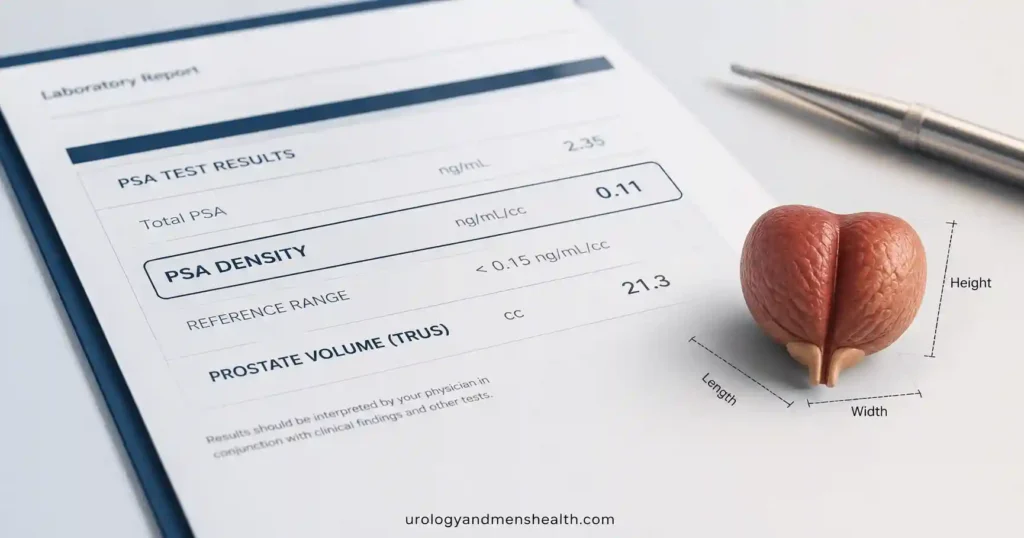
Divide the PSA by the prostate volume in millilitres and you have PSA density, which asks the question the raw number cannot: is this gland producing more PSA than its size accounts for? A PSA of 6 with a 90 mL prostate gives a density of 0.07. The same PSA of 6 with a 30 mL prostate gives 0.20, above the commonly used 0.15 threshold, and is a different conversation entirely. The mechanics and the thresholds are covered in prostate volume and PSA density, and if you have a volume figure from an ultrasound or MRI report, our PSA density calculator will do the arithmetic.
3. Where you sat in midlife
This is the most underused piece of information in prostate screening. A single PSA measured in your 40s or 50s predicts long-term outcome remarkably well. In the Malmö Preventive Project, of men measured at 60, those in the top quartile (above 2 ng/mL) accounted for 90% of all subsequent prostate cancer deaths, while men at or below 1 ng/mL had a 0.5% risk of metastasis and a 0.2% risk of death by age 85 [8]. A 2024 analysis of 129,067 men in a contemporary American health system found that men with a baseline PSA at or above the 90th percentile before age 60 had a hazard ratio of 7.48 for lethal prostate cancer compared with men below the median [9].
Median PSA is roughly 0.4 to 0.7 ng/mL for men in their 40s and 0.7 to 1.0 for men in their 50s. Sitting at 1.8 at age 47 is well under the chart’s 2.5 line and simultaneously well above the median for your age. The chart calls that normal. The evidence calls it a reason to keep testing on a shorter interval.
4. What the rate of rise does and doesn’t do
PSA velocity — how fast the number climbs — is treated online as a red flag in its own right, usually via a 0.75 ng/mL per year rule that has been retired. The AUA 2026 guideline states, as a Strong Recommendation at Evidence Grade B, that velocity should not be used as the sole indication for a secondary biomarker, imaging, or biopsy: once age, PSA, rectal exam, percent free PSA, family history, and prior biopsy history are known, velocity adds nothing to the prediction of clinically significant cancer. More counterintuitively, a very steep rise above 3 ng/mL per year is more closely associated with inflammation on biopsy than with tumor [1]. Velocity still has a defined role in post-treatment follow-up and in narrow repeat-biopsy criteria. It is not a screening trigger.
5. How often, and when to stop
For average-risk men, the AUA recommends a baseline PSA between 45 and 50 and regular screening every two to four years from 50 to 69. Intervals can be stretched considerably for men with a PSA below 1 ng/mL or below the age-specific median — modeling suggests extending from two years to eight for a man with a PSA under 1.0 at 45 halves the number of tests while preserving more than 95% of the lives saved. At the other end, discontinuing or substantially lengthening screening is reasonable at 75 or older if the PSA is below 3 [1].
When the Chart Is Beside the Point
Reference ranges apply to screening in men without symptoms. If any of the following is present, the number is not the question — arrange assessment now rather than waiting for a scheduled test:
- Visible blood in the urine or in semen
- New, persistent bone pain, particularly in the spine, ribs, or hips
- Complete inability to pass urine, with a painful lower abdomen — this is a same-day emergency
- Unexplained weight loss alongside urinary symptoms
- A PSA above 20 ng/mL at any age, which warrants urgent urology referral rather than a repeat test in six months
- New leg weakness, numbness, or loss of bladder or bowel control in a man with known prostate cancer — go to the emergency room, as this can indicate spinal cord compression
Frequently Asked Questions
My PSA is 4.2 at age 62. The chart says that’s under the limit for my age — does that mean I’m clear?
It means you are in a lower-probability group, not a zero-probability one. In the Prostate Cancer Prevention Trial, 26.9% of men with a PSA between 3.1 and 4.0 had cancer on biopsy. What should happen next is a repeat test, then a look at your prostate volume and family history. I’ve worked through exactly this situation in my guide to grey-zone PSA results.
I’m 46 with no symptoms. Is there any point in getting a baseline PSA now?
Yes, and the reason is prognostic rather than diagnostic. A PSA at 45 to 50 tells you which screening schedule you belong on for the next twenty years. Below the median, you can test far less often. In the top decile, you need closer follow-up regardless of whether you are under the chart line. Our age-by-age screening guide sets out the intervals.
My PSA went from 1.9 to 2.4 in a year. Should I be worried about that rise?
That increase is about 26%, which sits inside the range attributable to normal biological and laboratory variation. It is also below the 3.0 ng/mL threshold used in the trials that showed a mortality benefit. The AUA is explicit that rate of rise alone should not trigger imaging or biopsy. Repeat it at the same laboratory in six to twelve months and look at the trend across three points, not two.
I take finasteride for my prostate. Do I just double my PSA to compare it with the age chart?
Doubling is the traditional adjustment, but it is a rough one. The AUA notes that only around a third of men on a 5-alpha reductase inhibitor show the expected 40% to 60% fall at one year, so individual responses vary widely. What matters more than the multiplication is the trend: a PSA that rises while you remain on the drug should be investigated, whatever the adjusted number looks like against a chart.
I’m over 40 and booking a full check-up. Where do PSA levels by age fit into it?
Treat the PSA as one item on a broader list rather than the headline. At 40 to 50, blood pressure, fasting glucose, lipids, and waist circumference will alter your life expectancy more than a PSA in the normal range will. Our 40-plus men’s health checklist sequences what to request and when.
References
- Lin DW, Carlsson S, Filson CP, et al. Updates to Early Detection of Prostate Cancer: AUA/SUO Guideline. J Urol. 2026. AUA
- Oesterling JE, Jacobsen SJ, Chute CG, et al. Serum prostate-specific antigen in a community-based population of healthy men: establishment of age-specific reference ranges. JAMA. 1993;270(7):860-864. PubMed
- Morgan TO, Jacobsen SJ, McCarthy WF, et al. Age-specific reference ranges for serum prostate-specific antigen in black men. N Engl J Med. 1996;335(5):304-310. PubMed
- Thompson IM, Pauler DK, Goodman PJ, et al. Prevalence of prostate cancer among men with a prostate-specific antigen level 4.0 ng per milliliter or less. N Engl J Med. 2004;350(22):2239-2246. PubMed
- Nixon RG, Wener MH, Smith KM, et al. Biological variation of prostate specific antigen levels in serum. J Urol. 1997;157(6):2183-2190. PubMed
- Foj L, Filella X, Alcover J, et al. Variability of assay methods for total and free PSA after WHO standardization. Tumour Biol. 2014;35(3):1867-1873. PubMed
- Pannek J, Marks LS, Pearson JD, et al. Influence of finasteride on free and total serum prostate specific antigen levels in men with benign prostatic hyperplasia. J Urol. 1998;159(2):449-453. PubMed
- Vickers AJ, Cronin AM, Bjork T, et al. Prostate specific antigen concentration at age 60 and death or metastasis from prostate cancer: case-control study. BMJ. 2010;341:c4521. PubMed
- Finati M, Davis M, Stephens A, et al. The role of baseline prostate-specific antigen value prior to age 60 in predicting lethal prostate cancer. Eur Urol Oncol. 2024;7(6):1535-1542. PubMed
Dr. Muhammad Khalid
MBBS · FCPS (Urology) · MCPS (General Surgery) · CHPE · CRSM · IMC #539472
Specialist urologist with 11+ years of clinical experience across tertiary teaching hospitals. Trained at Lady Reading Hospital and Khyber Teaching Hospital, Peshawar. Author or co-author of five peer-reviewed international publications, including in Cureus and the World Journal of Surgery. Procedural expertise: URS, PCNL, RIRS, TURP, TURBT, and major open urological surgery. Full profile →
This article is for educational purposes only and does not constitute medical advice. Always consult your physician or urologist for diagnosis and treatment decisions specific to your condition.