Does Ozempic Cause ED? The Wegovy Semaglutide Evidence
Does Ozempic cause ED? One large cohort says yes, the only randomized trial in the drug class says the opposite, and the gap between those two findings is where the real answer sits.

“Does Ozempic cause ED?” is a question I now hear in clinic most weeks, usually from a man who has lost more weight in six months than in the previous fifteen years and is quietly furious about the trade. The honest answer is that the evidence is thin, split, and mostly not randomized — but it is not empty, and semaglutide keeps landing on the wrong side of the comparisons that have been run. One large database study of non-diabetic men found a fourfold jump in new erectile dysfunction diagnoses. A separate analysis of the whole drug class found no meaningful signal at all. The only randomized trial in the family tested a different molecule and found erections got slightly better. This page sorts those findings by how much weight each deserves, then tells you what to actually do if your erections changed after your first injection. For the wider picture on men’s sexual function, see our Sexual Health Hub.
Key Takeaways
- In the largest cohort of non-diabetic men, new ED or a first PDE5 inhibitor prescription appeared in 1.47% on semaglutide versus 0.32% not on it — a 4.5-fold relative risk, but an absolute gap of roughly one man in 87.
- Semaglutide is the only GLP-1 with a positive erectile dysfunction signal in FDA adverse-event reporting; dulaglutide carries none, and dulaglutide is the one agent tested in a randomized trial, where ED incidence fell slightly.
- Head to head in men with type 2 diabetes, tirzepatide carried a 33% lower risk of an ED diagnosis or PDE5 prescription than injectable semaglutide.
- The Wegovy pill approved in December 2025 is the same molecule as the injection — there is no separate ED evidence for the oral form, and no reason to expect a different answer.
- ED that begins during rapid weight loss is frequently not the drug: severe caloric restriction, newly unmasked vascular disease, and changed sleep and alcohol patterns all cluster into the same eight weeks.
Does Ozempic cause ED? What the evidence actually shows
Four separate pieces of evidence exist, and they do not agree. That disagreement is not a reason to dismiss the question — it is a reason to rank the studies rather than quote whichever one suits.
The study that generated the headlines came from a urology group using the TriNetX research network [1]. They took 3,094 obese men aged 18 to 50 with no diabetes and no prior erectile problems who were prescribed semaglutide, and matched them one-to-one against men who were not. Over follow-up, 1.47% of the semaglutide group received a new ED diagnosis or a first prescription for a PDE5 inhibitor such as sildenafil, against 0.32% of the controls — a risk ratio of 4.5. A second finding is easier to miss: testosterone deficiency diagnoses also rose, 1.53% versus 0.80%.
Read that carefully. A 4.5-fold increase sounds catastrophic. The absolute difference is 1.15 percentage points — about one extra man in 87. And because this is a retrospective database study, men who see a doctor often enough to be prescribed semaglutide are also men who see a doctor often enough to mention their erections. That surveillance effect alone can manufacture a relative risk of this size.
The pharmacovigilance data splits in an interesting way. A 2026 analysis of the FDA Adverse Event Reporting System looked at individual antidiabetic drugs rather than whole classes and found a significant disproportionality signal for semaglutide specifically, with a reporting odds ratio of 1.53 (95% CI 1.16–2.03) across 49 ED reports [2]. Dulaglutide, in the same drug class, showed no signal. An earlier cross-sectional analysis that pooled all six GLP-1 agents together found the opposite — a reporting odds ratio of 0.41, meaning male sexual dysfunction was reported less often for GLP-1 drugs than for medicines generally [3]. Both are correct. Pooling the class hides an agent-level difference. That class-wide picture, including what it means for the drugs as a group, is covered in our full review of GLP-1 drugs and erectile dysfunction.
| Study | Design and population | What it found | Evidence strength |
|---|---|---|---|
| Able 2025 (TriNetX) | Retrospective matched cohort; 3,094 non-diabetic obese men aged 18–50 | New ED or PDE5 prescription 1.47% vs 0.32% (RR 4.5) | Low |
| Lin 2026 (FAERS) | Disproportionality analysis of spontaneous reports, drug by drug | Semaglutide ED reporting odds ratio 1.53; dulaglutide no signal | Low |
| Pourabhari Langroudi 2025 (FAERS) | Class-wide analysis, 182 male sexual dysfunction reports | Reporting odds ratio 0.41 across all six GLP-1 agents | Low |
| Cowart 2025 (TriNetX) | Propensity-matched cohort; men aged 18–70 with type 2 diabetes | Tirzepatide vs injectable semaglutide, RR 0.67 for ED | Moderate |
| Bajaj 2021 (REWIND) | Randomized placebo-controlled trial; 3,725 men, dulaglutide | ED incidence hazard ratio 0.92 in favor of the drug | High |
The single highest-quality entry in that table is the one nobody quotes, because it is about the wrong drug. The REWIND trial handed the International Index of Erectile Function questionnaire to 3,725 men with type 2 diabetes randomized to dulaglutide or placebo, and followed them for years. Moderate or severe ED developed at 21.3 per 100 person-years on dulaglutide against 22.0 on placebo, a hazard ratio of 0.92 [6]. Modest, but it points the other way. That is the standard of evidence we do not yet have for semaglutide.
Wegovy, Ozempic and Rybelsus are the same molecule
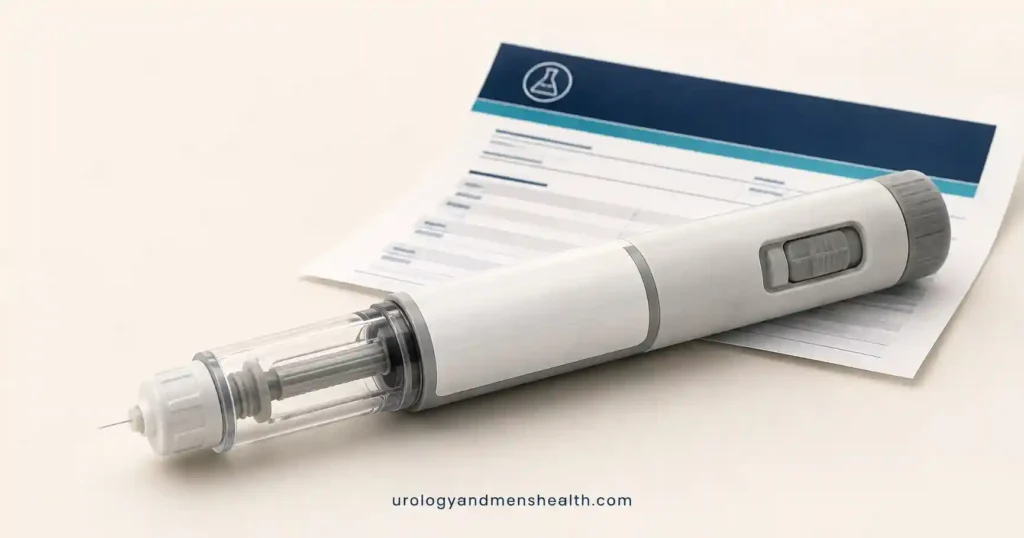
Men frequently ask me whether switching from Ozempic to Wegovy will change anything. It will not, because there is nothing to switch. All three products are semaglutide. Ozempic is the weekly injection licensed for type 2 diabetes, usually at 0.5 to 2 mg. Wegovy is the same weekly injection licensed for weight management, at 2.4 mg. Rybelsus is the older daily tablet licensed for diabetes at 7 or 14 mg.
In December 2025 the FDA approved a fourth form — the Wegovy pill, once-daily oral semaglutide 25 mg, the first oral GLP-1 licensed for weight management, launched in the United States in January 2026 [4]. In the OASIS 4 trial it produced mean weight loss of 16.6% at 64 weeks with full adherence, close to the injection. No study has looked at erectile function on the oral form specifically, and I would not expect one to show anything different. What reaches your bloodstream is the same peptide; the tablet simply gets it there by a different route.
The practical consequence: if erections changed on Ozempic, moving to Wegovy or to the pill is not a fix. It is a dose change at most. A change of molecule is a different question, and one that has actually been studied.
Semaglutide versus tirzepatide: the one comparison that has been run
A 2025 cohort study did the comparison directly. Using the same TriNetX network, researchers took men aged 18 to 70 with type 2 diabetes and no history of erectile problems, and ran three separate propensity-matched comparisons against tirzepatide [5]. Tirzepatide came out lower on every one:
- versus sitagliptin — risk ratio 0.70 (95% CI 0.64–0.76)
- versus injectable semaglutide — risk ratio 0.67 (95% CI 0.62–0.72)
- versus dulaglutide — risk ratio 0.55 (95% CI 0.51–0.59)
Set what that does and does not establish. It does not show semaglutide causes ED — there is no untreated comparison group here, only other drugs. It shows that among men with diabetes already on treatment, those receiving tirzepatide were diagnosed with ED or given a PDE5 inhibitor about a third less often than those on semaglutide. Tirzepatide acts on the GIP receptor as well as GLP-1, and produces greater weight loss at comparable doses, either of which could explain the gap. The tirzepatide side of this story, including what it means if you are already on Mounjaro, is covered in our review of tirzepatide and erectile function.
If you are choosing between agents and sexual function is a stated priority, this is real information and worth raising with your prescriber. If you are six months into semaglutide and doing well metabolically, a 0.67 risk ratio from a non-randomized database is not sufficient reason to abandon a drug that is working.
Get the ED and Sexual Function Action Plan — what to test before you blame your GLP-1
Enter your email below to receive Dr. Khalid’s complete ED & Sexual Function Action Plan as a free, printable PDF.
Three things that actually cause ED during rapid weight loss
An erection is a vascular event. Blood has to arrive under pressure through the cavernosal arteries and stay trapped by the tunica albuginea. Anything that damages the arterial lining or blunts the nitric oxide signal that opens those vessels produces the same symptom, regardless of what triggered it. That matters because three separate things are happening at once during a rapid weight-loss program, and only one of them is the drug.
1. Vascular disease that was already there
The penile arteries are roughly 1 to 2 mm across; the coronary arteries are 3 to 4 mm. Plaque narrows both at a similar rate, so the smaller vessel declares itself first. ED commonly precedes a cardiac event by three to five years. A man who starts semaglutide at a BMI of 38 has, by definition, been carrying metabolic risk for years. If his erections fail in month three, the drug is the most recent change but not necessarily the cause. Blood pressure medication is the other frequent culprit and one that gets blamed far less often than it should — see which BP drugs affect erections and which do not.
2. Testosterone shifting in both directions
Fat tissue converts testosterone to estradiol, so losing 20 kg (44 lb) usually raises total testosterone. The Able cohort nonetheless recorded more testosterone deficiency diagnoses on semaglutide [1], while 2026 conference data pointed the opposite way. That contradiction deserves its own page rather than a paragraph here — the full testosterone evidence, including the AUA 2026 findings, is set out in GLP-1 drugs and testosterone.
3. The caloric deficit itself
Men on 2.4 mg semaglutide frequently eat 1,200 to 1,400 kcal a day without deliberately restricting, because appetite simply goes. Sustained deficits of that depth suppress the hypothalamic-pituitary-gonadal axis, reduce lean mass, and worsen sleep. Animal work adds a further wrinkle: direct GLP-1 receptor activation in reward-related brain regions suppressed sexual motivation in rodents, while a randomized crossover trial of dulaglutide in healthy lean men found no effect on sexual desire, reproductive hormones, or semen parameters [7]. Low desire and failed erections are different complaints with different causes, and men conflate them constantly.
In My Practice
A man in his early forties came to see me genuinely angry with his prescriber. Nineteen kilos down (42 lb) in five months on semaglutide, and his erections had gone. He had already decided the drug was responsible and had stopped it a fortnight earlier. Two questions in, he mentioned that he still woke with erections most mornings — he had simply stopped counting those. That single detail reframed the whole consultation: intact morning erections point away from an arterial or hormonal cause and toward something situational. His were, in the end, mostly about alcohol replacing the food he could no longer face in the evenings.
Whether morning erections are still happening tells me more in five seconds than the entire drug history does, and almost nobody volunteers it.
What to do if ED starts after you begin semaglutide
Do not stop the injection on your own. Semaglutide has documented cardiovascular benefit, and abandoning it over a symptom you have not yet characterized is a poor trade. Work through this instead.
- Score it before you argue about it. Complete a validated five-item questionnaire and write down the number and the date, using our IIEF-5 erectile function self-assessment. A score gives you something to compare against in three months. “It’s worse” does not.
- Note whether morning erections persist. Track it for two weeks. If they are present, an arterial or hormonal cause is much less likely.
- Request specific bloods. Ask for a total testosterone drawn fasting between 8 and 10 am and repeated on a second morning if low, plus HbA1c, a fasting lipid panel, and thyroid function. One low morning testosterone means nothing on its own.
- Have your blood pressure measured properly. Seated, arm supported, after five minutes of rest, on two occasions.
- Ask about a PDE5 inhibitor trial. The AUA recommends these as first-line therapy for most men with ED [8]. Adequate trials mean at least four to six attempts at a sufficient dose, not one disappointing evening.
- Set a review at 12 weeks. Repeat the questionnaire on the same date. If the score has not moved, that is the point to discuss changing agent or referral — not week three.
When ED Is Not the Drug
Book an appointment within two weeks, rather than waiting out a 12-week review, if any of these apply:
- Erections have failed completely and abruptly, including morning erections, over days rather than months
- Chest tightness, breathlessness on exertion, or calf pain when walking has appeared alongside the erectile change
- You have developed a bend or palpable lump in the shaft, or pain on erection
- Loss of desire has come with breast tenderness or enlargement, or a visible drop in body or facial hair
- You are also passing urine far more often, or waking repeatedly overnight to do so
Frequently asked questions
Does Ozempic cause ED, or is it the weight loss doing it?
Nobody can separate the two yet, because no randomized trial of semaglutide has measured erectile function. The database studies compare men on the drug with men not on it, and men on it are losing weight fast. My working position in clinic is that the caloric deficit and the unmasking of existing vascular disease account for most cases I see, with a possible small drug contribution on top.
I developed ED three weeks after starting Wegovy. Should I stop the injection?
Not on your own. Three weeks is early — you are usually still in dose escalation, eating far less, and sleeping differently. Score your erectile function now, track morning erections for a fortnight, get a morning testosterone and blood pressure checked, and review at 12 weeks. If the score has not improved by then, that is the conversation to have with your prescriber about switching agent.
Is the Wegovy pill less likely to cause erection problems than the injection?
There is no evidence either way, and no mechanism that would predict a difference. Oral semaglutide 25 mg is the same molecule delivered by a different route, producing weight loss close to the 2.4 mg injection. If erections changed on injectable semaglutide, switching to the tablet is a route change, not a drug change.
Does semaglutide lower testosterone enough to affect erections?
The evidence conflicts. One cohort recorded more testosterone deficiency diagnoses on semaglutide, while 2026 guideline-body data reported the class raising total testosterone independently of weight loss. Either way, testosterone below roughly 300 ng/dL rarely explains erectile failure on its own in a man whose morning erections persist. Get two morning readings before drawing conclusions.
If I switch from Ozempic to Mounjaro, will my erections improve?
Possibly, but the evidence is indirect. In matched men with type 2 diabetes, tirzepatide carried about a third lower risk of an ED diagnosis than injectable semaglutide — that is a comparison of populations, not proof that switching reverses an existing problem. Before changing anything, rule out the vascular explanation with our ED vascular risk screener, since a switch will not fix arterial disease.
References
- Able C, Liao B, Saffati G, et al. Prescribing semaglutide for weight loss in non-diabetic, obese patients is associated with an increased risk of erectile dysfunction: a TriNetX database study. Int J Impot Res. 2025;37(4):315-319. doi:10.1038/s41443-024-00895-6. PubMed
- Lin S, Ding X, Dang X, Zhan Q. Sexual safety signals of common antidiabetic drugs: insights from FAERS disproportionality analysis. Andrology. 2026;14(6):1627-1635. doi:10.1111/andr.70222. PubMed
- Pourabhari Langroudi A, Chen AL, Basran S, et al. Male sexual dysfunction associated with GLP-1 receptor agonists: a cross-sectional analysis of FAERS data. Int J Impot Res. 2025;37(8):661-667. doi:10.1038/s41443-025-01061-2. PubMed
- Novo Nordisk. Wegovy pill approved in the US for weight management and cardiovascular risk reduction. Company announcement, 22 December 2025. Novo Nordisk
- Cowart K, Murphy C, Carris N. Association of tirzepatide with erectile dysfunction in people with type 2 diabetes. J Diabetes Complications. 2025;39(10):109116. doi:10.1016/j.jdiacomp.2025.109116. PubMed
- Bajaj HS, Gerstein HC, Rao-Melacini P, et al. Erectile function in men with type 2 diabetes treated with dulaglutide: an exploratory analysis of the REWIND placebo-controlled randomised trial. Lancet Diabetes Endocrinol. 2021;9(8):484-490. doi:10.1016/S2213-8587(21)00115-7. PubMed
- Merhi Z. GLP-1 receptor agonists and sexual function in women and men: a narrative review of emerging evidence and the need for further research. Sex Med Rev. 2026;14(1). doi:10.1093/sxmrev/qeag015. PubMed
- Burnett AL, Nehra A, Breau RH, et al. Erectile Dysfunction: AUA Guideline. American Urological Association. AUA
Dr. Muhammad Khalid
MBBS · FCPS (Urology) · MCPS (General Surgery) · CHPE · CRSM · IMC #539472
Specialist urologist with 11+ years of clinical experience across tertiary teaching hospitals. Trained at Lady Reading Hospital and Khyber Teaching Hospital, Peshawar. Author or co-author of five peer-reviewed international publications, including in Cureus and the World Journal of Surgery. Procedural expertise: URS, PCNL, RIRS, TURP, TURBT, and major open urological surgery. Full profile →
This article is for educational purposes only and does not constitute medical advice. Always consult your physician or urologist for diagnosis and treatment decisions specific to your condition.