Do GLP-1 Drugs Raise Testosterone? 2026 Evidence
A Mayo Clinic team reported a 99 ng/dL testosterone rise in men taking GLP-1 drugs. The number is real. What it means for you depends almost entirely on why your testosterone was low in the first place.

The evidence on GLP-1 and testosterone levels reversed direction in 2026. Two years ago the worry in my clinic was that semaglutide might be flattening men’s hormones. At the American Urological Association’s 2026 meeting, a Mayo Clinic team reported the opposite in more than 1,600 men: median total testosterone climbed from 320 to 419 ng/dL (11.1 to 14.5 nmol/L) after starting a GLP-1 receptor agonist [1]. That is a rise of 99 ng/dL (3.4 nmol/L) — roughly the gap between a number your doctor flags and a number nobody mentions. The headlines then made a second claim: that the rise had nothing to do with weight loss. That part is shakier than it sounds, and the distinction changes what you should do about it. Here is what the 2026 data actually support, who sees the effect, and who sees nothing at all.
Key Takeaways
- At AUA 2026, median total testosterone rose 99 ng/dL (3.4 nmol/L) — from 320 to 419 ng/dL — in over 1,600 men on GLP-1 therapy.
- The effect is concentrated in men who are metabolically unwell. A placebo-controlled trial in healthy men with normal testosterone found no hormonal change at all.
- Unlike testosterone therapy, GLP-1 drugs leave LH and FSH intact or raise them — your testicles keep producing rather than switching off.
- Total testosterone can rise while free testosterone barely moves, because SHBG climbs alongside it. Ask for both numbers, not just the total.
What GLP-1 drugs do to testosterone levels: the 2026 numbers
The AUA 2026 dataset is the largest yet. Paired total testosterone measurements were available for 1,629 men and free testosterone for 1,216. Median total testosterone rose from 320 to 419 ng/dL, and median free testosterone from 9 to 10.4 ng/dL. After statistical adjustment for age and starting BMI, the total testosterone gain held at 97.6 ng/dL [1]. For context, most US laboratories set the lower limit of normal near 300 ng/dL (10.4 nmol/L), so a median starting value of 320 describes a group sitting on the edge of deficiency.
An 18-month cohort study of 110 men on semaglutide, dulaglutide, or tirzepatide, presented at ENDO 2025, gives a more useful patient-facing figure. Alongside 10% body weight loss, the proportion of men with normal total and free testosterone rose from 53% to 77% [7]. That is the number I quote in clinic, because it answers the question men actually ask — not “how many points” but “will I end up in the normal range”.
The peer-reviewed literature agrees on direction. A 2025 meta-analysis in Andrology pooled seven studies covering 680 men and found significant increases in total testosterone, free testosterone, SHBG, LH, and FSH, with falls in weight, BMI, waist circumference, and HbA1c [2]. A 2026 systematic review in the Journal of Sexual Medicine covering 639 men reached the same conclusion [3], and a further systematic review presented at ENDO 2026 found no evidence that these drugs harm male hormones, sexual function, or sperm quality with long-term use [8]. Testosterone is one part of a wider picture — our Sexual Health Hub maps how these threads connect.
Why the rise is not only about weight loss
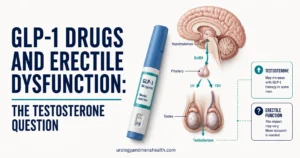
Visceral fat is not inert storage. It is metabolically busy tissue packed with aromatase, the enzyme that converts testosterone into estradiol. The estradiol then travels back to the hypothalamus and pituitary and tells them to ease off — less GnRH, less LH, and therefore less testosterone from the testis. Insulin resistance compounds it by suppressing SHBG and blunting Leydig cell output directly. The result is a self-sustaining loop: fat lowers testosterone, low testosterone makes fat easier to gain. I go through this mechanism in more depth in the hormonal link between obesity, testosterone, and erectile problems.
Strip out the visceral fat and you take the brake off. That is the simplest reading, and it is almost certainly most of the story. The argument is over what is left after weight loss is accounted for.
Here is where I part company with the coverage. The AUA cohort reported that testosterone changes were not directly correlated with BMI change, which the authors read as evidence of a weight-independent mechanism [1]. But the 2025 Andrology meta-regression found precisely the opposite pattern — the men with the largest reductions in weight and BMI showed the largest testosterone gains, and the authors concluded that the current literature does not demonstrate a direct action on testicular function at all [2]. An observational cohort adjusting for BMI and a meta-regression across trials are answering slightly different questions, and only one of them is peer-reviewed.
My position: assume the testosterone rise is earned through metabolic improvement until a trial proves otherwise. GLP-1 receptors do exist in testicular tissue and animal work suggests direct effects on spermatogenesis, but that has not been shown in men. Practically, this means your testosterone follows your metabolic health — which you can quantify with our BMI and metabolic syndrome risk screen before and during treatment.
GLP-1 versus testosterone therapy: what happens to your own production
This is the difference that matters clinically, and almost nobody explains it to patients before they start. Testosterone therapy raises your blood level by supplying testosterone from outside. Your pituitary detects the surplus and stops sending LH and FSH, so your own testicular production shuts down for as long as you stay on treatment. A GLP-1 does the reverse: the 2026 systematic review found LH and FSH were preserved or increased on GLP-1 therapy, against clear suppression in the testosterone-treated comparison groups [3].
| What is measured | On a GLP-1 | On testosterone therapy |
|---|---|---|
| Total testosterone | Rises, mainly in men with obesity or type 2 diabetes | Rises reliably and quickly |
| Free testosterone | Rises less, because SHBG rises alongside it | Rises |
| SHBG | Rises | Falls |
| LH and FSH | Preserved or increased | Suppressed |
| Your own testicular production | Continues | Switched off during treatment |
| If treatment stops | Levels track your weight and metabolic health | Levels fall back; recovery can take months |
That table is not an argument against testosterone therapy. Testosterone works, it works faster, and for a man with structural hypogonadism it is the correct treatment — I set out who it suits and what it costs in my full guide to testosterone replacement therapy. The point is that these two treatments produce a similar number on a blood test by opposite biological routes, and the route determines what you keep.
One honest complication. A 24-week randomized trial comparing semaglutide against intramuscular testosterone in men with type 2 diabetes and functional hypogonadism found that both raised total testosterone and both improved symptom scores — but erectile function scores improved significantly only in the testosterone arm [5]. Raising the number is not the same as fixing the symptom. The erectile side of GLP-1 therapy has its own evidence base, including a genuine split between agents, which I cover separately in GLP-1 drugs and erectile dysfunction.
Your Testosterone Recheck Plan While on a GLP-1
Enter your email below to receive Dr. Khalid’s complete Low Testosterone: Testing & Treatment Guide as a free, printable PDF.
Who actually gets a testosterone rise, and who gets nothing
A 2026 systematic review in Cells, covering studies published between January 2021 and January 2026, separated responders from non-responders cleanly. In men with obesity, type 2 diabetes, or functional hypogonadism, GLP-1 therapy was associated with testosterone increases. In a placebo-controlled trial of healthy men with normal testosterone, there was no significant endocrine or reproductive effect whatsoever [4]. Response depends on baseline metabolic status, not on the drug.
Read that as a filter. If your testosterone is low because visceral fat and insulin resistance are suppressing the axis, expect movement as your metabolic markers improve. If your testosterone is low for a structural reason — pituitary disease, primary testicular failure, long-term opioid use, or a history of anabolic steroid use — a GLP-1 will do nothing for it, and waiting six months to find that out costs you six months.
Sorting one from the other before you start
The pattern that separates them is your LH. In metabolic hypogonadism, testosterone is low and LH is low or inappropriately normal, with a large waist and often a raised HbA1c. In primary testicular failure, testosterone is low and LH is high — the pituitary is shouting and the testis is not answering. That single result reframes the whole plan, so ask for LH on the same draw rather than testosterone alone. If you are unsure whether your symptoms fit testosterone deficiency in the first place, our low testosterone symptom quiz is a reasonable place to start, and low testosterone in men over 40 covers what the symptoms mean mechanically.
In My Practice
The presentation I see most often now is not a man worried about his weight-loss drug. It is a man arriving with a printout, a total testosterone of 240 ng/dL, and a telehealth quote for testosterone therapy — and it emerges partway through the consultation that he is six weeks into tirzepatide, and the blood was drawn at four in the afternoon. I repeated his testosterone at 8am on two separate mornings, four months into treatment, and it came back at 390 ng/dL with no hormone therapy at all.
A testosterone level measured in the afternoon during active weight loss is not a diagnosis, and starting lifelong hormone therapy on the strength of one is a decision that shuts down the very production that was about to recover.
When Low Testosterone Is Not About Your Weight
Book an urgent appointment rather than waiting to see whether weight loss fixes it if you have any of the following alongside a low testosterone result:
- Headaches or any change in your peripheral vision — this combination raises the possibility of a pituitary tumor
- Breast enlargement or milky nipple discharge, which points toward a raised prolactin
- A total testosterone below 150 ng/dL (5.2 nmol/L), which is rarely explained by body weight alone
- Testes that have become noticeably smaller or firmer, or loss of body and facial hair
- Low testosterone with a high LH, which indicates the testis itself has failed
The muscle-loss caveat, and what to ask for
Weight lost through a pharmacological calorie deficit is not all fat. A proportion of it is lean muscle, and testosterone is the main hormonal defense against that. Men who start with low testosterone therefore have the least anabolic reserve at exactly the moment they need it most [9]. This is not a reason to avoid GLP-1 therapy — the cardiometabolic gains are substantial — but it is a reason to measure something other than the scale. A man who has lost 15 kg (about 33 lb) and cannot carry his shopping has not had a good outcome.
The AUA guideline on testosterone deficiency is specific about diagnosis: low total testosterone on two separate early-morning measurements, combined with symptoms or signs [6]. Nothing about starting a weight-loss drug changes that standard, and rapid weight loss makes a single reading even less reliable than usual.
What to request, and when
- Before your first injection: ask for a baseline panel drawn fasting, before 10am — total testosterone, SHBG, LH, FSH, and prolactin. Without a baseline you will never know whether the drug moved anything.
- Ask for SHBG explicitly. Most primary care panels report total testosterone alone. Since GLP-1 therapy raises SHBG, a rising total can sit on top of an unchanged free level, and you will feel the free level, not the total.
- Repeat at six months, on two separate mornings. Earlier than that and you are measuring the middle of a metabolic transition rather than a new steady state.
- Protect muscle while you lose weight: ask your doctor to confirm a protein target for your body weight and add resistance training twice a week from the first month, not after the weight has gone.
- If your testosterone has not moved by six months despite meaningful weight and HbA1c improvement, that is the point to ask for a full hypogonadism workup rather than assuming more time will fix it.
One caution on combining treatments. Small pilot work has looked at adding testosterone to a GLP-1 in men who lose little weight and remain hypogonadal, and the early signals on lean mass are interesting. But these are pilot studies of ten men, and no randomized trial has yet tested combined therapy properly [9]. If a clinic offers you both at once as a package, ask them which trial they are relying on.
Frequently Asked Questions
Does Ozempic increase testosterone, or is it just the weight loss?
Both, and the split is still genuinely argued. The AUA 2026 cohort found the testosterone rise held after adjusting for age and BMI, while the 2025 Andrology meta-analysis found larger gains in the men who lost the most weight. My reading is that most of the effect comes from clearing visceral fat off the hormone axis, with a smaller direct contribution that has not yet been demonstrated in humans.
How long does it take for testosterone to rise on a GLP-1?
Hormone changes track metabolic changes rather than the calendar. The 24-week semaglutide trial showed measurable increases at six months, and the 18-month cohort study showed the proportion of men with normal levels climbing from 53 percent to 77 percent. If you have lost little weight and your HbA1c has not moved, do not expect your testosterone to have moved either.
Will a GLP-1 raise my testosterone if my level is already normal?
No. The one placebo-controlled trial conducted in healthy men with normal testosterone found no meaningful change in reproductive hormones at all. These drugs appear to lift testosterone by releasing a metabolic brake, and if that brake was never applied there is nothing to release. Taking one for hormonal reasons alone is not supported by evidence I would act on.
My total testosterone went up but I still feel exhausted. Why?
Look at your free testosterone and SHBG. GLP-1 therapy raises SHBG, which binds testosterone and holds it out of circulation, so a healthy-looking total can sit on top of an unchanged free level. Fatigue during rapid weight loss also has competing explanations worth checking: lean muscle loss, low iron, inadequate protein intake, and disrupted sleep.
Should I stop testosterone therapy if I start a GLP-1?
Not on your own, and not abruptly. Coming off testosterone leaves a gap of weeks to months before your own production restarts, and stopping without a plan can leave you feeling worse than when you began. If fertility is the reason you are asking, that decision has its own evidence base, covered in GLP-1 drugs and male fertility. Raise it with the doctor who prescribed the testosterone.
References
- Guillén-Lozoya AH, et al. Testosterone levels improve in men under GLP-1 receptor agonist therapy (PD26-01). J Urol. 2026;215(5 Suppl). AUA 2026
- Salvio G, Ciarloni A, Ambo N, et al. Effects of glucagon-like peptide 1 receptor agonists on testicular dysfunction: a systematic review and meta-analysis. Andrology. 2025;13(8):2022-2034. PubMed
- Deameh MG, Ramez M, Rowaiee R, et al. Effects of glucagon-like peptide-1 receptor agonists on male reproductive hormones, semen parameters, and metabolic outcomes: a systematic review. J Sex Med. 2026;23(2):qdaf381. PubMed
- Zafrani Z, Khan SS, Zitzmann M. Metabolic reversal of functional hypogonadism? GLP-1 receptor agonists and male reproductive endocrinology: a systematic review. Cells. 2026;15(15):1319. PubMed
- Gregorič N, Šikonja J, Janež A, Jensterle M. Semaglutide improved sperm morphology in obese men with type 2 diabetes mellitus and functional hypogonadism. Diabetes Obes Metab. 2025;27(2):519-528. PubMed
- Mulhall JP, Trost LW, Brannigan RE, et al. Evaluation and management of testosterone deficiency: AUA guideline. J Urol. 2018;200(2):423-432. Reviewed and validity confirmed 2024. AUA
- Portillo Canales S, et al. Anti-obesity medications can normalize testosterone levels in men. Presented at ENDO 2025, San Francisco. Endocrine Society
- Endocrine Society. Clinical trials suggest GLP-1s may improve fertility in men with obesity. Presented at ENDO 2026, Chicago. Endocrine Society
- Canal de Velasco LM, González Flores JE, Kraus Fischer G, et al. Testosterone replacement therapy as a potential strategy to preserve lean mass in men with persistently low serum testosterone receiving GLP-1 receptor agonists: a narrative review. Cureus. 2026;18(3):e105734. PubMed
Dr. Muhammad Khalid
MBBS · FCPS (Urology) · MCPS (General Surgery) · CHPE · CRSM · IMC #539472
Specialist urologist with 11+ years of clinical experience across tertiary teaching hospitals. Trained at Lady Reading Hospital and Khyber Teaching Hospital, Peshawar. Author or co-author of five peer-reviewed international publications, including in Cureus and the World Journal of Surgery. Procedural expertise: URS, PCNL, RIRS, TURP, TURBT, and major open urological surgery. Full profile →
This article is for educational purposes only and does not constitute medical advice. Always consult your physician or urologist for diagnosis and treatment decisions specific to your condition.