Online TRT Clinics: A Urologist’s Honest Review
Most men who ask me about online TRT clinics already have a prescription offer in hand after a single blood draw. Here are the seven checks that should have happened first — and how to tell whether they did.

Online TRT clinics did something my specialty failed to do for twenty years: they made a man with flat energy and a dead libido feel like someone was actually listening. I am not going to pretend that counts for nothing. Testosterone prescribing in the US fell steadily from a 2013 peak and has now overtaken it, with the sharpest growth in men in their thirties and forties [7], and telehealth is a large part of why. But the model has a structural problem. A testosterone prescription is a decision about your fertility, your blood, and your prostate — and the intake form that generates it takes about four minutes to complete. I see the downstream version in clinic: men on weekly injections with a hematocrit nobody has looked at, no baseline PSA on record, and a wife who wants to conceive next year. For the wider picture on male hormones, start with our Sexual Health Hub.
Key Takeaways
- A diagnosis of low testosterone requires two early-morning blood draws below 300 ng/dL (10.4 nmol/L) plus symptoms — one afternoon test is not a diagnosis.
- In a 2022 secret-shopper study of seven platforms, six offered testosterone to a man whose level was a normal 675 ng/dL (23.4 nmol/L).
- Exogenous testosterone shuts down sperm production. In pooled contraceptive trials the median recovery time after stopping was 3.4 months, but 10% of men had still not recovered at 12 months.
- The FDA removed the cardiovascular boxed warning in February 2025 but kept the statement that testosterone is not approved for age-related low testosterone.
What Online TRT Clinics Get Right — and What They Charge
Start with the honest part. A man in a rural county with one urologist and a four-month waiting list can be assessed on a Tuesday evening and have medication delivered the following week. Nobody makes him sit in a waiting room reading a poster about prostate cancer. The pricing is printed on the website, which is more than most American hospitals manage.
That access matters, because the men who avoid clinics are often the ones carrying the most disease. When UCLA reviewed 388 men aged 40 or under attending a real andrology clinic for erectile dysfunction, 54% had dyslipidemia, 20% had prediabetes or diabetes, 20% had hypogonadism, and 35% had a varicocele [6]. Of those who had a semen analysis, 40% were abnormal. A questionnaire finds none of that.
The convenience is not free. A 2022 cost analysis in The Journal of Sexual Medicine compared direct-to-consumer platforms against a tertiary center and found twelve months of intramuscular testosterone cost $1,586 to $4,200 through the platforms, against $134 to $1,333 at the center depending on insurance [3]. If you are uninsured, the platforms are competitive. If you have Medicare or private coverage, you are paying a substantial premium for the shipping label.
What the 2025 FDA Label Change Actually Changed
On 28 February 2025 the FDA issued class-wide labeling changes for every testosterone product [5]. Three things happened at once: the TRAVERSE trial results were added to all labels, the cardiovascular language was removed from the boxed warning, and a new blood pressure warning was added after postmarket ambulatory monitoring studies. The agency also kept the Limitation of Use language stating these products are not approved for age-related low testosterone.
Marketing copy has compressed all of that into “the FDA cleared testosterone.” It did not. It removed one specific cardiac concern and added a new vascular one in the same document.
Where the Model Breaks Down: What a Secret-Shopper Study Found
In 2022 a group at Northwestern published a research letter in JAMA Internal Medicine that is still the most useful thing written on this subject [1]. One of the authors, a urologist, became the patient. He presented to seven direct-to-consumer platforms as a 34-year-old man with low energy and low libido who wanted children in the future.
His total testosterone came back at 675 ng/dL (23.4 nmol/L), against a reference range of 264 to 916. His free testosterone was normal. He is, by any guideline in existence, a man who does not have testosterone deficiency.
Six of the seven platforms offered him testosterone anyway. One asked about recent cardiovascular events or his stated wish to father children. The initial consultation was conducted by a nurse practitioner, a physician assistant, or in some cases someone with no medical license at all.
| Step in the workup | What AUA guidance calls for | What the 2022 study found |
|---|---|---|
| Confirming the number | Two early-morning total testosterone measurements on separate days, same laboratory and assay | Therapy offered to a shopper with a normal 675 ng/dL (23.4 nmol/L) level by 6 of 7 platforms |
| Threshold for treating | Total testosterone below 300 ng/dL (10.4 nmol/L), combined with symptoms or signs | Six of seven platforms applied no total testosterone threshold at all |
| Fertility intent | Reproductive health evaluation before any exogenous testosterone in men who want children | One of seven platforms asked about future fertility |
| Polycythemia counseling | Hemoglobin and hematocrit measured first, thickening-blood risk explained upfront | About 83% of prescribing platforms did not raise it |
| Dose target | Middle of the reference range, roughly 450 to 600 ng/dL (15.6 to 20.8 nmol/L) | Half quoted a treatment goal above 1,000 ng/dL (34.7 nmol/L) |
That last row is the one I would tattoo on a wall. A target above 1,000 ng/dL is not aggressive treatment of a deficiency — it is supraphysiological dosing. It buys you a higher hematocrit, more estradiol conversion, and a number that feels impressive on a portal screen. It does not buy more symptom relief.
The Seven Checks a Real Testosterone Workup Includes
None of this is obscure. It is the published AUA guideline, reviewed and validity-confirmed in 2024 [2], and it takes one extra blood draw and about five minutes of conversation.
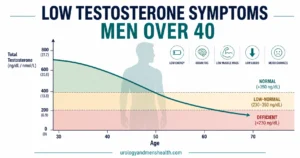
- Two early-morning total testosterone measurements, on separate days. Testosterone peaks between 3 and 8 a.m. A man in his thirties tested at 4 p.m. reads 20 to 25% lower than his own 8 a.m. value. Repeat measurements on the same man can vary by more than half. One draw is a snapshot in a storm; two morning draws at the same lab are a diagnosis.
- Symptoms documented alongside the number. A low level without symptoms is not testosterone deficiency, and symptoms without a low level are usually something else — sleep debt, depression, untreated apnea, alcohol.
- Luteinizing hormone (LH). This separates a failing testis from a failing pituitary. It changes the treatment entirely and costs almost nothing.
- Prolactin, when LH is low or low-normal. This is the test that catches a pituitary tumor. A man handed testosterone for a prolactinoma gets a chemically normal level and a mass that keeps growing.
- Hemoglobin and hematocrit before the first dose. Testosterone drives red cell production. A rising hematocrit is the single most common reason I lower a dose or stop treatment.
- PSA in every man over 40, before starting. Not because testosterone causes prostate cancer — the evidence does not support that, as covered in our review of what the data actually shows about TRT and prostate cancer risk — but because you need a baseline to interpret every future result against.
- A dose target in the middle of the range, not above it. Roughly 450 to 600 ng/dL (15.6 to 20.8 nmol/L).
If your symptoms are non-specific — tiredness, low mood, thinning motivation — the more useful question is whether this is a hormone problem at all. Our piece on the difference between andropause and genuine hypogonadism covers where that line sits.
In My Practice
The consultation I have most often about online TRT is not about testosterone at all. It is a couple in their early thirties, eighteen months of trying, and a semen analysis showing no sperm whatsoever. He has been on weekly injections for two years and had assumed — reasonably, given nobody told him otherwise — that a hormone marketed for male vitality would help him father a child. The look on his face when I explain the mechanism is the same every time.
Ask any prescriber, in person or online, one direct question before your first dose: what will this do to my sperm count, and how long does it take to come back.
Low testosterone: the 7-point workup checklist to bring to any TRT consultation
Enter your email below to receive Dr. Khalid’s complete Low Testosterone: Testing & Treatment Guide as a free, printable PDF.
The Fertility Problem That Never Reaches the Intake Form
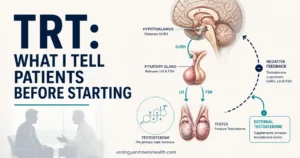
Here is the mechanism, because it explains why this catches men off guard. Sperm production does not run on the testosterone in your bloodstream. It runs on testosterone concentrated inside the testis at levels many times higher than the blood, and that concentration depends on a pituitary signal.
When you inject testosterone, the pituitary reads the blood level as sufficient and switches the signal off. Blood testosterone rises. Intratesticular testosterone collapses. Spermatogenesis stops. The drug marketed to make you more of a man is, mechanically, a male contraceptive — which is exactly how it has been trialled.
Recovery is usually good but not instant and not universal. A pooled analysis of 1,549 healthy men across 30 hormonal contraceptive studies found the median time to recover a sperm concentration of 20 million per mL was 3.4 months, with 67% recovered by six months, 90% by twelve, and effectively all by twenty-four [4]. Those were healthy volunteers on short, controlled courses. Men who have been on unmonitored high-dose testosterone for years recover more slowly, and some do not fully recover.
AUA guidance is unambiguous on this: exogenous testosterone should not be prescribed to a man currently trying to conceive, and men who want to preserve fertility should have a reproductive evaluation first [2]. There are alternatives — hCG, SERMs, aromatase inhibitors, alone or combined — that raise testosterone without shutting the axis down. If you already have a semen analysis in hand and want to understand it, our semen analysis interpreter walks through what each parameter means.
How to Use an Online TRT Clinic Without Getting Burned
I am not telling you to avoid telehealth. Some platforms do this properly, and a man who will never book a urology appointment is better served by a good online clinic than by nothing. But you have to audit them, and you can do it in one message before you pay anything.
Send this before the first payment. Ask, in writing: will you draw two separate early-morning total testosterone levels before prescribing; will you check LH, hemoglobin and hematocrit, and a PSA if I am over 40; what serum level are you targeting; and what is your plan for my fertility. Any clinic practicing real medicine will answer all four without hedging. A clinic that responds with reassurance instead of numbers has told you what you need to know.
Then hold them to the monitoring schedule. A follow-up testosterone level after the first interval to confirm you have reached target, then levels every 6 to 12 months on treatment. Hematocrit rechecked on the same rhythm. Blood pressure checked at home, given the 2025 label change. And a genuine review at 3 to 6 months: if your level has normalized but you feel no different, AUA guidance says the conversation should turn to stopping [2]. A subscription model has no commercial reason to raise that. Raise it yourself.
Keep your own file. Download every lab result as a PDF the day it appears. Platforms change ownership, get acquired, and lose portals. If you later see a urologist, the difference between two years of documented levels and “I think it was around 900” is the difference between a five-minute consultation and starting from zero.
Stop and Get Seen in Person If
Any of these means the remote model is no longer adequate for your situation:
- You were prescribed testosterone on a single blood draw, or on an afternoon or non-fasting sample — ask for two early-morning levels off treatment before continuing.
- Your hematocrit is above 52% or has never been measured — request a full blood count this week.
- You want children within the next three years — get a semen analysis and a urology referral before your next dose.
- You are over 40 and no baseline PSA was taken — this needs correcting before the next prescription cycle.
- New chest pain, leg swelling, shortness of breath, or a persistent headache with visual changes — same-day medical assessment, not a portal message.
Frequently Asked Questions About Online TRT Clinics
Can an online TRT clinic diagnose low testosterone from a single blood test?
No. AUA guidance requires two total testosterone measurements taken on separate days, both in the early morning, before low testosterone can be diagnosed at all. A single afternoon draw can read 20 to 25 percent lower than the same man’s 8 a.m. value in his thirties. If a platform prescribed after one convenience-time sample, the number underpinning your prescription is not a diagnosis.
Why do online TRT clinics aim for testosterone levels above 1,000 ng/dL?
Because a bigger number feels like a better result, and it keeps subscribers refilling. AUA guidance targets the middle of the normal range, roughly 450 to 600 ng/dL (15.6 to 20.8 nmol/L). Half the platforms in the 2022 secret-shopper study quoted a goal above 1,000 ng/dL (34.7 nmol/L). Pushing higher raises your hematocrit and estradiol without buying extra symptom relief.
Will an online TRT clinic warn me that testosterone can make me infertile?
Often not. Only one of the seven platforms studied asked about future fertility at all. Exogenous testosterone suppresses the pituitary signals that drive sperm production, and men taking it frequently become azoospermic. If you may want children, that conversation has to happen before the first injection, not after a failed semen analysis.
Is TRT from an online clinic more expensive than going through my own doctor?
Usually yes, if you have insurance. A 2022 cost analysis found twelve months of intramuscular testosterone through direct-to-consumer platforms ran roughly $1,586 to $4,200, against $134 to $1,333 for equivalent care at a tertiary center depending on coverage. The platforms compete on convenience and speed, not on price.
The FDA removed the boxed warning in 2025, so is online TRT safe for my heart?
That change removed one specific concern, not the whole conversation. The February 2025 action dropped the cardiovascular language from the boxed warning after the TRAVERSE trial, added a class-wide blood pressure warning, and kept the statement that testosterone is not approved for age-related low testosterone. Your blood pressure still needs checking on treatment.
What should I ask an online TRT clinic before paying for the first month?
Ask four things: will you draw two early-morning testosterone levels before prescribing, will you check LH, hematocrit and a PSA if I am over 40, what serum level are you targeting, and what happens to my fertility. A clinic that answers all four clearly is doing real medicine. To organize your symptoms first, the low testosterone symptom quiz gives you a structured list to bring.
References
- Dubin JM, Jesse E, Fantus RJ, et al. Guideline-Discordant Care Among Direct-to-Consumer Testosterone Therapy Platforms. JAMA Intern Med. 2022;182(12):1321-1323. PubMed
- Mulhall JP, Trost LW, Brannigan RE, et al. Evaluation and Management of Testosterone Deficiency: AUA Guideline. J Urol. 2018;200(2):423-432. Reviewed and validity confirmed 2024. AUA
- Jesse E, Sellke N, Rivero MJ, et al. Practice Comparison and Cost Analysis of Direct-to-Consumer Telemedicine Platforms Offering Testosterone Therapy. J Sex Med. 2022;19(11):1608-1615. PubMed
- Liu PY, Swerdloff RS, Christenson PD, et al. Rate, extent, and modifiers of spermatogenic recovery after hormonal male contraception: an integrated analysis. Lancet. 2006;367(9520):1412-1420. PubMed
- US Food and Drug Administration. FDA issues class-wide labeling changes for testosterone products. February 28, 2025. FDA
- Shahinyan RH, Amighi A, Carey AN, et al. Direct-To-Consumer Internet Prescription Platforms Overlook Crucial Pathology Found During Traditional Office Evaluation of Young Men With Erectile Dysfunction. Urology. 2020;143:165-172. PubMed
- Epic Research. After Nearly a Decade-Long Decrease, Testosterone Prescribing Rates Rising Again. 2026. Epic Research
Dr. Muhammad Khalid
MBBS · FCPS (Urology) · MCPS (General Surgery) · CHPE · CRSM · IMC #539472
Specialist urologist with 11+ years of clinical experience across tertiary teaching hospitals. Trained at Lady Reading Hospital and Khyber Teaching Hospital, Peshawar. Author or co-author of five peer-reviewed international publications, including in Cureus and the World Journal of Surgery. Procedural expertise: URS, PCNL, RIRS, TURP, TURBT, and major open urological surgery. Full profile →
This article is for educational purposes only and does not constitute medical advice. Always consult your physician or urologist for diagnosis and treatment decisions specific to your condition.