
Acute Kidney Stone Pain Triage Tool
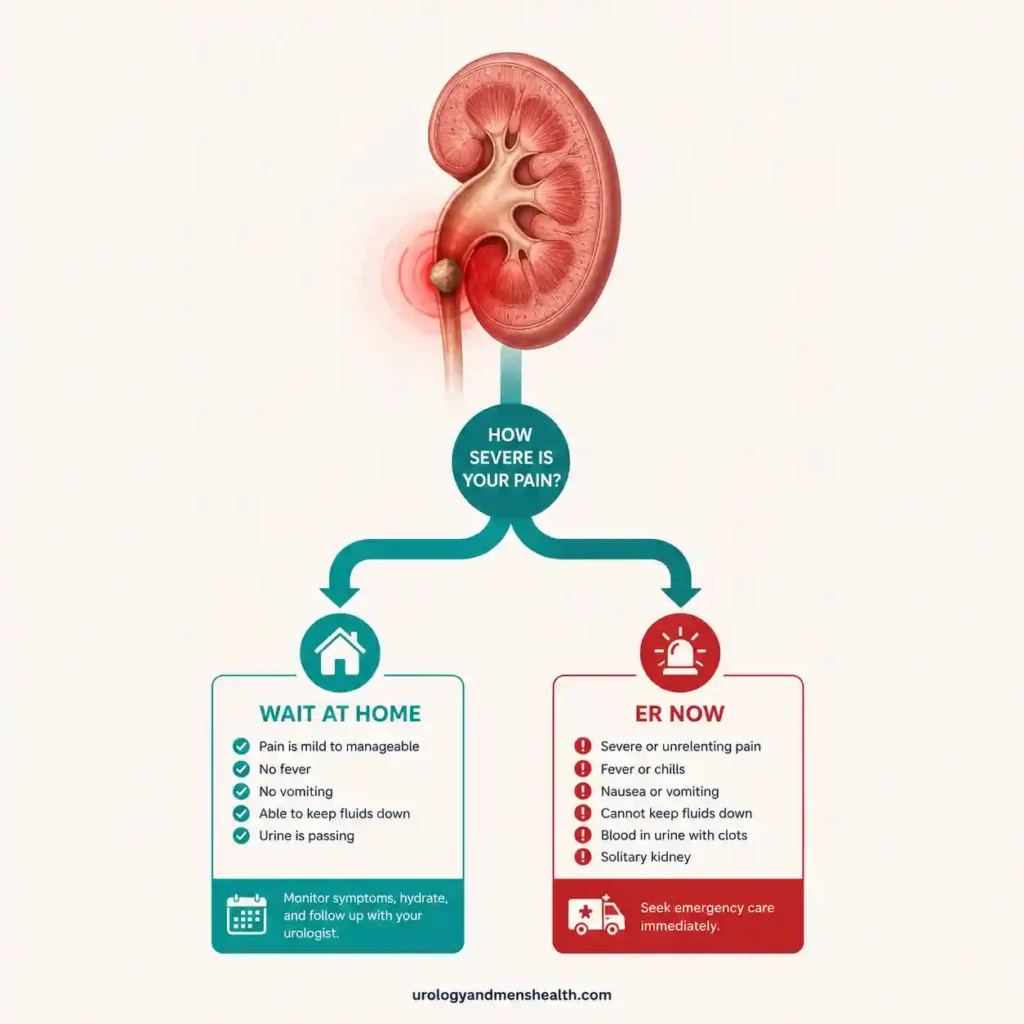
This kidney stone pain triage tool helps you decide, right now, whether your stone pain is a manage-at-home situation, a see-a-urologist-soon one, or a go-to-the-ER emergency. Answer up to five quick questions about fever, pain, and your kidney history to get a clear next step built on AUA and EAU guidelines. For the full picture, visit the kidney stones hub.

The Tool
Related Kidney Tools
Full Clinical Guide
In This Guide:
- The one stone emergency that cannot wait is a blocked kidney that is also infected – flank pain plus fever, chills, or shaking means the ER now.
- Stone size drives the plan: under 5 mm passes on its own about three-quarters of the time, 5-10 mm about half, and over 10 mm under a quarter.
- Uncontrollable pain, constant vomiting, passing almost no urine, or having a single or transplant kidney all escalate a stone to emergency care.
- This tool sorts your symptoms into home, urologist, or ER – it does not diagnose the stone, and a brand-new unconfirmed episode still needs a scan.
What This Kidney Stone Pain Triage Tool Sorts Out
This kidney stone pain triage tool takes the question everyone in the middle of an attack is asking – “is this an emergency, or can I wait?” – and answers it in a structured way, using the same red flags the American Urological Association (AUA) and European Association of Urology (EAU) use in their urolithiasis guidelines [1]. It does not scan you or confirm a stone. What it does is sort your current symptoms into one of three lanes: safe to manage at home with a plan, a stone that needs a urologist soon, or a situation that needs the emergency room today. The sorting is deliberately cautious – when an answer sits on a line, the tool sends you toward more care, not less, because the cost of under-calling an infected, blocked kidney is far higher than the cost of an extra assessment.
Why a Blocked Kidney Can Turn Into an Emergency
A stone only causes trouble when it lodges in the ureter, the narrow tube draining the kidney. Urine keeps being made but has nowhere to go, so it backs up and swells the kidney – a state called hydronephrosis. That back-pressure alone causes the classic waves of renal colic. The danger changes entirely if bacteria get into that trapped urine: you now have an infected, obstructed kidney, which the guidelines class as a urological emergency because the infection cannot drain and can seed the bloodstream within hours [2]. This is the rationale that separates the lanes. A painful but draining kidney can often be watched. A blocked kidney that is also infected – signalled by fever, chills, or shaking – is decompressed urgently with a stent or a nephrostomy tube first, and the stone itself is dealt with later, once the infection has settled [3].
How to Read Your Result
Two men can walk in with identical pain and get completely different advice. A man with a confirmed 4 mm stone, no fever, and two healthy kidneys lands in the Manage at Home lane – a stone that small passes on its own about three-quarters of the time, usually over two to three weeks [1]. A man with the same pain but a temperature and shaking chills lands in Emergency, because his kidney may be blocked and infected. In between sits the See a Urologist lane: stones from 5 to 10 mm, which pass unaided only about half the time, and stones over 10 mm, which pass under a quarter of the time and usually need a procedure. The confidence label on your result reflects how clear-cut the guideline call is – “Clear recommendation” for the emergency and small-stone paths, “Worth discussing options” where a scan or a clinic conversation is what settles it.
What to Do With Your Result
If you land in the home lane, the plan is simple but has rules: keep your urine pale with around 2.5 to 3 liters (about 85 to 100 fl oz) of fluid a day, use the pain relief your doctor allows, ask about an alpha-blocker such as tamsulosin to help a lower stone pass, and strain every urine so you can catch the stone for analysis. Give it a firm 4 to 6 week ceiling – past that, or at the first fever, the plan changes. If you land in the urologist lane, the next move is a non-contrast CT KUB and a clinic review to choose between shock-wave lithotripsy and ureteroscopy. You can gauge the passage odds yourself first with the Kidney Stone Passage Calculator. If you land in the emergency lane, go now – delay in an infected, blocked kidney is what causes harm, and urgent drainage is what prevents it [4].
If you are unsure about your result, the PDF report this tool generates gives you a ready-made framework to bring to your next appointment.
In My Practice
The single most common way I see people get hurt by a stone is not the pain – it is talking themselves out of a fever. They have had stones before, they know the drill, so when a temperature creeps in on day three they put it down to “the stone” and wait it out at home overnight. By morning a simple obstruction has become an infected one, and what would have been a routine stent becomes a spell in intensive care.
The rule I give every stone patient is unglamorous but it works: pain you can manage at home, but the moment a thermometer reads a fever or you start to shiver, the plan is no longer “wait” – it is “go”. That one sentence, decided in advance, is what keeps home management safe.
References
- EAU Guidelines on Urolithiasis (2025): spontaneous passage rates by stone size and location, and medical expulsive therapy. EAU / Uroweb.
- Wollin DA, Preminger GM, et al. Guideline of guidelines: kidney and bladder stones (AUA + EAU comparison) – infected obstructed kidney as a urological emergency; MET for uncomplicated distal ureteric stones up to 10 mm. PMC7731951.
- Surgical Management of Kidney and Ureteral Stones: AUA Guideline (2025) – evaluation, decompression, and treatment selection. American Urological Association.
- Surgical decompression is associated with decreased mortality in patients with sepsis and ureteral calculi. Journal of Urology.
Frequently Asked Questions
When is kidney stone pain an emergency I should go to the ER for?
How do I know if my stone will pass on its own?
Does this tool diagnose that I actually have a kidney stone?
How accurate is this tool, and can I rely on it?
How do I use this result at my doctor’s appointment?
Dr. Muhammad Khalid
MBBS · FCPS (Urology) · MCPS (General Surgery) · CHPE · CRSM · IMC #539472
Specialist urologist with 11+ years of clinical experience across tertiary teaching hospitals. Trained at Lady Reading Hospital and Khyber Teaching Hospital, Peshawar. Author or co-author of five peer-reviewed international publications, including in Cureus and the World Journal of Surgery. Procedural expertise: URS, PCNL, RIRS, TURP, TURBT, and major open urological surgery. Full profile →
This article is for educational purposes only and does not constitute medical advice. Always consult your physician or urologist for diagnosis and treatment decisions specific to your condition.