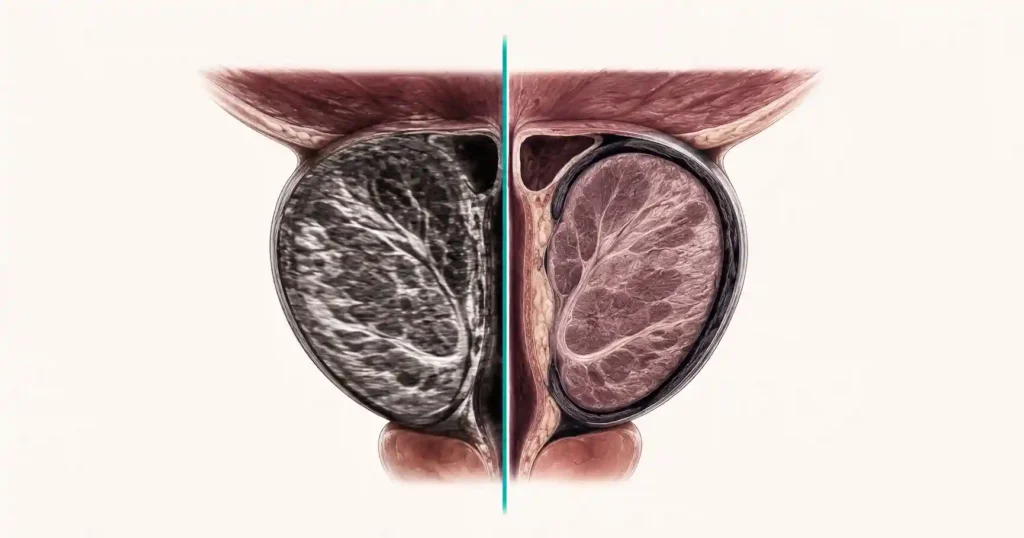
What a PI-RADS 3 Score Means: Biopsy or Not?
A PI-RADS 3 result sits exactly on the fence — not reassuring, not alarming. Here's how I read it in clinic, what your true cancer odds are, and why your PSA density usually settles the biopsy question.

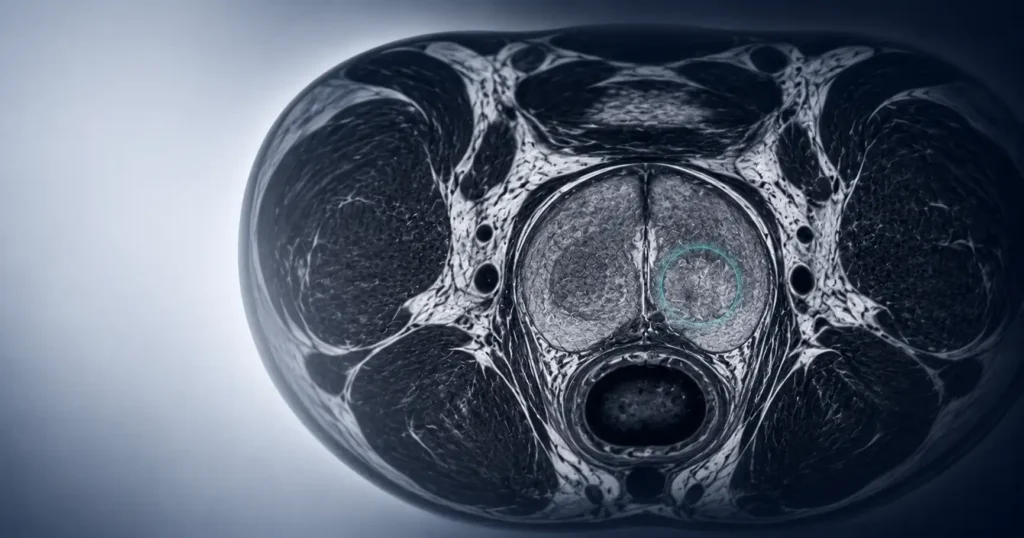
A PI-RADS 3 score is the one prostate MRI result that satisfies no one. It isn’t the reassuring all-clear of a 1 or 2, and it isn’t the strong warning of a 4 or 5. It sits on the fence — radiologists call it equivocal, which is a precise way of saying the scan cannot tell whether what it sees is cancer or something harmless. If your report came back with this number, you are probably staring at it wondering whether you need a biopsy or whether you can wait. That uncertainty is the whole point of this article. A PI-RADS 3 result is common, the true cancer risk attached to it is lower than most men fear, and there is usually one extra number — your PSA density — that settles the biopsy question more cleanly than the MRI alone. For how prostate MRI fits into modern screening, see our Prostate Health Hub. Here, I’ll walk through exactly what the score means and what I’d advise you to do next.
Key Takeaways
- A PI-RADS 3 score is “equivocal” — the MRI cannot tell whether the area is early cancer or a benign mimic like a BPH nodule or a patch of inflammation.
- Most PI-RADS 3 lesions are not dangerous: clinically significant cancer (Grade Group 2 or higher) turns up in only about 1 in 5.
- PSA density is the strongest tiebreaker — below about 0.15 ng/mL per cc, the cancer risk drops to roughly 14%; at or above 0.15 it roughly doubles.
- A PI-RADS 3 result does not commit you to a biopsy; a repeat MRI in 6 to 12 months is a legitimate option when PSA density is low.
What a PI-RADS 3 score actually means
PI-RADS stands for the Prostate Imaging Reporting and Data System — a standardized way radiologists score a prostate MRI from 1 to 5. Each number estimates one thing: the probability that a clinically significant cancer is hiding in what the scan shows. A 1 means that probability is very low; a 5 means it is very high. The American Urological Association recommends an MRI before a first biopsy and asks radiologists to report it using exactly this PI-RADS scale.[1]
A PI-RADS 3 lands in the true middle, and the official wording for it is equivocal. That is radiology’s honest admission that the area in question could be early cancer — or could be something completely benign. A patch of inflammation (prostatitis), a benign enlargement nodule (BPH), or normal transition-zone tissue can all look suspicious on the same images. The scan alone cannot separate them.
This is also why the MRI now comes before the biopsy rather than after it: it lets your urologist target only the areas that look concerning instead of sampling the gland blindly. For the full picture of that shift in how prostate cancer is diagnosed, the related read below is the place to start.
Related: Why an MRI now comes before the prostate biopsy →How likely is cancer with a PI-RADS 3 result?
Before talking about risk, one term has to be clear. Clinically significant cancer means a tumor graded Grade Group 2 or higher — Gleason 3+4=7 and above. That is the kind worth finding and treating. Grade Group 1 disease, by contrast, is so slow-moving that it is often safely monitored rather than removed, which is why not every cancer a biopsy finds actually changes your life.
So how often does a PI-RADS 3 lesion hide significant cancer? Across large studies, the answer clusters around 1 in 5 — roughly 15 to 20 percent.[2][4] Put the other way: four out of five men with this score do not have significant cancer. That is reassuring, but a 1-in-5 chance is still too high to simply ignore — which is the exact bind a PI-RADS 3 puts everyone in.
If your PSA sat in the 4 to 10 ng/mL gray zone that usually triggers the scan, the same lesson holds: the absolute number rarely settles things alone. You can estimate your overall risk from age, PSA, and family history — but for a PI-RADS 3 specifically, one measurement does more work than any other.
PSA density: the number that usually decides
That measurement is PSA density. It is simply your total PSA divided by the size of your prostate — its volume in cubic centimeters, which the MRI has already measured. A PSA of 6 means something very different in a small 30 cc gland than in a bulky 90 cc one. In the small gland the PSA is concentrated (high density); in the large gland it is diluted by benign tissue (low density).
The number that matters is 0.15 ng/mL per cc. Below roughly 0.15, the chance that a PI-RADS 3 lesion harbors significant cancer falls to about 14 percent.[2] At or above 0.15, that risk roughly doubles, and PSA density at this cutoff has held up as a consistent predictor of significant disease in men with a PI-RADS 3 lesion.[3] This single ratio is usually what tips a PI-RADS 3 toward biopsy or toward watchful repeat imaging.
If you want to see how the two values combine, a PI-RADS and PSA density biopsy-decision tool walks through the same thresholds I use in clinic.
In My Practice
A man came to me last year clutching his MRI report, having read the word “lesion” a dozen times and convinced he had aggressive cancer. His PSA was 5.8, but his prostate was small — only 28 cc — which put his PSA density above 0.20. That number, not the word “lesion,” was what told me his PI-RADS 3 deserved a biopsy. It found a Grade Group 2 cancer, caught early.
The report wording rarely settles a PI-RADS 3 — the PSA density usually does.
Facing a PSA result you do not fully understand? Download Dr. Khalid’s PSA & Prostate Cancer Decision Guide.
Enter your email below to receive Dr. Khalid’s complete PSA & Prostate Cancer Decision Guide as a free, printable PDF.
PI-RADS 3 — should you get a biopsy?
A PI-RADS 3 does not put you on an automatic path to biopsy. The AUA guideline supports targeted biopsy of suspicious lesions scored 3 to 5, but it is precisely at a 3 that shared decision-making carries the most weight.[1] The choice comes down to stacking the rest of your risk picture on top of that single score.
Factors that push toward a biopsy now:
- PSA density of 0.15 ng/mL per cc or higher
- An abnormal digital rectal exam
- A first-degree relative with prostate cancer, or a known BRCA mutation
- No previous biopsy combined with a steadily rising PSA
Factors that support a repeat MRI instead:
- PSA density comfortably below 0.10 to 0.15
- A large, benign-feeling gland that explains the PSA
- One or more prior negative biopsies
- Older age or other health conditions that limit the benefit of finding slow-growing disease
When the picture leans low-risk, a repeat MRI in 6 to 12 months alongside PSA monitoring is a legitimate, guideline-consistent path — not a cop-out. If you do proceed, it helps to know what the biopsy itself involves and to ask about a transperineal route, which lowers the risk of serious infection.
What to do next if your report says PI-RADS 3
If your report says PI-RADS 3, here is what I would do in your position — concretely, not vaguely.
- Get your PSA density. Ask for your most recent PSA and the prostate volume on the MRI report, then divide one by the other. If it is 0.15 or higher, raise that with your urologist directly.
- Ask the specific question: “Given my PSA density and risk factors, do you recommend a targeted biopsy now, or a repeat MRI in 6 to 12 months?” Make them choose between the two named paths.
- Ask about the biopsy route. A transperineal approach carries a lower risk of serious infection than the older transrectal method — worth requesting if you do go ahead.
- Read the report wording yourself. Words like “lesion” or “focus” are descriptive, not a diagnosis — the score and your PSA density mean more than any single word.
A PI-RADS 3 is also a good prompt to confirm the rest of your screening is current. Our men’s health checklist for the over-40s covers what else belongs on the list at your age.
When Not to Wait
A PI-RADS 3 score is usually not an emergency — but a few situations call for prompt urology review rather than a relaxed repeat scan:
- PSA density of 0.15 or higher together with a strong family history of prostate cancer
- A clearly abnormal digital rectal exam
- Visible blood in the urine or semen
- New bone pain or unexplained weight loss
- Difficulty passing urine, or being unable to urinate at all
Frequently asked questions about a PI-RADS 3 score
Does a PI-RADS 3 score mean I have cancer?
No. A PI-RADS 3 score means the MRI finding is equivocal — the scan cannot say whether the area is early cancer or a benign mimic such as a prostatitis patch or a BPH nodule. Across studies, only about 1 in 5 PI-RADS 3 lesions turn out to be clinically significant cancer, so most men with this result do not have a dangerous tumor.
Should I get a biopsy if my MRI shows a PI-RADS 3 lesion?
Not automatically. A biopsy makes most sense when your PSA density is 0.15 ng/mL per cc or higher, your digital rectal exam is abnormal, or you have a strong family history. When PSA density is low and the gland is large, a repeat MRI in 6 to 12 months with PSA monitoring is a reasonable, guideline-consistent alternative to sampling straight away.
What PSA density is reassuring with a PI-RADS 3 result?
A PSA density below roughly 0.15 ng/mL per cc is reassuring: in that range the chance a PI-RADS 3 lesion is significant cancer falls to about 14 percent. At or above 0.15, the risk roughly doubles. A PI-RADS and PSA density biopsy-decision tool can show how your two numbers combine before you see your urologist.
Can a PI-RADS 3 score change on a repeat MRI?
Yes. Some PI-RADS 3 lesions are downgraded to a 1 or 2 on a follow-up scan, especially if inflammation has settled, while a minority are upgraded to a 4. That movement is exactly why a repeat MRI in 6 to 12 months is a sensible option for low-risk men rather than rushing to biopsy a finding that may resolve.
What is the difference between PI-RADS 3 and PI-RADS 4?
A PI-RADS 4 means significant cancer is likely and almost always warrants a targeted biopsy. A PI-RADS 3 is genuinely uncertain — the imaging features are too ambiguous to call either way, so the decision leans on PSA density and your clinical risk rather than the score alone. In short, a 4 points you toward biopsy; a 3 leaves the choice open.
References
- Early Detection of Prostate Cancer: AUA/SUO Guideline (2023; amended 2025). J Urol. 2026. AUA
- Utility of PSA density in patients with PI-RADS 3 lesions across a large multi-institutional collaborative. Urol Oncol. 2023. Journal
- Considering Predictive Factors in the Diagnosis of Clinically Significant Prostate Cancer in Patients with PI-RADS 3 Lesions. Life (Basel). 2021;11(11):1432. PubMed Central
- To biopsy or not biopsy — PI-RADS 3 prostate lesions: validation of clinical and radiological parameters for biopsy decision-making. BMC Urol. 2025. PubMed Central
Dr. Muhammad Khalid
MBBS · FCPS (Urology) · MCPS (General Surgery) · CHPE · CRSM · IMC #539472
Specialist urologist with 11+ years of clinical experience across tertiary teaching hospitals. Trained at Lady Reading Hospital and Khyber Teaching Hospital, Peshawar. Author or co-author of five peer-reviewed international publications, including in Cureus and the World Journal of Surgery. Procedural expertise: URS, PCNL, RIRS, TURP, TURBT, and major open urological surgery. Full profile →
This article is for educational purposes only and does not constitute medical advice. Always consult your physician or urologist for diagnosis and treatment decisions specific to your condition.