The 2025 Hypertension Guideline & PREVENT Score Explained
The 2025 hypertension guideline left the 130/80 threshold alone — but rebuilt the risk math underneath it. For the first time, that calculation runs partly on your kidney function.

If you have read that the 2025 hypertension guideline changed everything, let me lower the temperature a little. The number that defines high blood pressure did not move — 130/80 mmHg still draws the line, exactly as it has since 2017. What changed is the math that sits behind that number: how your doctor decides whether your blood pressure actually threatens you, and when a tablet is worth starting. The headline shift is a new risk calculator called PREVENT, and for the first time it puts your kidney function directly into your heart-disease math. As a urologist, that last part is the piece I want you to understand, because I spend my days with men whose kidneys and blood vessels are quietly damaging each other. This article walks through what the guideline kept, what it rebuilt, and what the change means for a real reading on a real morning. For the wider picture of how pressure and kidneys interact, our blood pressure hub collects the rest.
Key Takeaways
- The 2025 guideline kept the diagnostic threshold at 130/80 mmHg — the change is in how risk is calculated, not where high blood pressure begins.
- PREVENT replaces the older Pooled Cohort Equations and adds kidney function (eGFR) as a core input, alongside cholesterol, blood pressure, and diabetes status.
- For a reading of 130–139/80–89 mmHg with a PREVENT 10-year risk under 7.5%, the guideline favors 3–6 months of lifestyle change before medication.
- Because eGFR now sits inside the score, a man with early, silent kidney decline can carry a higher calculated heart risk than the same man with healthy kidneys.
What the 2025 hypertension guideline changed — and what it left alone
The 2025 guideline is the first major rewrite of US blood pressure advice since 2017, published in the Journal of the American College of Cardiology in August 2025 by the AHA, the ACC, and eleven other societies [1]. Despite the long gap, the part that affects most people is reassuringly stable. The threshold for diagnosing high blood pressure stays at 130/80 mmHg, and the stages above it are unchanged. If your readings were controlled under the old rules, they are still controlled today.
What is new sits mostly under the hood. The guideline adopts the PREVENT risk calculator to decide who benefits from treatment, expands screening for primary aldosteronism — a hormonal cause of high blood pressure — to everyone with stage 2 or treatment-resistant hypertension, and introduces renal denervation as an add-on option for selected resistant cases [1]. It also gives more specific advice for people with chronic kidney disease, diabetes, and pregnancy.
So the practical message is calmer than the headlines suggest. Nobody woke up with worse blood pressure because of a document. The line is the same; the change is in how seriously a reading near that line is taken once your full risk is weighed. If the two numbers themselves still confuse you, start with our plain-English guide to reading your blood pressure, then come back. For the foundational picture of how sustained pressure injures the kidneys, our overview of high blood pressure and kidney damage covers the mechanism in full.
PREVENT vs. the old calculator: why the risk math was rebuilt
For a decade, US risk estimates ran on the 2013 Pooled Cohort Equations. They had two well-known problems: they used race as a mathematical input, and they tended to overestimate risk. In a contemporary sample of 3.3 million US adults, the older equations overpredicted cardiovascular risk by roughly twofold, while PREVENT stayed accurately calibrated across racial and ethnic groups [1]. That overprediction matters, because an inflated number can push someone onto medication they did not actually need.
PREVENT, released by the AHA in 2023, was built to fix that [2]. It is race-free, works across ages 30 to 79, and estimates risk over both 10 and 30 years rather than 10 alone. It also widens the outcomes it predicts — not just heart attack and stroke, but heart failure and total cardiovascular disease. The core inputs are the familiar ones: age, sex, total and HDL cholesterol, systolic blood pressure, diabetes, smoking, and whether you take blood-pressure or statin medication.
Two additions change the character of the score. PREVENT adds body mass index and, more importantly for this site, your kidney function. There is also an optional layer — urine albumin, HbA1c, and social factors — for people whose risk needs finer tuning. The 30-year window is the quiet upgrade most men miss: a 35-year-old with borderline numbers can finally see a long-range figure instead of a falsely comfortable 10-year one. If you want a feel for how these inputs combine, our vascular age calculator translates a similar risk profile into the age your arteries are behaving like.
The kidney link: why your eGFR now sits inside your heart-risk score
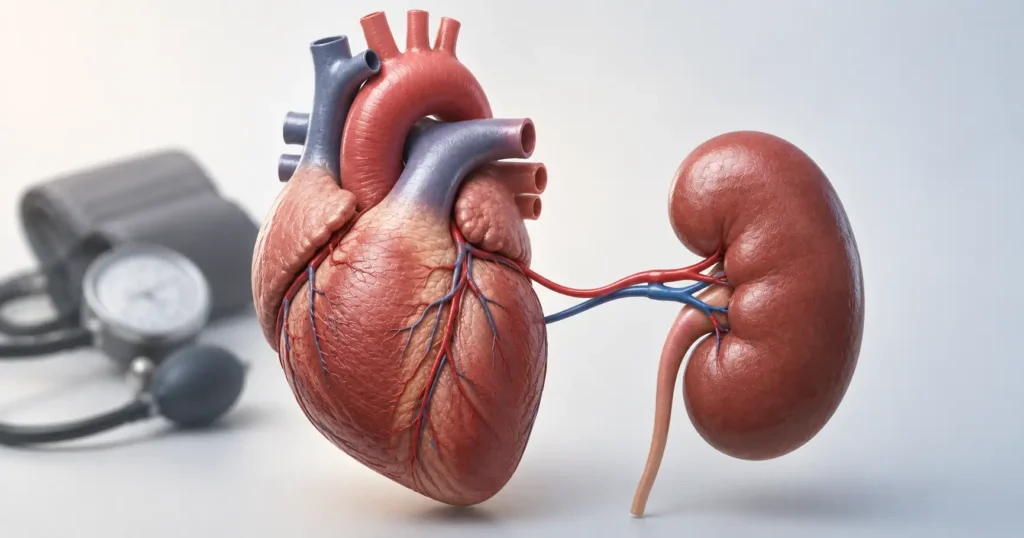
This is the change I care about most. PREVENT was built on a framework the AHA calls cardiovascular-kidney-metabolic health — the recognition that the heart, the kidneys, and metabolism are one connected system rather than three separate clinics [3]. Acting on that, the equations include your eGFR — the estimated glomerular filtration rate, the standard measure of how well your kidneys filter — as a core input, calculated with the race-free 2021 CKD-EPI formula.
Why does that belong in a heart score? Because reduced filtration is an independent predictor of cardiovascular events, and the risk climbs steadily once eGFR drops below 60 mL/min/1.73 m². The same is true of albumin leaking into the urine. These are not bystander findings; they are accelerators. A man can have a blood pressure that looks acceptable and a filtration rate that is quietly telling a different story. To understand what your own filtration number means, our explainer on chronic kidney disease stages breaks the eGFR bands down.
In My Practice
A man in his late fifties came to me mainly because he was getting up twice a night to pass urine. His blood pressure that morning was 134/82 — barely over the line, the kind of reading most people shrug off. But his eGFR was 58 and there was a trace of protein in his urine. Under the old risk math, his number looked unremarkable. Under PREVENT, those two kidney findings pushed his ten-year cardiovascular risk into a range that changed the entire conversation.
The same blood pressure can mean two very different things depending on what your kidneys are doing underneath it.
This is also why I screen blood pressure and kidney function together rather than in isolation. If you want to see how the two interact for your own readings, our BP and kidney damage risk tool walks through it with the same logic the guideline now uses.
Want your real heart risk before symptoms appear? Download Dr. Khalid’s Cardiovascular Risk Reduction Guide.
Enter your email below to receive Dr. Khalid’s complete Men’s Cardiovascular Risk Reduction Guide as a free, printable PDF.
What this means for you: thresholds, treatment, and what to ask
Here is where the new math meets a real decision. For a reading in the 130–139/80–89 mmHg band with a PREVENT 10-year risk under 7.5%, the guideline recommends 3 to 6 months of focused lifestyle change first, then medication only if your blood pressure stays at or above 130/80 [1]. If your calculated risk is 7.5% or higher, or you are already in stage 2, the balance tips toward starting medication sooner. The blood-pressure treatment threshold did not move — what moved is how the in-between zone is handled.
So your next appointment is worth steering. Three concrete requests:
- Ask for your PREVENT 10-year risk number specifically, not just “your blood pressure is fine.” The number is what drives the treatment call now.
- Ask whether your eGFR and a urine albumin (UACR) have been checked in the last year. Without them, the score is running on incomplete kidney data.
- If you are between 130–139/80–89 with low calculated risk, ask for a defined 3–6 month lifestyle plan with a recheck date rather than an open-ended “watch it.”
If a secondary or kidney-driven cause is on the table — younger age, resistant readings, or abnormal kidney tests — our article on renal hypertension explains when blood pressure is the symptom rather than the disease. The lifestyle work is not filler, either: in the lower-risk band it is the actual treatment, and done properly it can keep you off medication for years.
When to Seek Urgent Care
The risk-scoring conversation above is for routine, stable readings. A very high reading with symptoms is a different situation and needs emergency assessment. Go to the emergency room if a blood pressure of 180/120 mmHg or higher comes with any of the following:
- Chest pain, shortness of breath, or a sudden severe headache
- Blurred vision, slurred speech, or weakness on one side of the body
- Confusion, or blood in the urine with flank pain
Frequently Asked Questions
Did the 2025 hypertension guideline change the blood pressure numbers?
No. The 2025 hypertension guideline kept the diagnostic threshold at 130/80 mmHg, the same line used since 2017. What changed is how your doctor weighs that number against your overall risk. If your blood pressure was controlled under the old rules, it is still controlled. For a refresher on what the two numbers mean, see our guide to reading your blood pressure.
How is the PREVENT score different from the old risk calculator?
The older Pooled Cohort Equations estimated only 10-year heart-attack and stroke risk and used race as an input. PREVENT is race-free, works from age 30 to 79, estimates risk over both 10 and 30 years, and adds heart failure and kidney function to the math. You can see the idea behind it in our vascular age calculator.
Why does my kidney function affect my heart risk now?
Because reduced kidney filtration is an independent driver of heart disease, not a separate problem. PREVENT includes your eGFR as a core input, so a lower filtration rate raises your calculated cardiovascular risk even when your blood pressure looks acceptable. If you want to understand your own filtration number, our CKD stage calculator explains what your eGFR means.
My blood pressure is 132/84 — does the new guideline say I need medication?
Not automatically. For a reading of 130–139/80–89 mmHg with a PREVENT 10-year risk under 7.5%, the guideline favors 3 to 6 months of focused lifestyle change first, then medication only if your blood pressure stays at or above 130/80. Higher calculated risk shifts that decision toward starting medication sooner. Our overview of high blood pressure and kidney damage explains why the threshold sits where it does.
References
- Jones DW, et al. 2025 AHA/ACC/Multisociety Guideline for the Prevention, Detection, Evaluation and Management of High Blood Pressure in Adults. J Am Coll Cardiol / Hypertension. 2025. AHA Journals
- Khan SS, et al. Development and Validation of the American Heart Association’s PREVENT Equations. Circulation. 2024;149(6):430–449. AHA Journals
- Khan SS, et al. Novel Prediction Equations for Absolute Risk Assessment of Total Cardiovascular Disease Incorporating Cardiovascular-Kidney-Metabolic Health: A Scientific Statement From the American Heart Association. Circulation. 2023;148(24):1982–2004. AHA Journals
Dr. Muhammad Khalid
MBBS · FCPS (Urology) · MCPS (General Surgery) · CHPE · CRSM · IMC #539472
Specialist urologist with 11+ years of clinical experience across tertiary teaching hospitals. Trained at Lady Reading Hospital and Khyber Teaching Hospital, Peshawar. Author or co-author of five peer-reviewed international publications, including in Cureus and the World Journal of Surgery. Procedural expertise: URS, PCNL, RIRS, TURP, TURBT, and major open urological surgery. Full profile →
This article is for educational purposes only and does not constitute medical advice. Always consult your physician or urologist for diagnosis and treatment decisions specific to your condition.