Salt and Kidney Stones: The Blood Pressure Link
The same salt that nudges up your blood pressure quietly pushes calcium into your urine — where kidney stones form. Here's the shared mechanism, and the single number that improves both.

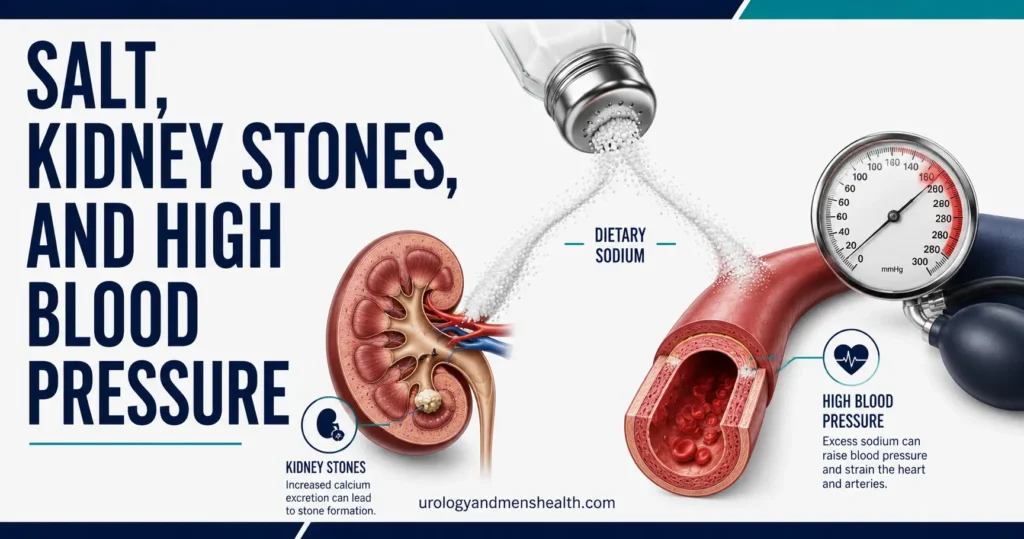
Salt and kidney stones are linked far more tightly than most people expect — and the same salt is quietly pushing up your blood pressure at the same time. I see this overlap constantly in clinic: a man comes in for a stone, and his blood pressure reading is already in the danger zone. It is not a coincidence. Sodium, the part of salt that matters inside your body, changes how your kidneys handle calcium and how your blood vessels handle water. The result is two separate problems — stones forming in your urinary tract and pressure rising in your arteries — growing from one shared root. The upside is that this makes the fix efficient: cut the sodium, and you work on both at once. Below I walk through exactly how salt drives stone formation, how it raises blood pressure, and the single sodium target that improves both numbers. For the wider picture of how pressure damages the kidneys over time, our Blood Pressure & Cardiovascular Hub pulls the topic together.
Key Takeaways
- A high-salt diet raises the calcium in your urine, and that extra urinary calcium is what seeds calcium-oxalate stones — the most common stone type.
- In a 2010 randomized trial of stone formers, cutting salt alone dropped urinary calcium from 361 to 271 mg/day, with no change to calcium intake.
- The same sodium load that pulls calcium into your urine also holds onto water and stiffens arteries, pushing blood pressure up.
- Keeping sodium under 2,300 mg/day — ideally near 1,500 mg — lowers stone risk and blood pressure at the same time.
How Salt and Kidney Stones Are Connected
Your kidneys reabsorb sodium and calcium through the same machinery. Inside the tubules — the tiny channels that decide what stays in your blood and what leaves in your urine — sodium and calcium travel side by side. When you flood the system with sodium, the kidney works to dump the excess, and calcium gets carried out into the urine along with it.
That extra calcium in the urine is the problem. We call it hypercalciuria — too much calcium in the urine. The more calcium floating in your urine, the more readily it binds with oxalate, a compound from food, to form calcium-oxalate crystals. Those crystals are the seed of the most common kidney stone.
This is not theory. In a 2010 randomized controlled trial of stone formers with high urinary calcium, cutting salt alone lowered urinary calcium from 361 to 271 mg per day over three months — and nobody changed how much calcium they ate.[2] On the strength of evidence like this, the American Urological Association advises patients with calcium stones and high urinary calcium to limit sodium.[1]
The practical point: if you form calcium stones, salt is often a bigger lever than the high-oxalate foods you have probably been told to fear.
Read next: the complete kidney stone prevention diet I give my patientsWhy the Same Salt Raises Your Blood Pressure
Sodium does something parallel on the cardiovascular side, by a different route. Salt pulls water with it. Eat more sodium, and your body holds onto more water to keep the salt concentration in your blood steady. More water means more blood volume, and more volume pushing against your artery walls means higher pressure.[4]
Over months and years, a high-sodium diet also makes the small arteries stiffer and slower to relax, so pressure stays elevated even between meals. That is why salt and blood pressure are so tightly bound together in clinic.
The kidneys sit at the center of both problems. The same organ that spills calcium into your urine is the one that high blood pressure slowly damages, as high-pressure blood injures the delicate filtering units inside. I go through that cascade in detail in how high blood pressure quietly damages your kidneys.
In My Practice
A man in his forties came to me for his third calcium-oxalate stone in two years, frustrated that he had already cut back on spinach and tea. His 24-hour urine told the real story: his urinary sodium was nearly triple the target, and his urinary calcium was high right alongside it. His blood pressure that morning was 148/92 mmHg. We never touched his calcium intake — we cut his salt, and at the three-month recheck both his urinary calcium and his blood pressure had come down together.
When recurrent stones and high blood pressure show up in the same man, salt is usually the thread connecting them.
High blood pressure and worried about your kidneys? Download Dr. Khalid’s Blood Pressure & Kidney Protection Guide.
Enter your email below to receive Dr. Khalid’s complete Blood Pressure & Kidney Protection Guide as a free, printable PDF.
The One Sodium Number That Helps Both
Because one mineral drives both problems, one change addresses both. In the DASH-Sodium trial, the landmark study on salt and blood pressure, cutting sodium to about 1,500 mg per day lowered systolic blood pressure by roughly 7 mmHg compared with a high-salt diet[3] — a drop comparable to starting a blood pressure medication.
The targets I give patients: keep sodium under 2,300 mg per day (about 1 teaspoon of salt) as a floor everyone should meet, and aim closer to 1,500 mg (about 2/3 teaspoon) if you have high blood pressure, recurrent stones, or both. The same reduction that brings your pressure down also lowers the calcium in your urine — you are treating two conditions with one habit.
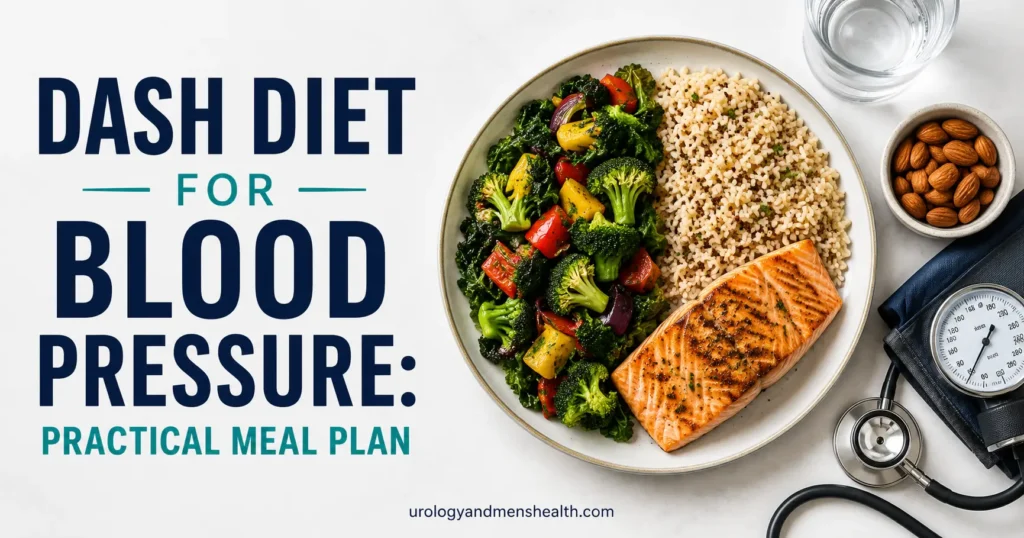
The DASH eating pattern was built around exactly this balance. My practical DASH diet meal plan for blood pressure shows what those numbers look like on a plate. To see where you currently stand, the sodium intake tracker totals a typical day for you in a couple of minutes.
Where Your Salt Is Really Hiding — and What to Do
Here is the part that surprises people: the salt shaker is not your main problem. More than 70% of the sodium most people eat is already baked into packaged and restaurant food before it reaches the table, and the average American takes in around 3,400 mg a day — far above target.[4] Cutting back at the stove barely moves the needle if the rest of your diet is loaded.
The biggest hidden sources are bread and rolls, deli and cured meats, canned soup, pizza, cheese, and bottled sauces and dressings. A single deli sandwich can carry more than half a day’s sodium. This is why reading the milligrams on a label matters far more than banishing the shaker.
Most people badly underestimate their intake. The hidden sodium calculator adds up the sodium in everyday foods you might not suspect, so you can find the few items doing the most damage.
What I tell patients to do: for two weeks, read the sodium line on every packaged food and keep a running daily total, aiming under 2,300 mg. If you form stones and your number is consistently high, ask your urologist for a 24-hour urine collection to measure your sodium and calcium directly — it turns guesswork into a target you can actually track.
When to Get Checked
Salt is a common thread, but some signs need a clinician, not a diet tweak:
- Severe one-sided flank pain coming in waves, with nausea or visible blood in your urine, can mean a stone is blocking your ureter. Go to the emergency room — an obstructing stone with fever is a urological emergency.
- A home blood pressure reading at or above 180/120 mmHg: rest five minutes and recheck, and if it stays that high, seek same-day urgent care.
- Stones that keep returning despite cutting salt: ask your urologist for a 24-hour urine collection measuring sodium, calcium, oxalate, and citrate, rather than guessing at the cause.
Frequently Asked Questions
Does cutting salt dissolve kidney stones I already have?
No — lowering salt does not dissolve a stone that has already formed. The link between salt and kidney stones is about prevention: less sodium means less calcium spilling into your urine to build new ones, which is why salt sits near the top of any prevention plan. For the foods that matter most, see my breakdown of the foods that raise oxalate and sodium in your urine.
How much can lowering salt actually drop my blood pressure?
In the DASH-Sodium trial, moving from a high-sodium diet down to roughly 1,500 mg a day lowered blood pressure by about 7 mmHg systolic — a meaningful drop that rivals some medications. The effect is largest in people who are salt-sensitive, which includes many men who carry both high blood pressure and a history of stones.
If salt raises urinary calcium, should I also eat less calcium?
No, and this is the mistake I correct most often. Cutting dietary calcium backfires: with less calcium in your gut, more oxalate gets absorbed and ends up in your urine, raising stone risk. The AUA recommends keeping calcium at 1,000 to 1,200 mg a day while lowering sodium — it is the salt you cut, not the calcium.
Is sea salt or pink Himalayan salt safer for stones or blood pressure?
No. Your kidneys respond to sodium, and sea salt, pink Himalayan salt, and ordinary table salt are all roughly 40% sodium by weight. The trace minerals in the fancier salts do not change how much calcium spills into your urine or how much water your body retains. The total sodium is what counts, whatever the source.
What daily sodium target should I aim for if I get both stones and high blood pressure?
Aim for under 2,300 mg of sodium a day as a starting point — about one teaspoon of salt — and work toward 1,500 mg if you have hypertension or recurrent stones. Most of that sodium hides in bread, deli meat, sauces, and restaurant meals, not your shaker, so reading labels matters more than locking the salt away.
References
- Pearle MS, Goldfarb DS, Assimos DG, et al. Medical Management of Kidney Stones: AUA Guideline. J Urol. 2014;192(2):316-324. AUA
- Nouvenne A, Meschi T, Prati B, et al. Effects of a low-salt diet on idiopathic hypercalciuria in calcium-oxalate stone formers: a 3-mo randomized controlled trial. Am J Clin Nutr. 2010;91(3):565-570. PubMed
- Sacks FM, Svetkey LP, Vollmer WM, et al. Effects on blood pressure of reduced dietary sodium and the Dietary Approaches to Stop Hypertension (DASH) diet. N Engl J Med. 2001;344(1):3-10. PubMed
- U.S. Food and Drug Administration. Sodium in Your Diet. FDA
Dr. Muhammad Khalid
MBBS · FCPS (Urology) · MCPS (General Surgery) · CHPE · CRSM · IMC #539472
Specialist urologist with 11+ years of clinical experience across tertiary teaching hospitals. Trained at Lady Reading Hospital and Khyber Teaching Hospital, Peshawar. Author or co-author of five peer-reviewed international publications, including in Cureus and the World Journal of Surgery. Procedural expertise: URS, PCNL, RIRS, TURP, TURBT, and major open urological surgery. Full profile →
This article is for educational purposes only and does not constitute medical advice. Always consult your physician or urologist for diagnosis and treatment decisions specific to your condition.