White Coat Hypertension: Harmless or Hidden Risk?
For years "white coat hypertension" was filed under harmless nerves. The evidence moved. Here's what an untreated office-only spike does to your heart and kidneys — and the one test that proves which kind you have.

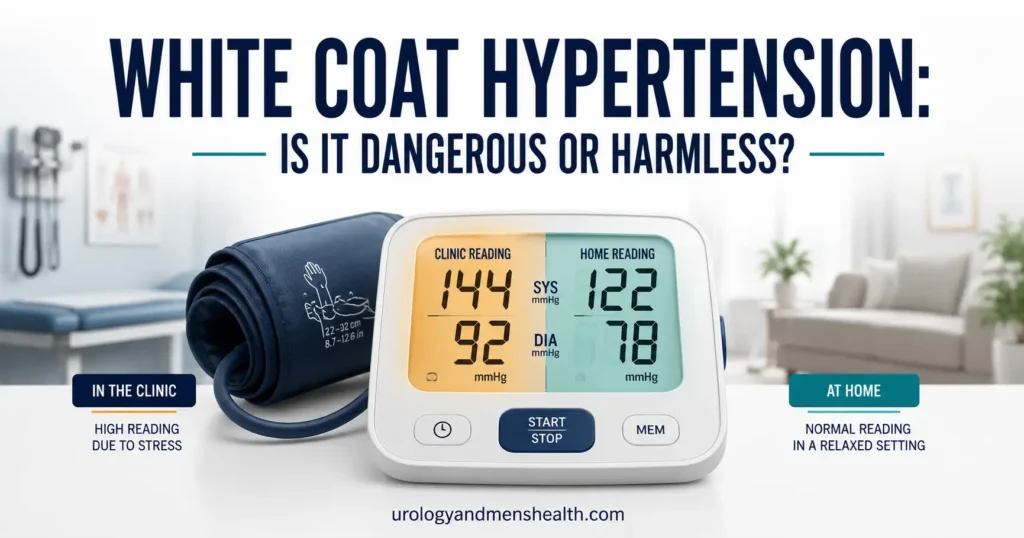
White coat hypertension is one of the most misunderstood readings in medicine — your blood pressure climbs in the clinic but reads normal everywhere else. For years it was filed under “harmless nerves,” and I was taught to reassure patients and move on. The evidence has since moved, and so has my answer. Untreated, an office-only spike is not the same as having no problem at all — it sits in a gray zone between normal pressure and the real thing, and where you land in that zone matters for your heart and kidneys. The good news is that this is one of the few cardiovascular questions you can settle with near-certainty using a single out-of-office test. This article walks through what the diagnosis actually means, whether it is dangerous, and what I tell men to do about it. For the wider context on blood pressure and organ damage, our complete Blood Pressure Hub ties these topics together.
Key Takeaways
- White coat hypertension means an office reading of 130/80 mmHg or higher while home or 24-hour readings stay below 130/80 mmHg — in someone not taking blood pressure medication.
- It is not automatically harmless: untreated, it carries roughly a 36% higher risk of cardiovascular events and about double the risk of dying from heart disease versus normal blood pressure.
- The only way to confirm it is an out-of-office reading — ideally 24-hour ambulatory monitoring, with validated home monitoring as the practical alternative.
- About 1 in 5 adults with a high office reading actually have white coat hypertension, and 1–5% convert to sustained hypertension each year, so it needs annual rechecking, not dismissal.
What White Coat Hypertension Actually Means
White coat hypertension describes a specific mismatch: your blood pressure reads high in the clinic but normal when you measure it anywhere else, and you are not on any blood pressure medication. The name points to the cause — the clinical setting itself triggers a brief stress response that nudges your pressure up for a few minutes. Think of it as your cardiovascular system reacting to the appointment the way it would to any short-lived stressor, then settling once you leave.
The numbers are specific. Under the 2025 AHA/ACC blood pressure guideline, white coat hypertension means an office reading of 130/80 mmHg or higher paired with a daytime home or ambulatory average below 130/80 mmHg [1]. It is common — roughly 1 in 5 adults with a high office reading turns out to have it rather than true, sustained hypertension [3].
One distinction matters. White coat hypertension applies to people not yet on treatment. When someone already taking blood pressure medication shows a high office reading but normal readings at home, that is the “white coat effect” — a related but lower-risk pattern. Keeping the two apart changes what the reading means for you.
Is White Coat Hypertension Dangerous? What the Data Says
For most of my training, the teaching was that white coat hypertension was harmless. The largest analysis of the question changed that. A 2019 meta-analysis of 27 studies and more than 60,000 people found that untreated white coat hypertension carried a 36% higher risk of cardiovascular events, a 33% higher risk of death from any cause, and roughly double the risk of dying from heart disease, compared with people whose pressure was normal everywhere [2].
The same study found something reassuring. People already on treatment who only spiked in the office — the white coat effect — did not carry that excess risk [2]. The danger sits with the undetected, untreated version. Finding it is most of the battle.
So why does an “occasional” spike matter? Because the office reading is often a sign that your pressure is not as stable as it looks, and sustained high pressure damages organs you cannot feel — the kidneys most of all. If white coat hypertension drifts into the sustained kind, the same quiet process behind how kidney damage builds silently through its stages begins.
In My Practice
I see the same script almost weekly: a man in his 50s who has been told for a decade that his high clinic readings are “just nerves,” waves off the monitor, and only agrees to a 24-hour cuff when something else — a creatinine bump, a thickened heart muscle spotted on an unrelated scan — forces the question. By then we are no longer debating white coat hypertension; we are managing the organ damage it had been quietly tracking toward.
The label “white coat” should trigger a 24-hour reading and a yearly recheck, never a permanent dismissal.
How White Coat Hypertension Is Diagnosed
You cannot diagnose white coat hypertension from office readings alone — by definition it requires measurements taken outside the clinic. The reference standard is 24-hour ambulatory blood pressure monitoring (ABPM): a small automated cuff you wear for a day that records your pressure at set intervals, including overnight [1][4]. Overnight readings matter because they predict outcomes better than daytime numbers do.
When ambulatory monitoring is not available, validated home monitoring is the practical alternative the guidelines accept. The catch is the device and the technique: a clinic-grade upper-arm monitor, the right cuff size, and a consistent schedule of morning and evening readings. If you are buying one, our guide to which home monitors actually give clinic-grade readings covers the validated options.
Whichever route you take, the numbers only help if you record them properly. I ask patients to log their readings in a simple trend tracker — a week of paired morning and evening measurements tells me far more than three numbers taken in my exam room.
High blood pressure and worried about your kidneys? Download Dr. Khalid’s Blood Pressure & Kidney Protection Guide.
Enter your email below to receive Dr. Khalid’s complete Blood Pressure & Kidney Protection Guide as a free, printable PDF.
White Coat Syndrome vs. Masked Hypertension
“White coat syndrome” is just the common name for white coat hypertension — high in the clinic, normal outside it. The pattern you actually want to rule out is its mirror image: masked hypertension, where the office reading looks fine but your true, out-of-office pressure is high.
Masked hypertension is the more dangerous of the two precisely because nothing flags it at a routine visit. Studies put its cardiovascular risk on par with sustained hypertension — roughly double that of normal pressure — yet it hides behind a normal clinic number. Men are disproportionately affected, often because work stress and poor sleep push pressure up during the day, away from the clinic.
This is the real argument for out-of-office measurement: a single setting, the exam room, can mislead you in either direction. One reading is a snapshot; a day of readings is the film.
When an Office Spike Is Not Harmless
A high clinic reading is not always “just white coat.” Treat these as reasons to act now rather than wait for a 24-hour test:
- An office reading of 180/120 mmHg or higher, especially with chest pain, breathlessness, severe headache, vision changes, or confusion — this is a hypertensive emergency. Go to the emergency room.
- High office readings alongside blood in the urine, foamy urine, or swelling in the legs, which can signal kidney involvement.
- A creatinine or eGFR that has worsened, or protein found in your urine.
- Home readings that are also climbing — that points to sustained or masked hypertension, not white coat.
What to Do If You Have White Coat Hypertension
White coat hypertension is a monitoring diagnosis, not an automatic prescription. For most men with no other heart risk factors, the right answer is lifestyle and surveillance: the measures that lower true hypertension also slow the drift toward it. That means keeping sodium under 1,500 mg a day (about 3/4 teaspoon of salt), regular aerobic activity, limiting alcohol, and treating poor sleep.
Medication enters only when the wider picture justifies it. The 2025 AHA/ACC guideline leans on overall cardiovascular risk — estimated with tools like the PREVENT calculator — and on any evidence of organ damage, rather than the office number alone [1]. If your risk is high or there are early signs of strain on the heart or kidneys, treatment becomes reasonable.
Concretely: ask your doctor whether 24-hour ambulatory monitoring is appropriate, repeat an out-of-office assessment every year, and have your kidney function (creatinine and eGFR) plus a urine test checked at least annually — since what sustained high pressure does to your kidneys is the damage you most want to catch early. White coat hypertension earns a yearly look, not a permanent dismissal.
Frequently Asked Questions
Is white coat hypertension dangerous, or is it really just nerves?
It is not as benign as the name suggests. The 2019 Cohen meta-analysis found untreated white coat hypertension carried a 36% higher risk of cardiovascular events and about double the risk of cardiovascular death versus normal blood pressure. The nerves are real, but so is the long-term signal — which is why it earns a 24-hour reading rather than a shrug.
What blood pressure numbers count as white coat hypertension?
Under the 2025 AHA/ACC definition, it is an office reading of 130/80 mmHg or higher while your daytime home or ambulatory average stays below 130/80 mmHg — and only if you are not already taking blood pressure medication. If you are on treatment and only the office reading is high, that is the white coat effect, which carries a different, lower risk.
Can I diagnose white coat hypertension with a home monitor, or do I need the 24-hour test?
A validated upper-arm home monitor can strongly suggest it, and for many men that is the practical route. But 24-hour ambulatory monitoring remains the reference standard because it captures your pressure during sleep and daily stress, which home readings miss. If your home and office numbers disagree sharply, ask for the ambulatory cuff to settle it.
If my home readings are normal, why should I still worry about my kidneys?
Because white coat hypertension converts to sustained hypertension in 1–5% of people each year, and sustained high pressure damages kidneys long before you feel it. That slow drift is why I recheck these patients yearly, and why a simple blood pressure and kidney risk estimate is worth running to see where you stand today.
Will I be put on blood pressure medication for white coat hypertension?
Usually not at first. For most men with no other heart risk factors, the answer is lifestyle changes and yearly monitoring, not pills. Medication enters the conversation only if your overall cardiovascular risk is high or there are early signs of organ damage. The decision rests on your whole risk profile, not the office number alone.
References
- Jones DW, et al. 2025 AHA/ACC Guideline for the Prevention, Detection, Evaluation and Management of High Blood Pressure in Adults. Circulation. 2025. AHA Journals
- Cohen JB, et al. Cardiovascular Events and Mortality in White Coat Hypertension: A Systematic Review and Meta-analysis. Ann Intern Med. 2019;170(12):853-862. PubMed
- White Coat Hypertension in Primary Care: A Narrative Review. J Clin Med / PMC. 2025. PubMed Central
- Shimbo D, et al. Status of ambulatory and home blood pressure monitoring for the diagnosis and management of hypertension in the US: an up-to-date review. Hypertens Res / PMC. 2023. PubMed Central
Dr. Muhammad Khalid
MBBS · FCPS (Urology) · MCPS (General Surgery) · CHPE · CRSM · IMC #539472
Specialist urologist with 11+ years of clinical experience across tertiary teaching hospitals. Trained at Lady Reading Hospital and Khyber Teaching Hospital, Peshawar. Author or co-author of five peer-reviewed international publications, including in Cureus and the World Journal of Surgery. Procedural expertise: URS, PCNL, RIRS, TURP, TURBT, and major open urological surgery. Full profile →
This article is for educational purposes only and does not constitute medical advice. Always consult your physician or urologist for diagnosis and treatment decisions specific to your condition.