PSMA PET Scan: What It Finds That Other Scans Miss
When a man's PSA climbs after treatment, a PSMA PET scan can often pinpoint exactly where the cancer is — sometimes years before a standard bone scan could. Here's when I use it and what it shows.

A PSMA PET scan is the most sensitive imaging test we have for finding prostate cancer that has spread or come back — and it can do that while older scans still look completely clean. If your urologist or oncologist has mentioned one, it usually means we are trying to answer a specific question: where exactly is the cancer, and has it traveled beyond the prostate? I order these scans in two situations — staging an aggressive cancer before treatment, and chasing a rising PSA after treatment. For how this fits with the rest of your prostate care, see our full Prostate Health Hub. In both cases the goal is the same: to base your treatment on what is actually there, not on guesswork. This guide explains what the scan sees, when it is the right test, how it compares to the bone scan and CT it is replacing, and where its limits lie. I will also walk you through the day of the scan itself, because the radioactive-tracer part understandably makes men nervous.
Key Takeaways
- A PSMA PET scan uses a radioactive tracer that sticks to a protein (PSMA) on prostate cancer cells, lighting up tumor deposits a CT or bone scan would miss.
- The two approved reasons to order one are staging high-risk prostate cancer before treatment and locating cancer when PSA rises after surgery or radiation.
- In the proPSMA trial, PSMA PET was 92% accurate for detecting spread versus 65% for CT plus bone scan — using less than half the radiation.
- The same PSMA target also enables lutetium-177 PSMA therapy (Pluvicto), so a positive scan can directly open a treatment door for advanced disease.
What a PSMA PET Scan Actually Sees
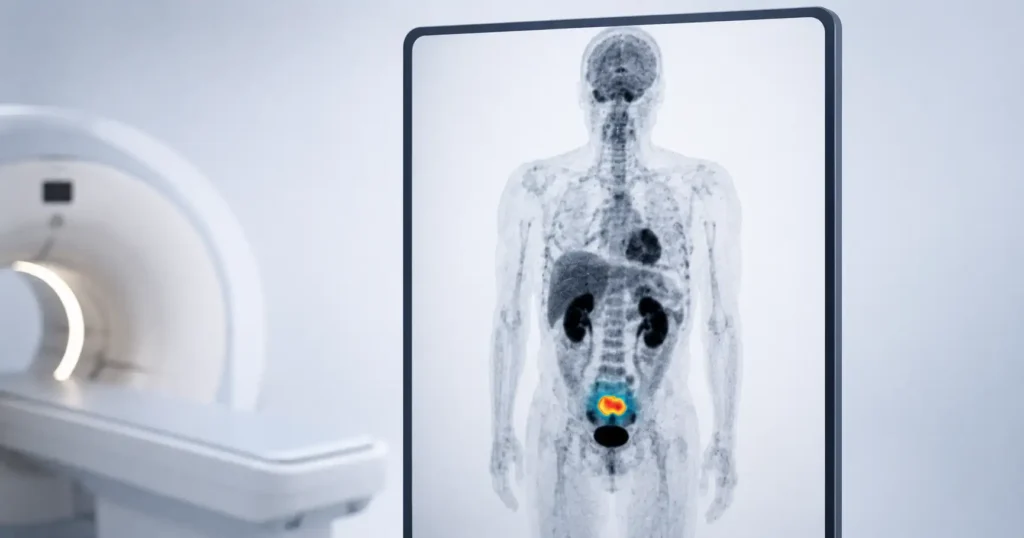
PSMA stands for prostate-specific membrane antigen — a protein that sits on the surface of most prostate cancer cells in far higher amounts than on normal tissue. We attach a radioactive tracer to a molecule that locks onto PSMA, inject it into a vein, and let it travel through the body and clamp onto any cluster of prostate cancer cells. A PET scanner then photographs where the radioactivity collects.
Think of it as a homing signal that only recognizes one chemical signature. The result is a whole-body map where cancer deposits glow — even small ones in a lymph node or a rib that a CT or bone scan reads as normal. This is the opposite of a prostate MRI, which examines the gland itself to guide a biopsy; a PSMA PET scan ignores the gland’s fine detail and instead hunts for cancer cells anywhere. If you are still at the diagnosis stage, our explainer on why an MRI usually comes before a biopsy covers that earlier step.
Three tracers are approved for this in the United States: gallium-68 PSMA-11 (cleared December 2020), piflufolastat F-18 / Pylarify (May 2021), and flotufolastat F-18 / Posluma (May 2023).[3] They differ in their logistics and availability, not in the basic idea — all three find PSMA.
When I Actually Order a PSMA PET Scan
There are two situations where this scan earns its place. The first is staging an aggressive, newly diagnosed cancer. These are men whose biopsy and PSA already mark the disease as high-risk — the same risk tiers I describe in our guide to prostate cancer screening by age. Before I send a man for surgery or radiation, I want to know whether cancer has already reached lymph nodes or bone, because that single fact can change the entire plan. How aggressive the tumor looks under the microscope drives this decision — if you want to make sense of that number, our Gleason Score Risk Interpreter translates it into plain risk language.
Staging matters because every treatment carries a cost. Knowing the true extent of disease lets you weigh aggressive treatment against quality-of-life trade-offs, including the recovery of sexual function after prostate surgery. A scan that quietly rules out spread can be just as valuable as one that finds it.
The second situation is biochemical recurrence — a PSA that was undetectable after prostatectomy starts climbing, or rises after radiation. A rising PSA tells us cancer is active somewhere; a PSMA PET scan tells us where. The AUA now recommends using PSMA PET preferentially in this setting because of its greater sensitivity.[2] How fast the PSA is doubling helps me decide how urgently to scan and treat. For the follow-up rules after surgery, see what a rising PSA after prostatectomy means.
Track your PSA doubling time and velocity →What I do not do is order a PSMA PET scan for a grey-zone screening PSA in a man with no cancer diagnosis. That is not what this test is for, and using it that way produces confusing results rather than answers.
PSMA PET vs the Bone Scan and CT It Replaces
For decades, staging meant a CT scan plus a technetium bone scan. They work, but they miss small or early deposits — the cancer has to reach a certain size before either test notices it. PSMA PET sees cancer at the cellular level, which is why it finds disease so much earlier.
The proPSMA trial put this to a direct test: 302 men with high-risk prostate cancer were randomized to either conventional imaging or a PSMA PET/CT scan. PSMA PET was 92% accurate at detecting spread, compared with 65% for CT plus bone scan — a 27% gap driven by far higher sensitivity (85% versus 38%). It also delivered less than half the radiation dose (8.4 versus 19.2 mSv).[1] On the strength of evidence like this, the AUA now considers PSMA PET standard of care for staging recurrence after primary treatment.[3]
Facing a PSA result you do not fully understand? Download Dr. Khalid’s PSA & Prostate Cancer Decision Guide.
Enter your email below to receive Dr. Khalid’s complete PSA & Prostate Cancer Decision Guide as a free, printable PDF.
In My Practice
I remember a man in his sixties whose PSA had crept from undetectable to 0.4 ng/mL two years after his prostatectomy. His CT and bone scan were spotless, and the old default would have been lifelong hormone therapy on the assumption the cancer was “somewhere.” His PSMA PET scan found exactly one lit-up pelvic lymph node — and nothing else. That single image let his radiation oncologist treat that node directly, and his PSA fell back to undetectable.
A scan that turns “it’s back somewhere” into “it’s back here” can be the difference between blanket treatment and a precise, potentially curative one.
When the Scan Becomes the Treatment: PSMA Theranostics
Here is where PSMA imaging becomes genuinely powerful. Because cancer cells grab the PSMA tracer so reliably, you can swap the imaging isotope for a therapeutic one. Lutetium-177 PSMA-617 (brand name Pluvicto) uses the same targeting molecule but carries a radioactive payload that delivers short-range radiation straight into PSMA-positive cancer deposits, wherever they sit in the body.
The VISION trial tested this in men with metastatic, castration-resistant prostate cancer who had already been through hormone therapy and chemotherapy. Adding lutetium-177 PSMA-617 to standard care improved overall survival.[4] The principle is simple and elegant: see it, treat it. The scan that finds the cancer and the therapy that attacks it lock onto the same target. That is also why a PSMA PET scan is the gatekeeper for this treatment — we use it to confirm a man’s cancer is PSMA-positive before offering the therapy at all.
What a PSMA PET Scan Can’t Do
No scan is perfect, and PSMA PET has real limits worth understanding before you read too much into a result.
- False positives. PSMA also appears naturally in the salivary glands, kidneys, and small bowel, and healing rib fractures or some benign tumors can light up. Not every bright spot is cancer — which is why a nuclear medicine specialist reads the whole pattern rather than reacting to a single dot.
- PSMA-negative cancers. A minority of prostate cancers do not make enough PSMA to show up, more often when the cancer has shifted toward a neuroendocrine pattern. In the VISION trial, about 12.6% of screened men were PSMA-negative and did not qualify for the targeted therapy.[4]
- Very low PSA levels. When PSA is only barely detectable, there may be too few cancer cells to register, so a negative scan does not always mean the cancer is gone.
- Access and cost. Not every center offers PSMA PET, and insurance coverage varies, so availability can shape what is realistic for you.
What to Expect If You’re Booked for One
The process is more comfortable than most men expect. A technician injects the tracer into a vein in your arm. You then wait roughly 30 to 60 minutes while it circulates and binds to any cancer cells. The scan itself takes about 20 to 30 minutes, lying still on a moving table inside the scanner ring. There is no pain and no claustrophobic tunnel of the kind an MRI involves.
The amount of radioactivity is small and clears quickly; you will be asked to drink water and pass urine afterward to flush the tracer out. A nuclear medicine physician reads the images, and your urologist or oncologist usually discusses the findings with you within a few days. Two questions are worth asking at that appointment: does this scan change my treatment plan, and if it is positive, am I a candidate for PSMA-targeted therapy? Those two answers are the entire reason the scan was done.
Red Flags — Don’t Wait for a Scan
Imaging can be scheduled; some symptoms cannot wait for it. If you have advanced or recurrent prostate cancer and develop any of the following, treat it as an emergency and go to the ER the same day:
- New severe back pain with leg weakness, numbness, or trouble walking — possible spinal cord compression.
- Loss of bladder or bowel control, or numbness around the groin and inner thighs.
- Being completely unable to pass urine despite a full, painful bladder.
- Bone pain with fever or suddenly feeling acutely unwell.
Frequently Asked Questions
Is a PSMA PET scan worth it if my PSA is only mildly raised?
It depends on why your PSA is up. For a grey-zone screening PSA in a man with no cancer diagnosis, a PSMA PET scan is the wrong test — we start with an MRI and possibly a biopsy. PSMA PET earns its place once you already have high-risk cancer being staged, or a confirmed rising PSA after treatment, where the doubling time guides the timing.
How is a PSMA PET scan different from a prostate MRI?
They answer different questions. A prostate MRI looks closely at the gland itself to find suspicious areas and target a biopsy. A PSMA PET scan scans the whole body to find prostate cancer cells wherever they have gone — lymph nodes, bone, or elsewhere. Many men have both at different points, because targeting a biopsy and mapping spread are separate jobs.
What does a positive PSMA PET scan mean after a prostatectomy?
It usually means your rising PSA now has a located source — often a single lymph node or a small bone deposit. That is genuinely useful: pinpointing the recurrence can let your team aim salvage radiation precisely instead of treating blindly. The right next step depends on the location and number of spots, which is part of interpreting a rising PSA after prostatectomy.
Can a PSMA PET scan be wrong?
Yes. PSMA appears naturally in the salivary glands, kidneys, and bowel, and healing rib fractures or some benign tumors can light up — so not every bright spot is cancer. A minority of prostate cancers are PSMA-negative and stay invisible. This is exactly why a nuclear medicine specialist interprets the overall pattern rather than acting on one dot.
Will a positive PSMA PET scan change my treatment?
Often, yes. Finding disease that older scans missed can shift the plan from surgery to radiation plus hormones, redirect salvage radiation to a specific lymph node, or qualify you for PSMA-targeted lutetium therapy if the cancer is advanced. Reading your scan alongside your Gleason score and risk group is what turns an image into a decision.
References
- Hofman MS, Lawrentschuk N, Francis RJ, et al. Prostate-specific membrane antigen PET-CT in patients with high-risk prostate cancer before curative-intent surgery or radiotherapy (proPSMA): a prospective, randomised, multicentre study. Lancet. 2020;395(10231):1208-1216. PubMed
- American Urological Association / SUO. Advanced Prostate Cancer: AUA/SUO Guideline. AUA. AUA
- American Urological Association / ASTRO. Clinically Localized Prostate Cancer: AUA/ASTRO Guideline. AUA. 2026. AUA
- Sartor O, de Bono J, Chi KN, et al. Lutetium-177–PSMA-617 for metastatic castration-resistant prostate cancer (VISION). N Engl J Med. 2021;385(12):1091-1103. NEJM
Dr. Muhammad Khalid
MBBS · FCPS (Urology) · MCPS (General Surgery) · CHPE · CRSM · IMC #539472
Specialist urologist with 11+ years of clinical experience across tertiary teaching hospitals. Trained at Lady Reading Hospital and Khyber Teaching Hospital, Peshawar. Author or co-author of five peer-reviewed international publications, including in Cureus and the World Journal of Surgery. Procedural expertise: URS, PCNL, RIRS, TURP, TURBT, and major open urological surgery. Full profile →
This article is for educational purposes only and does not constitute medical advice. Always consult your physician or urologist for diagnosis and treatment decisions specific to your condition.