Prostate Genomic Tests: Decipher vs Prolaris Explained
A Gleason 7 doesn't mean the same thing for every man. When the treat-or-watch decision is genuinely uncertain, prostate genomic tests like Decipher and Prolaris can tip the balance — here's how I read them.

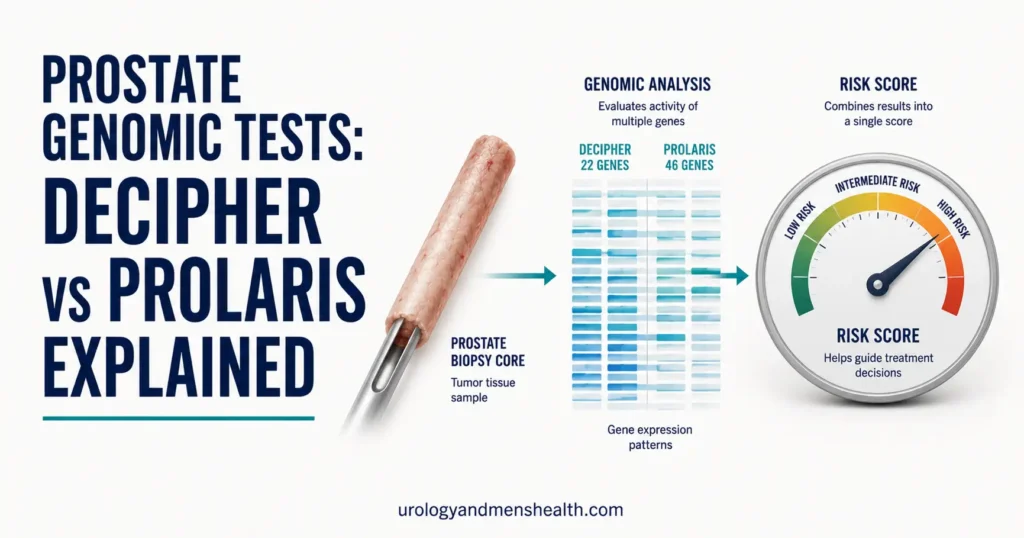
Prostate genomic tests like Decipher and Prolaris are now part of how I counsel men whose biopsy lands in a gray area — a Gleason 3+4=7 where the path forward genuinely isn’t obvious. Two men can have the same Gleason grade and the same PSA and still have cancers that behave completely differently. That’s the gap these tests try to close. They read the molecular activity of your own tumor tissue and turn it into a number that estimates how aggressive the cancer is likely to be over the next decade. They don’t replace your Gleason score or your PSA, and they aren’t for everyone. They sit alongside the standard numbers, and for a specific group of men sitting on the fence, the result is what finally tips the decision between active surveillance and treatment. For the wider picture on diagnosis and treatment, see our complete Prostate Health Hub. Here’s what each test actually measures, and when it earns its place.
Key Takeaways
- A prostate genomic test reads gene activity in your biopsy tissue and estimates how aggressive your specific tumor is — beyond what Gleason grade and PSA show on their own.
- Decipher is a 22-gene test that scores metastasis risk from 0 to 1 and carries the highest evidence rating among these tests in NCCN’s guidelines.
- Prolaris measures how fast tumor cells are dividing and combines that with your clinical risk to estimate 10-year progression and prostate-cancer mortality.
- These tests matter most when you are on the fence — usually favorable intermediate-risk disease — where the result can confidently push you toward surveillance or toward treatment.
What Prostate Genomic Tests Actually Measure (and What They Don’t)
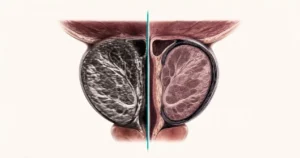
Your Gleason score and PSA tell me how your cancer looks under a microscope and how much protein it’s leaking into your blood. Useful, but both are indirect. A prostate genomic test goes a step deeper: it extracts the genetic material from the cancer cells in your biopsy and measures which genes are switched on and how loudly. Genes that drive cell division, invasion, and spread leave a fingerprint, and the test reads that fingerprint as a single risk number.
This is why the result can disagree with your grade. A cancer that looks like a quiet Gleason 3+4 under the microscope can still carry an aggressive molecular signature — and the reverse happens too. If you haven’t yet made sense of your grade, start with what your Gleason score really means for prognosis, then layer the genomic result on top. You can also estimate where your grade sits with the Gleason Score Risk Interpreter.
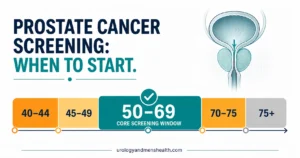
One thing these tests are not: a screening tool. They are run on tissue you already have after a positive biopsy, so they come into play after diagnosis — not in place of a PSA test or a decision about whether to screen at all. If you’re earlier in the process, the age-by-age screening guide is the right starting point. Both the AUA and NCCN are explicit that genomic testing is for selective use — ordered when the result is likely to actually change what you do next, not reflexively on every diagnosis [1][2].
Decipher: A Genomic Read on Your Metastasis Risk
Decipher is a 22-gene test that produces a score from 0 to 1, and the higher the number, the higher your estimated risk of the cancer spreading (metastasis) if treated with standard care. The result is usually banded into low (under 0.45), intermediate (0.45 to 0.60), and high (0.60 or above). What makes Decipher stand out clinically is the strength of its evidence: it holds the highest evidence rating among the gene-expression tests in current NCCN guidance, validated in both the post-biopsy and post-surgery settings [3].
In practice, I reach for Decipher most often in two situations. The first is a man with favorable intermediate-risk disease weighing active surveillance against treatment — a low score adds real reassurance, a high score is a reason to take treatment seriously. The second is after surgery, when the pathology comes back worse than expected and we’re deciding whether early radiation is worth it. A high Decipher score in that setting argues for acting sooner rather than waiting for the PSA to climb.
Prolaris: Measuring How Fast the Tumor Is Growing
Prolaris takes a different angle. Instead of estimating spread directly, it measures cell-cycle progression — essentially how fast your tumor cells are dividing — by reading the activity of 31 cell-cycle genes. A faster-dividing cancer is generally a more dangerous one. On its own this gives a CCP (cell-cycle progression) score, but the number that matters most combines it with your standard clinical risk into a CCR (combined cell-cycle risk) score, which estimates your 10-year risk of progression and of dying from prostate cancer [4].
The value of that combined score is that it adds information your clinical risk grouping doesn’t already contain. In validation work, the CCR score remained an independent predictor of prostate-cancer death even after accounting for standard clinical risk [6]. Translated into clinic terms: two men in the same risk box can separate clearly once you factor in how fast their tumors are actually proliferating, which is exactly the kind of tie-breaker that helps a surveillance-versus-treatment conversation move forward.
Facing a PSA result you do not fully understand? Download Dr. Khalid’s PSA & Prostate Cancer Decision Guide.
Enter your email below to receive Dr. Khalid’s complete PSA & Prostate Cancer Decision Guide as a free, printable PDF.
When a Genomic Test Actually Changes My Advice
The honest answer is that for a man with clear low-risk disease, a genomic test rarely changes anything — surveillance is already the right call, and a test that confirms it just adds cost. The same is true at the other extreme: high-grade, high-PSA cancer needs treatment regardless of what a genomic score says. The tests earn their keep in the messy middle, where the standard numbers leave the decision genuinely open.
That’s where the result can move a man off the fence in either direction. A low score can give someone the confidence to choose active surveillance instead of rushing to surgery — and that choice also keeps him away from the sexual recovery trade-offs that follow prostatectomy. A high score can be the nudge to treat now rather than watch. Studies of real-world use have shown these reports change the intended treatment plan in a large share of cases — one registry found a change in around two-thirds of men after the result came back [5].
In My Practice
I think of a 58-year-old who came to me set on having his prostate removed. His biopsy was a low-volume Gleason 3+4 with a PSA of 6 — textbook favorable intermediate-risk, exactly the borderline where I find genomic testing useful. He couldn’t sleep at the idea of “leaving cancer in.” His Decipher came back low, and seeing an actual number that matched what I’d been telling him did what my reassurance alone couldn’t. He chose surveillance, and three years on his disease is stable and his erections and continence are intact.
The test didn’t make the decision for him — it gave him permission to trust a decision he was already leaning toward but afraid to make.
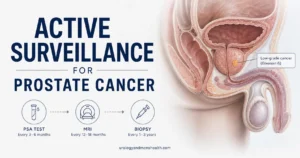
If you’re working through this choice yourself, the Active Surveillance Decision Aid walks through the same factors I weigh with patients — grade, PSA, MRI findings, and where a genomic result fits in.
What These Tests Cost — and Their Real Limits
Cost depends heavily on coverage. Medicare covers Decipher and Prolaris for appropriately selected men, and many commercial insurers do too — but coverage is tied to your risk category and whether the test will plausibly change management. If it’s ordered outside those criteria or denied, the out-of-pocket figure can run into the thousands, so it’s worth asking the lab about pre-authorization and patient-assistance programs before the sample is sent.
Before You Bank on the Result
A genomic score is a probability, not a verdict — treat it as one input, not the final word.
- It’s read from a small sample. The test runs on the biopsy tissue you have. If a higher-grade area of the gland was never sampled, the score can read falsely reassuring.
- It doesn’t override clear red flags. A rapidly rising PSA, a palpable nodule, or a suspicious MRI lesion still demands attention regardless of a “low” score.
- Low risk is not no risk. A reassuring score supports surveillance — it does not mean you can skip your follow-up PSA tests and repeat biopsies.
- It won’t tell you which treatment to pick. These tests estimate how aggressive the cancer is; they don’t choose surgery over radiation for you.
Frequently Asked Questions
What is a prostate genomic test, and how is it different from my Gleason score?
A prostate genomic test measures gene activity inside your biopsy cancer cells to estimate how aggressive the tumor is. Your Gleason score grades how the cells look under a microscope; the genomic test reads how they behave molecularly. The two can disagree, which is the whole point — the genomic result adds information your grade alone can’t show. See what your Gleason score means first.
Should every man with prostate cancer get a Decipher or Prolaris test?
No. Both the AUA and NCCN recommend genomic testing selectively — only when the result is likely to change your decision. For clearly low-risk or clearly high-risk cancer, the path is usually already obvious. The tests are most useful in favorable intermediate-risk disease, where surveillance and treatment are both reasonable and you need a tie-breaker.
Can a prostate genomic test let me stay on active surveillance instead of having surgery?
Sometimes, yes. A low Decipher or Prolaris score in an appropriately selected man adds confidence to choosing active surveillance over immediate treatment. It does not replace ongoing monitoring — you still need regular PSA checks and, in most protocols, periodic repeat biopsies or MRI to make sure nothing has changed.
Is Decipher or Prolaris better?
They measure different things, so “better” depends on the question. Decipher estimates metastasis risk directly and carries the highest evidence rating among these tests in NCCN guidance. Prolaris measures how fast the tumor is dividing and folds that into a combined 10-year risk score. Which one you get often depends on what your urologist or oncologist routinely uses and what your insurer covers.
Does insurance cover prostate genomic tests, and what do they cost?
Medicare covers Decipher and Prolaris for appropriately selected men, and many commercial plans follow similar criteria tied to your risk category. If the test is ordered outside those criteria or denied, out-of-pocket costs can reach the thousands. Ask the lab about pre-authorization and assistance programs first. For the broader diagnostic picture, see the Prostate Health Hub.
References
- Schaeffer EM, Srinivas S, Adra N, et al. NCCN Guidelines Insights: Prostate Cancer, Version 3.2024. J Natl Compr Canc Netw. 2024;22(3):130-150. JNCCN
- Eastham JA, Auffenberg GB, Barocas DA, et al. Clinically Localized Prostate Cancer: AUA/ASTRO Guideline, Part I. J Urol. 2022;208(1):10-18. AUA
- Decipher prostate test receives high (Level 1B) evidence rating in NCCN guidelines. Urology Times. 2024. Urology Times
- Analysis of the prognostic utility of the cell cycle progression (CCP) score from needle biopsy in men treated with definitive therapy. Prostate Cancer Prostatic Dis. 2019. Prostate Cancer Prostatic Dis
- Cell cycle progression score and treatment decisions in prostate cancer: results from an ongoing registry. 2014. PubMed
- Validation of the cell cycle progression (CCP/CCR) score in conservatively managed prostate cancer diagnosed through TURP biopsy. PubMed Central
Dr. Muhammad Khalid
MBBS · FCPS (Urology) · MCPS (General Surgery) · CHPE · CRSM · IMC #539472
Specialist urologist with 11+ years of clinical experience across tertiary teaching hospitals. Trained at Lady Reading Hospital and Khyber Teaching Hospital, Peshawar. Author or co-author of five peer-reviewed international publications, including in Cureus and the World Journal of Surgery. Procedural expertise: URS, PCNL, RIRS, TURP, TURBT, and major open urological surgery. Full profile →
This article is for educational purposes only and does not constitute medical advice. Always consult your physician or urologist for diagnosis and treatment decisions specific to your condition.