Sex After Prostate Surgery: How Long Until It’s Safe?
Most men are told to wait four to six weeks for sex after prostate surgery — but that number covers wound healing, not erections. Here are both timelines, and which one actually applies to you.

Almost every man asks about sex after prostate surgery, and almost every man gets the same vague answer: four to six weeks. That number is not wrong, but it answers a question you probably were not asking. Four to six weeks is how long the surgical site needs before orgasm is physically safe. It says nothing about whether your erections will come back, when, or how good they will be — which is what most men actually want to know. The confusion exists because “prostate surgery” describes two completely different operations with two completely different sexual outcomes. A TURP or HoLEP for an enlarged prostate leaves your erection nerves alone but almost always changes your ejaculation. A radical prostatectomy for cancer removes the gland entirely, and your erections then depend on whether the nerves running alongside it could be saved. I have watched men conflate the two and spend months dreading a problem their operation was never going to cause. For the wider picture, see our Prostate Health Hub.
Key Takeaways
- After TURP or HoLEP the wait is about four weeks — the prostatic fossa is a raw surface, and the pelvic floor contractions of orgasm can dislodge healing tissue and restart bleeding.
- After radical prostatectomy the wound heals in four to six weeks, but erectile recovery runs 12 to 24 months, with the deepest trough in the first three.
- Retrograde ejaculation follows most TURP and HoLEP procedures and is usually permanent — it does not affect erections or the sensation of orgasm.
- Dry orgasm after radical prostatectomy is permanent, because the prostate and seminal vesicles that made the fluid are gone. Orgasm itself still works without an erection.
- Daily tadalafil improves erections while you take it, but the REACTT trial found it did not improve unassisted erectile function once stopped — it is a treatment, not a repair.
Sex After Prostate Surgery: Why the Answer Depends on Which Operation You Had
Three separate structures control three separate parts of sex, and each operation affects them differently. Understanding which structure your surgeon touched tells you almost everything about what to expect.
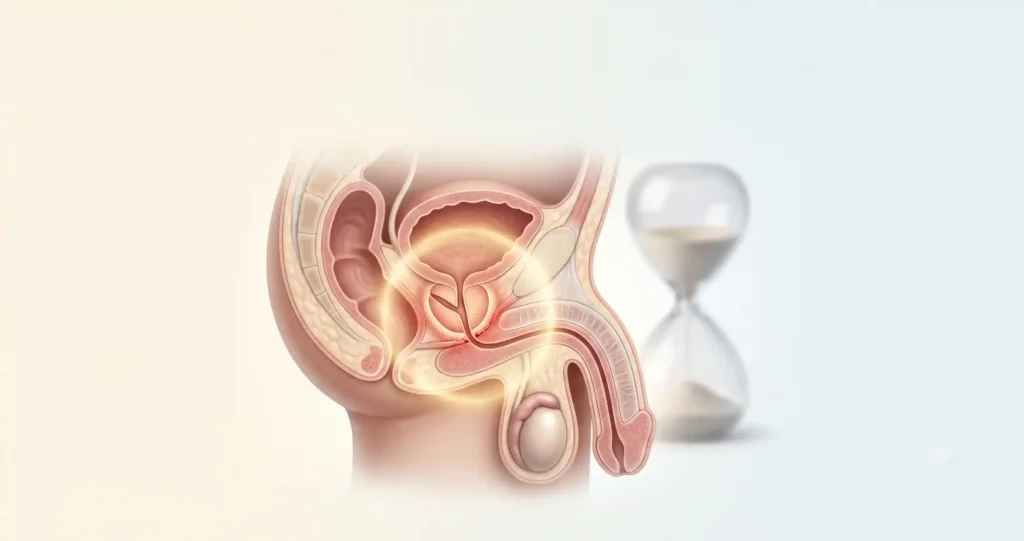
Erections depend on the cavernous nerves, which run in two bundles along the back and sides of the prostate — outside the prostate capsule. Think of them as two thin electrical cables taped to the outside of a box. Surgery that hollows out the inside of the box leaves the cables untouched. Surgery that removes the entire box has to peel the cables off it first.
Ejaculation forward depends on the bladder neck squeezing shut at the moment of orgasm, so semen takes the only remaining exit. TURP, HoLEP and similar procedures deliberately open that bladder neck to relieve obstruction. Once it is open, it cannot close on demand.
The semen itself is made almost entirely by the prostate and the seminal vesicles. Remove both, as a radical prostatectomy does, and there is no fluid left to ejaculate — regardless of nerves, regardless of erections.
So a man who has had a TURP should expect his erections to be roughly what they were, and his ejaculation to change. A man who has had a radical prostatectomy should expect a permanently dry orgasm, and an erection outcome that depends entirely on his nerves. These are not variations of one problem. They are different problems.
Sex After BPH Surgery: The Four-Week Rule and the Ejaculation Change
When you can resume
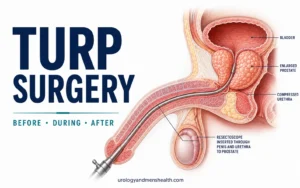
After a TURP or HoLEP, most surgeons ask for four weeks before any sexual activity, including masturbation. The reason is mechanical. Coring out prostate tissue leaves a cavity — the prostatic fossa — lined with raw, exposed surface that heals by growing a new lining over roughly six to eight weeks. During that window the surface is covered by a fragile crust. The forceful pelvic floor contractions of orgasm can strip it off, and the result is a toilet bowl full of blood at week two. It is frightening, it is usually self-limiting, and it is entirely avoidable. If you want the full recovery arc, I have written about what actually happens week by week after a TURP.
The gentler procedures move faster. UroLift places implants without removing tissue, and many men resume within one to two weeks. Rezum needs the catheter out first and the irritative symptoms to settle, which usually means two to four weeks. Aquablation and HoLEP sit closer to the TURP timeline. Whatever the general rule says, your own surgeon knows what your prostate looked like at the end of the case — follow their instruction over anything you read, here or elsewhere.
What changes, and what does not
Here is the part men are rarely told clearly. Your erections should be unchanged. Pooled comparisons of TURP, HoLEP and Rezum find no meaningful difference in IIEF erectile function scores between procedures or against baseline [1]. New-onset erectile dysfunction after these operations is uncommon, and when it appears it is usually explained by age, diabetes or vascular disease rather than the surgery itself.
Your ejaculation almost certainly will change. Retrograde ejaculation — semen travelling backwards into the bladder — is reported in 70% to over 95% of men after TURP and standard HoLEP, because both open the bladder neck by design [1]. Rezum and UroLift largely preserve forward ejaculation, and Aquablation preserves it in most men. This single difference is why the AUA 2026 BPH guideline treats ejaculatory preservation as a distinct decision axis rather than a footnote, and it is worth raising before you choose between HoLEP and TURP.
What retrograde ejaculation feels like in practice: the orgasm sensation is intact, little or no fluid appears, and the next urine looks cloudy. Nothing accumulates, nothing is damaged, and it causes no symptoms. It does end natural conception, which matters if you are under 55 or have not completed your family — say so before surgery, not after.
Why dry ejaculation happens after surgery — and whether anything reverses itRebuilding Erections After Prostate Surgery: The Step-by-Step Action Plan
Enter your email below to receive Dr. Khalid’s complete ED & Sexual Function Action Plan as a free, printable PDF.
Sex After Radical Prostatectomy: The Real Erection Recovery Curve
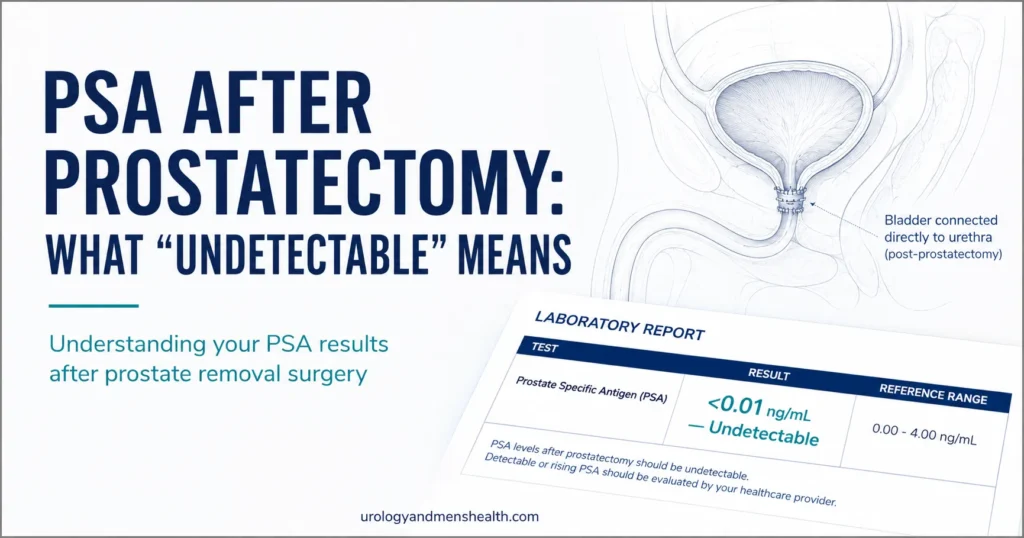
The catheter comes out somewhere between day 7 and day 14. The join between bladder and urethra needs longer, so most surgeons ask for four to six weeks before attempting intercourse. That is the wound timeline, and it is the one you were probably quoted. The erection timeline is a different order of magnitude.
Even when both nerve bundles are preserved, the nerves are stretched, retracted and handled during dissection. The result is neuropraxia — a functioning nerve temporarily unable to conduct. Nerves regenerate at roughly a millimetre a day under good conditions, and the recovery is not linear. Function is at its worst around three months, begins climbing between six and twelve months, and plateaus somewhere between 18 and 24 months. Meaningful spontaneous improvement after two years is uncommon. The broader recovery timeline after radical prostatectomy covers continence and activity alongside this.
Four things predict where you land on that curve: age under 60, how good your erections were before surgery, whether nerve-sparing was bilateral, unilateral or not possible, and the volume of the surgeon performing the case. If neither bundle could be spared because of tumor extent, spontaneous erections will not return, and tablets will not work either — PDE5 inhibitors amplify a nerve signal, so they need a nerve to amplify. That is a hard sentence to read, but knowing it at month three is far better than discovering it at month eighteen.
What is permanent, regardless of nerves
Orgasm becomes dry, permanently. The fluid-producing organs are gone. Orgasm itself is a spinal and brain event, so it still happens — many men reach orgasm with a completely soft penis in the first year. Intensity often feels reduced at first and typically recovers.
Some men leak urine at climax. This is climacturia, and it is far more common than the consent conversation suggests: a systematic review of 5,208 men across 13 studies found a pooled prevalence of 27.2% [4]. It usually improves with the same pelvic floor training used for daytime continence. Emptying the bladder immediately before sex and using a condom are the two practical fixes worth trying in week one rather than month six.
Track recovery with numbers rather than impressions. Record an IIEF-5 erectile function score at three, six, twelve and twenty-four months. Memory after cancer surgery is mood-dependent and unreliable; a scored sequence is not.
In My Practice
The pattern I see most is not a surgical failure — it is a month-three surrender. A man attempts twice at around twelve weeks, gets nothing, quietly concludes the surgery took it from him permanently, and does not try again or raise it until his one-year review. By then he has spent nine months out of the exact window in which nerve recovery, drug response and confidence were all still moving. His two-year outcome is consistently worse than the man beside him with identical pathology and an identical operation who kept attempting through the trough.
Erectile recovery after prostatectomy is measured in months, and the men who score it and keep attempting do better than the men who wait to be pleasantly surprised.
Penile Rehabilitation: What the REACTT Trial Actually Showed
The theory behind penile rehabilitation is sound and easy to follow. Without nerve signals, nocturnal erections stop. Without regular erections, the erectile tissue sits in a low-oxygen state. Chronic low oxygen drives smooth muscle loss and collagen deposition — fibrosis — and fibrotic tissue cannot trap blood properly. So, the argument goes, keep the tissue oxygenated with daily tadalafil, a vacuum device or injections, and you preserve the hardware while the nerves regrow.
The trial built to test that argument did not support it. REACTT randomized men after bilateral nerve-sparing prostatectomy to tadalafil 5 mg once daily, tadalafil 20 mg on demand, or placebo for nine months, then imposed a six-week drug-free washout before measuring unassisted erectile function [2]. Once the drug was out of the system, once-daily tadalafil did not produce better unassisted erections than placebo. It did improve erections during the treatment period, and it was associated with less penile length loss — both real benefits — but the central rehabilitation claim did not hold.
Neither the AUA erectile dysfunction guideline nor the EAU sexual health guidance endorses any rehabilitation protocol as proven to improve long-term unassisted function [3][5]. I still start most men on a PDE5 inhibitor early after surgery. I am simply honest about why: it lets them have sex during the two years they would otherwise spend waiting, and being sexually active through the trough protects the relationship and the confidence. Those are good reasons. Repairing the nerve is not one of them.
What to Do If Erections Have Not Returned by Month Six
Month six is the point at which passive waiting stops being reasonable. Work up the ladder deliberately, and do not skip a rung because it sounds unappealing before you have tried it.
- Optimize the tablet first. Ask for a full dose — sildenafil 100 mg or tadalafil 20 mg — and make at least eight properly conducted attempts before declaring failure. Sildenafil needs an empty stomach; both need genuine sexual stimulation. Under-dosing and under-trialling account for most apparent PDE5 failures [3].
- Vacuum erection device. Works by mechanics, not nerves, so nerve status is irrelevant. Expect to need three or four practice sessions before it produces a usable erection with the constriction ring in place. Two or three sessions a week is a reasonable target.
- Intracavernosal injection. Alprostadil alone or a Trimix combination produces an erection without any nerve input, and it succeeds in the majority of men in whom tablets have failed. The first dose must be titrated in clinic, never self-started at home, because of priapism risk.
- Intraurethral alprostadil. Less effective than injection but tolerated by men who will not inject. Worth one honest trial rather than a permanent stall.
- Penile implant. The definitive answer, with the highest satisfaction rates of any erectile dysfunction treatment. Reasonable to discuss from around 24 months, once the recovery curve has flattened.
If the problem is desire rather than rigidity, ask for a morning total testosterone level. Replacement after prostate cancer is a specialist conversation requiring an undetectable PSA and oncology input — but low testosterone is a treatable cause of post-surgical sexual withdrawal that gets missed because everyone assumes the problem is mechanical. The full treatment protocol I use for erectile dysfunction covers each rung in more detail.
Work through the step-up pathway and see which rung you should be onRed Flags After Resuming Sex
Most post-surgical sexual problems are inconvenient rather than dangerous. These five are not — contact your urology team or attend the emergency room the same day.
- Heavy visible blood or clots in the urine after orgasm in the first six weeks following TURP or HoLEP, particularly if you cannot pass urine.
- An erection lasting more than four hours after injection therapy. This is priapism and needs emergency treatment within hours to prevent permanent damage.
- Chest pain, severe breathlessness or collapse during sex. Never combine a PDE5 inhibitor with any nitrate medication.
- A new palpable lump or curvature developing in the shaft, which can follow prolonged loss of erections and needs assessment before it stabilises.
- Orgasm that remains genuinely painful beyond three months rather than simply different.
Frequently Asked Questions
How soon can I have sex after prostate surgery for an enlarged prostate?
After a TURP or HoLEP, most surgeons ask for about four weeks. The prostatic fossa left behind is a raw surface that grows a new lining over six to eight weeks, and the pelvic floor contractions of orgasm can dislodge the healing crust and restart bleeding — the same reason heavy lifting is restricted after a TURP. UroLift and Rezum are gentler and often allow resumption within one to two weeks.
Why do I have no semen when I orgasm after prostate surgery?
That is retrograde ejaculation. TURP and HoLEP open the bladder neck, so at orgasm semen takes the path of least resistance backwards into the bladder rather than forwards. It follows most of these procedures and is usually permanent. The sensation of orgasm is unchanged and nothing accumulates. Whether dry ejaculation can ever be reversed depends on the cause.
Can I have an orgasm after radical prostatectomy if I cannot get an erection?
Yes. Orgasm is a spinal and cerebral event that requires neither an erection nor a prostate, and many men climax with a completely soft penis during the first year. What is permanently gone is the fluid, because the prostate and seminal vesicles that produced it were removed. Intensity often feels reduced early and usually recovers over the first year after surgery.
Is it too late to recover erections two years after prostate surgery?
Meaningful spontaneous recovery beyond 24 months is uncommon, so the question shifts from waiting to treating. That is not the same as nothing working. Vacuum devices, intracavernosal injections and penile implants all function independently of nerve recovery, and implant satisfaction rates are the highest of any erectile dysfunction treatment. Book a dedicated appointment rather than raising it at a PSA review.
How do I know whether my erections are actually improving after prostate surgery?
Score it rather than trusting memory, which is mood-dependent and unreliable after cancer surgery. Record an IIEF-5 score at three, six, twelve and twenty-four months and compare the numbers directly. A rise of four points or more represents a real change rather than one good night. Bring the sequence to your follow-up appointment.
References
- Goueli R, Badlani GH, Welliver C, et al. Management of Lower Urinary Tract Symptoms Attributed to Benign Prostatic Hyperplasia: AUA Guideline (2026) Part III: Procedural/Surgical Management. J Urol. 2026;216(2):161-170. Journal of Urology
- Montorsi F, Brock G, Stolzenburg JU, et al. Effects of tadalafil treatment on erectile function recovery following bilateral nerve-sparing radical prostatectomy: a randomised placebo-controlled study (REACTT). Eur Urol. 2014;65(3):587-596. PubMed
- Burnett AL, Nehra A, Breau RH, et al. Erectile Dysfunction: AUA Guideline. J Urol. 2018;200(3):633-641. American Urological Association
- Ferrao JV, Becker AS, Konopka G, et al. The Prevalence of Climacturia in Patients after Radical Prostatectomy: A Systematic Review. Int Braz J Urol. 2025;51(1). PubMed
- European Association of Urology. Guidelines on Sexual and Reproductive Health. EAU; 2025. Uroweb
Dr. Muhammad Khalid
MBBS · FCPS (Urology) · MCPS (General Surgery) · CHPE · CRSM · IMC #539472
Specialist urologist with 11+ years of clinical experience across tertiary teaching hospitals. Trained at Lady Reading Hospital and Khyber Teaching Hospital, Peshawar. Author or co-author of five peer-reviewed international publications, including in Cureus and the World Journal of Surgery. Procedural expertise: URS, PCNL, RIRS, TURP, TURBT, and major open urological surgery. Full profile →
This article is for educational purposes only and does not constitute medical advice. Always consult your physician or urologist for diagnosis and treatment decisions specific to your condition.