Radical Prostatectomy Recovery: A Urologist’s Timeline
After a radical prostatectomy, recovery is really three separate timelines — the catheter, urinary continence, and erections. Here's the honest version I give my patients, not the brochure version.


Radical prostatectomy recovery is rarely the story men expect. The operation to remove the prostate for cancer is often over in a few hours, but the recovery that follows runs on three separate clocks — the catheter, your urinary control, and your erections — and they do not move at the same speed. Most men I see in clinic have been told the surgery “went well” and assume that means they will feel normal in a week or two. The honest picture is more layered, and knowing the real timeline up front removes most of the fear. This is what I tell my own patients before they go home. For the wider picture of prostate cancer testing and treatment, see our full Prostate Health Hub.
Key Takeaways
- Most catheters come out 7 to 14 days after a radical prostatectomy, once the bladder-to-urethra join has sealed.
- Urinary leakage is normal at first and improves to near baseline for most men by 12 months, per AUA guidance.
- Erections recover on the slowest clock — typically 12 to 24 months, and only when at least one nerve bundle was spared.
- Daily pelvic floor (Kegel) training is the single most useful thing you can do yourself to speed up urinary control.
What a Radical Prostatectomy Removes — and Why Recovery Takes Time
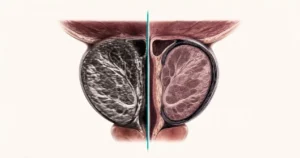
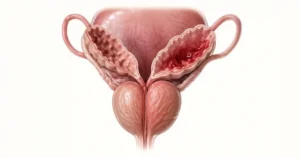
A radical prostatectomy removes the entire prostate gland and the seminal vesicles. Because the prostate sits like a doughnut around the top of the urethra, taking it out leaves a gap between the bladder and the urethra. The surgeon closes that gap by stitching the bladder directly onto the urethra — a join called the vesicourethral anastomosis. The catheter you go home with is not there to drain urine for comfort; it holds that fresh join still while it heals.
Two structures sit right next to the prostate and matter enormously for recovery: the external urethral sphincter, the muscle that will now do most of the work of holding urine, and the paired neurovascular bundles, the nerves that drive erections. When the cancer allows, the surgeon spares these nerves. When the cancer is too close, control of the disease has to come first — and that decision shapes your erectile recovery more than anything else.
Men often ask whether robotic surgery recovers faster than open surgery. Robotic prostatectomy usually means less blood loss and a slightly shorter hospital stay, but the AUA is clear that open and robotic approaches give similar long-term continence and sexual recovery outcomes [1]. The skill and volume of your surgeon matter more than the equipment in the room.
The Radical Prostatectomy Recovery Timeline, Week by Week
Here is the realistic prostate surgery recovery timeline I walk patients through. Treat the dates as a guide, not a contract — bodies heal at different rates.
- Weeks 1-2 — the catheter phase. You go home with a catheter. Expect fatigue, some bladder spasms, and blood-tinged urine that clears over days. No lifting heavier than about 5 kg (10 lb), no driving while the catheter is in. The catheter usually comes out at 7 to 14 days.
- Weeks 2-6 — early activity. Once the catheter is out, leakage is at its heaviest and pads are normal. Gentle walking is encouraged; heavy lifting and core strain still off-limits. Most men doing desk work return at 3 to 4 weeks.
- Around 6-12 weeks — first PSA. Your first blood test should show the PSA falling to undetectable, confirming the cancer was removed. This is the moment surveillance begins.
- 3-12 months — continence settles. Urinary control improves steadily; most men reach near their old baseline by 12 months [2].
- 12-24 months — erections. If nerves were spared, erectile function keeps recovering across the second year, sometimes beyond [4].
That first undetectable PSA is the beginning of long-term monitoring, not the end of it. Understanding how often to test and what a small rise means is its own subject — I cover it in detail in our guide to PSA follow-up after prostatectomy.
Track your post-surgery PSA readings over time → PSA Velocity Tracker
Red Flags: Call Your Surgeon Now
Most recovery is uneventful, but a few symptoms in the first weeks need urgent assessment. Contact your surgical team or go to the emergency room if you develop:
- A fever above 38°C (100.4°F), or wound redness, swelling, or discharge.
- Calf pain, swelling, or tenderness in one leg, or sudden breathlessness — possible blood clot.
- The catheter stops draining, leaks heavily around it, or blocks with clots.
- Heavy fresh bleeding, or severe and worsening abdominal pain.
Preparing for urological surgery? Download Dr. Khalid’s Urology Surgery Recovery Guide.
Enter your email below to receive Dr. Khalid’s complete Urology Surgery Recovery Guide as a free, printable PDF.
Regaining Urinary Control After Surgery
Incontinence after prostate surgery has a mechanical cause, not a willpower one. The prostate normally shares the job of holding urine with the external sphincter. Remove the prostate, and that whole task lands on the external urethral sphincter alone. Until that muscle adapts and strengthens, urine leaks with coughing, lifting, or standing up — what we call stress incontinence.
The pattern is reassuringly predictable. Leakage is worst the day the catheter comes out, then improves week by week. Most men reach social continence — one or fewer pads per day — within a few months, and near their pre-surgery baseline by 12 months [2]. A meaningful minority leak longer, and a small number need a procedure such as a sling or an artificial urinary sphincter if leakage persists past a year [3].
The most effective thing you can do yourself is pelvic floor muscle training. The AUA supports offering pelvic floor exercises around the time of surgery, and starting before the operation gives you a head start on technique [2]. Done correctly and daily, these exercises retrain the sphincter you now depend on. Done wrong — bearing down instead of lifting — they do nothing, which is why learning the technique properly is worth the effort.
Learn the correct technique → Kegel Exercises for Men
In My Practice
The question I get most often, usually around three weeks after surgery, isn’t about cancer at all — it’s a man quietly asking whether the leaking means something went wrong. He has often stopped going out, embarrassed by pads, convinced he is the exception. When I show him that his pad use is already dropping week on week, exactly on schedule, the relief is visible.
Leakage after a prostatectomy is a healing curve, not a verdict — and for the large majority of men, that curve keeps bending the right way through the first year.
Getting Your Erections Back: Nerve Recovery and Penile Rehab
Erectile function after prostatectomy recovers on the slowest clock, and understanding why prevents a lot of needless despair. Even when both nerve bundles are perfectly preserved, the act of dissecting around them bruises and stretches them — a temporary injury called neuropraxia. Bruised nerves do not fire normally, so in the first weeks almost every man has erectile dysfunction regardless of how well the surgery went. The nerves then slowly recover over months, which is why patience is part of the treatment.
Realistic numbers help. With nerve-sparing surgery, reported potency rates vary widely — roughly 40% to 86% — and useful recovery typically takes 12 to 24 months, occasionally longer [4]. The strongest predictors are whether at least one nerve bundle was spared, your age, and how firm your erections were before surgery. Nerve preservation is consistently linked to a lower risk of long-term erectile dysfunction [1].
This is where penile rehabilitation comes in — using PDE5-inhibitor tablets, and often a vacuum erection device, to bring blood into the penis regularly while the nerves recover. The goal is to keep the erectile tissue healthy and prevent the scarring that follows long periods without erections. Tracking your progress objectively with the IIEF-5 erectile function self-assessment gives you and your urologist a real measure rather than a guess. Expect to discuss climacturia (leaking a little urine at orgasm) and a “dry” orgasm too — both common and manageable, and worth raising early rather than suffering in silence.
If erections have not returned with tablets by the end of the first year, that is not the end of the road. Our guide to sex and intimacy after prostate surgery covers the month-by-month picture, and there is a clear step-up pathway of treatments beyond pills.
When tablets aren’t enough → The Full ED Treatment Pathway
Frequently Asked Questions
How long does radical prostatectomy recovery take overall?
Radical prostatectomy recovery runs on three clocks. You will feel physically recovered from the operation itself within about 4 to 6 weeks, but urinary control keeps improving for up to 12 months and erections for up to 24 months. Most men return to desk work by 3 to 4 weeks. See our Prostate Health Hub for the wider picture.
When will I stop leaking urine after prostate surgery?
Leakage is heaviest right after the catheter comes out and improves steadily as the external sphincter takes over the job the prostate used to share. Most men reach social continence — one or fewer pads a day — within months, and near their old baseline by 12 months. Daily pelvic floor (Kegel) training speeds this up.
Will I be able to have erections again after a radical prostatectomy?
It depends mainly on whether at least one nerve bundle was spared and how firm your erections were before surgery. With nerve-sparing, recovery typically takes 12 to 24 months and often needs help from tablets or a vacuum device. Our guide on sex after prostate surgery covers what to expect month by month.
When does the catheter come out after prostate removal?
Most surgeons remove the catheter 7 to 14 days after surgery, once the join between the bladder and urethra has sealed. Some confirm healing with a quick X-ray dye test first. After removal, expect leakage at first — that is normal, not a sign the surgery failed. Your first PSA check after prostatectomy usually follows at 6 to 12 weeks.
Is robotic prostatectomy recovery faster than open surgery?
Robotic surgery usually means less blood loss and a slightly shorter hospital stay, but AUA guidance is clear that open and robotic approaches give similar long-term continence and erectile outcomes. The surgeon’s experience matters more than the machine. Tracking your erections with the IIEF-5 self-assessment helps you and your surgeon measure real progress.
References
- American Urological Association / ASTRO. Clinically Localized Prostate Cancer: AUA/ASTRO Guideline. 2022. AUA
- American Urological Association / GURS / SUFU. Incontinence after Prostate Treatment: AUA/GURS/SUFU Guideline. 2019 (Amended 2024). AUA
- European Association of Urology. EAU Guidelines on Prostate Cancer: Quality of Life Outcomes. 2024. EAU
- Erectile dysfunction after radical prostatectomy and penile rehabilitation: clinical review. 2017. PubMed Central
Dr. Muhammad Khalid
MBBS · FCPS (Urology) · MCPS (General Surgery) · CHPE · CRSM · IMC #539472
Specialist urologist with 11+ years of clinical experience across tertiary teaching hospitals. Trained at Lady Reading Hospital and Khyber Teaching Hospital, Peshawar. Author or co-author of five peer-reviewed international publications, including in Cureus and the World Journal of Surgery. Procedural expertise: URS, PCNL, RIRS, TURP, TURBT, and major open urological surgery. Full profile →
This article is for educational purposes only and does not constitute medical advice. Always consult your physician or urologist for diagnosis and treatment decisions specific to your condition.