Blood in Semen After Prostate Biopsy: How Long It Lasts
Over nine in ten men get blood in semen after a prostate biopsy, and almost nobody is warned it can look like rust for a month. Here is what is normal, what is not, and the one pattern that needs a call.

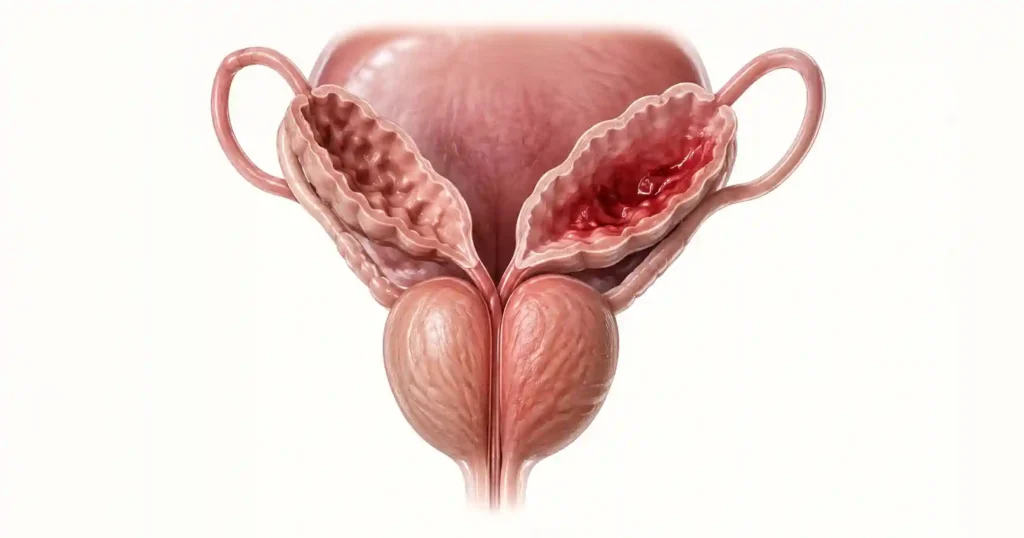
Blood in semen after a prostate biopsy is the side effect men are least warned about and most alarmed by. In the ProBE study, a prospective evaluation of 1,147 men biopsied within the UK ProtecT trial, 92.6% of men who ejaculated in the 35 days after biopsy saw blood, and just over a quarter rated it a moderate or major problem [1]. That is not an uncommon complication. It is the default outcome. What makes it frightening is almost always that nobody said it was coming. My aim on this page is to give you a clean line between the version of this that needs nothing at all and the version that needs a phone call, because those two things look different and the difference is not how red it is. If you are earlier in the process and still deciding about testing, the wider picture sits in our Prostate Health Hub.
Key Takeaways
- Over 90% of men see blood in semen after a prostate biopsy — 92.6% in the ProBE study — which makes it the rule, not a complication.
- Clearance tracks ejaculations rather than calendar days: roughly six ejaculations on average, spread over about four weeks.
- Rust, coffee or near-black semen weeks after the biopsy is old blood draining out of the seminal vesicles, not fresh bleeding.
- Blood still appearing beyond three months, or returning after semen had fully cleared, is no longer a biopsy effect and needs its own assessment.
How Common Is Blood in Semen After a Prostate Biopsy?
Common enough that I now tell men to expect it rather than to watch for it. The ProBE numbers are the cleanest we have because the men were asked systematically rather than left to report problems on their own: blood in semen 92.6%, blood in urine 65.8%, rectal bleeding 36.8%, pain 43.6%, fever 17.5% [1]. Blood in semen was both the most frequent finding and the one men were most likely to call a moderate or major problem, at 26.6%. Bleeding tops the list; distress follows it.
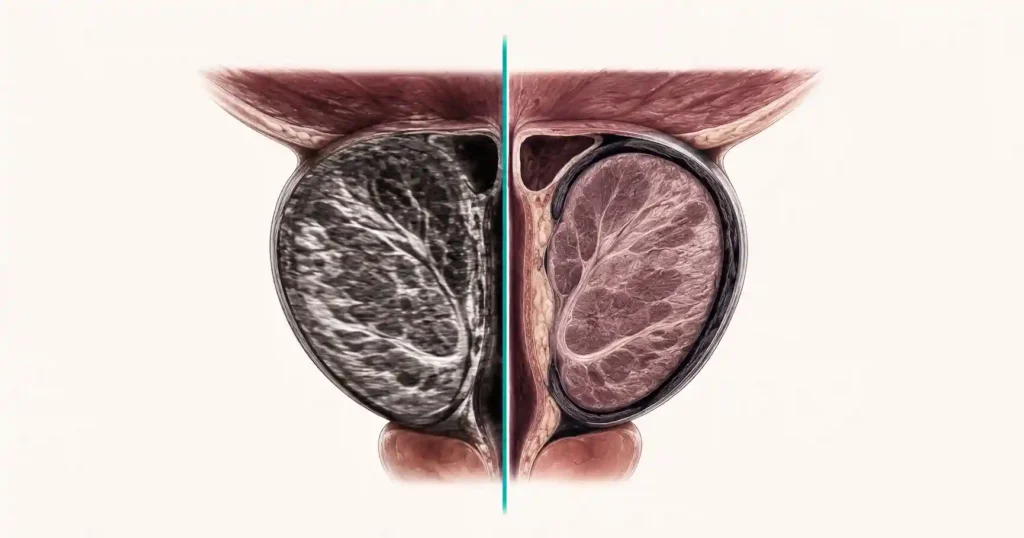
The reason is anatomical rather than technical. A standard biopsy takes 10 to 12 cores through the peripheral zone of the prostate, which sits directly beneath the paired seminal vesicles and is crossed by the ejaculatory ducts. Each needle pass opens small vessels inside a structure whose entire job is to store and deliver fluid at ejaculation. Blood that enters that space has exactly one exit route, and it is the one you are worried about.
Men often ask whether the transperineal approach, where the needle goes through the skin between the scrotum and the anus rather than through the rectal wall, avoids it. It does not. A 2024 meta-analysis of the three randomized trials comparing MRI-targeted transperineal and transrectal biopsy found comparable cancer detection and comparable complication rates overall, with the transperineal route’s real advantage being that it can be performed safely without antibiotics [4]. The needle still crosses prostate tissue either way. What differs is the infection profile, not the bleeding.
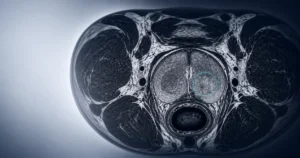
Where the number of cores does move is with imaging. If your prostate was mapped first and only suspicious areas were sampled, fewer needle passes were taken — which is one of several reasons an MRI-first pathway has become standard practice, covered in detail in why an MRI before biopsy changes what gets sampled. What that page will not tell you is how the recovery feels, which is what a step-by-step account of the biopsy itself covers.
In My Practice
The call I get most often lands around day ten, and it is nearly always the same story. The man abstained after his biopsy because he assumed that was the careful thing to do, then ejaculated for the first time and saw something that looked like the procedure had gone badly wrong. It had not. He had stored ten days of blood in his seminal vesicles and released the whole lot at once.
Abstaining does not prevent bleeding after a biopsy — it concentrates it, and guarantees the first ejaculation is the most alarming one you will have.
How Long It Lasts: Count Ejaculations, Not Days
Published durations look wildly inconsistent until you notice what is actually being measured. One prospective series of men undergoing transrectal biopsy reported a mean duration of four weeks, plus or minus 1.4 weeks — but the more useful figure in the same study was that men needed a mean of six ejaculations before semen looked normal again [2]. A separate randomized study in men having 12-core biopsy reported a median of only 8 to 10 days [3].
Both are right. The blood does not break down and disappear on a schedule; it has to be flushed out, and the only pump is ejaculation. A man who ejaculates twice a week is clear in three weeks. A man who ejaculates twice a month is still seeing traces at ten weeks and reasonably concludes something is wrong. Nothing is wrong. He has simply run six ejaculations more slowly.
That reframing matters practically. If you want this over with sooner, ejaculating regularly once any post-biopsy soreness has settled is the thing that shortens it. If you would rather not think about it, that is fine too — it just takes longer in calendar terms, and you should not read that extra time as deterioration.
Most men are still seeing blood when the pathology report arrives, which is its own kind of bad timing. If your report comes back positive, the number that determines almost everything next is the Gleason grade — our Gleason score risk interpreter converts the pathology language into a risk group before your follow-up appointment, which is generally the point at which anxiety peaks and clear explanation is hardest to find.
What to track after a prostate biopsy: PSA timing, repeat-biopsy triggers, and the results that actually need action
Enter your email below to receive Dr. Khalid’s complete PSA & Prostate Cancer Decision Guide as a free, printable PDF.
What the Color Tells You — and What It Does Not
Men read red as active and brown as sinister. It is the other way round. Fresh blood is red for the first ejaculation or two. After that, hemoglobin sitting in the seminal vesicles oxidizes, and the color moves through rust to coffee to something close to black. Brown is the reassuring color. It means what you are seeing is a residue of the biopsy rather than new bleeding, and it is the normal end of the sequence, not a new problem.
| What you see | When it usually appears | What it means |
|---|---|---|
| Bright red streaking | First 1-2 ejaculations | Fresh blood from the needle tracks. Expected. |
| Rust, coffee or near-black | Weeks 1-6 | Old blood draining from the seminal vesicles. Expected. |
| Soft dark clots in the ejaculate | Weeks 1-4 | Clotted old blood. Worth mentioning at follow-up, not urgent on its own. |
| Blood returning after semen had fully cleared | After month 3 | No longer a biopsy effect. Needs its own assessment. |
The pattern in that last row is the one worth memorising, because it is the only one that changes the plan. Bleeding that tails off and stops, then restarts weeks later with nothing in between, is not the biopsy finishing. It is a new event, and it should be worked up as hematospermia in its own right rather than dismissed as a hangover from the procedure.
That assessment is usually more reassuring than men expect. In a 15-year review of 342 men presenting with blood in semen from a base of over 161,000 urology patients, inflammation or infection accounted for 49.4% of cases and a genitourinary cancer was found in only 3.2% [5]. The workup exists to catch that small group, not because blood in semen is a cancer signal.
When to Call Your Urologist
Blood in the semen alone is not urgent. These are, and they are all about infection or obstruction rather than bleeding:
- Fever of 38C (100.4F) or above, shaking chills, or feeling systemically unwell in the first week — go to the emergency room the same day, do not wait for an office appointment. Post-biopsy sepsis moves fast.
- You cannot pass urine at all, or you are passing clots and straining — emergency room the same day.
- Burning on urination with cloudy urine after day three — call the office and ask specifically for a urine culture, not just an empirical antibiotic.
- Heavy fresh rectal bleeding that does not stop within a few minutes — call the office the same day.
- Blood still appearing in semen beyond three months, or returning after it had cleared — book a review and ask for a urinalysis with culture, a PSA drawn at the appropriate interval, and a discussion of whether pelvic MRI is warranted.
Sex, Your Partner, and the PSA Test That Comes Next
You can resume sex as soon as the soreness has settled and you want to, which for most men is within a week. There is no infection risk to a partner and no reason to wait for the bleeding to stop first — waiting only prolongs it. The single most useful thing you can do is tell your partner in advance what the ejaculate is going to look like. A conversation before it happens is far easier than the one afterwards.
Erections are a separate question and worth flagging. Some men notice softer erections for a few weeks after biopsy. This is nearly always the nerve tissue around the prostate reacting to needle trauma and inflammation, and it settles. If it has not settled by three months, that is a conversation to have rather than something to sit on.
The one piece of practical timing that trips people up is the follow-up PSA. A biopsy inflames the prostate and can push PSA up for weeks, so a test drawn too soon reads high for reasons that have nothing to do with cancer. I generally do not draw a comparison PSA until at least six weeks after the biopsy. If your biopsy was negative and the question is whether to repeat it, the AUA/SUO 2026 Early Detection guideline frames that decision around MRI findings, PSA density and biomarker testing rather than a single repeated PSA value [6] — so the useful thing to ask at follow-up is which of those your urologist plans to use, and when.
Frequently Asked Questions
How long does blood in semen after a prostate biopsy usually last?
Most men are clear within four to six weeks. The more useful measure is ejaculations rather than days: in a prospective series of men biopsied for suspected prostate cancer, the average was six ejaculations before semen looked normal again, over a mean of four weeks. If you ejaculate rarely, old blood sits in the seminal vesicles longer and can still show up at eight or ten weeks.
Does blood in semen after a prostate biopsy mean the biopsy found cancer?
No. Bleeding reflects where the needle went, not what it found. Ten to twelve cores pass through prostate tissue that is richly supplied with blood and sits directly against the seminal vesicles, so bleeding happens whether the cores come back benign or malignant. Men with completely negative biopsies bleed at the same rate as men later diagnosed with cancer.
Is it safe to have sex while there is still blood in my semen after the biopsy?
Yes, once any pain or fever has settled and you feel ready, which is usually within a week. The blood is not infectious and carries no risk to a partner. Ejaculating actually clears it faster, since that is the only route the old blood has out. The one thing worth doing is warning your partner in advance so the color does not frighten either of you.
Why is my semen brown or rust-colored instead of red after my prostate biopsy?
Brown means the blood is old, not that something new is wrong. Fresh blood is red for the first ejaculation or two; after that, hemoglobin pooled in the seminal vesicles oxidizes and turns rust, coffee, or near-black. Brown semen weeks after a biopsy is the expected end of the process, and it usually fades to normal over the following few ejaculations.
Should blood in my semen change how my PSA is followed after the biopsy?
No, but the timing of the PSA test does matter. A biopsy inflames the prostate and can raise PSA for several weeks, so a test drawn too early reads high for reasons unrelated to cancer. I generally wait at least six weeks after biopsy before drawing a comparison PSA, then read the number against your age-adjusted range using our PSA interpreter.
References
- Rosario DJ, Lane JA, Metcalfe C, et al. Short term outcomes of prostate biopsy in men tested for cancer by prostate specific antigen: prospective evaluation within ProtecT study. BMJ. 2012;344:d7894. PubMed
- Abdelkhalek M, Abdelshafy M, Elhelaly H, Kamal M. Hemospermia after transrectal ultrasound-guided prostatic biopsy: a prospective study. Urol Ann. 2013;5(1):30-33. PubMed
- Park BH, Kim JI, Bae SR, et al. The effect of ultrasound-guided compression immediately after transrectal ultrasound-guided prostate biopsy on postbiopsy bleeding: a randomized controlled pilot study. Int Urol Nephrol. 2017;49(8):1319-1325. PubMed
- Zattoni F, Rajwa P, Miszczyk M, et al. Transperineal versus transrectal magnetic resonance imaging-targeted prostate biopsy: a systematic review and meta-analysis of prospective studies. Eur Urol Oncol. 2024;7(6):1303-1312. PubMed
- Efesoy O, Cayan S, Asci R, Orhan I, Yaman O. Hematospermia is rarely related to genitourinary cancer: lessons learned from 15 years of experience with 342 cases. Int J Impot Res. 2021;33(6):627-633. PubMed
- American Urological Association / Society of Urologic Oncology. Early Detection of Prostate Cancer: AUA/SUO Guideline. 2026 amendment. AUA
Dr. Muhammad Khalid
MBBS · FCPS (Urology) · MCPS (General Surgery) · CHPE · CRSM · IMC #539472
Specialist urologist with 11+ years of clinical experience across tertiary teaching hospitals. Trained at Lady Reading Hospital and Khyber Teaching Hospital, Peshawar. Author or co-author of five peer-reviewed international publications, including in Cureus and the World Journal of Surgery. Procedural expertise: URS, PCNL, RIRS, TURP, TURBT, and major open urological surgery. Full profile →
This article is for educational purposes only and does not constitute medical advice. Always consult your physician or urologist for diagnosis and treatment decisions specific to your condition.