Flying With Kidney Stones: Is It Safe to Board Untreated?
Flying with kidney stones is rarely dangerous because of the altitude. It is the six hours without a CT scanner, without an ultrasound, and without anything stronger than a 325 mg tablet that decide whether you should board.

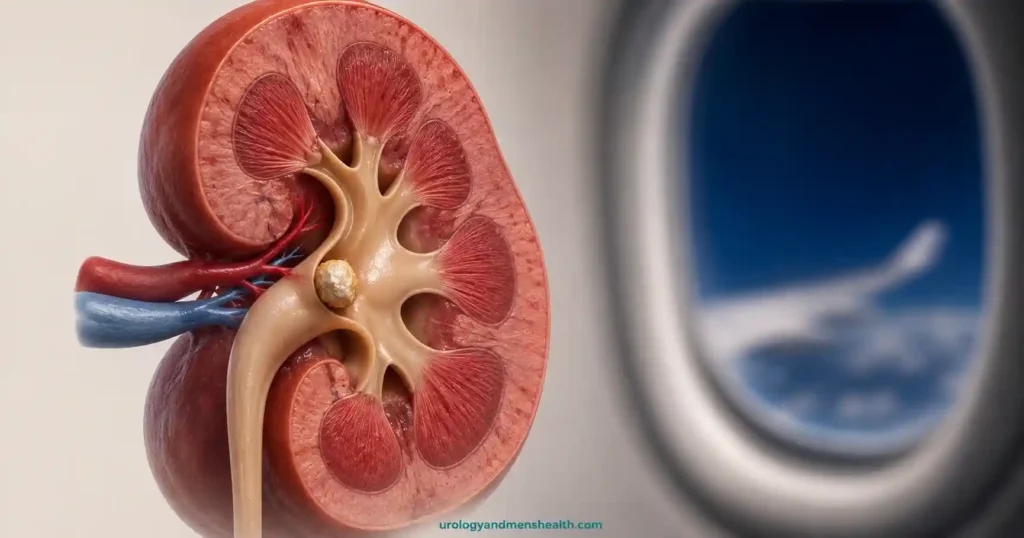
Flying with kidney stones is one of the questions I am asked most often in clinic, usually two days before a trip that is already paid for. The honest answer is that the aircraft itself is almost never the problem. Cabin pressure does not squeeze a stone down your ureter, and no published study shows that flying triggers renal colic. What a flight does is remove your options. Six hours over the Atlantic, you cannot get a CT scan, you cannot get an injected anti-inflammatory, and the aircraft’s emergency medical kit is legally required to carry nothing stronger for pain than a 325 mg non-narcotic tablet. So the real question is not whether the flight will hurt you. It is whether you would be safe if the stone chose that particular six-hour window to move. For the wider picture on how stones behave and what treats them, see our Kidney Stones Hub. This article deals with the untreated stone specifically: the one still sitting inside you when you reach the gate.
Key Takeaways
- Cabin pressure expands gas, not fluid. Your sinuses and bowel swell by up to about a quarter at cruising altitude; urine and a calcium oxalate stone do not expand at all.
- Urological problems make up roughly 1% of all in-flight medical emergencies, and across three years of global airline data flank pain caused only six flight diversions.
- The FAA-mandated emergency medical kit contains exactly one painkiller: non-narcotic tablets, 325 mg. Renal colic will not be controlled in the air.
- Fever above 38°C (100.4°F) with a known obstructing stone is an infected obstructed kidney. That is an emergency department problem, not a travel problem.
Flying With Kidney Stones: The Short Answer
Can you fly with kidney stones? In most cases, yes. But the decision splits cleanly into three groups, and which group you are in depends on the stone, not on the airline.
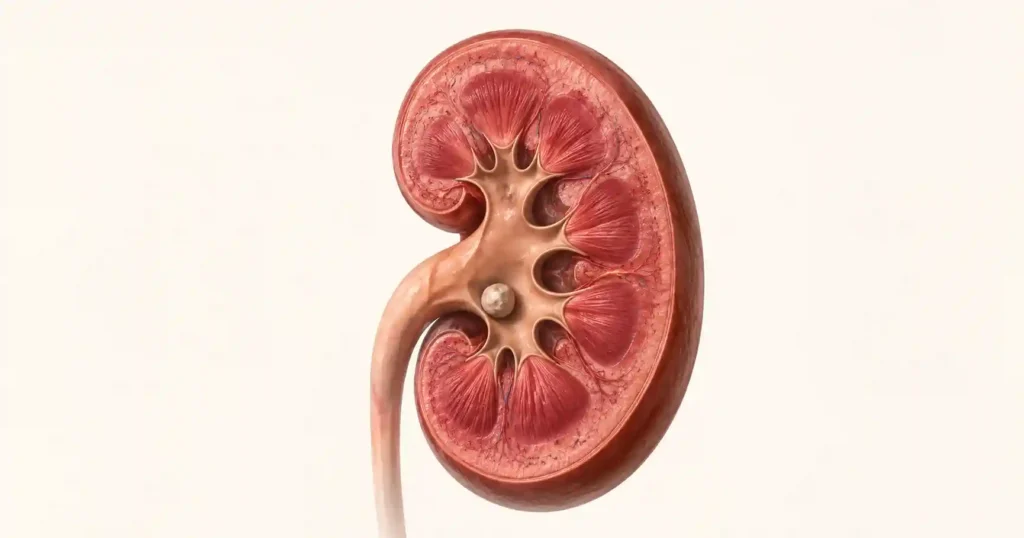
Group one: fly. You have a known stone sitting quietly in a calyx, found on a scan, no colic in the past two weeks, normal kidney function, no infection. A stone in the kidney is not obstructing anything. Altitude does not change its position, and there is no reason to cancel a trip over it.
Group two: think hard, and prepare properly. You had an episode of colic in the past two to three weeks, imaging showed the stone has moved into the ureter, and it has not passed yet. This is the group that ends up in trouble, because the stone is already mobile and the ureter is already irritable. You can usually still fly, but only with a written pain plan in your cabin bag and a clear-eyed look at the route.
Group three: do not board. Fever, uncontrolled pain, persistent vomiting, a single functioning kidney, or a rising creatinine. These are covered in detail further down, and every one of them is a reason to be in a hospital rather than an airport.
Already had the stone treated? Lithotripsy, ureteroscopy and a stent in place all follow different flying rulesWhat Cabin Pressure Actually Does to a Kidney Stone
Almost everyone who asks me this question has the same picture in their head: the cabin depressurizes a little, something inside expands, and the stone gets pushed. It is a reasonable guess. It is also wrong, and understanding why removes most of the anxiety.
US federal airworthiness rules require a pressurized cabin to hold an equivalent altitude no higher than 2,400 m (8,000 feet) at the aircraft’s maximum operating altitude [1]. In practice most airliners cruise with the cabin somewhere between 1,800 and 2,400 m (6,000 to 8,000 feet), which puts ambient pressure at roughly three quarters of what it is at sea level. The National Research Council’s review of the airliner cabin environment puts the practical consequence plainly: gas trapped in body cavities such as the middle ear, the sinuses and the gut expands in volume by as much as a quarter [2].
Here is the part that matters. Gas expands. Liquid does not, and neither does rock. Take a sealed bag of chips on a flight and it inflates. Take a sealed bottle of water and nothing happens to it at all. Your renal collecting system is the water bottle: a closed, fluid-filled plumbing circuit containing urine and, in your case, a small crystal of calcium oxalate or uric acid. There is no gas phase in it to expand. The pressure change at 8,000 feet exerts no meaningful force on a stone sitting in a calyx.
There is one narrow exception worth naming, and it is not a passenger issue: air introduced into the collecting system during a recent ureteroscopy or nephrostomy, and the rare gas-forming infection called emphysematous pyelonephritis. Both are hospital situations, and anyone in either of them is not deciding about a holiday flight.
What about turbulence and vibration?
This is the better version of the question, and the evidence here is genuinely interesting. In 2016 Mitchell and Wartinger built a silicone model of a patient’s own kidney, loaded it with that patient’s own stones, and rode it sixty times on a roller coaster at Walt Disney World. From the rear car, stones passed out of the calyces in 23 of 36 rides, and every upper-pole stone moved [3]. So mechanical acceleration can dislodge a calyceal stone.
Do not over-read it. A roller coaster delivers repeated sharp accelerations in several axes; commercial cruise flight is one of the smoothest rides available to a human being, and even significant turbulence does not approach those forces. If anything, the study suggests a mild upside for a small upper-pole stone rather than a risk. What it does not support is the idea that a normal flight will dislodge anything that was not already about to move.
The Real Risk Is Distance From Care, Not Altitude
The strongest data on this comes from a Vanderbilt review of in-flight medical calls handled by a ground-based support center covering roughly 35% of world passenger traffic. Across 2015 to 2017 there were 1,368 urological in-flight emergencies out of 138,612 medical events in total, about 1%, working out to roughly one urological event per two million passengers. Lower urinary tract symptoms accounted for 35%, urinary retention 30%, and flank pain 21%. Sixty percent settled in the air, 28% needed assessment on arrival, and 21 events, 1.5%, forced the aircraft to divert. Of those diversions, twelve were for urinary retention and only six for flank pain [4].
Read that carefully, because it cuts both ways. Six diverted flights in three years across a third of global air travel is a vanishingly small absolute risk, and it should reassure you. But it also tells you that when renal colic does happen at altitude, the overwhelming likelihood is that you stay in your seat until the wheels touch down.
Which raises the question of what is actually available to you in that seat. The federally required emergency medical kit on a US commercial aircraft is stocked for cardiac arrest, anaphylaxis, hypoglycemia and asthma. Its entire analgesic inventory is aspirin and non-narcotic tablets at 325 mg [5]. There is no opioid, no injectable anti-inflammatory, no antiemetic in the mandatory list. Renal colic is, by most patients’ account, among the worst pain in medicine. A 325 mg tablet will not touch it.
The one flight factor that genuinely matters: dehydration
Cabin relative humidity sits far below the 30 to 60% range recommended for indoor comfort [2]. Add the three behaviors that go with air travel, and the picture changes. People drink less before and during a flight to avoid the lavatory. They drink alcohol, which suppresses antidiuretic hormone and increases urine output. They drink coffee. The result is concentrated urine for eight or ten hours, and concentrated urine is the one variable that plausibly nudges a borderline stone toward symptoms.
This is worth sitting with, because it is the only mechanism in this entire article that is both real and entirely under your control.
In My Practice
A man in his forties came to see me the week after a long-haul flight to Dubai. His stone had been found in an emergency department five days before he travelled: 6 mm, mid-ureter, one episode of colic already behind him. He had the prescription. He left it in a drawer at home because he felt fine, and he had two glasses of wine to help him sleep on the aircraft. He woke somewhere over the Gulf with the pain back. The cabin crew found a doctor on board. The doctor found paracetamol. He spent the last three hours of that flight kneeling in the galley with a sick bag.
The flight did not cause his colic; that stone was always going to move within the fortnight. What boarding without his medication did was convert a bad night at home, with an anti-inflammatory and a bathroom, into three hours of untreated pain with no exit.
Traveling with an untreated stone? Get the pre-flight checklist and the pain plan to pack with it.
Enter your email below to receive Dr. Khalid’s complete Passing a Kidney Stone: What to Expect as a free, printable PDF.
Stone Size and Location Decide This, Not the Flight
If you take one practical thing from this article, take this: “I have a kidney stone” is not enough information to make a travel decision. Two numbers are. How big is it in millimeters, and where exactly is it sitting. Both are in the radiology report of the scan you have already had, and both change the answer completely.
| Stone size and location | Passes without surgery | What that means before a flight |
|---|---|---|
| Under 5 mm, distal (lower) ureter | 89% | Most favorable position. Reasonable to travel with a pain plan. |
| Under 5 mm, upper ureter | 71% | Still likely to pass, but it has the whole ureter left to travel. |
| 5 mm or larger, any location | 62% | Discuss treating it before a long-haul or remote route. |
Now the number that changes most people’s plans. In the EAU data, the average time from diagnosis to spontaneous passage is around 17 days, with a usual range of roughly 6 to 29 days [7]. So the common plan of “I will just drink water and pass it before Friday” is, for most patients, arithmetic that does not work. If your flight is inside two weeks, plan around still having the stone, not around being rid of it. To see how your own size and position map onto those odds, run the numbers through our kidney stone passage calculator.
On medication to help it along, the 2026 AUA guideline is more specific than most people realize. For a stone of 10 mm or less in the distal ureter, an alpha blocker such as tamsulosin increases the chance of passage, reduces pain and cuts unplanned trips back to hospital. For stones of the same size in the proximal or mid ureter, the meta-analysis prepared for that guideline found no significant benefit [6]. That distinction is worth raising by name with your urologist, because it decides whether a prescription is doing anything for you.
When You Should Not Board
Everything above assumes an uncomplicated stone. The following situations are different in kind, not in degree. Each one means the kidney is either infected, failing, or has no spare capacity, and each one gets worse on a timescale measured in hours.
Do Not Fly — Go to the Emergency Department
Any one of these means the airport is the wrong destination today:
- Fever above 38°C (100.4°F) with flank pain and a known stone. This is an obstructed, infected kidney. It does not respond to antibiotics alone; it needs the blockage drained, usually within hours.
- Pain your oral medication has not controlled in the past 24 hours. If it is uncontrolled on the ground with a full medicine cabinet, it will be uncontrolled at 38,000 feet with a 325 mg tablet.
- Vomiting you cannot keep fluids down against. Dehydration plus obstruction is how kidney function drops.
- One functioning kidney, a transplanted kidney, or stones obstructing both sides. There is no reserve, so obstruction becomes acute kidney injury quickly.
- Less urine, or a creatinine that has risen since the stone was found. The kidney is already telling you it is under pressure.
The first of those deserves particular emphasis, because it is the one people talk themselves out of. A stone that obstructs a ureter turns the kidney above it into a closed, stagnant space; if bacteria reach it, the infection cannot drain and pressure drives it into the bloodstream. The same organisms that cause an ordinary bladder infection cause this one, which is why our guide on when a urinary tract infection in men stops being routine matters here. A urinary infection on its own is treated with tablets. A urinary infection sitting above a stone is a surgical emergency.
Your Pre-Flight Protocol
Seven days out: get the number. Email your urologist’s office or the emergency department that scanned you and ask for a copy of the CT report. You want two things from it: the stone’s maximum diameter in millimeters, and its exact position. Save it to your phone. If you end up in a foreign hospital, that single document saves you a repeat scan and several hours.
Seven days out: ask the right medication question. If the stone is 10 mm or less and in the distal ureter, ask specifically whether tamsulosin 0.4 mg daily is appropriate for you. If it is higher up, ask whether it would add anything, because the guideline evidence says it probably will not.
Three days out: get a written escalation plan, not just a prescription. Ask your doctor to write down what you take first, what you add if that fails, what you take for nausea, and the specific point at which you stop self-treating and seek care. For most patients without contraindications that means an oral anti-inflammatory as the first line, a stronger analgesic held in reserve, and an antiemetic. Carry it all in your cabin bag, in the original labelled pharmacy packaging, with the prescription. Never in checked luggage, where it is four hours and one lost bag away from you.
Three days out: check your travel insurance in writing. A stone diagnosed before you bought the policy is a pre-existing condition, and an undeclared one is the standard reason these claims are refused. Declare it by email and keep the reply.
The day itself: drink to pale straw and choose the aisle. Target roughly 250 mL (about 8 fl oz) of water for every hour in the air, take an aisle seat so that drinking does not feel like a chore, and skip alcohol entirely on this trip. If you are not passing urine every two to three hours in flight, you are behind.
Think about the route, not just the flight time. A transpolar or mid-Pacific sector has very few realistic diversion airports; a domestic hop has one every twenty minutes. If you have an 8 mm mid-ureteric stone and a choice between the short trip now and the long one next month, take the short one and treat the stone first. And if colic does start before departure, use our acute stone pain triage tool to work out whether this is a manage-at-home episode or an emergency department one, before you commit to a gate.
If you fly for a living, the rules are stricter
Everything above is the passenger standard. Aircrew are held to a different one, for the obvious reason that colic in the left-hand seat is an incapacitation event. Under the FAA’s Guide for Aviation Medical Examiners, a history of kidney stones is assessed under the genitourinary item, with a documented worksheet required where a stone has occurred within the past five years, and additional evidence needed for retained stones [8]. Military aviation medicine is stricter again, with a strong preference for stone-free status even when the stone is asymptomatic and found by chance. If you hold a medical certificate, do not extrapolate from what is safe for a passenger; talk to your aviation medical examiner before your next renewal.
Frequently Asked Questions
Can you fly with kidney stones if the stone has not caused pain yet?
Usually yes. A stone sitting quietly inside the kidney is not obstructing anything, and altitude does not change that. What matters is whether it could move. Get the stone size and exact location from your CT report, and carry a written pain plan regardless. A silent stone becomes a problem the moment it enters the ureter, and an aircraft is a poor place for that to happen.
Does cabin pressure make a kidney stone move?
No. Cabin pressure falls to roughly three quarters of sea level, which expands gas in your sinuses, middle ear and bowel by up to about a quarter. Your kidney and ureter contain urine and a solid stone. Neither expands under reduced pressure. No published study shows that flying triggers renal colic, and the mechanism people assume is at work simply does not apply to fluid.
I have a 4 mm stone and a flight in three days. Should I try to pass it first?
Three days is optimistic. The average stone that passes on its own takes around 17 days to do it, so planning travel around passage rarely works. Use the time differently: get the CT report, ask about an alpha blocker if the stone is in the lower ureter, and fill the prescription. Our guide on how to pass a kidney stone faster covers what genuinely shortens that window.
Can I carry prescription pain medication for renal colic on a flight?
Yes, and it belongs in your cabin bag rather than checked luggage, in the original labelled pharmacy packaging, with a copy of the prescription or a letter from your doctor. Rules on stronger analgesics differ sharply by country, and several Gulf and Asian destinations restrict drugs that are routine in the United States. Check the destination country’s embassy page before you pack, not at the airport.
Will a kidney stone or a ureteral stent set off airport security scanners?
No. Stones are made of calcium, oxalate or uric acid, and ureteral stents are polyurethane or silicone. None of that is metallic, so a walk-through detector or millimeter-wave body scanner will not react to it. Some stents contain barium so they show up on a medical X-ray, but airport screening does not image inside you. You do not need a letter for the stent itself.
References
- Federal Aviation Administration. Pressurized cabins. 14 CFR 25.841. eCFR
- National Research Council. Health Considerations Related to Chemical Contaminants and Physical Factors. In: The Airliner Cabin Environment and the Health of Passengers and Crew. Washington DC: National Academies Press; 2002. NCBI Bookshelf
- Mitchell MA, Wartinger DD. Validation of a functional pyelocalyceal renal model for the evaluation of renal calculi passage while riding a roller coaster. J Am Osteopath Assoc. 2016;116(10):647-652. PubMed
- Hancock J, Sui W, Alves P, Nerwich N, Hsi RS. Urological in-flight medical events on commercial airlines. J Urol. 2020;203(5):991-995. PubMed
- Federal Aviation Administration. First Aid Kits and Emergency Medical Kits. 14 CFR Part 121, Appendix A. eCFR
- Pearle MS, Matlaga BR, Antonelli JA, et al. Surgical Management of Kidney and Ureteral Stones: AUA Guideline (2026). J Urol. 2026;215(2):113-141. AUA
- European Association of Urology. EAU Guidelines on Urolithiasis. Arnhem, The Netherlands: EAU Guidelines Office; 2026. EAU
- Federal Aviation Administration. Item 41. Genitourinary System — Disposition Table. Guide for Aviation Medical Examiners. 2026. FAA
Dr. Muhammad Khalid
MBBS · FCPS (Urology) · MCPS (General Surgery) · CHPE · CRSM · IMC #539472
Specialist urologist with 11+ years of clinical experience across tertiary teaching hospitals. Trained at Lady Reading Hospital and Khyber Teaching Hospital, Peshawar. Author or co-author of five peer-reviewed international publications, including in Cureus and the World Journal of Surgery. Procedural expertise: URS, PCNL, RIRS, TURP, TURBT, and major open urological surgery. Full profile →
This article is for educational purposes only and does not constitute medical advice. Always consult your physician or urologist for diagnosis and treatment decisions specific to your condition.