Low Oxalate Diet: What You Can Actually Eat (Food List)
Most low oxalate diet advice is a list of things to give up. The more useful question is what goes on the plate instead — and why the calcium you eat alongside it matters more than the oxalate you cut.

Almost every low oxalate diet you will find online is a subtraction list. Spinach, almonds, beets, rhubarb, chocolate, tea — cross them off and hope for the best. Patients arrive in my clinic holding a printout of forty foods they can no longer eat, and the first thing most of them tell me is that they gave up after three weeks. That failure is predictable, and it is not a discipline problem. A restriction list with nothing on the other side of it is not a diet, it is a deprivation exercise. It also misses the mechanism that decides how much of the oxalate you eat ever reaches your kidney in the first place. Dietary oxalate is only one lever, and on its own it is a surprisingly weak one — the stronger lever is what you eat alongside it. This article covers what goes on the plate, in what combination, and how to check within three months whether it changed anything. For the wider prevention picture, see our Kidney Stones Hub.
Key Takeaways
- Cutting dietary calcium backfires. In controlled feeding studies, dropping calcium from about 1,000 mg to 390 mg a day raised urinary oxalate by roughly 28% on an identical oxalate intake.
- Oxalate restriction is only worth doing if your stone was calcium oxalate and your 24-hour urine oxalate is above 40 mg per day. Without both, you are restricting for nothing.
- Timing beats totals: 1,000-1,200 mg of dietary calcium eaten with the oxalate-containing meal binds oxalate inside the gut before it can be absorbed.
- Vitamin C supplements at 1,000 mg or more daily were associated with a 43% higher stone risk in men — one bottle can cancel out a careful diet.
- Spinach alone accounted for more than 40% of total oxalate intake in the Harvard cohorts. Removing one food does most of the work.
Who a Low Oxalate Diet Is Actually For
Two facts have to be true before oxalate restriction earns its place in your life.
The first is stone composition. If your stone was uric acid, struvite, cystine, or calcium phosphate, oxalate is not your problem and restricting it will not lower your recurrence risk. Only calcium oxalate stones — the majority, but far from all — respond to this. If you passed a stone and nobody sent it for analysis, you are guessing. Ask your urologist whether a stored fragment can still be analyzed, and if you pass another one, strain your urine and bring it in.
The second is your 24-hour urine. Hyperoxaluria is usually defined as urinary oxalate above 40 mg per day. If your collection comes back at 25 mg and your urine volume is 1.2 liters, your problem is water, not spinach. The AUA’s 2026 Medical Management of Kidney Stones guideline, released in July 2026, builds its dietary recommendations for calcium stone formers around exactly this — the measured urine profile, not a generic food list [1]. Ask for a 24-hour urine collection before you change anything, and ask specifically for oxalate, calcium, citrate, uric acid, sodium and volume.
Why the evidence for oxalate restriction is weaker than you would expect
This is the part most diet sheets leave out. When Taylor and Curhan tracked oxalate intake across nearly 200,000 people in the Health Professionals Follow-up Study and the two Nurses’ Health Studies, men in the highest fifth of oxalate intake had a relative risk of stones of just 1.22 compared with the lowest fifth [2]. Mean intake in men was 214 mg a day, and it was essentially the same in stone formers and non-stone formers. In other words, at a population level, how much oxalate people eat barely separates those who form stones from those who do not.
That finding does not make oxalate irrelevant. It tells you that oxalate matters in a subgroup — the people with documented hyperoxaluria, low calcium intake, or fat malabsorption — and that blanket restriction across everyone else buys very little. It is also why the wider dietary protocol, covered in my full kidney stone diet protocol, treats oxalate as one component among five rather than the headline act.
What You Can Eat: The Everyday Swap List
Here is the practical shape of a low oxalate diet: you are not eliminating food groups, you are trading within them. Almost every high-oxalate food has a close nutritional cousin that is low in oxalate, which means the meal structure you already have can survive intact.
| Swap out | Swap in | What changes |
|---|---|---|
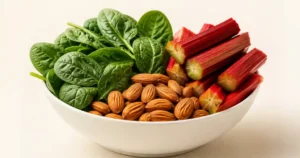
| Spinach, raw or cooked | Kale, cabbage, bok choy, arugula | Same dark-green micronutrient profile, a small fraction of the oxalate load |
| Almonds and almond butter | Pecans, macadamias | Keeps the fat and protein; almonds are the highest-oxalate common nut |
| Rhubarb | Blueberries, apples, melon | Rhubarb is among the most concentrated oxalate sources in the Western diet |
| Beets and beet greens | Cauliflower, mushrooms, zucchini | Retains bulk and fiber without the oxalate |
| Baked potato with skin | White rice, peeled potato, cauliflower mash | Most of a potato’s oxalate sits in the skin |
| Wheat bran cereal | Rice- or corn-based cereal | Bran is a concentrated source; get fiber from vegetables instead |
| A pitcher of iced black tea | Water, lemon water, herbal tea | Volume is the issue — a single mug is not the problem, a liter a day is |
| Dark chocolate on an empty stomach | A smaller portion taken with milk or yogurt | The calcium pairing blunts absorption rather than banning the food |
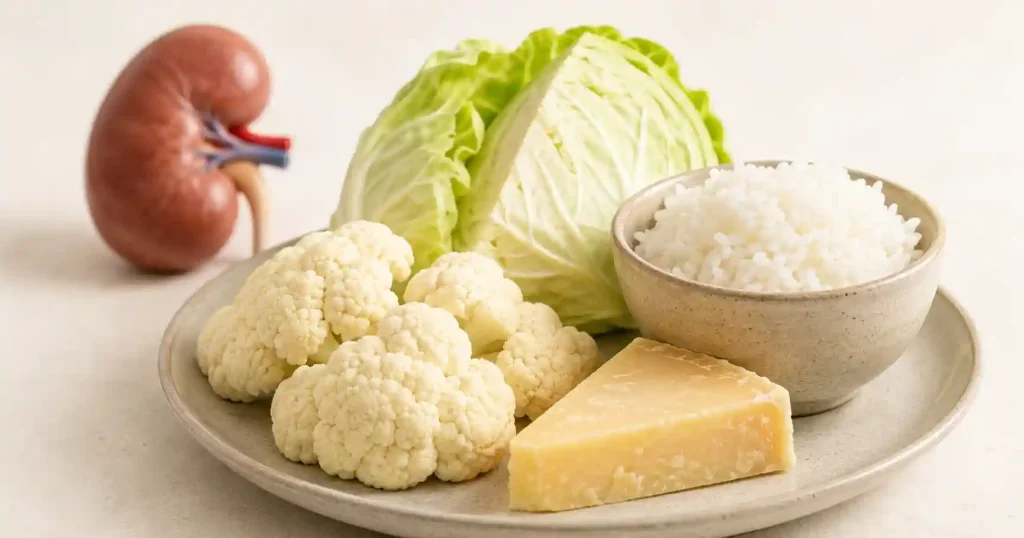
Notice how few rows that takes. If you make one change only, make it spinach — no other single food carries that much of the load. Beyond these categories, most of what fills a normal plate is already low in oxalate: eggs, meat, fish, poultry, cheese, milk, yogurt, butter, white rice, most fruit, cauliflower, cabbage, cucumber, mushrooms, peas and onions.
For anything not on this list, look it up rather than guessing — food-by-food values are the one place where intuition fails badly, since oxalate content tracks neither calorie density nor how “healthy” a food seems. Our searchable oxalate database lets you check any individual food in a few seconds, and the complete high-oxalate chart organized by category gives you the full numbers behind the eight swaps above.
A reasonable therapeutic target is around 100 mg of oxalate a day, against a typical intake of just over 200 mg. That is a halving, not an elimination — and the swap table above gets most people there without counting anything.
The Calcium Rule That Matters More Than Cutting Oxalate
This is the single most consequential thing in this article, and it runs directly against what most people assume after a calcium oxalate stone.
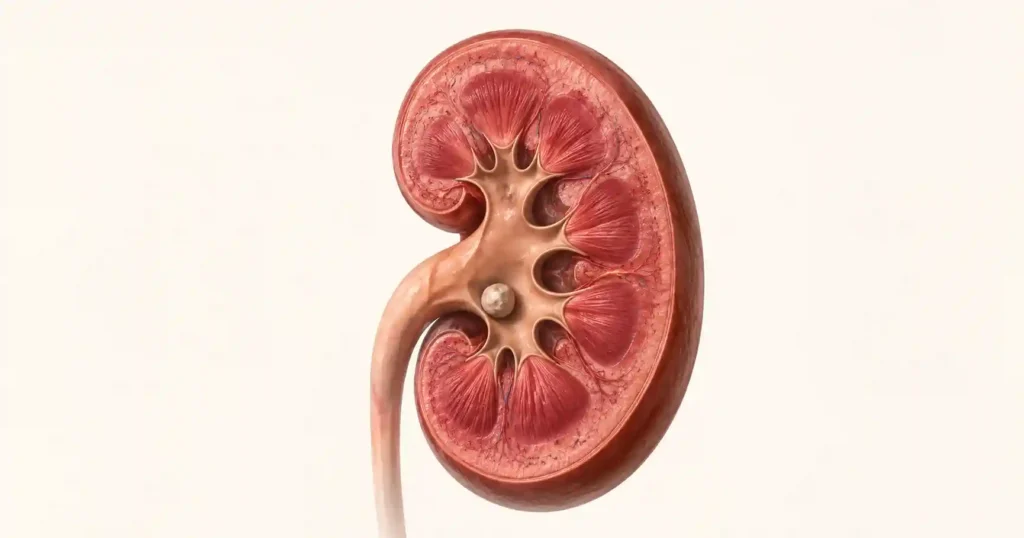
Calcium and oxalate bind to each other. Where they bind decides everything. If they meet in your intestine, they form an insoluble complex that leaves in the stool and never reaches your kidney. If oxalate arrives in the gut with no calcium to bind to, it crosses the intestinal wall, enters the bloodstream, and gets filtered into your urine — where it now has your blood calcium to crystallize with, inside the kidney.
Holmes and colleagues measured this directly. Feeding people an identical 250 mg oxalate diet, they cut dietary calcium from 1,002 mg to 391 mg a day. Urinary oxalate rose by a mean of 28.2%, and the proportion of urinary oxalate traceable to diet climbed to over half [3]. Nothing about the oxalate intake changed. Only the calcium did.
The clinical proof came from Borghi’s five-year randomized trial in 120 men with recurrent calcium oxalate stones and hypercalciuria. One group ate the traditional low-calcium diet. The other ate normal calcium (about 1,200 mg daily) with restricted animal protein and salt. The normal-calcium group had a relative risk of recurrence of 0.49 — roughly half the stones — compared with the low-calcium group [4]. The low-calcium diet was not merely useless. It was worse.
How to apply this at the table
- Target 1,000-1,200 mg of calcium daily, from food. Roughly: a glass of milk, a pot of yogurt, and a matchbox-sized piece of hard cheese.
- Eat it with the oxalate, not separately. Calcium taken hours away from an oxalate-containing meal does not bind anything. Yogurt with your berries, milk with your chocolate, cheese in the salad.
- Prefer food calcium to supplements. Calcium supplements taken between meals have been linked with higher stone risk, precisely because they arrive with no oxalate to bind. If you must supplement for bone health, take it with a meal and tell your urologist.
If you want the pairing done arithmetically rather than by eye, the Calcium-Oxalate Meal Balancer will tell you how much calcium a given meal needs to offset its oxalate content.
In My Practice
A 46-year-old man came back to my clinic eighteen months after his first ureteroscopy with a 9 mm stone in the same kidney. He had done everything the internet told him. He had cut out dairy entirely — no milk, no cheese, no yogurt — on the reasoning that his stone was made of calcium. His repeat 24-hour urine told the story precisely: urinary calcium unchanged, urinary oxalate up by a third. He had removed the only thing standing between the oxalate in his food and his kidney.
When a man tells me he has given up dairy since his stone, I stop the consultation and correct that before we discuss anything else.
Get the 7-Day Kidney Stone Prevention Meal Plan — every meal calcium-paired to block oxalate absorption
Enter your email below to receive Dr. Khalid’s complete 7-Day Kidney Stone Prevention Meal Plan as a free, printable PDF.
Three Things That Quietly Undo the Diet
Patients who follow the food list carefully and still see no change in their urine are usually running into one of these three.
1. High-dose vitamin C
Ascorbic acid is metabolized into oxalate. Ferraro and colleagues followed nearly 200,000 people and found that in men, total vitamin C intake of 1,000 mg a day or more carried a hazard ratio of 1.43 for incident stones compared with under 90 mg — and supplemental vitamin C alone carried a hazard ratio of 1.19 at that dose [6]. Dietary vitamin C from fruit was not associated with stones. The problem is the tablet, not the orange. If you are a calcium oxalate stone former taking a 1,000 mg vitamin C supplement, stop it — that one change may outweigh everything else on your food list.
2. Salt, which raises calcium in the wrong compartment
Sodium and calcium are handled together in the renal tubule. Eat more sodium, and you excrete more calcium into your urine — which is precisely where you do not want it. Aim below 2,300 mg of sodium a day (about three-quarters of a teaspoon of salt), and understand that most of it arrives in bread, processed meat, sauces and restaurant food rather than from the shaker. The overlap between stone prevention and blood pressure control here is not coincidental: I have written separately on why the same salt intake drives both kidney stones and hypertension, and the dietary fix is the same one for both conditions.
3. Not enough urine
Oxalate concentration is a fraction. Diet changes the numerator; fluid changes the denominator, and it changes it faster. The long-standing target is urine output above 2.5 liters a day (around 85 fl oz / 10 cups), which for most men means drinking closer to 3 liters. A man passing 1 liter of urine daily on a perfect low oxalate diet is still at higher risk than a man passing 2.5 liters on an ordinary one.
The special case: fat malabsorption
If you have had a Roux-en-Y gastric bypass, have Crohn’s disease, celiac disease, or chronic pancreatitis, you are in a different category called enteric hyperoxaluria. Unabsorbed fat binds calcium in the gut, leaving oxalate free to be absorbed in large quantities, and urinary oxalate can climb far above what diet alone explains. Strict oxalate restriction genuinely matters here, alongside calcium with every meal and a lower-fat diet. If any of these apply to you, say so explicitly at your next appointment — the management is not the same.
How to Tell Whether It Is Working
A diet you cannot measure is a diet you will abandon. Repeat the 24-hour urine collection 8 to 12 weeks after you change your eating, while still eating your usual diet rather than a temporary careful version of it. Four numbers tell you whether it worked:
- Urine volume — above 2.5 liters per day. This is the one that should move first and most.
- Oxalate — below 40 mg per day, and ideally toward 25-30 mg.
- Calcium — should not have fallen through the floor. A urinary calcium that collapses after a dietary change usually means you cut food calcium, which is the failure mode described above.
- Citrate — a natural crystallization inhibitor. Low citrate is a treatable finding in its own right, often with potassium citrate.
One more piece of honesty about the evidence. When Noori and colleagues randomized 57 recurrent stone formers with hyperoxaluria to either a low-oxalate diet or a DASH-style diet, urinary oxalate trended higher in the DASH group — but calcium oxalate supersaturation, the measure that actually predicts crystal formation, trended lower, driven by rises in citrate, magnesium and urine pH [5]. Both trends fell short of statistical significance in a small trial, so this is a signal rather than a verdict. It does tell you something worth carrying: the goal is a lower supersaturation, not a lower oxalate number in isolation, and a whole dietary pattern can beat single-nutrient restriction on the outcome that counts.
If your repeat collection shows oxalate still above 40 mg despite genuine adherence, that is the point to ask your urologist about pharmacological options rather than restricting your food further. There is a floor below which dietary oxalate cannot be pushed, and grinding against it produces misery without stones prevented.
When Diet Is Not the Answer
Book an appointment rather than adjusting your food if any of these apply:
- Stones that began in childhood or adolescence, a family history of stones in multiple relatives, or nephrocalcinosis on imaging — these raise the possibility of primary hyperoxaluria, a genetic condition that diet does not control.
- Recurrent stones despite a documented 24-hour urine profile that has normalized.
- Any history of gastric bypass, bowel resection, Crohn’s disease or chronic pancreatitis alongside stone disease.
- A single functioning kidney, chronic kidney disease, or a rising creatinine.
Go to the emergency room, not your kitchen, for flank pain with fever or chills, pain with vomiting that stops you keeping fluids down, or inability to pass urine. Infection behind an obstructing stone is a surgical emergency measured in hours.
Frequently Asked Questions
Do I need a low oxalate diet if my stone was calcium oxalate but my urine oxalate is normal?
No. Restriction is aimed at hyperoxaluria, meaning urinary oxalate above 40 mg per day. If your 24-hour urine is normal, your recurrence risk is being driven by something else — low urine volume, low citrate, high urinary calcium or high uric acid. Work on the number that is abnormal. The full stone prevention protocol covers each of those separately.
How much oxalate per day counts as a low oxalate diet?
Around 100 mg a day is the usual therapeutic target. For context, mean intake in the male Harvard cohort was 214 mg daily, so you are roughly halving it rather than eliminating oxalate. Enteric hyperoxaluria after bariatric surgery or bowel disease sometimes calls for a stricter 50 mg target, but that is a decision to make with your urologist rather than on your own.
Can I still eat spinach on a low oxalate diet?
Realistically, no — spinach is the one food I ask people to drop outright. It accounted for over 40% of total oxalate intake in the Harvard cohorts, which means removing it does more than the rest of the food list combined. Kale, cabbage, bok choy and arugula give you the same dark-green nutrition at a small fraction of the oxalate. Check any substitute in the oxalate food list before you commit to it.
Why does cutting calcium make calcium oxalate stones worse?
Because calcium binds oxalate in your intestine and carries it out in stool. Remove dietary calcium and that oxalate is absorbed into the bloodstream instead, then filtered into urine where it crystallizes with the calcium already in your blood. Controlled feeding showed a 28% rise in urinary oxalate when calcium was cut from about 1,000 mg to 390 mg daily, with oxalate intake held constant.
Does boiling vegetables reduce their oxalate content?
Yes, meaningfully — soluble oxalate leaches into the cooking water, so boiling and discarding the water lowers the oxalate you actually eat. Steaming does considerably less, and roasting or frying does essentially nothing. This is a useful trick for moderate-oxalate vegetables you want to keep in your diet. It will not rescue spinach, which starts too high for boiling to bring into a safe range.
Should I take a calcium supplement instead of eating more dairy?
Food calcium is the better choice. Calcium supplements taken between meals arrive in the gut with no oxalate to bind and have been associated with higher stone risk, whereas dietary calcium eaten alongside the oxalate is protective. If you need supplementation for bone health, take it with a meal rather than on an empty stomach, and tell your urologist so it can be factored into your overall stone prevention plan.
References
- Pearle MS, Matlaga BR, Antonelli JA, et al. Medical Management of Kidney Stones: AUA Guideline (2026) Part I: Evaluation of Patients with Kidney Stones and Dietary Management of Patients with Calcium Stones. J Urol. Published online July 30, 2026. AUA
- Taylor EN, Curhan GC. Oxalate intake and the risk for nephrolithiasis. J Am Soc Nephrol. 2007;18(7):2198-2204. PubMed
- Holmes RP, Goodman HO, Assimos DG. Contribution of dietary oxalate to urinary oxalate excretion. Kidney Int. 2001;59(1):270-276. PubMed
- Borghi L, Schianchi T, Meschi T, et al. Comparison of two diets for the prevention of recurrent stones in idiopathic hypercalciuria. N Engl J Med. 2002;346(2):77-84. PubMed
- Noori N, Honarkar E, Goldfarb DS, et al. Urinary lithogenic risk profile in recurrent stone formers with hyperoxaluria: a randomized controlled trial comparing DASH-style and low-oxalate diets. Am J Kidney Dis. 2014;63(3):456-463. PubMed
- Ferraro PM, Curhan GC, Gambaro G, Taylor EN. Total, dietary, and supplemental vitamin C intake and risk of incident kidney stones. Am J Kidney Dis. 2016;67(3):400-407. PubMed
Dr. Muhammad Khalid
MBBS · FCPS (Urology) · MCPS (General Surgery) · CHPE · CRSM · IMC #539472
Specialist urologist with 11+ years of clinical experience across tertiary teaching hospitals. Trained at Lady Reading Hospital and Khyber Teaching Hospital, Peshawar. Author or co-author of five peer-reviewed international publications, including in Cureus and the World Journal of Surgery. Procedural expertise: URS, PCNL, RIRS, TURP, TURBT, and major open urological surgery. Full profile →
This article is for educational purposes only and does not constitute medical advice. Always consult your physician or urologist for diagnosis and treatment decisions specific to your condition.