High Oxalate Foods Chart: What to Cut, What to Keep
Most high oxalate foods lists give you names and nothing else. This one gives you milligrams per serving, a daily budget to spend them against, and the one pairing that halves how much you absorb.

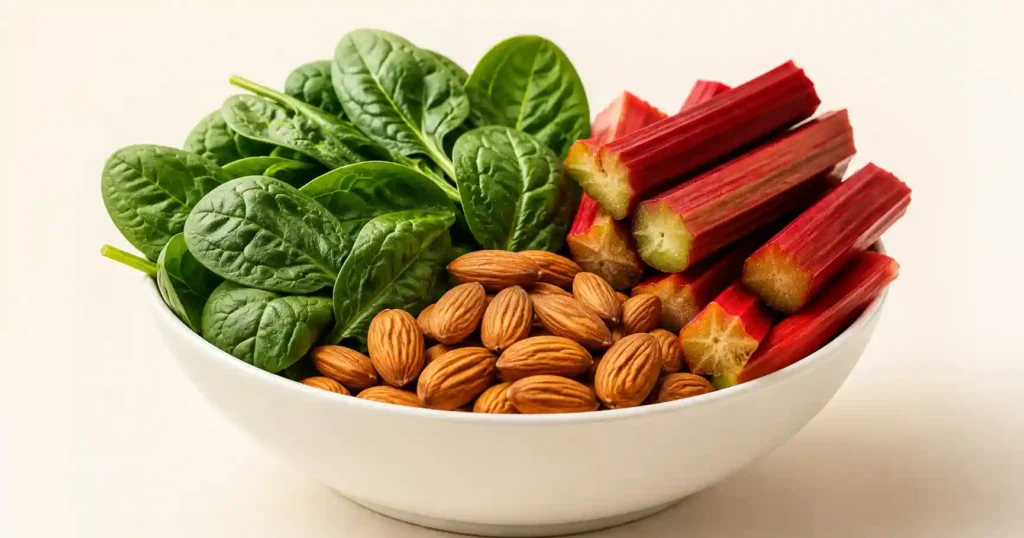
Most high oxalate foods lists hand you a column of names and leave you to panic. That is the wrong tool for the job. The name of a food tells you nothing useful without the number beside it, and the number tells you nothing useful without a daily budget to spend it against. A half-cup serving of cooked spinach (about 90 g) carries 755 mg of oxalate. A half cup of boiled cabbage carries 1 mg [6]. Both appear on plenty of avoid-this lists. In clinic I see two failure modes from that kind of advice: men who eliminate thirty foods and still form stones because they never touched the two that mattered, and men who abandon the whole idea within a fortnight because the list made normal eating impossible. This chart is built to prevent both. It gives you milligrams per serving, a daily target, and the pairing rule that changes how much of any of it you actually absorb. For the wider picture, start with our Kidney Stones Hub.
Key Takeaways
- Six foods sit above 100 mg of oxalate per serving: cooked and raw spinach, rhubarb, rice bran, buckwheat groats, almonds and miso soup. Removing those six does most of the work.
- Dietary oxalate supplies 24 to 42 percent of the oxalate in your urine, far more than the 10 to 20 percent figure that older textbooks used.
- Cutting dietary calcium while cutting oxalate raises urine oxalate. In controlled feeding, dropping calcium from 1,002 mg to 391 mg per day raised urinary oxalate by 28 percent.
- Boiling removes 30 to 87 percent of soluble oxalate; steaming removes 5 to 53 percent; baking a potato removes none.
- This diet is for men with calcium oxalate stones and a documented high oxalate result on a 24-hour urine collection. It does nothing for uric acid or calcium phosphate stones.
What Oxalate Actually Does Once It Reaches Your Kidney
Oxalate is a small molecule your body cannot break down or use. Some of it your liver makes as an end product of metabolism. The rest arrives in plant food. Either way it leaves through the kidney, and that is where the trouble starts. If that applies to you, read Kidney Stone Size Chart.
Around 75 percent of kidney stones are built mainly from calcium oxalate [4]. In most men’s urine, calcium oxalate already sits close to its saturation limit. Think of it as a glass of water that is already almost as sweet as it can get. Add a little more sugar and it stops dissolving and starts sitting on the bottom. Because urine oxalate concentration is roughly a tenth of urine calcium concentration, a small absolute rise in oxalate shifts saturation far more than the same rise in calcium would. That asymmetry is the entire reason a food chart exists.
The old teaching was that diet contributed only 10 to 20 percent of urinary oxalate, so restricting food was close to pointless. Holmes and colleagues at Wake Forest tested that directly using controlled diets of known oxalate content and found the contribution ranged from 24 percent on a 10 mg per day diet to 42 percent on a 250 mg per day diet [2]. Diet matters more than the old number suggested. It still does not explain everything, which is why a man can eat almost no oxalate and still run a high urine level.
The High Oxalate Foods Chart, by Category
Figures below are milligrams of oxalate per usual serving, taken from the Harvard oxalate analysis that most US stone programs work from [6]. The banding is mine, and it is deliberately coarse because precision beyond this is false comfort: High is 40 mg or more per serving, Moderate is 10 to 39 mg, Low is under 10 mg. Where a food is well documented as high but no reliable per-serving figure exists, I have named it in the text rather than inventing a number for the table.
The six foods in a class of their own
The University of Chicago stone program identifies only a handful of foods that clear 100 mg in a single ordinary serving [8]. If you do nothing else on this page, do this list.
| Food | Serving | Oxalate |
|---|---|---|
| Spinach, cooked | 1/2 cup (90 g) | 755 mg |
| Spinach, raw | 1 cup (30 g) | 656 mg |
| Rhubarb | 1/2 cup diced | 541 mg |
| Buckwheat groats, cooked | 1 cup | 133 mg |
| Almonds | 1 oz (28 g, ~22 kernels) | 122 mg |
| Rice bran | Standard serving | Over 100 mg |
| Miso soup | 1 bowl | Over 100 mg |
Vegetables
| Vegetable | Serving | Oxalate (mg) | Level |
|---|---|---|---|
| Spinach, cooked | 1/2 cup | 755 | High |
| Spinach, raw | 1 cup | 656 | High |
| Rhubarb | 1/2 cup | 541 | High |
| Potato, baked with skin | 1 medium | 97 | High |
| Rutabaga, mashed | 1/2 cup | 31 | Moderate |
| Turnip, mashed | 1/2 cup | 30 | Moderate |
| Celery, raw | 1/2 cup | 19 | Moderate |
| Brussels sprouts | 1/2 cup | 17 | Moderate |
| Tomato sauce | 1/2 cup | 17 | Moderate |
| Celery, cooked | 1 cup | 10 | Moderate |
| String beans | 1/2 cup | 9 | Low |
| Carrots, cooked | 1/2 cup sliced | 7 | Low |
| Tomato | 1 medium | 7 | Low |
| Asparagus | 4 spears | 6 | Low |
Four vegetables belong in the high band but do not have a per-serving figure I would stand behind: beets, beet greens, Swiss chard and okra. Beet greens sit in the same territory as spinach and should be treated the same way. Sweet potato is genuinely moderate rather than high, which surprises men who have been told to avoid it outright.
Nuts, soy, grains and legumes
| Food | Serving | Oxalate (mg) | Level |
|---|---|---|---|
| Soy milk or soy yogurt | 1 cup | Up to 336 | High |
| Tofu, firm | 3 oz (85 g) | 235 | High |
| Buckwheat groats, cooked | 1 cup | 133 | High |
| Almonds | 1 oz (28 g) | 122 | High |
| Soybeans | 1 cup | 96 | High |
| Mung beans | 1/2 cup | 8 | Low |
Almonds lead the nut category and are the single most over-consumed high oxalate food I see. Cashews, hazelnuts, pine nuts, sesame seeds and tahini follow. Peanuts, pistachios and walnuts sit meaningfully lower per equivalent weight, which makes them the sensible substitutions. Nut butters count exactly as the nuts do. On the grain side, the pattern is that the bran fraction carries the oxalate, so bran cereals, wheat germ, whole wheat flour and whole wheat bread are all higher than their refined equivalents. This is one of the few situations in men’s health where the white version of a food is the better choice.
Fruits, drinks and chocolate
In fruit, the high band is raspberries, blackberries, figs, dates, kiwi, concord grapes, star fruit (carambola), and citrus peel or marmalade. Star fruit deserves separate mention: it is high in oxalate and also carries a neurotoxin that is dangerous in reduced kidney function, so men with chronic kidney disease should avoid it outright rather than portion it. For the full picture, see ESWL Shockwave Lithotripsy.
In drinks: black tea, iced tea, cocoa, hot chocolate, instant coffee, dark beer and soy drinks. Chocolate itself runs around 117 mg per 100 g, so a square is nothing and a bar is not. The real problem in this category is volume rather than concentration. One cup of black tea is a rounding error; a litre jug of iced tea drunk daily through summer is not.
Foods you can eat without counting
| Food | Serving | Oxalate |
|---|---|---|
| Iceberg lettuce | 1 cup | 0 mg |
| Radish | 10 radishes | 0 mg |
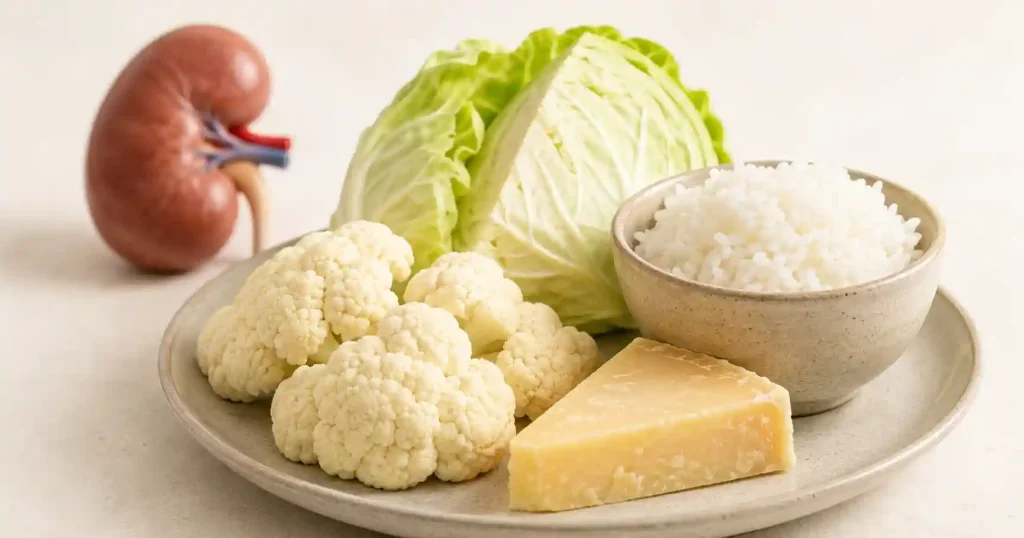
| Cabbage | 1/2 cup | 1 mg |
| Cauliflower, cooked | 1/2 cup | 1 mg |
| Corn | 1/2 cup | 1 mg |
| Peas | 1/2 cup | 1 mg |
| Kale, chopped | 1 cup | 2 mg |
| Mustard greens, chopped | 1 cup | 4 mg |
One thing worth correcting: several hospital handouts still list kale and collards as high oxalate foods. Older analytical methods overestimated oxalate in some greens, and the more recent enzymatic assays put kale at roughly 2 mg per cup. If you are choosing a green to build meals around, kale is not the problem spinach is.
Check any single food instantly with our searchable Oxalate Food List toolYour Daily Oxalate Budget, and the Calcium Rule That Makes It Work
There is no single agreed daily figure, and any site that gives you one without saying so is guessing. The University of Michigan urology department advises stone formers to hold intake to 40 to 50 mg per day, treating anything above 10 mg per serving as high [7]. The University of Chicago stone program works to a looser budget of about 100 mg per day [8]. Both are defensible. Pick one and hold to it, because the difference between the two targets is far smaller than the difference between counting and not counting. A single half cup of cooked spinach blows through either budget seven to eighteen times over.
Now the part that most charts leave out, and the reason a lot of careful low-oxalate diets fail. In the same Wake Forest feeding study, reducing dietary calcium from 1,002 mg to 391 mg per day while holding oxalate constant at 250 mg raised urinary oxalate excretion by 28 percent and pushed diet’s share of urine oxalate to 53 percent [2]. Cutting calcium made the oxalate problem worse, not better.
The mechanism is simple once you see it. Calcium and oxalate bind to each other. If they meet in your intestine, they form a complex too large to absorb and it leaves in stool. If calcium is absent from the meal, oxalate stays free, crosses the gut wall, enters the blood, and meets your calcium later in the renal tubule, where a crystal is exactly what you do not want. The AUA’s position, and the standard recommendation across stone programs, is to restrict oxalate-rich foods and keep dietary calcium at 1,000 to 1,200 mg per day [1][3].
Practically, that means calcium goes with the oxalate, in the same meal, not at a different time of day. Yogurt alongside the handful of nuts. Milk in the hot chocolate rather than water. Cheese on the pasta with tomato sauce. Same foods, different timing, materially different urine.
In My Practice
A man in his forties came back for review after six months of what he described as perfect compliance, and his repeat 24-hour urine oxalate had gone up rather than down. He had cut spinach, nuts and chocolate completely. He had also, without being told to, cut all dairy on the logic that his stones contained calcium and calcium must therefore be the enemy. He was eating maybe 300 mg of calcium a day.
When a low-oxalate diet fails to lower urine oxalate, the first thing I check is not oxalate intake but calcium intake, because removing calcium from the gut reliably increases how much of the remaining oxalate you absorb.
Get the 7-Day Kidney Stone Prevention Meal Plan built around this chart
Enter your email below to receive Dr. Khalid’s complete 7-Day Kidney Stone Prevention Meal Plan as a free, printable PDF.
The Hidden Oxalate Sources Most Charts Miss
Every man I have met who stalled on a low-oxalate diet was tripped up by something not on his printed list. These are the recurring ones.
- Almond flour, almond milk and almond butter. Low-carb and gluten-free baking runs on almond flour, and a slice of almond-flour bread is not a garnish, it is a serving of almonds. Using all three products in one day rebuilds an almond load without a single visible nut.
- Green smoothies. Raw spinach is 656 mg per cup, and nobody blends one cup. Two packed cups in a morning smoothie is a larger oxalate load than most men eat in a fortnight otherwise.
- Protein powders and bars built on soy protein isolate or almond base.
- High-dose vitamin C. Ascorbate is converted to oxalate in the body. In the Health Professionals Follow-up Study, men taking 1,000 mg per day or more of total vitamin C had a 43 percent higher risk of incident stones, and supplemental intake at that level carried a 19 percent higher risk [5]. Dietary vitamin C from food showed no such signal. If you are taking a gram of vitamin C daily for general health, stop; see our review of which supplements actually help or harm stone formers.
- Sweet potato fries, hummus and tahini — three items that read as the healthy option on a menu.
- Beet juice and nitrate shots used for training. Beets are high, and juice concentrates them.
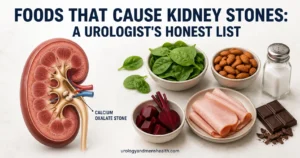
None of this makes those foods forbidden. It makes them countable. For the broader list of dietary triggers beyond oxalate, including sodium and animal protein, see our guide to the foods that actually drive stone formation.
Cooking Changes the Numbers on the Chart
Published oxalate values are usually measured on the food as prepared in that particular study, which is why the same vegetable appears with different numbers on different lists. Chai and Liebman analysed nine vegetables raw and cooked and found that boiling removed 30 to 87 percent of soluble oxalate, steaming removed 5 to 53 percent, and baking a potato removed none at all [4]. They recovered essentially all of the lost oxalate in the cooking water.
That last detail is the actionable one. The oxalate goes into the water, so the water must go down the sink. Boiling vegetables and then using the liquid for a soup or sauce returns the entire load to the plate.
- Boil and drain rather than steam, roast or sauté, for any vegetable in the moderate band.
- If you want the texture of sautéed vegetables, blanch them in boiling water for 3 to 5 minutes first, drain, then finish in the pan.
- Peel and boil potatoes instead of baking them in the skin. Most of a potato’s oxalate sits in and just under the skin.
- Do not expect this to rescue spinach or rhubarb. Cutting 87 percent off 755 mg still leaves you near 100 mg in a half-cup serving.
Who Actually Needs a Low-Oxalate Diet
This is the question the food charts never ask, and it decides whether any of the above is worth your effort. Oxalate restriction is indicated for men with calcium oxalate stones and a documented high oxalate result on a 24-hour urine collection [1][3]. Both halves of that sentence carry weight.
If your stone was uric acid, calcium phosphate or struvite, this chart is not your intervention and following it will cost you effort for no return. If your stone was calcium oxalate but your 24-hour urine oxalate came back normal, your stone risk is being driven by something else, most often low urine volume, hhronic kidney disease should avoid it outright rather than portion it. For the full picture, see ESWL Shockwave Lithotripsy.
There is one group in whom oxalate is the dominant problem and diet alone will not fix it: men with fat malabsorption. After gastric bypass, or with Crohn’s disease, chronic pancreatitis or coeliac disease, unabsorbed fat binds calcium in the gut, leaving oxalate free to be absorbed in large quantities. This is enteric hyperoxaluria, and it produces urine oxalate levels that a food chart cannot correct on its own. It needs specific management, usually including calcium taken deliberately with every meal. For the full picture, see CKD Explained.
What to actually ask for: send any stone you pass for composition analysis, and ask your urologist for two 24-hour urine collections on your normal diet. When the results come back, ask for the oxalate figure in milligrams per 24 hours rather than a verdict, and repeat the collection three to four months after any dietary change so you can see whether it worked. If you want the substitution side of this rather than the restriction side, our low-oxalate diet food list covers what a week of eating actually looks like.
When to Stop Self-Managing and Get Seen
A food chart is a prevention tool, not a treatment. Arrange urgent assessment rather than adjusting your diet if you have:
- Severe one-sided flank pain with vomiting that you cannot control at home
- Fever or shaking chills with flank pain — an infected obstructed kidney is a surgical emergency, not a stone that will pass
- Visible blood in the urine that persists beyond a single episode, or any visible blood if you are over 50
- Passing very little urine, or none, particularly if you have one working kidney
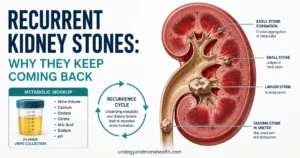
- Repeat stones despite a genuinely low-oxalate diet and adequate fluid intake, which points to a metabolic cause needing formal workup rather than more restriction
Frequently Asked Questions
Do I need to cut high oxalate foods if my stone was calcium oxalate?
Not automatically. The recommendation applies to men with calcium oxalate stones and a documented high oxalate level on a 24-hour urine collection. If your collection came back with normal oxalate, restricting spinach and nuts buys you very little, and the effort is better spent on fluid volume, sodium and citrate as set out in the full kidney stone diet protocol. Ask for the actual oxalate figure in milligrams per 24 hours before changing anything.
How many milligrams of oxalate per day should I aim for?
There is no single agreed number. The University of Michigan urology program advises 40 to 50 mg per day for stone formers, while the University of Chicago stone program works to a budget of about 100 mg per day. Either target is workable. What matters more is that you count at all, because two servings of the wrong food will exceed both several times over.
Does boiling spinach make it safe for a stone former?
It helps, but not enough. Boiling removes 30 to 87 percent of soluble oxalate, which still leaves a half-cup serving of cooked spinach in the hundreds of milligrams. Boiling turns a moderate food into a low one; it cannot turn the highest oxalate food in the ordinary diet into a safe one. Use the oxalate food list tool to find a substitute instead — kale runs about 2 mg per cup.
Is almond milk as high in oxalate as whole almonds?
Lower per glass, but it is not a free pass. Almond milk is made by soaking and straining almonds, so oxalate carries into the liquid, and people drink far more of it than they would ever eat as whole nuts. If you use almond milk in coffee, almond flour in baking and almond butter on toast in the same day, you have rebuilt a full almond serving without noticing.
Can a calcium supplement replace calcium from food?
Only if you take it with the meal that contains the oxalate. The benefit comes from calcium binding oxalate inside the gut so that it leaves in stool rather than urine. A calcium tablet swallowed at bedtime, hours away from dinner, misses that window entirely. Calcium citrate taken with food is the usual choice, and it supplies citrate, which itself inhibits stone formation.
References
- Pearle MS, Matlaga BR, Antonelli JA, et al. Medical Management of Kidney Stones: AUA Guideline (2026) Part I: Evaluation of Patients with Kidney Stones and Dietary Management of Patients with Calcium Stones. J Urol. Published online July 30, 2026. Journal of Urology
- Holmes RP, Goodman HO, Assimos DG. Contribution of dietary oxalate to urinary oxalate excretion. Kidney Int. 2001;59(1):270-276. PubMed
- Holmes RP, Knight J, Assimos DG. Lowering urinary oxalate excretion to decrease calcium oxalate stone disease. Urolithiasis. 2016;44(1):27-32. PubMed
- Chai W, Liebman M. Effect of different cooking methods on vegetable oxalate content. J Agric Food Chem. 2005;53(8):3027-3030. ACS Publications
- Ferraro PM, Curhan GC, Gambaro G, Taylor EN. Total, dietary, and supplemental vitamin C intake and risk of incident kidney stones. Am J Kidney Dis. 2016;67(3):400-407. PubMed
- Harvard T.H. Chan School of Public Health / Brigham and Women’s Hospital. Oxalate Content of Foods. Harvard
- University of Michigan Department of Urology. Low Oxalate Diet Guidelines for Kidney Stone Formers. Michigan Medicine
- Coe FL. How to eat a low oxalate diet. University of Chicago Kidney Stone Program. University of Chicago
Dr. Muhammad Khalid
MBBS · FCPS (Urology) · MCPS (General Surgery) · CHPE · CRSM · IMC #539472
Specialist urologist with 11+ years of clinical experience across tertiary teaching hospitals. Trained at Lady Reading Hospital and Khyber Teaching Hospital, Peshawar. Author or co-author of five peer-reviewed international publications, including in Cureus and the World Journal of Surgery. Procedural expertise: URS, PCNL, RIRS, TURP, TURBT, and major open urological surgery. Full profile →
This article is for educational purposes only and does not constitute medical advice. Always consult your physician or urologist for diagnosis and treatment decisions specific to your condition.