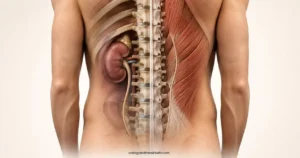
Heat and Kidney Stone Recurrence: What Actually Raises Risk
The link between heat and kidney stone recurrence is not a distant climate problem. In the data, risk peaks within three days of a hot spell — which means this week's weather matters far more than any 2089 projection.

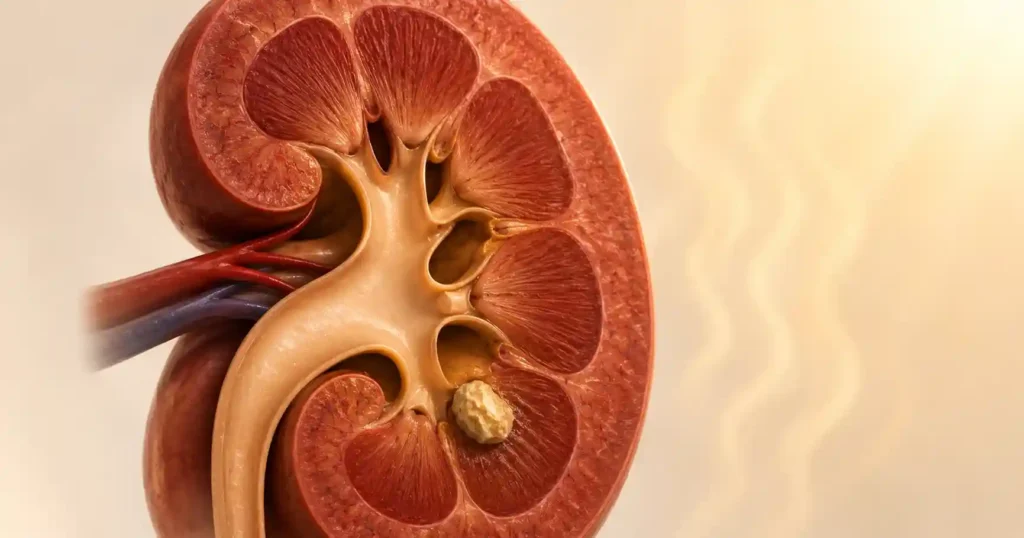
Heat and kidney stone recurrence are linked far more tightly — and far more quickly — than most men expect. The stone that puts you in the emergency room in August was not seeded in August. It was seeded over the preceding few days, while you were losing fluid faster than you replaced it and your kidneys quietly concentrated everything they were trying to excrete. Time-series data from five US cities shows stone presentations climbing within three days of a hot spell, not three months. That short lag is the practical point of this article. The weather that matters to your kidneys is the weather this week, not the climate projection for 2089. It also means the countermeasure is short-term and specific: you can change your fluid intake on Tuesday and change your urine chemistry by Friday. For the full picture of how stones form, present, and get treated, see our Kidney Stones Hub. Below is what the temperature data actually shows, who it applies to, and what to do about it.
Key Takeaways
- Stone presentations rise within three days of a hot day — the lag is short enough that a single heat wave can trigger an attack in someone who was fine the week before.
- Men working in high-heat industrial areas had a ninefold higher stone rate than colleagues in the same company working at room temperature, driven by low urine volume and low urinary citrate.
- Los Angeles — the hottest-climate city in the five-city US analysis — showed the weakest and least certain heat effect, which tells you acclimatization and behavior blunt the risk substantially.
- Raising urine output above 2 liters daily cut five-year stone recurrence from 27% to 12% in a randomized trial. In hot weather that is the highest-yield thing you can do.
How Heat Turns Into a Kidney Stone
Your kidneys do not respond to how much you drink. They respond to the concentration of what they have to get rid of. That distinction is the whole mechanism.
During heavy outdoor work in the heat, sweat losses can exceed 1 liter (about 34 fl oz) per hour. That fluid leaves through skin, not urine. Your solute load — calcium, oxalate, uric acid, sodium — does not drop by the same proportion. Antidiuretic hormone rises, the collecting ducts pull water back, and urine volume falls while the amount of stone-forming material inside it stays roughly constant.
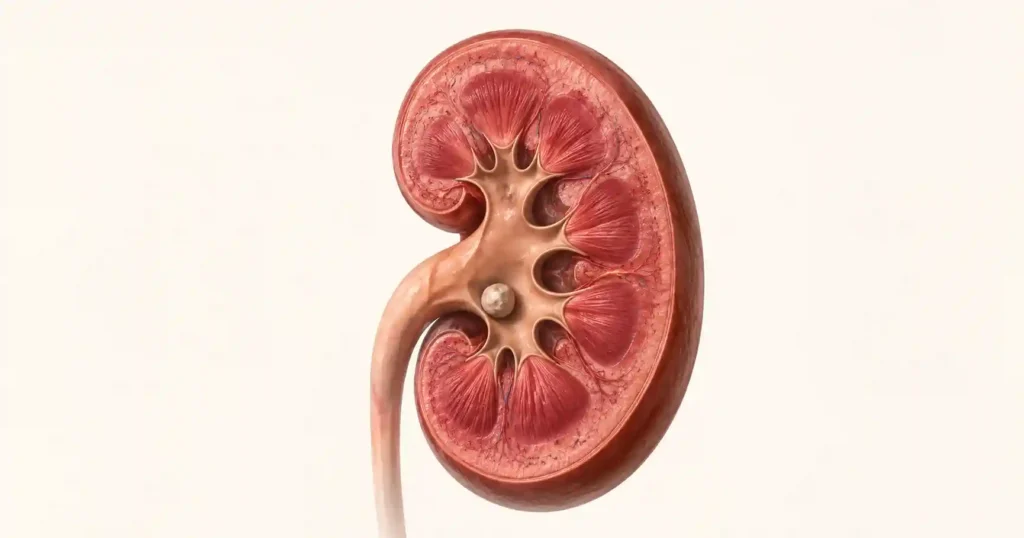
The result is supersaturation: a solution holding more dissolved material than it can stably keep dissolved. Think of stirring sugar into iced tea. Up to a point it disappears. Past that point it sits on the bottom of the glass no matter how hard you stir. Urine behaves the same way, except the crystals that drop out have a surface to cling to — the renal papilla — and they grow.
There is a second mechanism that gets far less attention, and in my view it is the more damaging one. Heat stress and repeated dehydration lower urinary citrate. Citrate is the body’s main built-in inhibitor of calcium oxalate crystallization — it binds calcium so that calcium is not available to bind oxalate. Losing citrate is not a side note. It removes the brake at exactly the moment the accelerator is pressed. A 2025 review of heat and kidney disease mechanisms traces the same pathway: dehydration, altered renal perfusion, and inflammatory tubular stress converging on stone formation [1].
The Three-Day Lag: What the Temperature Data Shows
The strongest evidence here is a time-series analysis of 60,433 patients who sought care for kidney stones between 2005 and 2011 across Atlanta, Chicago, Dallas, Los Angeles, and Philadelphia [2]. It compared daily mean temperature against stone presentations, using a reference temperature of 10°C (50°F).
At a daily mean of 30°C (86°F), the cumulative relative risk of a stone presentation was 1.38 in Atlanta, 1.37 in Chicago, 1.36 in Dallas, and 1.47 in Philadelphia. In plain terms: roughly a 36% to 47% higher chance of someone presenting with a stone on a hot day versus a cool one.
Two findings in that paper are more interesting than the headline number, and both get ignored in general coverage.
First, Los Angeles broke the pattern. The hottest-climate city in the group produced a relative risk of only 1.11, with a confidence interval crossing 1 — meaning the effect could not be distinguished from chance. If heat alone drove stones, LA should have shown the largest signal. It showed the smallest. The most plausible explanations are physiological acclimatization, near-universal air conditioning, and lower humidity permitting more efficient sweat evaporation. This matters to you personally: heat exposure is modifiable in ways average annual temperature is not.
Second, cold weather was not protective. Presentations also rose at temperatures below 2°C (36°F) in Atlanta and below 10°C in Chicago and Philadelphia. The relationship is not a straight line; it is U-shaped in several cities. Winter drives people indoors into dry heated air, reduces thirst signaling, and shifts diet. Stone formers who relax their fluid discipline in January are not safe — they are simply exposed by a different route.
The lag finding is the one that changes behavior. In four of the five cities, the strongest association between a 30°C day and a stone presentation occurred at lags of three days or fewer. Crystals do not need weeks. They need a few days of concentrated urine and a surface to grow on.
Check your own five-year recurrence risk with the Kidney Stone Risk Profiler →Who Actually Gets Heat-Driven Stones
The cleanest occupational data comes from a study of 10,326 steel industry employees, split into those working in areas above 45°C (113°F) and those working at room temperature within the same company [3].
Stone episodes occurred in 8.0% of the hot-area workers versus 0.9% of the room-temperature workers — a ninefold difference. When a subset without stones underwent metabolic testing, the hot-area group had hypocitraturia (low urinary citrate) in 55.8% versus 28%, and low urine volume in 79.4% versus 48%. Same employer, same region, same water supply. The variable was heat exposure at the workstation.
That study describes a foundry, but the physiology applies to anyone with sustained heat exposure and limited bathroom access: roofers, landscapers, road crews, warehouse and delivery drivers without cabin air conditioning, kitchen staff, military personnel, and long-haul drivers who deliberately restrict fluid to avoid stops. In my experience that last group is the most under-recognized, because the fluid restriction is voluntary and never mentioned unless you ask directly.
The three groups where heat matters most
- Anyone who has already passed a stone. You have demonstrated the metabolic tendency. Heat removes your margin of safety, it does not create a new problem.
- Occupational heat exposure with restricted bathroom access. The restriction is the multiplier — it converts a hydration problem into a deliberate one.
- Men on thiazides, loop diuretics, or SGLT2 inhibitors. These shift fluid balance before heat is added on top. If you take one and work outdoors, ask your prescriber at your next appointment whether your summer dosing needs review.
In My Practice
The pattern I see most often is not the man who has never had a stone. It is the man who passed one three or four years ago, changed his habits for about six months, then drifted back — and then took a construction job, or a summer holiday somewhere hot, or started working in an unventilated unit. He arrives in the emergency department genuinely surprised, because nothing about his diet changed. Nothing had to. His fluid output had halved.
Heat rarely creates a new stone former; it exposes an existing one who stopped compensating.
Cut your recurrence risk before the next heat wave — get the 7-Day Kidney Stone Prevention Meal Plan
Enter your email below to receive Dr. Khalid’s complete 7-Day Kidney Stone Prevention Meal Plan as a free, printable PDF.
What the Climate Projections Do and Don’t Tell You
I want to be straight about this section, because the climate framing gets oversold and that eventually costs credibility.
The most-cited projection modeled the northward expansion of the US “stone belt” — the historically high-risk southeastern band [4]. It estimated the share of the US population living in high-risk zones rising from 40% in 2000 to 56% by 2050 and 70% by 2095, with 1.6 to 2.2 million additional lifetime cases by 2050 and an annual cost increase of $0.9 to $1.3 billion in year-2000 dollars.
A later analysis modeled South Carolina specifically, using projected wet-bulb temperatures out to 2089 under two emissions scenarios [5]. Heat-attributable stone presentations were projected to increase by 2.2% under aggressive emissions reduction and 3.9% under unrestrained emissions by 2085–89, compared with 2010–2014, with excess costs of roughly $57 million and $99 million respectively.
Read those two numbers together. A 2 to 4 percentage-point rise in heat-attributable presentations over six decades is a real public health cost, but it is not the number that should govern your behavior. Contrast it with the ninefold occupational difference above, or the roughly 40% single-day risk increase on a hot day. Your job, your fluid habits, and this week’s forecast dominate your personal risk by an order of magnitude over the climate signal. Both projections also assume no adaptation — no behavior change, no cooling, no public health response. That assumption is the point of the model, not a prediction about you.
The honest summary: climate change is a reason your grandchildren’s urologist will be busier. It is not a reason you personally will form a stone. The heat wave next week is.
How Much You Actually Need to Drink in Hot Weather
The strongest single piece of evidence in stone prevention is a five-year randomized trial in first-time calcium stone formers [6]. One group was instructed to raise water intake with no other dietary change. The other received no intervention.
Recurrence at five years: 12 of 99 patients in the high-water group versus 27 of 100 in the control group. Among those who did recur, the average time to relapse was 38.7 months with high water intake versus 25.1 months without. Baseline urine volume in male calcium oxalate stone formers averaged 1,057 mL per 24 hours, against 1,401 mL in men who had never formed a stone. That gap — roughly 350 mL, about a mug and a half — separated stone formers from non-stone formers.
The AUA target for stone prevention is a urine output of at least 2.5 liters daily (about 85 fl oz) [7]. Note the wording carefully: urine output, not fluid intake. In hot weather those two numbers separate dramatically, because a large share of what you drink exits through skin. Drinking 2.5 liters on a 32°C day while working outdoors may produce well under a liter of urine. The intake target that worked in December will fail you in July.
How to know whether you are actually hitting the target
- Weigh yourself before and after a hot shift. Each kilogram lost is roughly 1 liter of fluid you have not replaced. Two kilos down means you are running a 2-liter deficit before you have urinated at all.
- Judge by urine color, not thirst. Pale straw is the target. Thirst is a lagging indicator — by the time you feel it you are already concentrated.
- Front-load. Drink 500 mL (about 17 fl oz) before heat exposure begins, not after. Catching up afterward does not undo crystals that already formed.
- Add a citrate source daily. Fresh lemon or lime juice in water raises urinary citrate, the inhibitor that heat depletes. It is the cheapest countermeasure available.
To set a personal daily target rather than a generic one, the hydration calculator for stone prevention adjusts for body weight and activity. Sodium replacement is the other half of this question, and it cuts both ways — heavy sweating genuinely depletes sodium, but higher sodium intake also drives urinary calcium excretion upward. The tension between those two is covered in detail in the piece on how salt links kidney stones and blood pressure.
What to Change Before the Next Heat Wave
Six specific actions, in the order I would give them in clinic to a man who has passed at least one stone.
- Set a bottle count, not a vague intention. Decide how many refills of your specific bottle equals your target, and count them. “Drink more water” fails every summer.
- Treat the forecast as a medical alert. When you see three consecutive days above 30°C, that is your cue to raise intake that morning — not after the third day.
- Fix the bathroom-access problem directly. If your work restricts breaks, that conversation with your supervisor is a genuine clinical intervention, not an inconvenience.
- Time your metabolic testing to a hot month. If you have had two or more stones, ask your urologist to schedule a 24-hour urine collection during summer rather than winter, so the result reflects your actual worst-case chemistry. The full workup is explained in the guide to why recurrent kidney stones keep coming back.
- Keep the dietary base steady year-round. Heat changes fluid requirements; it does not change your oxalate, calcium, or protein targets. Those are set out in the clinical kidney stone diet protocol.
- Review medications before summer starts. Ask your prescriber at your next scheduled appointment whether any diuretic or SGLT2 inhibitor needs adjustment for heavy heat exposure.
When Hot-Weather Stone Pain Needs the ER Today
Most stone pain can be managed at home or via a same-week urology appointment. These cannot wait, and heat-related dehydration makes several of them more likely:
- Fever above 38°C (100.4°F) with flank pain — this suggests an infected obstructed kidney, which is a surgical emergency, not an infection to treat with oral antibiotics.
- Vomiting that prevents you keeping any fluid down for more than a few hours, since you cannot rehydrate and the obstruction worsens.
- Producing little or no urine over 12 hours despite drinking, particularly if you have one functioning kidney or a transplant.
- Pain that is not controlled by the analgesia you were prescribed, or that changes character from colicky waves to constant severe pain.
- Confusion, fainting, or a heart rate that stays above 100 at rest — this is dehydration plus sepsis until proven otherwise.
Frequently Asked Questions
Does hot weather actually cause kidney stones, or does it just move ones I already have?
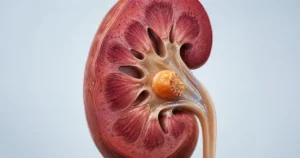
Both, but the first matters more. Heat raises the concentration of calcium, oxalate, and uric acid in your urine, and new crystals form within days. Heat does not physically push an existing stone. What it does is accelerate the growth of stones already sitting quietly in a calyx until one reaches the size where it drops into the ureter. That is why heat and kidney stone recurrence appear in the data as new presentations, not simply relocated old ones. Setting a personal daily fluid target using the hydration calculator for stone prevention is the direct countermeasure.
How soon after a hot spell does a stone attack usually happen?
Faster than most people assume. In the five-city US time-series analysis, the strongest association between a daily mean temperature of 30°C and a stone presentation appeared at lags of three days or fewer in four of the five cities studied. Practically, that means the fluid decisions you make during a heat wave affect your risk that same week, and catching up on water afterward will not dissolve crystals that have already formed. Front-loading fluid before heat exposure is covered in the clinical kidney stone diet protocol.
I passed one stone years ago. Does summer really raise my odds of another one?
Yes, and more than it raises anyone else’s. A first stone demonstrates the underlying metabolic tendency, so heat is not creating a new problem — it is removing the margin you were relying on. If you have had two or more stones, ask your urologist to schedule a 24-hour urine collection during a hot month rather than in winter, so the result captures your true worst-case chemistry. The full testing sequence is explained in the guide to why recurrent kidney stones keep coming back.
Is plain water enough in hot weather, or do I need electrolyte drinks?
For most men, water plus a daily citrate source such as fresh lemon juice is enough. Electrolyte replacement becomes relevant only with sustained heavy sweating over several hours, and it carries a trade-off: sodium replacement corrects one problem while raising urinary calcium excretion, which promotes stones. If you use electrolyte products daily, choose lower-sodium options and check the sugar content. The full trade-off between salt, stones, and blood pressure is worth understanding before you commit to a product.
If I live somewhere hot year-round, is my risk permanently higher?
Not as much as you would expect, and that is one of the more reassuring findings in this literature. Los Angeles, the hottest-climate city in the five-city analysis, showed the weakest heat effect of all five, with a relative risk that could not be separated from chance. Physiological acclimatization, air conditioning, and lower humidity appear to blunt the effect substantially. Sudden unaccustomed heat exposure carries more risk than chronic residence in a warm climate. The Kidney Stone Risk Profiler weighs climate alongside your other recurrence factors.
References
- Valcheva E, Dimov N. Rising Global Temperatures and Kidney Health: A Comprehensive Review of Current Evidence. Life (Basel). 2025;15(12):1897. PubMed
- Tasian GE, Pulido JE, Gasparrini A, et al. Daily mean temperature and clinical kidney stone presentation in five U.S. metropolitan areas: a time-series analysis. Environ Health Perspect. 2014;122(10):1081-1087. PubMed
- Atan L, Andreoni C, Ortiz V, et al. High kidney stone risk in men working in steel industry at hot temperatures. Urology. 2005;65(5):858-861. PubMed
- Brikowski TH, Lotan Y, Pearle MS. Climate-related increase in the prevalence of urolithiasis in the United States. Proc Natl Acad Sci U S A. 2008;105(28):9841-9846. PubMed
- Kaufman J, Vicedo-Cabrera AM, Tam V, et al. The impact of heat on kidney stone presentations in South Carolina under two climate change scenarios. Sci Rep. 2022;12(1):369. PubMed
- Borghi L, Meschi T, Amato F, et al. Urinary volume, water and recurrences in idiopathic calcium nephrolithiasis: a 5-year randomized prospective study. J Urol. 1996;155(3):839-843. PubMed
- American Urological Association. Medical Management of Kidney Stones: AUA Guideline (2026). AUA
Dr. Muhammad Khalid
MBBS · FCPS (Urology) · MCPS (General Surgery) · CHPE · CRSM · IMC #539472
Specialist urologist with 11+ years of clinical experience across tertiary teaching hospitals. Trained at Lady Reading Hospital and Khyber Teaching Hospital, Peshawar. Author or co-author of five peer-reviewed international publications, including in Cureus and the World Journal of Surgery. Procedural expertise: URS, PCNL, RIRS, TURP, TURBT, and major open urological surgery. Full profile →
This article is for educational purposes only and does not constitute medical advice. Always consult your physician or urologist for diagnosis and treatment decisions specific to your condition.