Kegel Exercises for Men: A Urologist’s 12-Week Protocol
Most men doing Kegel exercises are squeezing the wrong muscle and have never been told. Here is how to confirm you have found the pelvic floor, the 12-week protocol I give patients, and when Kegels make things worse.

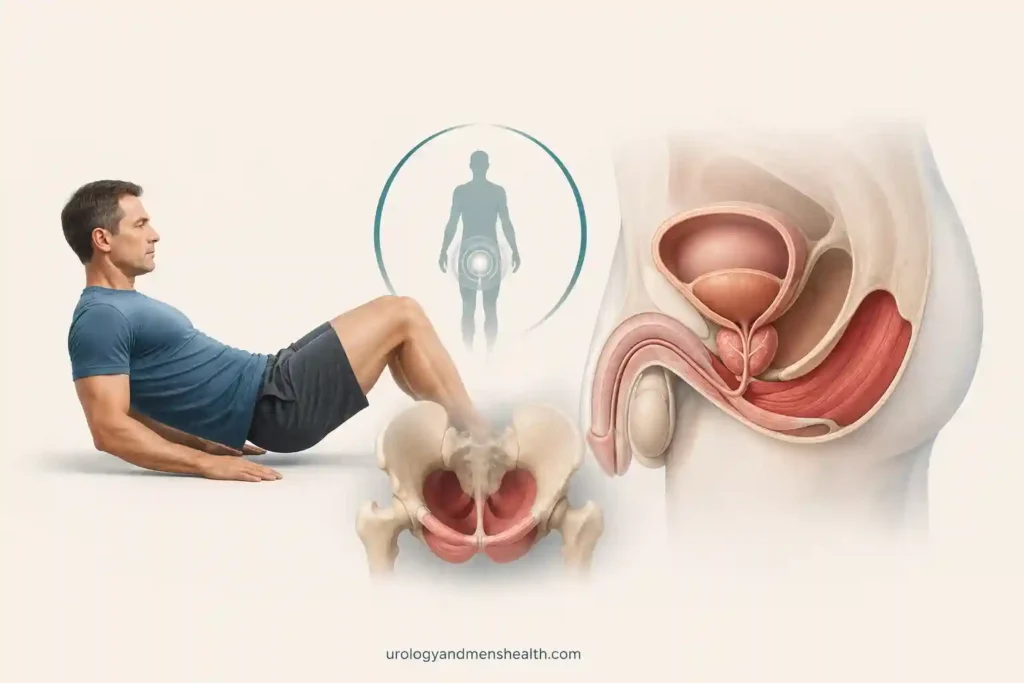
Kegel exercises for men are the most badly taught intervention in urology. I say that having watched hundreds of men leave a clinic with a photocopied sheet reading “squeeze the muscles you use to stop urine flow, ten times, three times a day” — then return six months later no better, because nobody ever checked whether they had found the right muscle. Some were squeezing their buttocks. Some were bearing down, which is the exact opposite of the movement they needed. A smaller group were performing them perfectly and getting worse, because a weak pelvic floor was never their problem. Done properly, pelvic floor muscle training moves real outcomes: faster continence recovery after prostate surgery, less post-void dribble, longer ejaculatory latency, and better erectile rigidity in men whose erectile dysfunction has a muscular component. Done from a photocopied sheet, it does close to nothing. For the wider picture on men’s urological health, see our Men’s Wellness Hub.
Key Takeaways
- The target is the levator ani and external urethral sphincter — not the abdomen, buttocks, or thighs. If your belly bulges or your buttocks clench, the contraction is wrong.
- AUA guidelines recommend pelvic floor muscle exercises before and immediately after radical prostatectomy, but the evidence says they shorten the recovery period rather than change the 12-month outcome.
- Post-void dribble responds to one “squeeze out” contraction performed after the last drop — not to more repetitions during the day.
- Twelve weeks is the minimum before judging whether the exercises have worked. Strength gains in a small postural muscle are slow and invisible for the first month.
- If your dominant symptom is perineal pain, pain at the tip of the penis, hesitancy, or a sense of incomplete emptying, Kegels may make you worse — that pattern usually means a non-relaxing pelvic floor.
What Kegel Exercises for Men Actually Do
A Kegel is not one muscle. A correct contraction recruits four structures at once, and each one explains a different symptom men come to see me about.
The levator ani is the muscular hammock slung across the pelvic outlet. Its front portion, the puborectalis, pulls the rectum and urethra forward toward the pubic bone. Think of it as a shelf: when it lifts, everything resting on it is supported against downward pressure from a cough or a lift.
The external urethral sphincter — the rhabdosphincter — is a ring of striated muscle around the membranous urethra, just below the prostate. This is the muscle under voluntary control, and it is the one that carries the entire continence burden once the prostate has been removed. Its length and strength are the single strongest anatomical predictor of how quickly a man regains continence after a prostatectomy.
The bulbospongiosus wraps the bulb of the urethra behind the scrotum. Its reflex job is to milk the last few millilitres of urine out of the bulbar urethra after voiding. When it is weak or its reflex timing is off, that residual pool drains out two minutes later, into underwear, in the car park.
The ischiocavernosus sits over each crus of the penis. When it contracts, it compresses the crura against the pubic bone and raises pressure inside the erectile bodies above what arterial inflow alone can generate. That pressure spike is what converts a full erection into a rigid one.
There is a fifth effect that is not muscular at all. A sharp pelvic floor contraction triggers a reflex that dampens bladder muscle activity — which is why a well-timed squeeze can shut down an urgency wave before it becomes a dash to the bathroom. That reflex is the basis of urge suppression training in overactive bladder in men, and it is a different skill from strengthening.
How to Find the Right Muscle, and the Three Mistakes Men Make
The instruction that works is not “stop your urine.” It is this: shorten your penis and lift your testicles, without moving anything else.
Stand undressed in front of a mirror. Attempt the contraction. If you are recruiting the pelvic floor correctly, you will see the base of the penis draw inward by a few millimetres and the scrotum lift slightly. That visible movement is the confirmation. Nothing else confirms it — not effort, not sensation, not how hard it feels.
Mistake 1: Using the urine stream as your training method
Interrupting the stream once, on one occasion, is a reasonable way to identify the muscle. Doing it routinely teaches your bladder and sphincter to work against each other. Over months that dyscoordination can raise the volume of urine left behind after voiding and make emptying less efficient. Identify the muscle this way once, then never again.
Mistake 2: Bearing down instead of lifting up
This is the most common and the most damaging error. Men associate “trying hard” with the sensation of straining, so they hold their breath and push down, as though passing a stool. That drives pressure onto the sphincter rather than closing it. If your abdominal wall bulges outward during the contraction, you are doing the opposite of the exercise. Breathe out gently as you lift.
Mistake 3: Substituting the buttocks, thighs, or abdomen
The pelvic floor is small and unfamiliar. Larger neighbouring muscles volunteer for the job. Put one hand flat on your abdomen and one on a buttock while you contract. Both should stay still. If either moves, the pelvic floor is likely doing very little of the work.
If you have practised in front of a mirror daily for two weeks and cannot produce any visible penile retraction, stop self-directing this. Ask your primary care doctor or urologist for a referral to a pelvic floor physiotherapist for a digital assessment with biofeedback — a therapist can confirm in one appointment what you may not be able to confirm alone in six months.
In My Practice
A man came back to see me five months after a robotic prostatectomy, still using three pads a day, frustrated that his Kegels were not working. He had been doing them faithfully, twice a day, since the catheter came out. I asked him to perform one while I watched. His abdominal wall pushed forward, his breath stopped, and his perineum descended. He had been bearing down roughly two hundred times a day for five months, loading the exact sphincter he was trying to protect.
Before you count repetitions, confirm the movement — an unverified Kegel programme is not a weak treatment, it is often the wrong one performed with commitment.
The Pelvic Floor Protocol I Give Patients
The pelvic floor contains both slow-twitch fibres, which hold tone all day, and fast-twitch fibres, which fire in the fraction of a second before a cough. Training only one leaves half the job undone, which is why a protocol built solely on long holds disappoints men who leak when they sneeze.
- Endurance holds: lift and hold for 5 seconds, rest fully for 10 seconds, repeat 10 times. Progress the hold by one second each week toward 10 seconds. The rest interval matters as much as the hold — a fatigued muscle recruits substitutes.
- Quick flicks: 10 maximal contractions of about one second each, with a full release between them. These train the reflex that closes the sphincter before intra-abdominal pressure rises.
- Three sessions per day. Not thirty. Volume beyond this produces fatigue and substitution, not strength.
- Position progression: weeks 1–4 lying down, weeks 5–8 seated, weeks 9–12 standing. Gravity is the load. Starting standing is why many men never feel the muscle at all.
Then there is the part that most instruction sheets omit, and the part that changes daily life fastest: the pre-emptive contraction. Contract and hold before you cough, sneeze, lift a box, or stand up from a chair — not after the leak has started. Most men who master this one habit report improvement weeks before their raw strength has changed at all.
The urge-suppression contraction
When urgency hits, the instinct is to rush toward the bathroom. Rushing raises abdominal pressure and worsens the urge. Instead: stop moving, sit or stand still, perform 5 to 8 quick flicks in succession, breathe out slowly, and wait for the wave to subside — it usually does within 30 seconds. Then walk at a normal pace. Combined with a structured bladder training schedule, this is the core of behavioural treatment for urgency. If you want a baseline number before you start, the Overactive Bladder Symptom Score takes about a minute and gives you a validated figure to re-measure at week 12.
Score your leakage before you start — the ICIQ Urinary Incontinence Severity Score gives you a number to compare against at week 12Get the OAB & Incontinence Guide — printable 12-week pelvic floor progression and bladder diary
Enter your email below to receive Dr. Khalid’s complete OAB & Incontinence Guide as a free, printable PDF.
Kegels After Prostate Surgery: What the Evidence Actually Shows
This is where I have to be straight with you, because most pages on this topic are not.
The AUA/GURS/SUFU Incontinence After Prostate Treatment guideline, published in 2019 and amended in 2024, states that clinicians may offer pelvic floor muscle exercises before radical prostatectomy, and should offer them in the immediate post-operative period [1][2]. That is a real recommendation from the primary US guideline body, and it is why I start every prostatectomy patient on a programme four weeks before surgery.
But the largest trial of formal training tells a more sobering story. The MAPS trial, published in The Lancet in 2011, randomised men who were still incontinent six weeks after radical prostatectomy or TURP to four one-to-one sessions with a therapist over three months, versus standard care with a written instruction sheet. At 12 months there was no significant difference in incontinence between the groups, and the intensive intervention was not cost-effective [4]. The 2015 Cochrane review of conservative management reached a similar conclusion: the evidence is conflicting and the value of the various approaches remains uncertain [3].
Here is how I reconcile that with the guideline, and with what I see in clinic. Most men are continent by 12 months after a prostatectomy whether or not they train. What pelvic floor work appears to change is how fast you get there — the first three to six months, which is precisely the period when men stop going out, stop exercising, and stop having sex. Shortening that window is a legitimate goal even if the 12-month endpoint is unchanged. What it is not is an insurance policy against permanent incontinence.
Practically, ask your surgical team for three specific things: a referral to a pelvic floor physiotherapist four weeks before your operation rather than after it; written confirmation of when to restart contractions once the catheter is out, which is usually immediately but should be confirmed for your case; and a review appointment at three months where the plan is re-examined if you are still using more than one pad a day.
What recovery actually looks like month by month after a radical prostatectomyKegels for Erections, Ejaculation Control, and Post-Void Dribble
Urinary leakage is the reason most men are handed this exercise. It is not the only reason it works.
Erectile function. Dorey and colleagues randomised 55 men with erectile dysfunction to pelvic floor exercises with biofeedback and lifestyle change, or lifestyle change alone, and reported that 40% regained normal erectile function and a further 34.5% improved by six months [5]. That trial was published in 2004, was small, and had no sham arm — so treat the figures as encouraging rather than settled. The mechanism is real regardless: the ischiocavernosus generates the supra-systolic pressure that produces rigidity, and it is a skeletal muscle that responds to training like any other.
Ejaculatory control. Pastore and colleagues treated 40 men with lifelong premature ejaculation and a baseline intravaginal ejaculatory latency time of one minute or less with a 12-week pelvic floor rehabilitation programme, and reported a substantial increase in latency [7]. Again: uncontrolled, 40 men, one centre. I offer it as an adjunct to men who want to avoid or delay medication, not as a replacement for treatments with stronger evidence.
Post-void dribble. This one I am confident about, because the fix is mechanical and the results are fast. After you finish voiding and shake off, perform one firm 3-second contraction — the “squeeze out” — which forces the bulbospongiosus to empty the pool of urine still sitting in the bulbar urethra. Dorey’s randomised trial found this specific technique significantly effective for post-micturition dribble [6]. Most men notice a difference inside two weeks, which is far faster than any strength adaptation. If dribbling is your main complaint, the full workup is covered in our guide to post-micturition dribble in men.
When Kegels Are the Wrong Answer
A pelvic floor can fail in two opposite directions, and the exercise that fixes one aggravates the other.
The non-relaxing pelvic floor. Some men have a floor that is not weak but permanently over-contracted and unable to let go. The presentation is distinctive: aching in the perineum, pain referred to the tip of the penis, pain that worsens with prolonged sitting, discomfort after ejaculation, hesitancy starting the stream, and a feeling that the bladder never fully empties. Telling that man to strengthen is like prescribing bicep curls for a cramp. Treatment runs in the opposite direction — diaphragmatic breathing, hip and adductor stretches, warm baths, and manual release with a pelvic floor therapist. If this pattern sounds familiar, read our article on pelvic floor dysfunction versus chronic pelvic pain syndrome before you start any strengthening programme.
Overflow leakage. If your bladder is not emptying — because of an enlarged prostate, a urethral stricture, or an underactive bladder muscle — urine spills over from a chronically full bladder. That leak looks like stress incontinence to the man experiencing it, but the mechanism is obstruction, and no amount of squeezing addresses it. A post-void residual above 100 mL (about 3.4 fl oz) on a bladder scan points this way. Ask for a bladder scan before starting a programme if you also strain to start, have a weak stream, or wake more than twice a night.
Severe persistent post-surgical incontinence. If you are 12 months out from prostate treatment and still using multiple pads a day, more repetitions will not resolve it. The AUA guideline is explicit that men who remain incontinent at one year, or who have severe incontinence at six months, should be evaluated for surgical treatment such as a male sling or an artificial urinary sphincter [1]. Request that referral rather than starting a fourth round of exercises.
When to Stop and See a Urologist
Pelvic floor training is safe for most men, but these findings mean the programme is not the right treatment and you need assessment first:
- Perineal, testicular, or penile-tip pain that appears or worsens after starting Kegels — stop the exercises and ask for a pelvic floor assessment within four weeks.
- Straining to start the stream, a weak flow, or the sense that your bladder never empties — request a post-void residual bladder scan before continuing.
- Still using more than one pad a day at 12 months after prostate surgery — ask for a referral to a reconstructive urologist, not more repetitions.
- Visible blood in the urine, fever with urinary symptoms, or complete inability to pass urine — go to the emergency room the same day.
Frequently Asked Questions
How long do Kegel exercises for men take to work?
Expect nothing measurable in the first four weeks. Post-void dribble often improves within two weeks because the squeeze-out is a technique change rather than a strength gain, but genuine strength adaptation in the pelvic floor takes 8 to 12 weeks. Score yourself at baseline using the ICIQ Urinary Incontinence Severity Score and repeat it at week 12 — judging progress by memory alone almost always underestimates it.
Can I do Kegels by stopping my urine stream?
Use it once, to identify the muscle, then stop. Repeatedly interrupting the stream trains your bladder and sphincter to contract against each other, which over months can leave more urine behind after voiding. The mirror test — watching for the base of the penis to draw inward — is a safer confirmation, and the post-void squeeze-out described in our guide to post-micturition dribble is the only stream-related contraction worth doing routinely.
Should I start Kegels before prostate surgery or after?
Before. The AUA guideline supports offering pelvic floor muscle exercises prior to radical prostatectomy as well as immediately afterward, and learning the movement is far harder through post-operative swelling and catheter discomfort. I ask patients to begin four weeks pre-operatively and to resume as soon as the catheter is removed. Our radical prostatectomy recovery timeline sets out what to expect month by month.
Can Kegel exercises make pelvic pain worse?
Yes, and this is the most common way the exercise backfires in men. If your floor is already over-contracted rather than weak, strengthening increases resting tone and typically worsens perineal ache, pain at the tip of the penis, and pain on sitting. Stop the programme and read our comparison of pelvic floor dysfunction and chronic pelvic pain syndrome, then ask for a pelvic floor assessment focused on relaxation rather than strength.
Do Kegels help urgency and frequency, or only leaking?
They help both, through different mechanisms. Strength addresses leaking on cough, sneeze, or lifting. Urgency responds to a reflex effect instead: a burst of 5 to 8 rapid contractions while standing still dampens bladder muscle activity and lets the wave pass. That skill is most effective paired with a structured schedule, which is covered in our guide to overactive bladder in men.
References
- Sandhu JS, Breyer B, Comiter C, et al. Incontinence after Prostate Treatment: AUA/SUFU Guideline. J Urol. 2019;202(2):369-378. AUA
- Breyer BN, Kim SK, Kirkby E, et al. Updates to Incontinence After Prostate Treatment: AUA/GURS/SUFU Guideline (2024). J Urol. 2024;212(4):531-538. Journal of Urology
- Anderson CA, Omar MI, Campbell SE, Hunter KF, Cody JD, Glazener CMA. Conservative management for postprostatectomy urinary incontinence. Cochrane Database Syst Rev. 2015;1(1):CD001843. PubMed
- Glazener C, Boachie C, Buckley B, et al. Urinary incontinence in men after formal one-to-one pelvic-floor muscle training following radical prostatectomy or transurethral resection of the prostate (MAPS): two parallel randomised controlled trials. Lancet. 2011;378(9788):328-337. PubMed
- Dorey G, Speakman M, Feneley R, Swinkels A, Dunn C, Ewings P. Randomised controlled trial of pelvic floor muscle exercises and manometric biofeedback for erectile dysfunction. Br J Gen Pract. 2004;54(508):819-825. PubMed
- Dorey G, Speakman M, Feneley R, Swinkels A, Dunn C, Ewings P. Pelvic floor exercises for treating post-micturition dribble in men with erectile dysfunction: a randomized controlled trial. Urol Nurs. 2004;24(6):490-497. PubMed
- Pastore AL, Palleschi G, Fuschi A, et al. Pelvic floor muscle rehabilitation for patients with lifelong premature ejaculation: a novel therapeutic approach. Ther Adv Urol. 2014;6(3):83-88. PubMed
Dr. Muhammad Khalid
MBBS · FCPS (Urology) · MCPS (General Surgery) · CHPE · CRSM · IMC #539472
Specialist urologist with 11+ years of clinical experience across tertiary teaching hospitals. Trained at Lady Reading Hospital and Khyber Teaching Hospital, Peshawar. Author or co-author of five peer-reviewed international publications, including in Cureus and the World Journal of Surgery. Procedural expertise: URS, PCNL, RIRS, TURP, TURBT, and major open urological surgery. Full profile →
This article is for educational purposes only and does not constitute medical advice. Always consult your physician or urologist for diagnosis and treatment decisions specific to your condition.