Best Diet for Prostate Health: What the Evidence Shows
Most men asking about the best diet for prostate health assume the goal is preventing cancer. The trial evidence points somewhere else entirely — and that changes what actually belongs on your plate.

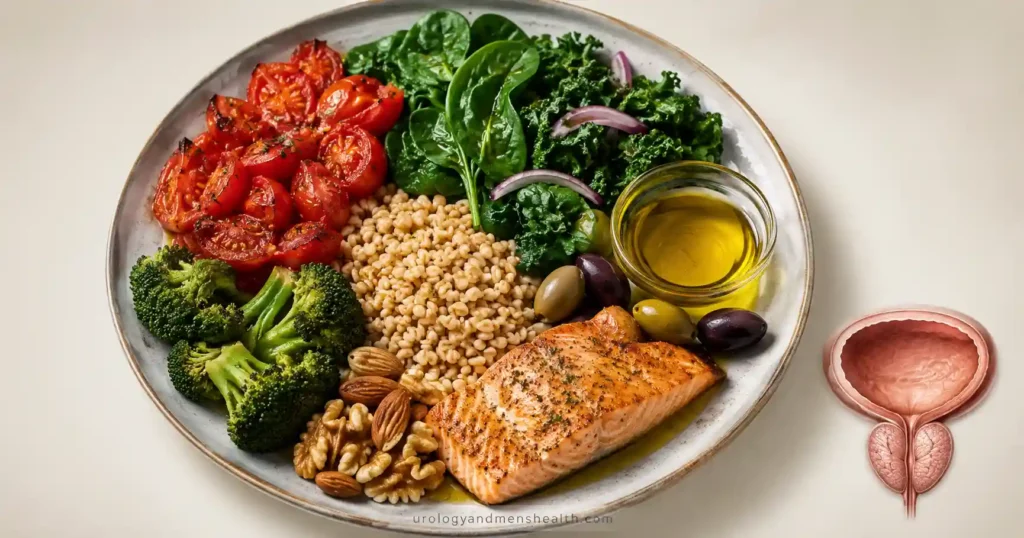
The best diet for prostate health is not the one most men come looking for. Almost every man who raises this with me wants a food list that prevents prostate cancer. That list does not exist — not in any form the randomized trial evidence supports. What does exist is a dietary pattern linked to lower death rates in men who already have prostate cancer, a small set of foods with a measurable risk signal in one direction or the other, and a metabolic route through which what you eat genuinely changes how you urinate at sixty. Those are three separate outcomes with three separate bodies of evidence, and blending them is why prostate nutrition advice online is such a mess. In clinic I regularly see men taking eight supplements while eating in a way that guarantees a widening waistline — and waist size, not any single food, is the dietary variable most consistently tied to aggressive prostate disease. This article compares the three main eating patterns against what the trials measured. For the wider picture, see our Men’s Wellness Hub.
Key Takeaways
- No dietary pattern has ever prevented prostate cancer in a randomized trial — the MEAL trial tested a vegetable-enriched diet directly and found no effect on progression.
- Higher dietary and dairy calcium intake is the most consistent adverse signal in the literature: roughly 6% higher prostate cancer risk for every extra 300 mg of dietary calcium per day.
- Vitamin E at 400 IU daily raised prostate cancer risk by 17% in a 35,533-man randomized trial. “Antioxidant” does not mean harmless.
- A Mediterranean pattern does not lower prostate cancer incidence, but higher adherence is associated with lower mortality in men who already have the disease.
- Better overall diet quality is linked to roughly 12% lower odds of bothersome urinary symptoms — the outcome most men over 55 actually care about.
What “Best Diet for Prostate Health” Actually Means
Ask three men what they mean by a prostate-friendly diet and you will get three different problems. One is thirty-eight and wants to never get prostate cancer. One is sixty-four with a Gleason 3+3 on active surveillance and wants to stop it progressing. One is fifty-seven, has no cancer at all, and is up three times a night. Food does not act on these three the same way.
Preventing prostate cancer with diet has the weakest evidence of the three. Decades of observational research have produced associations that shrink or vanish when tested in randomized trials. That is not a reason to eat badly — it is a reason to stop expecting a food to do a screening test’s job.
Slowing or surviving prostate cancer has moderate evidence, and most of it points at overall dietary pattern and body composition rather than individual foods. Improving urinary symptoms has moderate evidence too, and it works through a mechanism you can actually feel within months — metabolic, not anti-cancer.
Keep those three columns separate as you read. Almost every misleading claim you have seen about prostate nutrition comes from evidence in one column being sold as if it applied to another.
Mediterranean, Western and Plant-Based Diets Compared
The Mediterranean pattern — olive oil as the main fat, fish two or three times weekly, legumes, vegetables, whole grains, modest dairy, little red meat — has the largest evidence base of any diet studied in cancer. A 2021 systematic review pooling 117 studies and more than 3.2 million participants found that highest adherence to the Mediterranean diet reduced overall cancer mortality and the risk of several specific cancers [6]. Prostate cancer incidence was not one of them. Adherence did not shift the odds of developing the disease at all.
That is the finding almost nobody reports, and it is the honest starting point. Where the Mediterranean pattern does earn its reputation is after diagnosis: a 2026 meta-analysis of survival outcomes in cancer patients found higher adherence associated with reduced mortality in men with prostate cancer, with a hazard ratio of 0.97 [9]. A 3% relative reduction is small. It is also real, cheap, and carries no side effects — which is more than can be said for most things men buy for their prostate.
The Western pattern sits at the opposite end. Red and processed meat, refined carbohydrate, high dairy load and low fibre drive central obesity and insulin resistance, and those two states are where the strongest prostate signal lives. Plant-based patterns perform well on exactly that metabolic axis — lower energy density, higher fibre, lower saturated fat — which is the most plausible route by which they help.
- Mediterranean: no measurable effect on getting prostate cancer; modest association with surviving it; good for the metabolic drivers of urinary symptoms.
- Western: no direct carcinogenic food identified, but reliably produces the visceral obesity and insulin resistance linked to advanced disease and worse urinary symptoms.
- Plant-based: strongest on weight and insulin; direct anti-cancer evidence in prostate specifically is weak, as the next section shows.
What the MEAL Trial Proved About Vegetables
This is the single most useful study in prostate nutrition, and the reason I push back when a man tells me he is managing his cancer with kale.
The MEAL trial, published in JAMA in 2020, randomized 478 men aged 50 to 80 across 91 US urology and oncology clinics. All had biopsy-proven, early-stage prostate cancer managed with active surveillance. Half received a two-year telephone counseling program designed to get them eating seven or more servings of vegetables every day; half received a written diet leaflet. The endpoint was progression — a PSA of 10 ng/mL or higher, a PSA doubling time under three years, or upgrading on repeat biopsy [3].
At 24 months, 43.5% of the intervention group and 41.4% of the control group were progression-free. The adjusted hazard ratio was 0.97, with a confidence interval spanning 0.76 to 1.25. A well-funded, well-run, two-year behavioral trial in exactly the population most motivated to change, and it moved nothing.
Eat vegetables anyway — they are doing other work. But if you are on surveillance, your protocol is your PSA schedule and your repeat biopsy, not your produce drawer. If you are not yet in that system, the more consequential decision is when to start testing at all, which is covered in our age-by-age prostate cancer screening guide.
Get the Men's Health Screening Checklist — what to test, at what age, and how often
Enter your email below to receive Dr. Khalid’s complete Men’s Health Screening Checklist as a free, printable PDF.
Dairy and Calcium: The Clearest Dietary Signal
If one dietary finding in prostate cancer research has survived repeated re-analysis, it is this one — and it runs in the direction nobody wants.
A 2025 dose-response meta-analysis of 21 prospective cohort studies found that high intakes of total calcium, dietary calcium and dairy calcium were each associated with increased prostate cancer risk. Comparing highest to lowest intake, the pooled effect sizes were 1.08 for total calcium, 1.16 for dietary calcium and 1.13 for dairy calcium. On a dose-response basis, each additional 300 mg of dietary calcium per day was linked to roughly a 6% higher risk, and each additional 300 mg of dairy calcium to roughly 5% [5]. Supplemental calcium showed no significant association — the signal is specific to calcium arriving in food.
The World Cancer Research Fund and American Institute for Cancer Research reached the same conclusion in their prostate report: diets high in calcium probably increase prostate cancer risk [2].
Three hundred milligrams is roughly one cup of milk (240 ml / 8 fl oz), or about 40 g (1.5 oz) of hard cheese. So this is not a call to eliminate dairy — it is a call to notice when it stacks. A man drinking a litre of milk daily on top of cheese and yogurt is at a very different intake from one having a single yogurt.
What I actually advise: cap dairy at two servings a day, keep total calcium near the recommended intake for men under 71 (1,000 mg daily) rather than well above it, and do not cut calcium below that in pursuit of prostate benefit — the bone cost is certain and the prostate benefit is not.
Lycopene, Cruciferous Vegetables and the Supplements That Backfired
Lycopene, the pigment that makes tomatoes red, is the most-hyped compound in this field. A 2025 dose-response meta-analysis of 119 prospective studies found a linear inverse association between dietary lycopene intake and prostate cancer risk — pooled relative risk 0.99, confidence interval 0.97 to 1.00 [7]. That result is statistically significant and clinically tiny. It justifies cooking tomatoes with olive oil, because heat and fat both increase lycopene absorption. It does not justify a lycopene capsule.
Cruciferous vegetables and green tea sit in an even weaker position: mechanistically interesting, observationally inconsistent, never confirmed in a prostate endpoint trial.
Then there is the finding that should end the antioxidant conversation permanently. The Selenium and Vitamin E Cancer Prevention Trial randomized 35,533 men to selenium, vitamin E, both, or placebo. With extended follow-up, men taking 400 IU of vitamin E daily had a 17% higher rate of prostate cancer than placebo — hazard ratio 1.17, an absolute increase of 1.6 extra cases per 1,000 person-years. Selenium showed no benefit either [4].
A supplement designed to prevent prostate cancer caused more of it. If you take nothing else from this article, take that. Our full breakdown of what is and is not worth taking sits in the evidence review of the top prostate supplements.
Check any supplement you are currently taking against the trial evidence →Waist Size, Insulin and Your Urinary Symptoms
Here is where diet stops being a lottery ticket and starts being a lever you can pull.
Higher body mass index is associated with an increased risk of advanced prostate cancer and with prostate cancer mortality, in a dose-response fashion, according to the International Agency for Research on Cancer’s 2016 evidence review [8]. The WCRF/AICR prostate report reached a parallel conclusion, identifying waist circumference and waist-to-hip ratio as strongly associated with advanced disease [2]. Note what is being measured: not incidence, but the aggressive end of the disease — the part that actually kills men.
The same metabolic state drives benign symptoms. Visceral fat raises circulating insulin, and insulin is a growth signal for prostate stromal and epithelial tissue. That is one reason an enlarged prostate travels so reliably with metabolic syndrome. In a study of 6,506 men scored with the International Prostate Symptom Score, those with the highest overall diet quality had lower odds of bothersome lower urinary tract symptoms — odds ratio 0.88 — and the association held after adjusting for age, smoking, metabolic syndrome, body mass index and PSA [10].
This is also why the AUA guideline on lower urinary tract symptoms attributed to benign prostatic hyperplasia places behavioral and lifestyle modification as the first-line intervention, before any medication [1].
In My Practice
A 58-year-old came to me having spent close to four hundred euro over eighteen months on saw palmetto, pumpkin seed oil and a “prostate complex” blend. His IPSS was 19 — moderate-to-severe. His waist measured 112 cm (44 inches). I asked him to stop everything, cut evening fluid and alcohol, and work with his primary care doctor on weight. He came back nine months later 11 kg (24 lb) lighter with an IPSS of 11. Nothing about his prostate volume had changed meaningfully.
The urinary symptoms most men blame on their prostate are often being amplified by a metabolic state that food and weight can move, which is why I measure a waistline before I discuss a supplement.
If you do not know where you currently sit metabolically, measure it before you change anything — the BMI and metabolic syndrome risk screen takes about two minutes and gives you the baseline to track against.
The Diet I Recommend, and How to Start It This Week
Given everything above, the pattern I recommend is Mediterranean in structure, deliberately moderate in dairy, and judged primarily on what it does to your waist rather than on any anti-cancer promise.
- Cooked tomato with a fat source, most days. Passata, tinned tomatoes or roasted tomatoes with olive oil. Cheap, and the only single-food signal with a real dose-response.
- Dairy capped at two servings daily. One yogurt and one small piece of cheese is a reasonable ceiling. Count the milk in your coffee.
- Fish two to three times weekly, legumes on most days, and red meat down to once or twice a week with processed meat treated as occasional.
- Olive oil as the default cooking fat, and whole grains rather than refined — the insulin axis is where this diet earns its keep.
- No antioxidant supplements for prostate prevention. Not vitamin E, not selenium, not a lycopene capsule.
- Measure your waist, not your weight. Aim below 94 cm (37 inches) for most men; treat that number as the outcome the diet is being judged on.
Give it twelve weeks, then re-measure your waist and, if you have urinary symptoms, re-score your IPSS. If neither has moved, the diet is not the variable holding you back and you should be discussing medication with a urologist rather than adjusting your grocery list further.
Diet is one line on a much longer list of things that matter after forty. The rest of it — blood pressure, PSA timing, testosterone, colon screening — is laid out in our 40+ men’s health checklist.
When Diet Is the Wrong Conversation
No dietary change is an appropriate response to any of the following. Book a same-week appointment with your primary care doctor or a urologist, and ask specifically for a PSA test, a urinalysis and a post-void residual measurement:
- Visible blood in your urine or semen, even once, even painless.
- A sudden inability to pass urine at all — this is acute retention and needs an emergency room, not an appointment.
- New bone pain, particularly in the lower back, hips or ribs, alongside urinary symptoms.
- Unintentional weight loss you did not cause with a diet change.
- A PSA result your doctor has told you is rising, regardless of the absolute number.
Frequently Asked Questions
Does the best diet for prostate health actually lower prostate cancer risk?
No randomized trial has shown this. The MEAL trial randomized 478 men on active surveillance to a two-year program targeting seven or more daily vegetable servings and found no difference in cancer progression at 24 months. Diet is worth changing for other reasons, but it does not replace testing. Our age-by-age screening guide covers when PSA testing should start.
Should I stop drinking milk to protect my prostate?
Not stop, but cap it. A meta-analysis of 21 prospective cohorts linked each extra 300 mg of dietary calcium daily — roughly one cup of milk — to about a 6% higher prostate cancer risk. Two dairy servings a day is a sensible ceiling. Do not drop total calcium below 1,000 mg daily, as the bone cost is certain. See the 40+ health checklist for the wider picture.
Are cooked tomatoes better than raw ones for prostate health?
Yes, modestly. Heat and dietary fat both increase lycopene absorption, so passata or roasted tomatoes with olive oil deliver more than a raw salad tomato. The honest caveat is the effect size: the pooled relative risk for dietary lycopene and prostate cancer is 0.99. Real, but small. Our prostate supplement evidence review explains why a capsule is not the answer.
Can changing my diet shrink an enlarged prostate?
Diet does not measurably shrink prostate tissue. What it changes is the metabolic state amplifying your symptoms — visceral fat raises insulin, which acts as a growth signal on prostate tissue. Men with better overall diet quality have around 12% lower odds of bothersome urinary symptoms. Measure your baseline with the BMI and metabolic syndrome screen before changing anything.
Are prostate supplements worth taking if my diet is not perfect?
No, and one of them is actively harmful. In a 35,533-man randomized trial, 400 IU of vitamin E daily increased prostate cancer incidence by 17% versus placebo, and selenium offered no benefit. Food-based intake and supplement intake are not interchangeable. Run whatever you currently take through the evidence-based supplement matcher before your next appointment.
Does a Mediterranean diet help if I already have prostate cancer?
The evidence is stronger after diagnosis than before it. Higher Mediterranean diet adherence has not been shown to reduce prostate cancer incidence, but a 2026 survival meta-analysis found it associated with reduced mortality in men with prostate cancer, hazard ratio 0.97. It is a small effect with no downside. It does not alter your surveillance schedule — keep the monitoring plan from your screening and follow-up pathway.
References
- American Urological Association. Management of Lower Urinary Tract Symptoms Attributed to Benign Prostatic Hyperplasia: AUA Guideline (2026), Part II: Medical Management. J Urol. 2026. AUA
- World Cancer Research Fund / American Institute for Cancer Research. Diet, Nutrition, Physical Activity and Prostate Cancer. Continuous Update Project. WCRF
- Parsons JK, Zahrieh D, Mohler JL, et al. Effect of a Behavioral Intervention to Increase Vegetable Consumption on Cancer Progression Among Men With Early-Stage Prostate Cancer: The MEAL Randomized Clinical Trial. JAMA. 2020;323(2):140-148. PubMed
- Klein EA, Thompson IM, Tangen CM, et al. Vitamin E and the Risk of Prostate Cancer: the Selenium and Vitamin E Cancer Prevention Trial (SELECT). JAMA. 2011;306(14):1549-1556. PubMed
- Xiong K, Lu L, Ge P, et al. Calcium intake and risk of prostate cancer: a systematic review and dose-response meta-analysis of prospective cohort studies. J Trace Elem Med Biol. 2025;89:127652. PubMed
- Morze J, Danielewicz A, Przybylowicz K, et al. An updated systematic review and meta-analysis on adherence to Mediterranean diet and risk of cancer. Eur J Nutr. 2021;60(3):1561-1586. PubMed
- Balali A, Fathzadeh K, Askari G, Sadeghi O. Dietary intake of tomato and lycopene, blood levels of lycopene, and risk of total and specific cancers in adults: a systematic review and dose-response meta-analysis of prospective cohort studies. Front Nutr. 2025;12:1516048. PubMed
- Yang L, Drake BF, Colditz GA. Obesity and Other Cancers. J Clin Oncol. 2016;34(35):4231-4237. PubMed
- Nucci D, Ragusa FS, Veronese N, et al. Mediterranean diet in cancer patients’ survival: a systematic review and meta-analysis for tertiary prevention. Nutrition. 2026;145:113071. PubMed
- Lim JS, Hwang W, Kim JK, et al. Associations of dietary patterns and lower urinary tract symptoms (LUTS) in Korean adults. Nutr Res Pract. 2025;19(2):318-327. PubMed
Dr. Muhammad Khalid
MBBS · FCPS (Urology) · MCPS (General Surgery) · CHPE · CRSM · IMC #539472
Specialist urologist with 11+ years of clinical experience across tertiary teaching hospitals. Trained at Lady Reading Hospital and Khyber Teaching Hospital, Peshawar. Author or co-author of five peer-reviewed international publications, including in Cureus and the World Journal of Surgery. Procedural expertise: URS, PCNL, RIRS, TURP, TURBT, and major open urological surgery. Full profile →
This article is for educational purposes only and does not constitute medical advice. Always consult your physician or urologist for diagnosis and treatment decisions specific to your condition.