Botox for Overactive Bladder in Men: What to Expect
Most men are told their bladder symptoms come from the prostate. When the urgency survives prostate treatment, Botox for overactive bladder in men is often the option nobody bothered to mention.

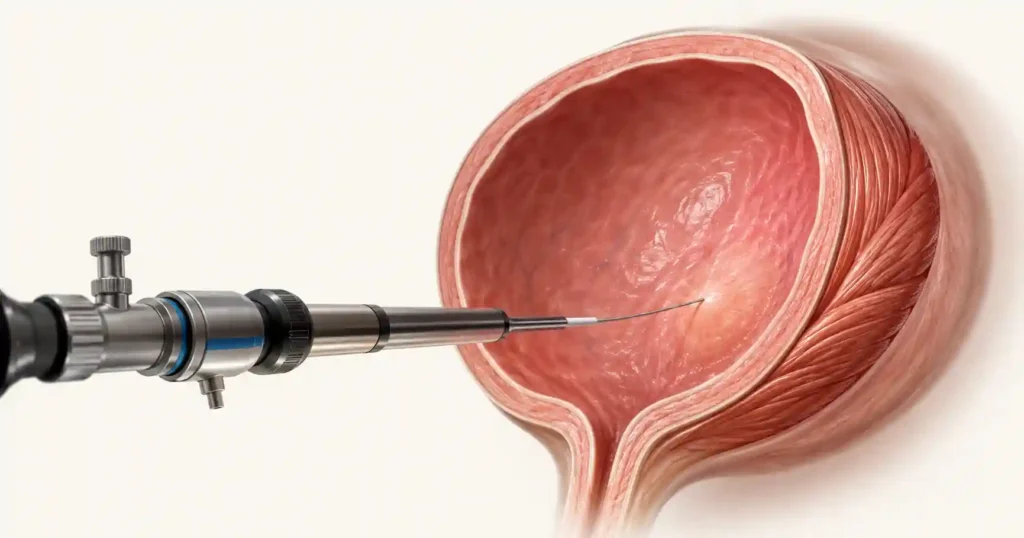
Botox for overactive bladder in men is the treatment most patients have never been offered — usually because their urgency was blamed on the prostate and never re-examined. I see this pattern constantly. A man has a TURP or starts tamsulosin, his stream improves, and he still cannot reach the bathroom in time. The prostate was treated. The bladder was not. Intradetrusor onabotulinumtoxinA — the same molecule used cosmetically, delivered in a completely different way — quiets an overactive bladder muscle for months at a stretch. The US Food and Drug Administration approved it for overactive bladder in January 2013, and the 2024 AUA/SUFU guideline places it alongside sacral neuromodulation and tibial nerve stimulation as a minimally invasive option [1]. Below: what the injection involves, what the response rates look like specifically in men, the retention risk that matters more in men than in women, and what to ask before you agree to it. For the wider picture on bladder and prostate symptoms after 40, start at our Men’s Wellness Hub.
Key Takeaways
- Overactive bladder affects 7% to 27% of men, and the 2024 AUA/SUFU guideline states plainly that men with prostates are underdiagnosed because their urgency gets attributed to the prostate by default.
- The treatment is 100 units of onabotulinumtoxinA delivered as 20 small injections into the bladder muscle during an office cystoscopy — a different molecule dose and a different target from cosmetic use.
- In pooled trial data covering 194 men, 61.2% reached at least a 50% reduction in daily leakage episodes at week 12, compared with 44.8% on placebo.
- About 4.7% of men needed catheterization for incomplete emptying afterwards, against 2.7% of women — which is why a post-void residual measurement before injection is non-negotiable.
- The median duration of effect is 7.6 months, so most men settle into roughly one to two treatments per year rather than a daily pill.
Why Urgency in Men Gets Blamed on the Prostate
There are two entirely different mechanical failures that produce urinary symptoms in men, and they are constantly confused.
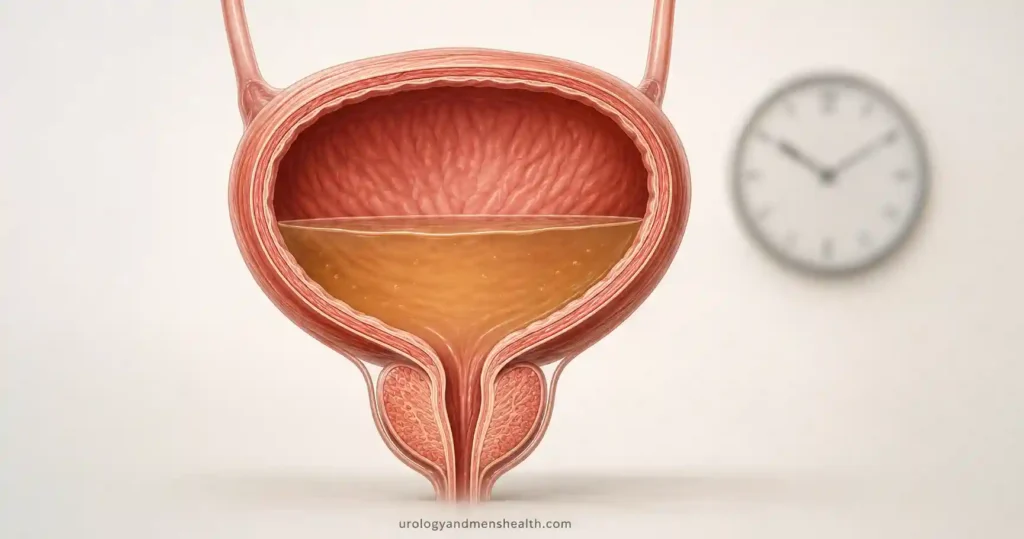
An emptying problem is obstruction. An enlarged prostate squeezes the urethra, the stream weakens, you strain, and the bladder never fully empties. That is benign prostatic hyperplasia, and it responds to alpha blockers, 5-alpha reductase inhibitors, or surgery. A storage problem is different physiology altogether: the detrusor — the muscular wall of the bladder — contracts when it should be sitting quietly, generating a sudden compelling urge that is difficult to defer. That is overactive bladder, and no amount of prostate surgery fixes it.
The two coexist often enough that clinicians developed a habit of treating the prostate and assuming the rest will follow. The 2024 AUA/SUFU guideline pushed back on this directly, noting that men experience overactive bladder nearly as often as women do but are underdiagnosed and undertreated because of the assumption that every voiding symptom traces back to the prostate [1]. Population studies put the prevalence in men somewhere between 7% and 27% depending on definition and age.
If you want the sequence of what should be tried and in what order, read the full workup and treatment ladder for overactive bladder in men. If your stream is genuinely weak and you are straining, the question is different — that is whether an enlarged prostate needs treating, and it should be settled before anyone injects your bladder.
In My Practice
The men who benefit most from bladder Botox are usually the ones who arrive already frustrated — two years of tamsulosin, a TURP eighteen months ago, a good stream, and still three changes of underwear a day. They have been told the operation worked, and mechanically it did. Nobody measured what the bladder was doing.
If urgency and leaking persist after the outlet has been fixed, the problem was never only the outlet — and that man is a candidate, not a treatment failure.
How Botox for Overactive Bladder in Men Actually Works
OnabotulinumtoxinA blocks the release of acetylcholine at the nerve endings supplying the detrusor muscle. Acetylcholine is the chemical signal that tells the bladder wall to contract. Interrupt it locally and the involuntary contractions that generate urgency lose their trigger — while the nerve endings gradually sprout new connections over the following months, which is precisely why the effect wears off rather than being permanent.
Think of it as turning down the gain on a microphone that has been picking up every small noise in the room. The bladder still fills, still signals, still empties. It simply stops shouting.
What the procedure involves
- Setting. An office or day-case cystoscopy suite. Local anesthetic instilled into the bladder, with or without light sedation. No general anesthetic in most cases.
- Dose. 100 units total for idiopathic overactive bladder — the licensed dose and the ceiling. Higher doses buy little extra benefit and cost you retention risk.
- Delivery. The 100 units are diluted and given as 20 separate injections of 0.5 mL each, spread across the bladder wall through a fine needle passed down the cystoscope [3].
- Time. Ten to fifteen minutes of actual injecting. Most men are home within the hour and back at work the next day.
- Onset. Symptoms usually improve within the first two weeks, not immediately.
Two details worth registering. First, this is a fundamentally different intervention from cosmetic Botox — different dose, different target tissue, different licensing. Second, the injections go into muscle you cannot feel, which is why the procedure is far less uncomfortable than most men expect from the description.
How Well It Works — The Numbers That Apply to Men
Here is the problem with most of the published evidence: the pivotal trials were roughly 88% female. When a website quotes response rates for bladder Botox, it is usually quoting a female population and letting you assume it transfers.
A 2024 pooled analysis of four randomized trials separated the sexes deliberately, isolating 194 men out of 1,564 participants [2]. At week 12:
- Men on 100 units averaged 2.2 fewer leakage episodes per day, against 1.3 fewer on placebo.
- 61.2% of men achieved at least a 50% reduction in daily leakage, versus 44.8% on placebo.
- Men without a BPH diagnosis did better — 65.1% hit that threshold, compared with 54.3% of men who also had BPH.
Note the placebo response of 44.8% in men. That is high, and it is honest to say so — part of what men report as improvement is regression to the mean and the natural fluctuation of the condition. The treatment effect is real but smaller than the headline response rate suggests.
On durability: the 3.5-year extension study following repeat treatments found a median duration of effect of 7.6 months, with reductions in leakage holding steady across up to six consecutive treatment cycles [4]. Practically, that means one to two injections a year for most people. And a network meta-analysis of 56 randomized trials found that 100 units of onabotulinumtoxinA produced the largest average reductions in incontinence, urgency episodes, and frequency of any licensed overactive bladder therapy at 12 weeks — outperforming both antimuscarinics and mirabegron [5].
Score your symptoms before the appointment — the OABSS gives you a 0–15 number your urologist can actually trackGet the OAB & Incontinence Guide — what to try, in what order, and when to ask about bladder Botox
Enter your email below to receive Dr. Khalid’s complete OAB & Incontinence Guide as a free, printable PDF.
The Risk That Matters More in Men: Incomplete Emptying
Relaxing the bladder muscle is the entire point of the treatment. The cost of that relaxation is a weaker emptying contraction, and in men with any degree of outlet resistance from the prostate, that margin is already thin.
The pooled male-versus-female data makes the difference visible [2]:
- Urinary retention requiring catheterization: 4.7% of men versus 2.7% of women.
- Blood in the urine: 6.8% of men versus 1.1% of women — a consequence of passing an instrument through a longer, prostate-bearing urethra.
- Urinary tract infection: 4.2% of men versus 13.1% of women. This is the one risk that is lower in men, and meaningfully so.
In the original phase 3 trial, mean post-void residual rose from around 10 mL on placebo to 47 mL on treatment at two weeks, and 6.9% of patients started clean intermittent self-catheterization [3]. Reassuringly, the long-term data showed the de novo catheterization rate was 4.0% after the first treatment and dropped to between 0.6% and 1.7% after subsequent ones — the first injection is where the risk concentrates [4].
The guideline response to this is specific: measure post-void residual before injecting, and measure it again in any patient whose symptoms fail to improve or get worse afterwards [1]. There is no universally agreed cutoff for “too high,” though most trials excluded patients above 150–200 mL. If your functional bladder capacity is under 300 mL (about 10 fl oz), voiding efficiency is a more useful measure than the residual alone. You can estimate where your own post-void residual sits on the risk scale before your consultation.
When to Call Your Urologist After the Injection
Contact the team the same day — do not wait for your scheduled follow-up — if any of the following occur in the two weeks after treatment:
- You cannot pass urine at all, or you are passing only small dribbles with a full, painful lower abdomen. This is acute retention and needs a catheter today.
- Your stream becomes noticeably weaker and you feel you are not emptying, even without pain.
- Fever above 38°C (100.4°F), shaking chills, or burning with urination lasting more than 48 hours.
- Visible blood in the urine persisting beyond 72 hours, or passing clots at any point.
Who Is a Good Candidate — And What to Ask Before You Agree
One structural change in the 2024 guideline is worth knowing about, because it directly affects what you are entitled to ask for. Previous guidance framed treatment as a strict ladder — behavioral therapy, then pills, then advanced options. The 2024 panel abandoned that “step therapy” model and grouped treatments by how invasive they are rather than by rank, explicitly allowing a minimally invasive option to be chosen without first cycling through medications, in the context of shared decision-making [1].
That matters most for men who do not want antimuscarinic medication at all. The same guideline instructs clinicians to discuss the potential association between antimuscarinics and dementia and cognitive impairment. If you are 68 and unwilling to take a drug class carrying that discussion, you are no longer obliged to fail it before being offered an injection.
Four questions to put to your urologist
- “What was my post-void residual today, in millilitres?” Ask for the number, not a reassurance. Have it measured by bladder scan at the same visit, and again at four to six weeks after the injection.
- “Am I obstructed, or is this purely a storage problem?” If there is genuine doubt, a uroflow or pressure-flow urodynamic study answers it. Injecting a bladder that is already struggling against an obstructed outlet is how men end up self-catheterizing.
- “Will you teach me self-catheterization before the injection, not after?” Being shown the technique in advance turns a frightening complication into a manageable two-week inconvenience.
- “When do I stop my current bladder tablets?” The guideline advises discontinuing oral medication once a minimally invasive treatment is working, and restarting only if the effect fades. Get a specific date rather than drifting on both.
One thing no injection replaces: the behavioral work. Timed voiding, urgency suppression, cutting caffeine and alcohol, and structured retraining all raise the ceiling on what any procedure achieves, and the 2024 guideline recommends bladder training for every patient with overactive bladder regardless of what else they are having done.
Bladder training is the one thing that makes every other OAB treatment work better — here’s the protocolFrequently Asked Questions
How long does Botox for overactive bladder in men last?
The median duration of effect across the 3.5-year extension study was 7.6 months, meaning half of patients needed retreatment sooner and half later. In practice most men settle into one or two injections per year. You do not lose response with repeat treatments — reductions in leakage held steady across up to six consecutive cycles. If your effect is consistently fading at three or four months, that is worth revisiting against the wider treatment options for overactive bladder in men.
Will I need a catheter after bladder Botox?
Probably not, but the risk is real and it is higher in men than in women. In pooled trial data, 4.7% of men needed catheterization for incomplete emptying compared with 2.7% of women. The risk concentrates around the first injection — the de novo catheterization rate was 4.0% after treatment one and fell to between 0.6% and 1.7% afterwards. Ask to have your post-void residual assessed before and after, and learn self-catheterization in advance rather than in a panic.
Can I have bladder Botox if I already have an enlarged prostate?
Yes, but your expected benefit is somewhat lower and your retention risk somewhat higher. In the pooled analysis, 54.3% of men with a BPH diagnosis achieved at least a 50% reduction in daily leakage, versus 65.1% of men without one. The sequencing question matters more than the yes-or-no: if you are meaningfully obstructed, treating the enlarged prostate usually comes first, because injecting a bladder that is already fighting an outlet is what produces retention.
Does the bladder injection hurt?
Less than the description suggests. Local anesthetic is instilled into the bladder and left to take effect, with light sedation available if you want it. The injections themselves go into detrusor muscle, which has poor pain sensation — most men describe pressure rather than pain. The uncomfortable part is passing the cystoscope, which takes seconds. Expect some stinging on urination and possibly pink urine for a day or two. Track your baseline first with the OAB symptom score so you can measure whether it was worth it.
What happens if bladder Botox does not work for me?
The first step is checking a post-void residual, because a bladder that is now retaining urine can produce frequency and urgency that mimic ongoing overactive bladder rather than treatment failure. If emptying is fine and symptoms persist, the alternatives within the same category are sacral neuromodulation and percutaneous tibial nerve stimulation, both of which the 2024 guideline places on equal footing. Urodynamic testing is reasonable at that point. Meanwhile, keep the behavioral retraining running — it works independently of anything injected.
References
- Cameron AP, Chung DE, Dielubanza EJ, et al. The AUA/SUFU guideline on the diagnosis and treatment of idiopathic overactive bladder. J Urol. 2024;212(1):11-20. AUA
- Nitti VW, Kohan A, McCammon K, et al. Efficacy and safety of onabotulinumtoxinA for the treatment of overactive bladder in men and women: a pooled analysis. Neurourol Urodyn. 2024;43(8):1765-1775. PubMed
- Chapple C, Sievert KD, MacDiarmid S, et al. OnabotulinumtoxinA 100 U significantly improves all idiopathic overactive bladder symptoms and quality of life in patients with overactive bladder and urinary incontinence: a randomised, double-blind, placebo-controlled trial. Eur Urol. 2013;64(2):249-256. PubMed
- Nitti VW, Ginsberg D, Sievert KD, et al. Durable efficacy and safety of long-term onabotulinumtoxinA treatment in patients with overactive bladder syndrome: final results of a 3.5-year study. J Urol. 2016;196(3):791-800. PubMed
- Drake MJ, Nitti VW, Ginsberg DA, et al. Comparative assessment of the efficacy of onabotulinumtoxinA and oral therapies (anticholinergics and mirabegron) for overactive bladder: a systematic review and network meta-analysis. BJU Int. 2017;120(5):611-622. PubMed
Dr. Muhammad Khalid
MBBS · FCPS (Urology) · MCPS (General Surgery) · CHPE · CRSM · IMC #539472
Specialist urologist with 11+ years of clinical experience across tertiary teaching hospitals. Trained at Lady Reading Hospital and Khyber Teaching Hospital, Peshawar. Author or co-author of five peer-reviewed international publications, including in Cureus and the World Journal of Surgery. Procedural expertise: URS, PCNL, RIRS, TURP, TURBT, and major open urological surgery. Full profile →
This article is for educational purposes only and does not constitute medical advice. Always consult your physician or urologist for diagnosis and treatment decisions specific to your condition.