What a Cystoscopy Feels Like: A Urologist Explains
Most men dread the cystoscope far more than the result. Here is what a cystoscopy actually feels like, minute by minute — and why the anticipation is nearly always worse than the two minutes it takes.

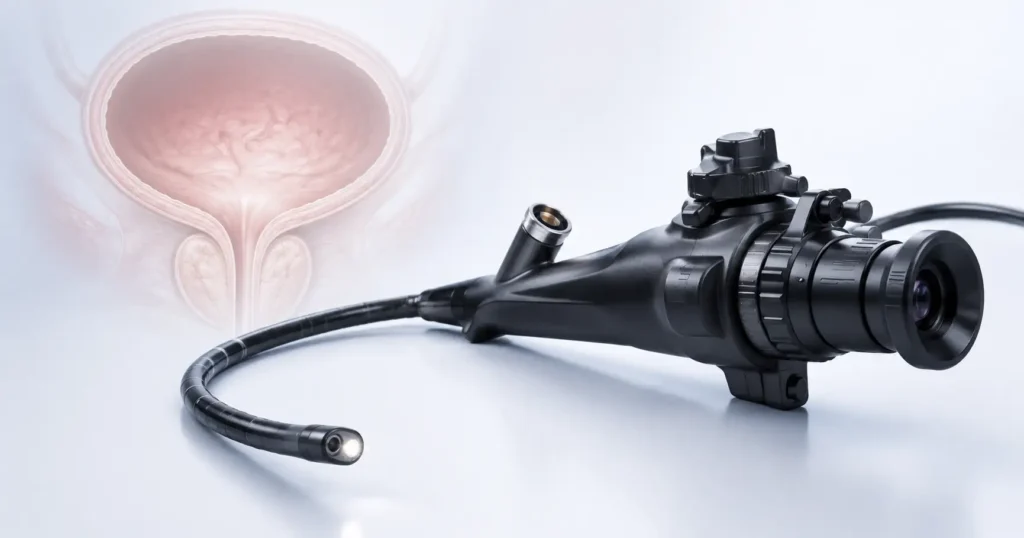
If you want to know what a cystoscopy feels like before yours, here is the honest answer: for most men, the camera test is far quicker and less painful than the days you spent dreading it. A cystoscopy lets your urologist look directly inside your urethra and bladder using a thin scope with a light and a tiny camera on the tip. It sounds alarming, and the idea of a scope passing through the penis is what makes men brace. But the version done in clinic — a flexible cystoscopy — is over in a couple of minutes, and the part that actually stings lasts only a few seconds. This is a procedure I perform constantly, and the gap between how men imagine it and how they describe it afterward is one of the widest in all of urology. Below is exactly what happens, what you will feel, and what counts as normal once you are home. For the bigger picture on urological procedures and aftercare, see our Surgery & Recovery hub.
Key Takeaways
- A flexible cystoscopy in clinic usually takes 2–5 minutes and stings for only a few seconds — at the sphincter, not along the whole penis.
- Pink or lightly blood-tinged urine and mild burning for 24–48 hours afterward are expected, not a complication.
- Most healthy men do not need antibiotics for a simple outpatient cystoscopy.
- Fever, chills, heavy bleeding with clots, or being unable to urinate are red flags that need same-day urology or ER attention.
Why your urologist ordered a cystoscopy
A cystoscopy is the only test that lets a urologist see the lining of your bladder and urethra directly, rather than guessing from a scan. The most common reason I order one is to investigate blood in the urine — whether you can see it or it only showed up under a microscope. For visible or microscopic blood, guidelines specifically recommend looking inside the bladder itself, because no scan reliably rules out a small early tumor of the bladder lining [1].
Beyond blood in the urine, a cystoscopy is used to look for bladder stones, tumors, a narrowing of the urethra (a stricture), or the bladder-side signs of an enlarged prostate [4]. It is also how we monitor someone who has had a bladder tumor before. If your test was prompted by blood in the urine, our guide to the causes of blood in the urine in men explains why that symptom is taken seriously even when you feel completely well. And if the goal is to rule out or follow a growth, our overview of bladder cancer symptoms and staging covers what a positive finding would actually mean.
Flexible vs rigid cystoscopy: which one you’re getting
This single distinction decides almost everything about what you will feel, so it is worth knowing which one your appointment is for. A flexible cystoscopy uses a soft, bendable scope about the width of a thick drinking straw. You are awake, lying back, and it is done in a clinic room with numbing gel and nothing more. This is what the overwhelming majority of men get, and it is what this article is mostly about.
A rigid cystoscopy uses a straight metal scope and is done in an operating room under sedation or a general anesthetic. Urologists reach for the rigid scope when they expect to treat something in the same sitting — taking a biopsy, removing a stone, or resecting a small tumor — because its larger working channel lets instruments pass. If your letter mentions the operating theatre, fasting, or someone driving you home, you are having the rigid version and you will feel nothing during it. If it is a quick clinic appointment with no fasting, it is the flexible scope.
What a cystoscopy actually feels like, step by step
You lie back, the area is cleaned, and a lubricating gel — usually containing a local anesthetic — is placed into the urethra and left to sit for a few minutes. Here is a detail most sites skip: in men, the numbing benefit of that gel over plain lubricant is modest. Pooled data from randomized trials show no reliable pain advantage from the anesthetic gel itself [3]. Its real job is lubrication and giving the urethra time to relax, which is why how relaxed you are matters as much as what is in the syringe.
The scope then passes in. Along the shaft of the penis you feel pressure and movement rather than pain — that tissue has little sensation to a smooth scope. The one moment men actually notice is when the scope crosses the external sphincter, the muscle you use to hold and stop your urine. That produces a brief, sharp sting and a strong urge to pee, lasting a few seconds. The bladder is then filled with sterile fluid so its walls open up for inspection, which feels like a building need to urinate. The whole inspection takes about two to five minutes, and then the scope slides out — which feels like nothing.
In My Practice
I have lost count of the men who arrive gripping the edge of the couch, jaw set, braced for the worst few minutes of their year — and who, about ninety seconds later, blink and ask, “Wait, is that it?” The bracing is the problem, because a clenched sphincter is a tight sphincter, and a tight sphincter is the only part that hurts.
The men who do best are the ones who breathe out slowly as the scope reaches the sphincter, exactly as I coach them to — the discomfort passes in a breath or two.
Preparing for urological surgery? Download Dr. Khalid’s Urology Surgery Recovery Guide.
Enter your email below to receive Dr. Khalid’s complete Urology Surgery Recovery Guide as a free, printable PDF.
After the cystoscopy: what’s normal and what isn’t
For the first day or two, expect your urine to be pink or lightly blood-tinged, and expect a mild burning sting when you pee. Passing urine often, and feeling you need to go urgently, is also normal as the bladder settles. Drinking a little extra water in the first 24 hours dilutes your urine and makes the burning easier to tolerate. After a flexible cystoscopy you can drive yourself home and return to work the same day; after a rigid cystoscopy under anesthetic, you need someone to drive you and you should rest that day.
One thing that surprises men: you almost certainly will not be sent home on antibiotics, and that is correct, not an oversight. Major urology guidance advises against routine antibiotics for a simple outpatient cystoscopy in an otherwise healthy man with no signs of infection, because the infection risk is low and needless antibiotics breed resistance [2]. If your cystoscopy found something that needs treating — a tumor that calls for a transurethral resection (TURBT), for example — your urologist will plan that as a separate procedure, and our post-operative recovery timeline tool can help you picture the days that follow.
Red Flags — Call Your Urologist or Go to the ER
Mild burning and pink urine are expected. These are not, and need same-day attention:
- A fever above 38°C (100.4°F), shaking chills, or feeling generally unwell — a possible urinary infection.
- Heavy bleeding, or passing blood clots, especially if it is getting worse rather than better.
- Being unable to pass urine at all, with a painfully full bladder — this needs the ER.
- Burning or pain that is worsening after 48 hours instead of settling.
Frequently Asked Questions
Does a flexible cystoscopy hurt for men?
For most men, a flexible cystoscopy stings for only a few seconds as the scope crosses the external sphincter — the muscle you use to stop your urine. The shaft of the penis has little sensation to the scope itself. Randomized trials show the numbing gel’s pain benefit over plain lubricant is modest in men, so staying relaxed matters as much as the gel. See what the recovery looks like afterward.
How long does a diagnostic cystoscopy actually take?
The camera portion of a flexible cystoscopy usually takes two to five minutes. Add a few minutes for the gel to sit and for positioning, and you are typically off the table within fifteen minutes. If your urologist is also inspecting for a growth as part of a bladder cancer workup, they may look a little longer and more carefully.
Will I need antibiotics after a cystoscopy?
Usually not. Urology guidance does not recommend routine antibiotics for a simple outpatient cystoscopy in an otherwise healthy man with no signs of infection, because the risk is low and unnecessary antibiotics drive resistance. Your urologist may make an exception for specific high-risk histories. Mild burning afterward is expected and is not the same thing as a urinary tract infection in men.
Is blood in my urine normal after a cystoscopy?
Yes, in small amounts. Pink or lightly blood-tinged urine for 24 to 48 hours is expected, since the scope brushes a delicate lining. Drinking a little extra water helps it clear. What is not normal is heavy bleeding or passing clots, particularly if it is worsening. If blood in your urine appeared before the test, our guide to the causes of blood in the urine explains why it was investigated.
Can I drive home and go to work after a cystoscopy?
After a flexible cystoscopy you can drive yourself home and return to work the same day — no sedation is involved. After a rigid cystoscopy under sedation or a general anesthetic, you must arrange a driver and rest for the remainder of the day. Either way, light activity is fine once any burning settles; for the wider picture on recovering from urological procedures, see our Surgery & Recovery hub.
References
- American Urological Association / SUFU. Microhematuria: AUA/SUFU Guideline (2020, amended 2025). AUA
- Lightner DJ, Wymer K, Sanchez J, Kavoussi L. Best Practice Statement on Urologic Procedures and Antimicrobial Prophylaxis. J Urol. 2020;203(2):351-356. AUA
- Patel AR, Jones JS, Babineau D. Lidocaine 2% gel versus plain lubricating gel for pain reduction during flexible cystoscopy: a meta-analysis of randomized, controlled trials. J Urol. 2008;179(3):986-990. Journal of Urology
- National Institute of Diabetes and Digestive and Kidney Diseases (NIDDK). Cystoscopy & Ureteroscopy. NIDDK
Dr. Muhammad Khalid
MBBS · FCPS (Urology) · MCPS (General Surgery) · CHPE · CRSM · IMC #539472
Specialist urologist with 11+ years of clinical experience across tertiary teaching hospitals. Trained at Lady Reading Hospital and Khyber Teaching Hospital, Peshawar. Author or co-author of five peer-reviewed international publications, including in Cureus and the World Journal of Surgery. Procedural expertise: URS, PCNL, RIRS, TURP, TURBT, and major open urological surgery. Full profile →
This article is for educational purposes only and does not constitute medical advice. Always consult your physician or urologist for diagnosis and treatment decisions specific to your condition.