PCNL Surgery: What Happens, Step by Step
When a stone is too big to blast or pass, PCNL surgery is how I remove it — through a tunnel the width of a straw in your back. Here is exactly what that involves, from the table to going home.

PCNL surgery is how I remove a kidney stone that has grown too large to pass on its own or to break up from outside the body. The full name — percutaneous nephrolithotomy — sounds intimidating, but it breaks down simply: percutaneous means through the skin, and nephrolithotomy means removing a stone from the kidney. Instead of a long open incision, I reach the stone through a tunnel about the width of a drinking straw made in your back, directly into the kidney. It is the most effective operation for clearing a large or branched stone in one sitting, and for stones bigger than about 2 cm (roughly 0.8 inch) it is what the American Urological Association recommends as first-line treatment. It is also the most involved of the routine stone procedures, so most men want a clear picture of what they are agreeing to. For how PCNL fits alongside shock wave lithotripsy and ureteroscopy, see our urological surgery and recovery hub. This article walks through what happens before, during, and after PCNL, how long recovery really takes, and the risks I make sure every patient understands first.
Key Takeaways
- PCNL surgery is the first-line treatment for kidney stones larger than about 2 cm (0.8 inch), including staghorn stones that fill the collecting system.
- The stone is removed through a roughly 1 cm tunnel made in your back directly into the kidney — not through a large open incision.
- Most patients stay in hospital 1 to 3 days and return to desk work within 1 to 2 weeks.
- PCNL clears large stones more completely than shock wave lithotripsy or ureteroscopy, but carries a higher risk of bleeding and infection — a complication occurs in roughly 7 to 27 percent of cases.
What PCNL Surgery Actually Is
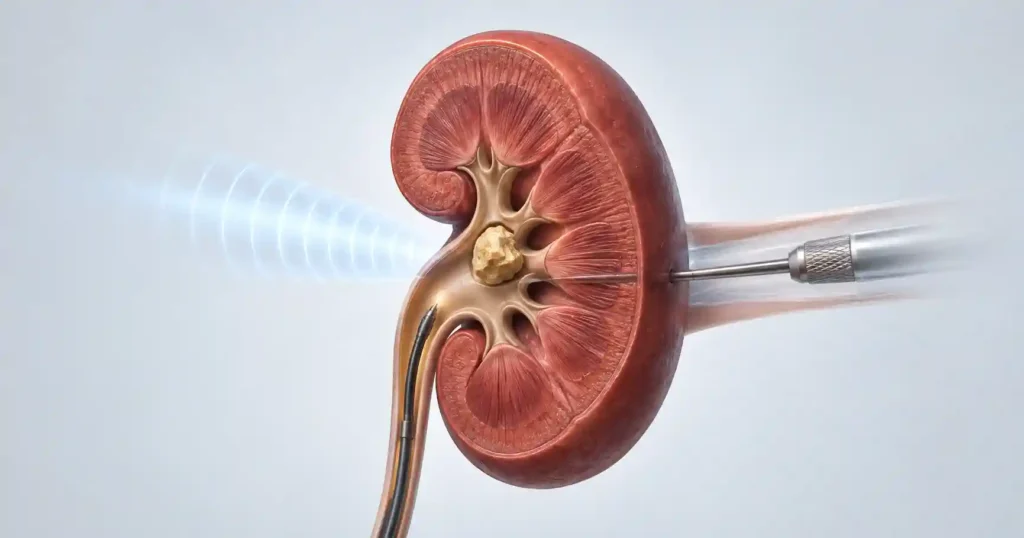
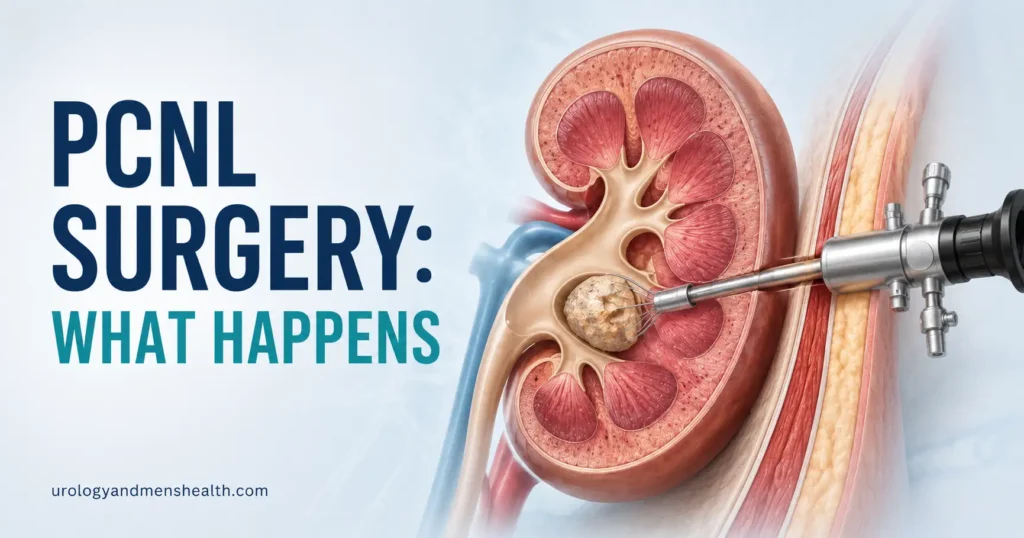
PCNL is keyhole surgery for the kidney. Under a general anesthetic, I pass a needle through your back into the exact part of the kidney holding the stone, using X-ray or ultrasound to guide it. That track is gently widened to about 1 cm and a thin metal sheath is left in place, like a porthole. Through it I pass a nephroscope — a rigid telescope with a camera and a working channel — so I can see the stone directly on a screen.
A stone larger than the sheath cannot simply be pulled out, so it has to be broken first. I use a probe that fragments the stone with laser energy, ultrasonic vibration, or pneumatic pulses, then suction or grasp the pieces out through the same channel. The goal of percutaneous nephrolithotomy is to leave the kidney as stone-free as possible in a single session, which is exactly where it beats the alternatives for large stones.
Two generations ago, a stone this size meant open surgery — a long flank incision, a cut into the kidney, and a hospital stay of well over a week. PCNL replaced that for almost all patients. The tunnel is small, the kidney muscle is spread rather than cut, and recovery is measured in days to weeks rather than months.
Who Actually Needs PCNL?
PCNL is not the answer for every stone — it is the answer for big ones. The American Urological Association recommends PCNL as first-line therapy for any kidney stone larger than 2 cm (0.8 inch), and reports that for lower-pole stones over 1 cm it clears the kidney more completely than shock wave lithotripsy or ureteroscopy [1]. European guidance draws a similar line, reserving PCNL for stones over 2 cm and lower-pole stones over about 1.5 cm [2].
Beyond raw size, I recommend PCNL for staghorn stones — branched stones that take the shape of the kidney’s inner drainage system and are usually too bulky for any other method to clear. It is also my choice when a stone is unusually hard (cystine or calcium oxalate monohydrate), when an infection stone needs to be removed completely to stop it regrowing, or when shock wave lithotripsy or ureteroscopy has already failed. Where your stone sits on that spectrum is decided by its size and density on a CT scan; our kidney stone size chart explaining when to wait versus operate shows where each treatment fits.
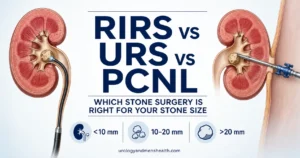
Compare PCNL against URS, RIRS, and ESWL: which stone surgery is right for youIf you are still weighing your options, working through the differences side by side helps. Our urology surgery comparison tool lines up the stone procedures by invasiveness, stone-free rate, and recovery so you can see why a large stone points toward PCNL.
In My Practice
One of the clearest patterns I see is the man who has been told for years to “just drink more water” while a single stone quietly grew into a staghorn filling half his kidney. By the time he reaches me with recurrent infections and a dull ache, that stone is far past anything water, medication, or shock waves can fix — PCNL is the only realistic way to clear it.
A large stone does not announce itself loudly, which is exactly why size on a CT scan, not how much pain you feel, should drive the decision to operate.
What Happens During PCNL Surgery, Step by Step
From your point of view, you are asleep for the whole thing and remember none of it. Here is what is actually happening while you are under:
- Anesthesia and positioning. You receive a general anesthetic, then you are positioned either face-down (prone) or on your back with the side propped up (supine), depending on where the stone sits.
- Access. Using live X-ray or ultrasound, I pass a fine needle through your back into the precise calyx holding the stone. Getting this puncture right is the part of the operation that most determines how smoothly the rest goes.
- Tract dilation. A guidewire is threaded through the needle, and the track is gradually widened to roughly 1 cm. A sheath holds the tunnel open.
- Stone fragmentation. The nephroscope goes in, the stone is broken with laser, ultrasonic, or pneumatic energy, and the fragments are suctioned or grasped out.
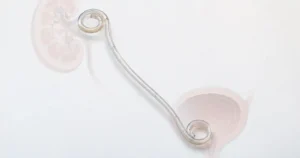
- Drainage. At the end I usually leave either a small drainage tube through the back (a nephrostomy), an internal stent between kidney and bladder, or in selected cases nothing at all (a “tubeless” PCNL).
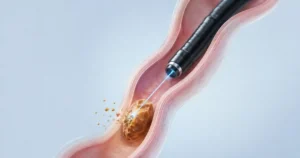
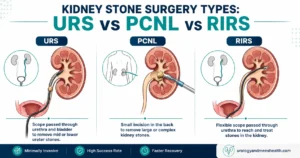
This direct route is what separates PCNL from the scope-through-the-tract operations. RIRS, or flexible ureteroscopy, reaches the same stone by passing a bendy telescope up the natural urinary tract from below — gentler, but far slower at clearing a large stone, which is why we cross over to PCNL once the stone burden gets big.
Preparing for urological surgery? Download Dr. Khalid’s Urology Surgery Recovery Guide.
Enter your email below to receive Dr. Khalid’s complete Urology Surgery Recovery Guide as a free, printable PDF.
PCNL Recovery: What to Expect
Most patients are in hospital for 1 to 3 days. A large staghorn stone that needs more than one tract, or a difficult case with bleeding, can mean a longer stay. You go home once your urine is running clear enough, your pain is controlled on tablets, and any drainage tube has been managed.
Expect some blood in your urine for several days — pink to light red is normal and settles as the tract heals. If a nephrostomy tube was left, it is usually removed within a day or two; an internal stent typically comes out at a short follow-up a week or two later. PCNL recovery is faster than most people fear: light desk work is realistic within 1 to 2 weeks, while heavy lifting, gym work, and manual labor should wait 4 to 6 weeks so the tract has fully healed.
One step matters more than any other: a follow-up scan, usually a CT or ultrasound, to confirm whether the kidney is truly stone-free or whether a small fragment needs a second, minor procedure. And because surgery removes the stone but not the tendency to form stones, this is the moment to act on prevention. Estimate your personal odds with our kidney stone risk profiler, then ask your urologist whether a 24-hour urine test is worthwhile given your stone history.
The Real Risks of PCNL
PCNL is safe in experienced hands, but it is real surgery on a vascular organ, and I would rather you hear the risks plainly than be surprised by them. Across published series a complication of some kind occurs in roughly 7 to 27 percent of cases, with the higher end driven by large staghorn stones that need multiple tracts [1].
- Bleeding. The kidney has a rich blood supply, so some bleeding is expected. A blood transfusion is needed in a minority of cases — uncommon for routine stones, but historically reported up to around 18 percent for complex staghorn surgery.
- Infection. Despite preventive antibiotics, bacteria released from an infected stone can trigger fever or, rarely, sepsis (a dangerous whole-body infection response) in a few percent of patients.
- Residual stone fragments. A large or branched stone is not always cleared in one session, and a small second procedure is sometimes needed.
- Injury to nearby structures. Rarely, the tract can affect the lung lining, bowel, or a blood vessel — uncommon, but the reason the puncture is planned so carefully.
Modern miniaturized PCNL — using a smaller tract — has lowered bleeding and shortened stays for suitable stones, which is one reason outcomes today are better than older figures suggest [3].
When to Get Urgent Help After PCNL
Some blood and mild discomfort are expected after going home. Go to the emergency room the same day if you develop any of these:
- Heavy bright-red bleeding or clots, or blood so thick you cannot pass urine
- A fever above 38°C (100.4°F), shaking chills, or feeling suddenly very unwell
- Severe flank or abdominal pain that your tablets are not controlling
- Inability to pass urine at all, or feeling faint and lightheaded
Frequently Asked Questions About PCNL Surgery
How large does a kidney stone need to be for PCNL surgery?
PCNL becomes the first-line choice once a stone passes about 2 cm (0.8 inch), and for lower-pole stones over 1 cm where other methods clear poorly. Smaller stones are usually handled by shock wave lithotripsy or ureteroscopy instead. Your stone’s size and density on a CT scan decide the route — our kidney stone size chart shows where each treatment fits.
Is PCNL surgery very painful?
Most patients describe moderate, manageable discomfort rather than severe pain. The tunnel into the kidney is small, and any drainage tube is the main source of soreness for the first day or two. Pain usually settles within a week, and we deliberately minimize opioids in favor of regular non-opioid relief. The recovery guidance in our surgery and recovery hub covers what to expect day by day.
How long is the hospital stay after PCNL?
A typical stay is 1 to 3 days for a standard stone, and longer for a large staghorn stone that needs more than one tract. You go home once your urine is clearing, your pain is controlled on tablets, and any tube has been managed. You can see how this compares with the shorter stays of other stone operations in our stone surgery comparison.
What is the difference between PCNL and ureteroscopy or RIRS?
PCNL reaches the stone directly through your back, which lets it clear much larger stones in a single session. Ureteroscopy and RIRS pass a thin scope up the natural urinary tract, which is less invasive but slower for big stones. Our guide to RIRS explains when the scope-through-the-tract approach is the better option.
Will my kidney stones come back after PCNL surgery?
Removing the stone does not remove the tendency to form stones. Without changes to diet, fluid intake, and any underlying metabolic problem, recurrence is common over the years that follow. Estimate your personal recurrence risk with our kidney stone risk profiler and use it to plan prevention with your urologist.
References
- American Urological Association. Surgical Management of Kidney and Ureteral Stones: AUA Guideline. 2026. AUA Guidelines
- European Association of Urology. Urolithiasis Guidelines. 2025. EAU Guidelines
- Extracorporeal shock wave lithotripsy versus percutaneous nephrolithotomy or retrograde intrarenal surgery for kidney stones. Cochrane Database Syst Rev. 2023;8:CD007044. Cochrane Library
Dr. Muhammad Khalid
MBBS · FCPS (Urology) · MCPS (General Surgery) · CHPE · CRSM · IMC #539472
Specialist urologist with 11+ years of clinical experience across tertiary teaching hospitals. Trained at Lady Reading Hospital and Khyber Teaching Hospital, Peshawar. Author or co-author of five peer-reviewed international publications, including in Cureus and the World Journal of Surgery. Procedural expertise: URS, PCNL, RIRS, TURP, TURBT, and major open urological surgery. Full profile →
This article is for educational purposes only and does not constitute medical advice. Always consult your physician or urologist for diagnosis and treatment decisions specific to your condition.