Adult Circumcision: Medical Reasons and Recovery
Most men I send for adult circumcision aren't choosing it — a tight or scarred foreskin has forced the decision. Here's how I tell whether surgery is genuinely needed, and what honestly happens afterward.

Adult circumcision is one of the few operations men rarely choose for themselves. In most cases, a problem with the foreskin — a ring that won’t retract, an infection that keeps coming back, or scarring that’s slowly tightening — has already made the decision before the man reaches my clinic. The procedure carries cultural and religious meaning for many families, but the version I perform as a urologist is almost always a treatment for a specific medical condition. That distinction matters, because it changes who actually needs surgery and who can be managed with a cream and some patience. In this guide I’ll cover the genuine medical reasons adults get circumcised, what the operation and recovery really involve, and the honest answer to the question every man asks me first: will it change sex? For the wider picture of genital and pelvic operations, our Surgery & Recovery hub collects the related guides in one place.
Key Takeaways
- Most adult circumcisions are done for a medical reason — pathologic phimosis, recurrent balanitis, paraphimosis, or lichen sclerosus — not preference.
- A foreskin that won’t retract isn’t automatically a problem; only scarred, pathologic phimosis usually needs surgery, and a 4 to 8 week course of a steroid cream resolves many cases first.
- Lichen sclerosus (BXO) is the one condition where circumcision is often curative, and it is strongly linked to staying uncircumcised.
- The best evidence, including randomized trials, shows adult circumcision has no overall adverse effect on erectile function, sensation, or sexual satisfaction.
What adult circumcision actually is
Circumcision is the surgical removal of the foreskin — the retractable hood of skin (the prepuce) that covers the head of the penis (the glans). In adults, it is a different operation from the newborn procedure most people picture. It is done under local or general anesthesia, the skin edges are stitched with dissolving sutures, and full healing takes weeks rather than days.
There is more than one way to perform it. The conventional approach removes a sleeve of foreskin and sutures the edges; a dorsal-slit technique is sometimes used when the foreskin is too tight or scarred to retract first. Device-assisted methods exist too, but for the medical cases I see — scarring, infection, skin disease — a sutured surgical circumcision remains the standard.
The reason the distinction matters: an adult coming to surgery almost always has a diagnosis driving it. That diagnosis decides whether the foreskin can be saved with treatment or genuinely needs to go.
The medical reasons adults get circumcised
In adult urology, circumcision is a treatment for specific conditions, not a default. These are the ones that bring men to my clinic.
Pathologic phimosis
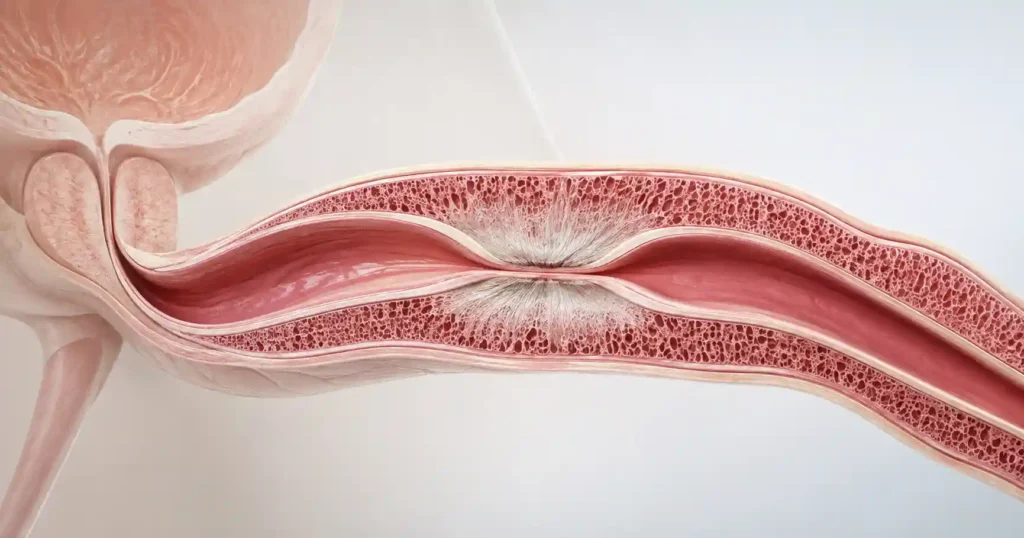
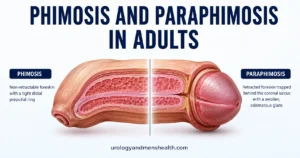
Phimosis means the foreskin won’t retract over the glans. Not all phimosis is a problem — many men have a naturally snug foreskin that never causes trouble. What needs treatment is pathologic phimosis: a foreskin tightened by scarring, recurrent infection, or skin disease. The first-line treatment is usually a 4 to 8 week course of a potent steroid cream, which resolves a large share of cases and avoids surgery [4]. Circumcision is reserved for scarred, fixed phimosis or when creams fail. Our guide to phimosis and paraphimosis in adults covers the non-surgical options in detail.
Recurrent balanitis and balanoposthitis
Balanitis is inflammation of the glans; balanoposthitis adds inflammation of the foreskin. When it keeps recurring — often in men with diabetes or a foreskin that is hard to clean — circumcision sharply reduces future episodes by removing the warm, moist space under the foreskin where the problem lives. If you are unsure whether your symptoms warrant a specialist, our overview of penile problems and when to see a doctor is a useful starting point.
Paraphimosis
Paraphimosis is the dangerous opposite of phimosis: the foreskin is pulled back behind the glans and won’t return, acting like a tight band that cuts off blood flow. It is a urological emergency. Once it has been reduced, recurrent episodes are a clear reason to consider circumcision to stop it happening again.
Lichen sclerosus (BXO)
Lichen sclerosus — known on the penis as balanitis xerotica obliterans, or BXO — is a chronic scarring skin condition that whitens and tightens the foreskin and glans. It is one of the few situations where circumcision is often curative, particularly when caught early [3]. BXO is strongly linked to being uncircumcised, and it carries a small association with penile cancer, so it is a diagnosis I take seriously rather than watch indefinitely.
Other indications
Less commonly, adults are circumcised for recurrent urinary tract infections in select cases, for a tight or tearing frenulum, or to remove and biopsy a suspicious or precancerous lesion. Each of these is a specific clinical decision — not a reason every man with a foreskin needs surgery.
Preparing for urological surgery? Download Dr. Khalid’s Urology Surgery Recovery Guide.
Enter your email below to receive Dr. Khalid’s complete Urology Surgery Recovery Guide as a free, printable PDF.
What the surgery and recovery involve
Adult circumcision is usually a day-case operation. It takes roughly 30 to 45 minutes, you go home the same day, and the stitches dissolve on their own over a few weeks.
Expect the first 1 to 2 weeks to be the uncomfortable stretch — swelling, bruising, and tenderness are normal and settle steadily. Most men take a few days to a week off work depending on how physical the job is. Full healing takes about 4 to 6 weeks, and that is the window where the most important rule applies: no sexual activity or masturbation until your surgeon clears you, because an erection on a fresh suture line risks bleeding and wound breakdown.
Complications are uncommon but real: bleeding, infection, and dissatisfaction with the cosmetic result are the main ones, and serious problems are rare when the surgery is done for a clear indication by an experienced surgeon [4]. To see what to expect day by day, our post-operative recovery timeline tool lays it out week by week, and recovery from other minor genital day-surgery — such as a hydrocele or spermatocele repair — follows a broadly similar pattern.
In My Practice
The men who do best after circumcision are usually the ones who came in for a tight, scarred foreskin they had been ignoring for years — and the ones who struggle most are those who expected a quick cosmetic tidy-up and underestimated the four to six weeks of healing. I spend more of that first consultation managing expectations about recovery than discussing the operation itself.
Realistic recovery expectations, not the surgical technique, are what separate a satisfied patient from a frustrated one.
Will adult circumcision change sex, sensation, or appearance?
This is the first question almost every man asks, and the honest answer is reassuring. The best available evidence — including the two randomized controlled trials that sit at the top of the quality ladder — shows that adult circumcision has no overall adverse effect on erectile function, penile sensitivity, ejaculation, or sexual satisfaction [1].
A separate meta-analysis of nearly 19,000 men found no significant difference between circumcised and uncircumcised men in erectile dysfunction, premature ejaculation, sexual desire, or orgasm difficulty [2]. Some men report changes in sensation in either direction, and a minority who had circumcision specifically for premature ejaculation notice a delay — but as a group, the function-altering fears that keep men from needed surgery are not supported by the data.
Appearance does change permanently: the glans is left exposed, which alters how the penis looks and feels day to day. That is worth thinking through in advance, because it is the one part of the result that cannot be reversed.
Red Flags — Get Urgent Help
Before surgery, paraphimosis — a retracted foreskin stuck behind the glans with swelling and pain — is a urological emergency. Go to the ER. After circumcision, contact your surgeon or go to the ER for any of the following:
- Bleeding that soaks through the dressing and won’t stop after 10 minutes of firm pressure
- Fever, spreading redness, or pus — signs of wound infection
- Inability to pass urine
- Severe, worsening pain that your prescribed pain relief does not control
Frequently Asked Questions
Do I really need circumcision, or can I treat a tight foreskin without surgery?
Often you can. For phimosis without heavy scarring, a 4 to 8 week course of a potent steroid cream resolves a large proportion of cases and lets you keep the foreskin. Surgery is reserved for scarred, fixed phimosis, lichen sclerosus, or when creams have failed. Our guide to phimosis in adults walks through the non-surgical ladder first.
How long does recovery from adult circumcision take?
Plan for 1 to 2 weeks of swelling and tenderness and about 4 to 6 weeks for full healing. Most men return to desk work within a few days. The firm rule is no sexual activity or masturbation until your surgeon clears you — usually at the 4 to 6 week mark — because an erection on a healing suture line can cause bleeding. The recovery timeline tool maps it out week by week.
Does adult circumcision reduce sexual sensation?
On the best evidence, no — not as a group. Randomized trials and large reviews found no overall adverse effect on penile sensitivity, erectile function, or sexual satisfaction after adult circumcision. Individual men report changes in either direction, but the widespread fear of lost sensation is not borne out by the high-quality data.
Will circumcision cure recurrent balanitis?
It will not guarantee zero future inflammation, but it sharply reduces recurrent balanitis by removing the moist, hard-to-clean space under the foreskin where it tends to start. For lichen sclerosus (BXO) specifically, circumcision is often curative when done early. If episodes keep returning despite hygiene and creams, it is worth a urology opinion.
Is adult circumcision riskier than infant circumcision?
It is a bigger operation — done under anesthesia, with stitches and a multi-week recovery rather than the quick newborn procedure. That said, serious complications are uncommon when it is performed for a clear medical reason by an experienced surgeon. The main risks are bleeding, infection, and dissatisfaction with cosmetic appearance.
What is the difference between phimosis and paraphimosis?
Phimosis is a foreskin that won’t retract forward over the glans. Paraphimosis is the reverse and far more urgent: the foreskin is stuck behind the glans and acts like a tightening band, cutting off blood supply. Paraphimosis is a medical emergency — go to the ER. Recurrent paraphimosis is a common reason to recommend circumcision.
References
- Morris BJ, Krieger JN. Does male circumcision affect sexual function, sensitivity, or satisfaction? A systematic review. J Sex Med. 2013;10(11):2644-2657. PubMed
- Tian Y, Wang J, Wazir R, Yue X, Wang K. Effects of circumcision on male sexual functions: a systematic review and meta-analysis. Asian J Androl. 2013;15(5):662-666. PubMed
- Balanitis Xerotica Obliterans (Male Penile Lichen Sclerosus). StatPearls [Internet]. StatPearls Publishing; 2024. NCBI Bookshelf
- Royal College of Surgeons of England. Commissioning Guide: Foreskin Conditions. RCS England. 2013. RCS England
Dr. Muhammad Khalid
MBBS · FCPS (Urology) · MCPS (General Surgery) · CHPE · CRSM · IMC #539472
Specialist urologist with 11+ years of clinical experience across tertiary teaching hospitals. Trained at Lady Reading Hospital and Khyber Teaching Hospital, Peshawar. Author or co-author of five peer-reviewed international publications, including in Cureus and the World Journal of Surgery. Procedural expertise: URS, PCNL, RIRS, TURP, TURBT, and major open urological surgery. Full profile →
This article is for educational purposes only and does not constitute medical advice. Always consult your physician or urologist for diagnosis and treatment decisions specific to your condition.