Penile Health: What’s Normal and When to See a Doctor
Most men who come to me worried about their penis are completely healthy — but a few have something that genuinely needs treatment. Here's how a urologist tells normal penile health from the changes that need a doctor.

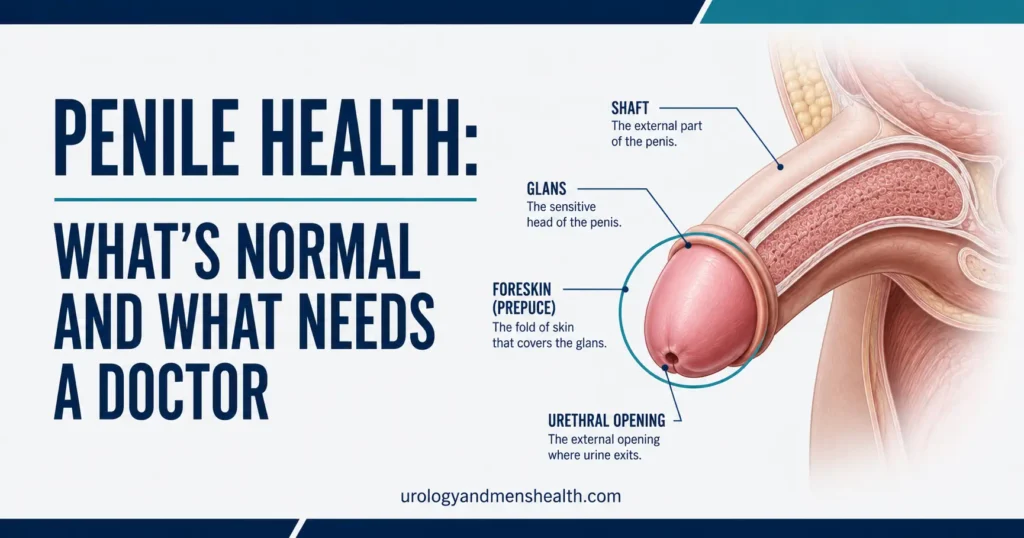
Penile health is the one topic men will research at midnight but won’t raise in a clinic. I see it constantly: a man notices a bump, a spot, or a change in color, spends a week convinced it’s cancer, and arrives barely having slept. Most of the time, I get to tell him he’s fine. Sometimes I don’t — and catching that difference early is what this article is for.
The penis is skin, blood vessels, nerves, and erectile tissue, and like any part of the body it has a wide range of normal. A lot of what alarms men is simply anatomy they’d never looked at closely before. But a smaller set of changes — a lump that doesn’t move, a sore that won’t heal, a sudden curve, blood, or discharge — are signals worth acting on. For the wider picture across erections, infections, and men’s sexual concerns, see our complete Sexual Health Hub. Here, I’ll take you through what’s normal, what needs a doctor, and what’s a genuine emergency.
Key Takeaways
- Pearly penile papules, Fordyce spots, and Tyson’s glands are normal anatomy — common, harmless, and not sexually transmitted, even though they’re the number-one reason men panic.
- A painless lump, or a sore that hasn’t healed in about three weeks, needs a doctor. Penile cancer is rare (under 1% of male cancers) but almost always starts as a visible skin change.
- A new curve, painful erections, or a firm lump you can feel along the shaft points to Peyronie’s disease, not cancer — and it’s treatable.
- A foreskin you suddenly can’t pull back forward over the head, or an erection lasting more than four hours, is an emergency. Go to the ER — don’t wait it out.
What’s Actually Normal: A Urologist’s Take on Penile Health
Before we get to what’s wrong, you need a baseline for what’s right. There is no single “normal” penis. Size, shape, the color of the glans (the head), the angle and direction of an erection, and skin texture all vary enormously between healthy men. A glans that’s pinker or darker than the shaft is normal. Visible veins are normal. A slight bend you’ve had as long as you can remember is almost always normal.
Most of the “findings” that send men to my clinic are anatomy, not disease. The three I reassure people about almost every week:
- Pearly penile papules. Small, skin-colored, dome-shaped bumps arranged in one or two neat rows around the rim of the glans. They’re present in roughly a third of men, are not an infection, and need no treatment. Because they sit in a tidy ring, men are convinced they’re warts — they aren’t.
- Fordyce spots. Tiny yellowish-white dots on the shaft. These are simply sebaceous (oil) glands sitting close to the surface. Everyone has them somewhere on the body; on the penis they’re just more visible.
- Tyson’s glands, skin tags, and prominent veins. All normal structures or harmless skin changes that become noticeable once a man starts inspecting closely.
The mechanical point is this: these are permanent, symmetrical, and stable. They don’t grow, bleed, ulcerate, or hurt. That stability is exactly what separates normal anatomy from the changes in the next section.
In My Practice
A 24-year-old once booked an urgent appointment, took a half-day off work, and came in pale because he’d found a ring of tiny bumps around the edge of his glans. He hadn’t slept properly in a week and hadn’t told his partner, certain it was an STI he’d somehow caught. It took me about thirty seconds to recognize pearly penile papules — completely normal, present since puberty, just never noticed until he went looking after a health scare online.
The findings that frighten men most are usually the ones that need no treatment at all — but the only way to know which is which is to have someone qualified actually look.
Penile Changes That Need a Doctor
Here’s the flip side. The features that make me want to examine a man are change, persistence, and asymmetry. If something is new, growing, not healing, or only on one side, it earns a closer look.
- A firm lump that’s fixed or growing. Normal bumps are soft and stable. A hard lump that’s anchored to deeper tissue or getting bigger needs assessment.
- A sore, ulcer, or wart that won’t heal. Anything that hasn’t settled in about three weeks should be looked at — sooner if it bleeds.
- A persistent red, velvety, or scaly patch. A patch that lingers and doesn’t respond to simple measures can occasionally be a precancerous skin change rather than a rash.
- Discharge, burning, or recurring sores. These point toward infection or a sexually transmitted infection rather than a skin lesion.
The condition men fear is penile cancer, and it’s worth being precise. It’s genuinely rare — fewer than 1% of cancers in men — but the reason early detection matters so much is that it almost always begins as a visible change on the skin of the glans or foreskin, exactly the kind of sore or patch above.[2] That’s good news: a cancer that announces itself on the surface is one you can catch early if you don’t ignore it. If you have a lesion that won’t heal, ask your primary care doctor or a urologist whether a biopsy is appropriate rather than watching it for months.
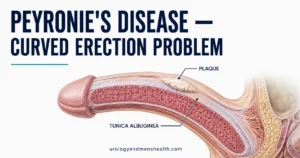
A different pattern is a new curve. If your erection has bent noticeably over recent weeks or months, often with pain on erection and a firm lump you can feel along the shaft, that’s Peyronie’s disease — scar tissue in the wall of the erectile chambers — not cancer. The American Urological Association’s framework treats it as a recognized, manageable condition with both non-surgical and surgical options depending on the stage.[1] If that sounds like you, here’s what causes a new bend in an erection and how it’s treated.
If your concern is mostly sores, discharge, or symptoms that come and go after sex, sorting infection from something else is the first step. This quick UTI-versus-STI symptom checker can help you decide how urgently to be seen and what to ask for.
ED that is not responding to the usual pills? Download Dr. Khalid’s ED & Sexual Function Action Plan.
Enter your email below to receive Dr. Khalid’s complete ED & Sexual Function Action Plan as a free, printable PDF.
Foreskin Problems: Tightness, Pain, and Infection
If you’re uncircumcised, the foreskin is where a large share of penile health problems show up. The most common is balanitis — inflammation of the glans, often with the foreskin involved too. It looks like redness, swelling, soreness, sometimes itch or a discharge under the foreskin.
The usual drivers are trapped moisture, a yeast (candida) overgrowth, or simple irritation from soap. Recurrent balanitis is also one of the body’s quieter signals of diabetes, because high blood sugar feeds yeast — so if it keeps returning, getting your glucose checked is a sensible step.[3] For most cases the fix is unglamorous: wash daily with lukewarm water, dry properly, and avoid harsh soap. Persistent or recurrent cases need a doctor to identify the cause rather than treating it blindly.
Repeated inflammation can gradually tighten the foreskin so it no longer retracts — phimosis. A tight foreskin isn’t just a nuisance; it traps moisture and makes balanitis more likely, and long-standing cases carry their own small risks. The opposite emergency — a retracted foreskin that gets stuck behind the glans and swells — is covered in the next section.
One foreskin finding to take seriously is a white, sclerotic ring or thickened pale patches (lichen sclerosus). It can scar the foreskin and urethral opening over time and warrants treatment, so don’t dismiss persistent white changes as just dryness.
When Penile Symptoms Are a True Emergency
Most penile health concerns can wait for a routine appointment. A few cannot. These are the ones where hours matter, because the tissue can be permanently damaged if you delay.
When to Go to the ER
Go to the emergency room — not the internet, and not a wait-and-see — if you have any of the following:
- Paraphimosis: a retracted foreskin stuck behind the head that won’t go back forward, with the glans swelling. This cuts off circulation and needs urgent reduction.
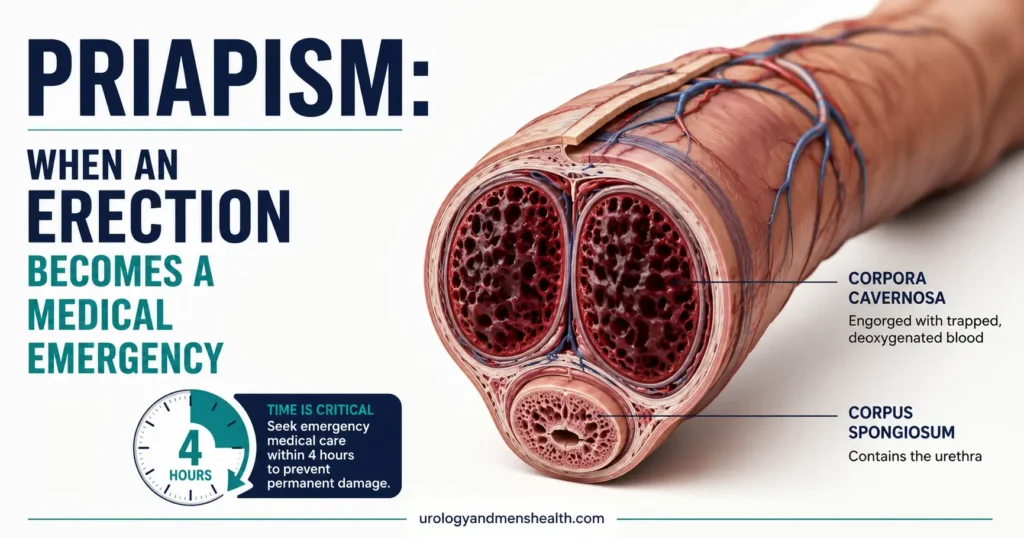
- Priapism: an erection lasting more than four hours, usually painful and unrelated to arousal. Trapped blood starves the tissue of oxygen.
- Penile fracture: a sudden popping or cracking sensation during sex, immediate loss of the erection, swelling, and bruising. This is a torn erectile chamber and is a surgical emergency.
- Fournier’s gangrene: rapidly spreading redness, severe pain that seems out of proportion, swelling, and fever in the genital or perineal area. This is a life-threatening infection.
The common thread is sudden, severe, and progressing. A bump you’ve watched for a month is not this. Acute swelling, an erection that won’t go down, or a tearing sensation during sex is. When in doubt with any of these, treat it as an emergency.
Keeping Your Penis Healthy Long-Term
Good penile health is mostly the same boring discipline that protects the rest of you, plus a couple of specifics:
- Wash and dry under the foreskin daily with lukewarm water — this alone prevents most balanitis.
- Stop smoking. The penis runs on blood flow, and smoking damages the small arteries first. Reliable erections are one of the earliest, most honest barometers of vascular health in the whole body.
- Control blood sugar and weight. Diabetes drives both recurrent infections and erectile problems through the same nerve and vessel damage.
- Consider the HPV vaccine. HPV is a known driver of penile cancer, and vaccination lowers that risk.
- Check yourself monthly. You’ll spot a new lump or sore far faster than any annual exam will.
That barometer point is worth dwelling on. When a man’s erections change before anything else does, it’s often the cardiovascular system flagging a problem early. If erections have become unreliable, don’t write it off as age — it’s frequently the first treatable sign of something larger. Here’s the step-by-step protocol I use to treat erectile dysfunction, including the workup that checks your heart and vessels at the same time.
Frequently Asked Questions About Penile Health
Are the small bumps around the head of my penis an STD?
Almost always, no. A ring of small, skin-colored, dome-shaped bumps around the rim of the glans is usually pearly penile papules — normal anatomy that around a third of men have. They aren’t infectious, aren’t caused by anything you did, and need no treatment. If the bumps are warty, painful, or appeared suddenly, run a quick UTI-versus-STI symptom check and see a doctor.
How long should I wait before seeing a doctor about a sore on my penis?
A sore, ulcer, or red patch that hasn’t healed within about three weeks should be examined, and sooner if it’s bleeding, growing, or hard. Most are infections or irritation, but a non-healing lesion is the most common first sign of penile cancer — which is rare but highly treatable when caught early. Don’t wait it out; ask for a urology referral.
Is a slight curve in my erection a sign of Peyronie’s disease?
Not by itself. Plenty of men have had a mild bend their whole adult life, and that’s normal. Peyronie’s disease is different: a new curve that develops over weeks or months, often with pain on erection and a firm lump you can feel along the shaft. If that describes you, here’s what causes a new bend and how it’s treated.
Can poor hygiene actually cause penile health problems?
Yes — especially under a foreskin. Trapped moisture, dead skin, and bacteria or yeast cause balanitis, an inflamed, sore, sometimes itchy glans. Repeated episodes can tighten the foreskin over time. Washing daily with lukewarm water and drying properly prevents most cases. If it keeps coming back, get your blood sugar checked and read about when a tight foreskin needs treatment.
Does penis size affect penile health?
No. Size has no bearing on penile health, urinary function, or fertility. What men perceive as a small penis is often a buried penis, where a normal-length shaft is hidden by fat or skin, rather than a true anatomical difference. If urination or hygiene is affected, that’s worth a conversation with a urologist; otherwise, size alone is not a medical problem.
References
- Nehra A, Alterowitz R, Culkin DJ, et al. Peyronie’s Disease: AUA Guideline. J Urol. 2015;194(3):745-753. AUA
- American Cancer Society. Signs and Symptoms of Penile Cancer. 2024. American Cancer Society
- Balanitis. In: StatPearls [Internet]. Treasure Island (FL): StatPearls Publishing; 2024. StatPearls
Dr. Muhammad Khalid
MBBS · FCPS (Urology) · MCPS (General Surgery) · CHPE · CRSM · IMC #539472
Specialist urologist with 11+ years of clinical experience across tertiary teaching hospitals. Trained at Lady Reading Hospital and Khyber Teaching Hospital, Peshawar. Author or co-author of five peer-reviewed international publications, including in Cureus and the World Journal of Surgery. Procedural expertise: URS, PCNL, RIRS, TURP, TURBT, and major open urological surgery. Full profile →
This article is for educational purposes only and does not constitute medical advice. Always consult your physician or urologist for diagnosis and treatment decisions specific to your condition.