Penile Injections for ED: Trimix, Risks & What to Expect
When Viagra and Cialis stop working, men assume an implant is next. It isn't. Penile injections like Trimix are the most reliable non-surgical fix I have — and most men inject without pain once trained.

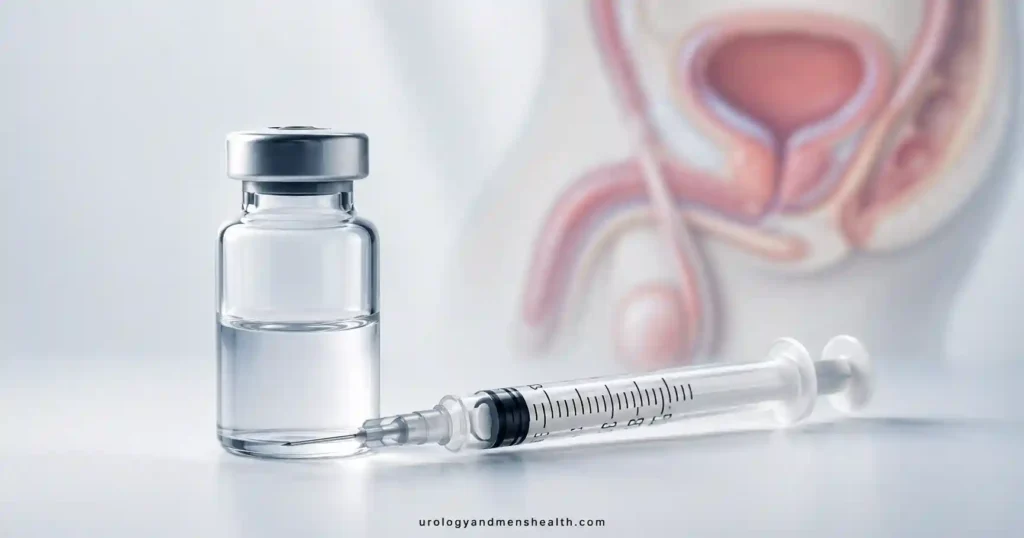
Penile injections for ED sound alarming until you understand one thing: they are the most reliable non-surgical erection treatment in urology, and the needle is finer than the one a person with diabetes uses for insulin. When Viagra, Cialis, and the other oral tablets stop working — or never worked — this is usually the next step in the treatment pathway I walk patients through, long before anyone needs to consider surgery. The medication goes directly into the side of the penis and produces an erection in 5 to 20 minutes, whether or not you feel aroused, because it bypasses the nerve and blood-flow problems behind most ED. The best-known version is Trimix, a compounded blend of three drugs. For where this sits among all your options, start with our Sexual Health Hub. Below I explain what is in the syringe, how well injections work, how the injection is performed, and the one complication — a prolonged erection called priapism — you must take seriously.
Key Takeaways
- Penile injections produce an erection in 5–20 minutes whether or not you feel aroused, because they act directly on penile blood vessels rather than the brain or nerves.
- Trimix (papaverine, phentolamine, and alprostadil) and alprostadil alone work in roughly 70–90% of men, including most who got no result from oral pills.
- The first injection is always done in a urologist’s office to set your dose and teach the technique — never start at home from a prescription alone.
- An erection lasting more than 4 hours is a medical emergency called priapism; know your plan before the first dose.
When Penile Injections Become the Right Move
I reach for injections when oral medication has genuinely failed, not just disappointed once. That includes men whose erections no longer respond to tablets — a situation I cover in why Viagra stops working and what comes next — and men who can’t take PDE5 inhibitors at all, usually because they need nitrates for their heart. The American Urological Association lists intracavernosal injections as a standard second-line treatment for ED, meaning the recognized step once first-line pills are exhausted[1].
Injections are also the workhorse for two specific groups. The first is men recovering from prostate cancer surgery, where the erection nerves are bruised or cut and pills often do little for months. The second is men with significant vascular ED, where blood flow is the limiting factor. Some men land here because the blood-pressure medication protecting their heart is also blunting their erections — a trade-off I unpack in how BP medication causes ED.
Before stepping up to needles, it helps to grade how severe your ED actually is. A validated tool like the IIEF-5 erectile function self-assessment gives you and your urologist a shared baseline, so you can tell later whether injections are genuinely working or whether something else needs attention.
Trimix vs. Alprostadil: What’s Actually in the Syringe
There are two main approaches, and the difference matters for both comfort and cost. Alprostadil (sold as Caverject or Edex) is prostaglandin E1, and it is the only single agent the FDA has approved for injection. It works well, but used alone it causes a deep aching pain in the penis for a meaningful number of men.
Trimix is a compounded blend of three drugs — papaverine, phentolamine, and a small dose of alprostadil — mixed by a specialist pharmacy. Combining three agents lets each one be used at a lower dose, which usually means less pain than alprostadil alone and a lower cost per erection. Because it is compounded rather than a single approved product, Trimix is prescribed and dosed individually by your urologist. Related blends exist too: Bimix drops the alprostadil entirely (useful if that ingredient is the one causing pain), and a stronger Quadmix adds a fourth agent for men who don’t respond to the standard mix.
How Well Penile Injections Actually Work
This is where injections earn their reputation. Reported effectiveness sits in the 70–90% range depending on the drug and the underlying cause of ED. In the large trial that established intracavernosal alprostadil, 92% of men reported satisfactory sexual activity at home[2]. That is a far higher response than most men ever got from tablets.
The reason it works so reliably is mechanical. The medication relaxes the smooth muscle inside the two erection chambers and opens the arteries directly, so the result does not depend on arousal, intact nerves, or a strong brain signal. That is exactly why injections rescue men whom pills cannot. The honest caveat: the dropout rate over time is real. Some men stop not because it fails, but because the routine of injecting feels like a burden — which is why I spend real time on technique and on bringing partners into the process.
ED that is not responding to the usual pills? Download Dr. Khalid’s ED & Sexual Function Action Plan.
Enter your email below to receive Dr. Khalid’s complete ED & Sexual Function Action Plan as a free, printable PDF.
How the Injection Is Done — and Why the First Dose Is in My Office
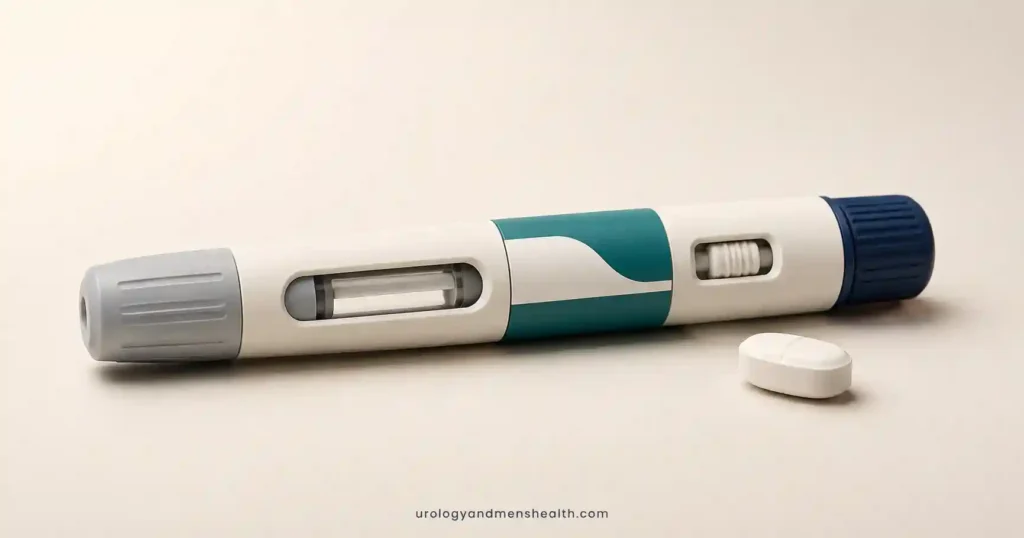
The technique is simpler than it sounds. You use a short, fine needle — typically a 27 to 30 gauge insulin-style syringe — and inject into the side of the shaft, somewhere between the base and the middle. You deliberately avoid the top, the underside (where the urethra runs), and any visible surface vein, and you alternate sides between doses to spread out the tissue stress.
The first dose is never a do-it-yourself event. The AUA treats in-office injection training as a clinical principle for good reason[1]: we use that visit to find the lowest dose that gives a usable erection without overshooting, and to watch what happens. Starting blind at home from a prescription risks both a useless dose and a dangerously strong one. Injections sit at a specific rung of the ED step-up pathway, and that office visit is what makes the rest safe to do yourself.
One practical thing I push hard: bring your partner to the training session if you can. Men whose partners understand and accept the technique stick with the treatment far longer than men who try to hide it.
The Real Risks: Priapism, Pain, and Scar Tissue
Three things can go wrong, and you should know all of them before your first dose. The most common is penile pain, mostly tied to alprostadil. In the original alprostadil trial, about half of men reported pain at least once, but it actually occurred after only roughly 1 in 9 injections, and was usually mild[2]. Switching to Trimix, which uses far less alprostadil, solves this for many men. Bruising at the injection site is also common and harmless.
The second concern is scar tissue — small nodules or areas of firmness (penile fibrosis) that can develop with frequent long-term use, reported in around 8% of long-term users[3]. Rotating injection sides and keeping the dose as low as works is how we minimize it, which is another reason not to self-escalate the dose.
The third is the one that is genuinely an emergency: priapism, an erection that won’t go down. In the alprostadil trial it affected about 1% of men, and longer-term figures run up to roughly 4%[2][3].
In My Practice
The most common reaction I get when I suggest injections is a flinch — men picture a long needle and assume it has to hurt as much as it looks like it should. So I do the first injection in the office, hand them the empty syringe afterward, and almost every man says the same three words: “That was it?” The needle is shorter than an eyelash is long, and the side of the shaft has surprisingly few pain fibers.
The fear of the needle, not the needle itself, is what stops most men from a treatment that works for the large majority who try it.
When an Erection Becomes an Emergency
An erection lasting longer than 4 hours is priapism — a medical emergency, not a success. Trapped blood loses its oxygen, and after several hours the damage to erectile tissue can become permanent, leaving you with worse ED than you started with.
- Go to the nearest ER if an erection lasts more than 4 hours — do not wait until morning.
- Tell the staff you used a penile injection, so they can treat it quickly (usually by draining blood and reversing it with medication).
- Never take a second dose to “rescue” a weak result — this is the most common cause of priapism.
- Keep your urologist’s number and your dose written down before your first injection at home.
Frequently Asked Questions
Do penile injections for ED hurt as much as the idea of them suggests?
For most men, no. The needle is a fine 27–30 gauge — shorter and thinner than an insulin needle — and the side of the shaft has few pain-sensing fibers. Alprostadil alone can cause a deep ache in some men, which is one reason I often prescribe Trimix instead. If the needle is your main worry, it usually disappears after the first supervised dose in the treatment pathway.
Is Trimix better than alprostadil alone for ED?
Neither is universally better, but Trimix has real advantages for many men. By combining three drugs, it uses a smaller dose of alprostadil — the component most likely to cause aching — so it tends to hurt less and cost less per dose. Alprostadil alone (Caverject, Edex) is the only FDA-approved single agent, while Trimix is compounded by a pharmacy. Grading your ED first with the IIEF-5 self-assessment helps track which works for you.
How quickly do penile injections work, and do I need to be sexually aroused?
An injection usually produces an erection within 5 to 20 minutes, and arousal is not required, because the medication relaxes the penile blood vessels directly rather than working through desire or nerve signals. That independence from arousal is why injections succeed in men whose ED comes from nerve damage or poor blood flow — including many for whom Viagra has stopped working. Plan to inject 10–15 minutes before sex.
Can I give myself the injection at home, or must a clinic do it?
After training, almost all men inject at home — that is the whole point of the therapy. But the first dose is always given in a urologist’s office so we can find the lowest effective dose and watch for a prolonged erection. Starting at home from a prescription alone risks both an ineffective dose and a dangerous one. You can see where injections sit on the ED step-up pathway to understand the sequence.
What should I do if my erection won’t go down after a Trimix injection?
If an erection lasts longer than 4 hours, treat it as an emergency and go to the nearest ER — do not wait until morning. Tell the staff you used a penile injection so they can act quickly, usually by draining blood and injecting a medication to reverse it. Prolonged erections can permanently scar erectile tissue. Never take a second dose to rescue a weak result. More options are covered in our Sexual Health Hub.
References
- Burnett AL, Nehra A, Breau RH, et al. Erectile Dysfunction: AUA Guideline. J Urol. 2018;200(3):633-641. PubMed
- Linet OI, Ogrinc FG. Efficacy and safety of intracavernosal alprostadil in men with erectile dysfunction. The Alprostadil Study Group. N Engl J Med. 1996;334(14):873-877. PubMed
- Alprostadil. In: StatPearls. Treasure Island (FL): StatPearls Publishing; 2025. NCBI Bookshelf
Dr. Muhammad Khalid
MBBS · FCPS (Urology) · MCPS (General Surgery) · CHPE · CRSM · IMC #539472
Specialist urologist with 11+ years of clinical experience across tertiary teaching hospitals. Trained at Lady Reading Hospital and Khyber Teaching Hospital, Peshawar. Author or co-author of five peer-reviewed international publications, including in Cureus and the World Journal of Surgery. Procedural expertise: URS, PCNL, RIRS, TURP, TURBT, and major open urological surgery. Full profile →
This article is for educational purposes only and does not constitute medical advice. Always consult your physician or urologist for diagnosis and treatment decisions specific to your condition.