Shockwave Therapy for ED: Scam or Real Treatment?
Men ask me if the $3,000 shockwave package they saw advertised will really fix their ED. The honest answer turns on one thing most clinics won't tell you: which machine they are actually using.

Shockwave therapy for ED is sold as the breakthrough that finally fixes erectile dysfunction at its source — no pills, no needles, no surgery, just a few sessions with a wand and your problem is solved. The pitch is everywhere now: men’s wellness clinics, med-spas, even some physiotherapy practices advertise it as a permanent cure. So is it a genuine treatment or an expensive scam? The honest answer is somewhere in between, and where exactly depends on details most clinics will never put in their advertising. There is a real biological mechanism here, and there is real (if modest) evidence behind it. There is also a great deal of money being made selling the wrong version of it to men who were never good candidates in the first place. I’ll walk you through what the science actually shows, who this helps, and the single most important question to ask before you hand over a credit card. For the broader picture on treating ED, see our Sexual Health Hub.
Key Takeaways
- Low-intensity focused shockwave therapy has a real mechanism — it promotes new blood-vessel growth — and modest evidence in mild-to-moderate vasculogenic ED. It is not pure quackery.
- The 2025 Cochrane review of 21 trials found it may slightly improve erectile function in the short term, but the certainty of that evidence is low and the durability is unproven.
- The AUA classifies shockwave therapy for ED as investigational; the EAU gives it only a weak recommendation for mild ED or men who don’t respond to pills.
- Many clinics use cheaper radial-wave machines and market them as “shockwave.” Focused devices outperform radial ones in head-to-head data, so the machine matters more than the marketing.
What Shockwave Therapy for ED Actually Is
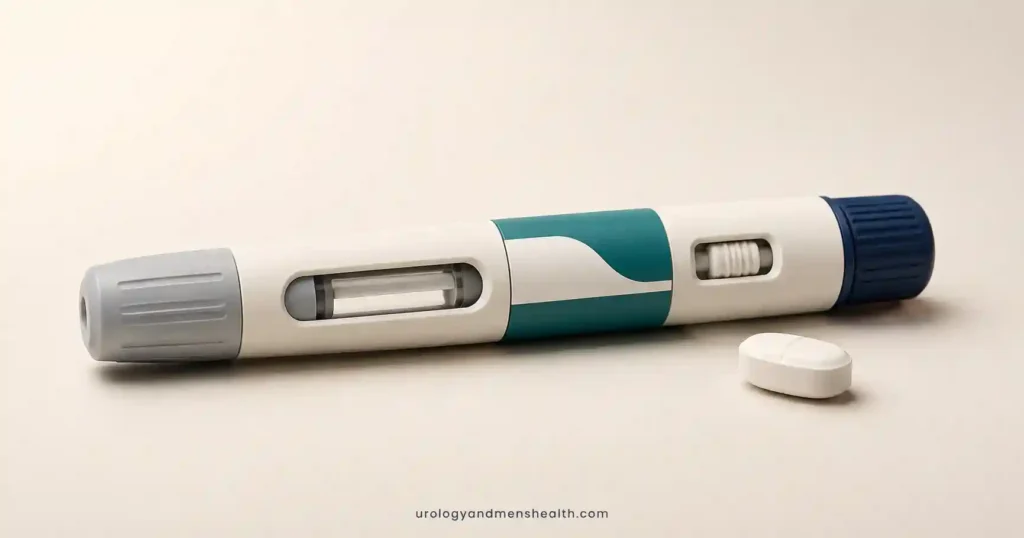
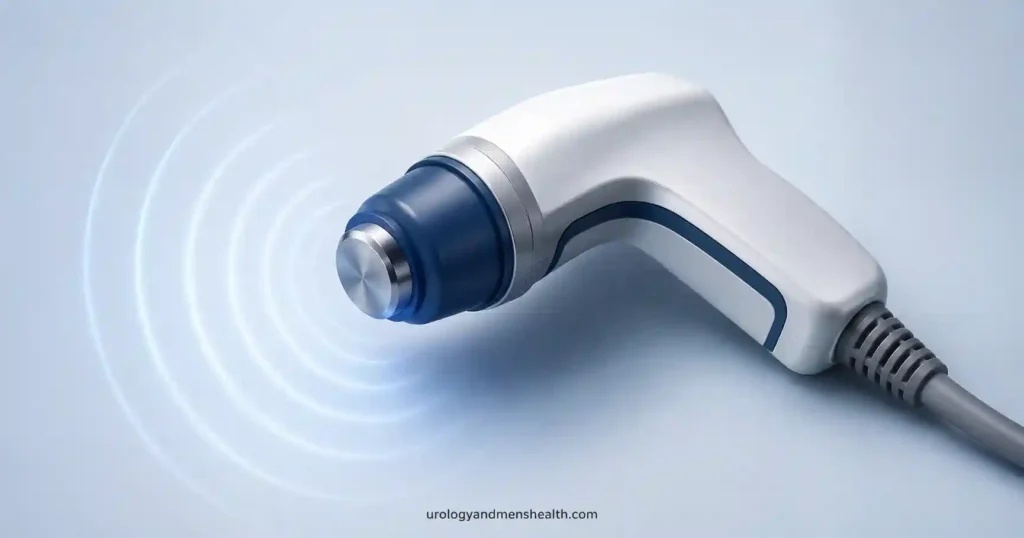
The full name is low-intensity extracorporeal shockwave therapy (LI-ESWT). A handheld applicator delivers low-energy acoustic pulses to the tissue of the penis. These are not the high-energy waves used to break kidney stones — the energy here is roughly a tenth of that, in the range of 0.08 to 0.27 mJ/mm².
The theory is straightforward and biologically plausible. The micro-pulses create controlled micro-stress in the tissue, which prompts the release of growth signals — chiefly vascular endothelial growth factor — that stimulate the formation of new blood vessels. In a man whose ED is driven by poor arterial blood flow, more blood vessels mean better inflow and, potentially, a firmer erection.
This is what makes shockwave different from tablets like sildenafil or tadalafil. A pill works for that one occasion and wears off. Shockwave is proposed as a way to actually improve the underlying plumbing, which is why it is studied almost entirely in vasculogenic ED — erectile dysfunction caused by blood-flow problems rather than nerve damage or psychology. A typical course runs 6 to 12 sessions over several weeks. If your ED comes from a vascular cause, you can check your own risk profile with our ED vascular risk screener before deciding whether this approach even fits your situation.
Does Shockwave Therapy for ED Actually Work?
Here is where the honest answer matters. The best current evidence is the 2025 Cochrane review, which pooled 21 randomized trials covering 1,357 men. It concluded that shockwave therapy may slightly improve erectile function in the short term — on average around a 4-point gain on the standard IIEF erectile-function score — but rated the certainty of that evidence as low, and stated plainly that the clinical importance of the improvement is uncertain.[2] In other words: there is a real signal, but it is small, and we cannot yet say how meaningful or how lasting it is.
The guideline bodies reflect that caution. The American Urological Association classifies shockwave therapy for ED as investigational, a conditional recommendation backed by Grade C (low-quality) evidence.[1] The European Association of Urology goes slightly further, allowing that it can be offered to men with mild organic ED or poor responders to pills — but only with a weak strength of recommendation.[3] Neither body endorses it as a standard, proven treatment.
So when a clinic’s website promises that shockwave “cures ED” or “regrows” your erections permanently, it is running well ahead of the data. The science supports a modest, short-term improvement in carefully selected men. It does not support a guaranteed or permanent cure for anyone.
In My Practice
A man in his late fifties came to me frustrated and several thousand dollars poorer. He had bought a six-session “shockwave” package at a wellness clinic after seeing it advertised as a permanent fix. No improvement. When I took his history, two things stood out: the clinic had never assessed why he had ED, and he had never been given a proper trial of a daily low-dose pill — the standard, cheap first step he turned out to respond to within weeks.
The men most often sold shockwave are frequently the same men who would respond to far cheaper, better-proven first-line treatment that nobody offered them first.
ED that is not responding to the usual pills? Download Dr. Khalid’s ED & Sexual Function Action Plan.
Enter your email below to receive Dr. Khalid’s complete ED & Sexual Function Action Plan as a free, printable PDF.
The Device Trap: Why “Shockwave” Isn’t Always Shockwave
This is the single most important thing to understand, and it is where the word “scam” becomes fair for a large share of the market. Not all “shockwave” machines are the same device, and the difference is not a marketing detail — it is physics.
Focused shockwave (fSWT) is what nearly all the research used. It is generated by an electromagnetic, electrohydraulic, or piezoelectric source, and the energy is focused so it penetrates deep enough to reach the erectile tissue. Radial wave (rSWT) is a different, cheaper technology — a pressure wave that spreads out and disperses near the surface, originally designed for muscle and tendon physiotherapy. The machine costs a fraction of a focused unit, which is exactly why many med-spas and “men’s clinics” use it.
The problem is that they are often marketed under the same word: “shockwave.” When researchers compared them head to head in a 2025 meta-analysis, focused therapy significantly outperformed radial therapy for erectile function.[4] So a man can pay focused-therapy prices for a radial machine that has weaker evidence behind it — and never know the difference, because the brochure just said “shockwave.”
If you are seriously considering this treatment, the question that protects you is blunt: “Is this a focused shockwave device or a radial pressure-wave device, and what is the brand name?” A clinic doing this properly will answer without hesitation. One that gets evasive is telling you something.
Who Shockwave Therapy for ED Helps — and What It Costs
The treatment is studied in a specific man, and the results follow that selection. The better candidate has mild-to-moderate ED from a vascular cause, still gets at least a partial response from pills like sildenafil or tadalafil, and wants to reduce his reliance on them. For this man, shockwave is a reasonable thing to try with realistic expectations — and worth confirming his baseline first with a validated measure like our IIEF-5 erectile function self-assessment so any change can actually be tracked.
It is far less likely to help men with severe ED, ED from nerve damage after prostate surgery, predominantly psychological ED, or significant venous leak. And if you have never had a proper trial of first-line treatment, that is the place to start — not an expensive procedure. Our full erectile dysfunction treatment protocol lays out that stepwise approach, and if pills have stopped working for you, the reasons matter — covered in what to do when Viagra stops working.
On cost: a full course is typically priced somewhere around $2,000 to $4,000 in the US, paid entirely out of pocket, because no insurer covers a treatment the AUA still labels investigational. That price tag is part of why selecting the right patient matters so much — it is a lot of money to spend chasing a modest, short-term benefit you may not even be positioned to receive. One more thing worth ruling out first: some blood-pressure medications cause or worsen ED, and switching the drug can fix the problem for free — see how BP medications affect erections.
Red Flags of a Clinic to Avoid
Shockwave therapy itself is not the scam — the way it is often sold can be. Walk away if a clinic does any of these:
- Guarantees results or promises a “permanent cure” for ED.
- Won’t tell you whether the machine is focused or radial, or dodges the brand name.
- Sells a large upfront package before anyone has assessed why you have ED.
- Has no urologist or physician involved in the assessment.
- Pressures you to add on supplements, testosterone, or a “P-shot” to “boost results.”
Frequently Asked Questions
Does shockwave therapy for ED actually work?
It can produce a modest, short-term improvement in the right man. The 2025 Cochrane review of 21 trials found a small average gain in erectile function but rated the evidence low-certainty, and the AUA still calls it investigational. It works best for mild-to-moderate vascular ED, not as a guaranteed cure. Confirm a vascular cause first with our ED vascular risk screener.
How long do the results of shockwave therapy for ED last?
Honestly, nobody knows reliably. The trials measured mostly short-term outcomes, and durability beyond a few months is one of the biggest unanswered questions in the research. Some men report benefit fading within a year and needing “top-up” sessions. If a clinic claims permanent results, they are stating something the evidence does not support, as our ED treatment protocol explains.
Is shockwave therapy better than Viagra or Cialis?
No — and they aren’t really competitors. Pills are cheap, well-proven, and work on demand. Shockwave is unproven by comparison and aims to improve underlying blood flow over time. For most men, a proper trial of pills comes first. Shockwave is mainly considered for men who partially respond but want to reduce pill reliance, or for whom pills have stopped working.
How do I know if a clinic uses a real focused shockwave machine?
Ask directly: “Is this a focused shockwave device or a radial pressure-wave device, and what’s the brand?” Focused devices were used in the clinical trials and penetrate deep enough to reach erectile tissue; cheaper radial machines disperse near the surface and performed worse head to head. A reputable clinic answers without evasion. Track your own baseline with the IIEF-5 assessment.
Can shockwave therapy fix ED after prostate surgery?
It is much less likely to help here. ED after radical prostatectomy is usually caused by nerve injury, not poor blood flow, and shockwave targets the vascular mechanism. Some research is ongoing, but current evidence does not support it as a reliable fix for nerve-related ED. A proper urological assessment of the cause should come first, as outlined in our treatment protocol.
References
- Burnett AL, Nehra A, Breau RH, et al. Erectile Dysfunction: AUA Guideline. J Urol. 2018;200(3):633-641. PubMed
- Ergun O, et al. Low-intensity shockwave therapy for erectile dysfunction. Cochrane Database Syst Rev. 2025;7:CD013166. PubMed
- European Association of Urology. EAU Guidelines on Sexual and Reproductive Health. EAU Guidelines Office; 2025. Uroweb
- Ramadhani T, et al. Comparative effectiveness of radial shockwave therapy versus focused linear shockwave therapy as an erectile dysfunction treatment: a systematic review and meta-analysis. Urol Ann. 2025;17(2):84-91. Urology Annals
Dr. Muhammad Khalid
MBBS · FCPS (Urology) · MCPS (General Surgery) · CHPE · CRSM · IMC #539472
Specialist urologist with 11+ years of clinical experience across tertiary teaching hospitals. Trained at Lady Reading Hospital and Khyber Teaching Hospital, Peshawar. Author or co-author of five peer-reviewed international publications, including in Cureus and the World Journal of Surgery. Procedural expertise: URS, PCNL, RIRS, TURP, TURBT, and major open urological surgery. Full profile →
This article is for educational purposes only and does not constitute medical advice. Always consult your physician or urologist for diagnosis and treatment decisions specific to your condition.