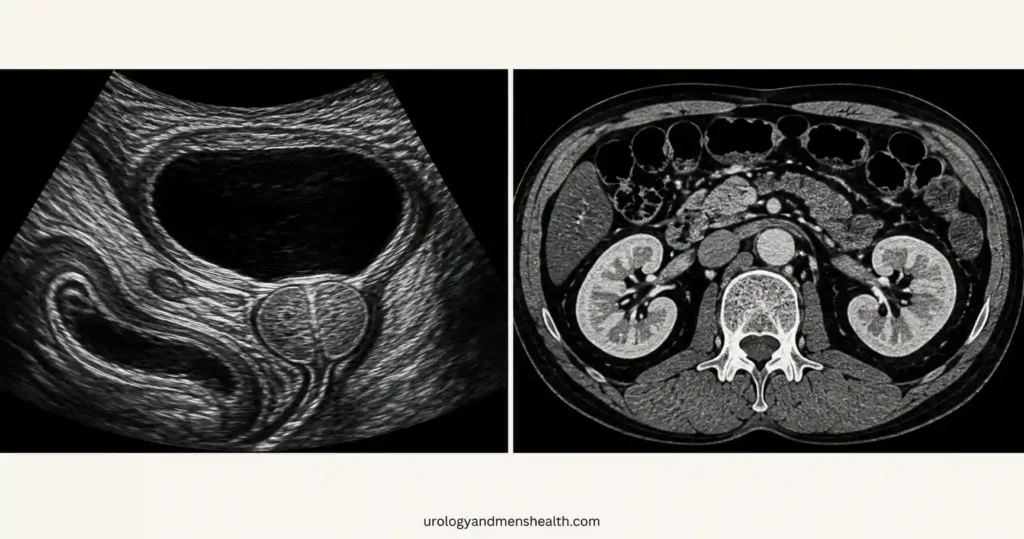
Post-Void Residual Urine: What Your PVR Number Means
Most men are told their post-void residual urine number without being told what produced it. The volume itself matters far less than what your bladder is doing to create it — here's how I read it in clinic.

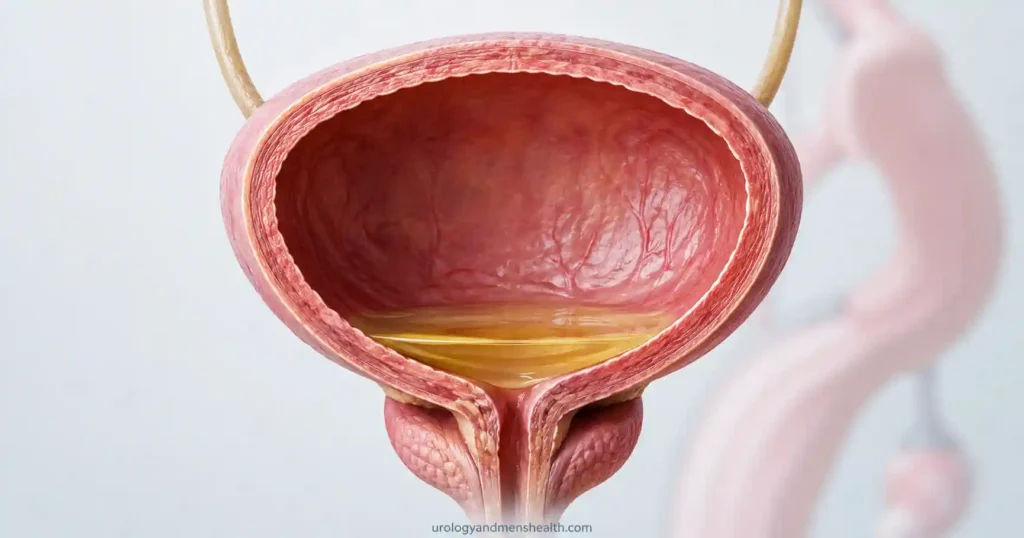
Post-void residual urine is the volume left sitting in your bladder immediately after you finish urinating, and it is one of the most misread numbers in urology. Men are handed a figure — 40 mL, 180 mL, 400 mL — and told it is “fine” or “high,” usually with no explanation of what produced it. On its own, that number tells you very little. What matters is how it compares to the volume you actually passed, whether it repeats on a second measurement, and whether your bladder is failing to push or your outlet is refusing to open. Those are opposite problems that produce identical numbers and need opposite treatments. For the wider picture of bladder and urinary tract conditions in men, see our UTIs and Infections Hub. Here is what your PVR figure actually means, why it moves around so much between measurements, and the point at which it genuinely needs acting on.
Key Takeaways
- A residual under 50 mL (about 1.7 fl oz) is treated as complete emptying, but there is no universal volume above which the number automatically becomes dangerous.
- The same residual volume can come from an obstructed outlet or a weak bladder muscle — opposite problems that need opposite treatments, and the number alone cannot tell them apart.
- A single elevated reading should never trigger surgery. Bladder scanners over-read or under-read by 15% or more, and volumes swing day to day.
- Residual volume only means something alongside voided volume: 100 mL left after passing 600 mL is normal emptying, while 100 mL left after passing 120 mL is not.
- Kidney damage tracks bladder pressure, not bladder volume — which is why a creatinine test and a renal ultrasound matter more than the millilitre figure.
What Post-Void Residual Urine Actually Measures
Emptying your bladder is a balance between two forces. The detrusor — the muscular wall of the bladder — contracts and pushes. The outlet, meaning the bladder neck, prostate and urethra, relaxes and lets urine through. When both work properly, the bladder empties to a few millilitres and the residual volume is essentially zero.
A high residual means that balance has broken. It does not tell you which side broke. A powerful bladder straining against a blocked outlet leaves urine behind. So does a weakened bladder with a completely open outlet. The scan reports the same figure in both cases. This is the single most important thing to understand about your number, and it is the reason two men with identical readings of 250 mL (about 8.5 fl oz) can end up on completely different treatment pathways — one toward prostate surgery, the other toward a medication review and intermittent catheterization.
There is a second layer most men are never told about. Residual volume is meaningless without knowing how much you passed at the same visit. Urologists call this voiding efficiency: the volume you voided divided by the total your bladder was holding. Void 400 mL and leave 100 mL behind, and you emptied 80% of a well-filled bladder — that is acceptable. Void 120 mL and leave 100 mL behind, and you emptied 55% of a bladder that was barely half full — that is a failing bladder. Same residual figure, entirely different clinical meaning.
What Counts as a Normal Post-Void Residual Volume?
There is no threshold that guideline bodies agree on, and men are often surprised by that. The 2026 American Urological Association guideline on lower urinary tract symptoms attributed to BPH treats residual measurement as a Clinical Principle — clinicians may obtain it to assess for retention or to rule out other conditions — but it deliberately stops short of naming a number above which the bladder is declared abnormal [1]. The European Association of Urology takes a firmer line on doing the test, listing residual measurement as a routine part of the initial assessment of male urinary symptoms, while similarly avoiding a fixed cutoff [2].
What exists instead are working bands that most urologists, myself included, use in clinic:
- Under 50 mL (about 1.7 fl oz) — complete emptying. No further action on the number itself.
- 50 to 100 mL (about 1.7 to 3.4 fl oz) — acceptable if you have no symptoms and no infections. Worth repeating if you do.
- 100 to 200 mL (about 3.4 to 6.8 fl oz) — incomplete emptying. Needs a repeat measurement and a cause identified, not immediate treatment.
- Above 200 mL (about 6.8 fl oz), confirmed on repeat — chronic retention until proven otherwise. This warrants a creatinine test and a kidney ultrasound.
- Above 400 mL (about 13.5 fl oz) — significant retention, regardless of how few symptoms you have. Painless chronic retention is common and is precisely the presentation that gets missed.
Residual volume also drifts upward with age in men who have no urological diagnosis at all. A Mayo Clinic cohort followed 529 community-dwelling men aged 40 to 79 with sonographic measurements every two years for up to 12 years, and found a median annual increase in residual volume of 2.2%, with enormous variation between individuals — the 25th percentile was actually falling by 11% a year while the 75th percentile rose by 18% [3]. Men whose baseline residual exceeded 50 mL were roughly twice as likely to show a rapid decline in the volume they could void. In other words, a slowly rising residual is partly normal ageing, and partly the earliest sign that the bladder is losing ground.
Put your own number in context: the Post-Void Residual Danger EstimatorWhy Your PVR Number Changes Every Time It’s Measured
If your reading was 280 mL at one appointment and 90 mL at the next, nothing miraculous happened to your prostate. Residual measurement is far less reproducible than most men assume, and there are six ordinary reasons the figure moves.
Delay between voiding and scanning. The kidneys produce roughly 1 to 2 mL of urine every minute. Wait fifteen minutes between the bathroom and the scanner and you have added 15 to 30 mL of freshly made urine that was never residual at all. The measurement should be taken within five to ten minutes of voiding, and if it was not, the number is inflated.
The scanner itself. Portable bladder scanners track catheter-measured volumes closely but are not exact. In a comparison of two devices against catheterization in 67 patients with voiding dysfunction, one scanner over-estimated true volume in the range above 100 mL by an average of 16.3%, while the other under-estimated across the whole range by an average of 14.1% [4]. That is a spread wide enough to move a borderline reading across a decision threshold in either direction.
Whether you stood or sat. This one is consistently underrated. A systematic review and meta-analysis of eleven studies found that men with lower urinary tract symptoms left behind roughly 25 mL less urine when they urinated sitting down compared with standing, while healthy men showed no difference at all [5]. If you have obstructive symptoms, posture is a free intervention.
How much you drank beforehand. Arriving over-hydrated distends the bladder past its comfortable working range, and an over-stretched detrusor contracts less efficiently. Anxiety and an unfamiliar bathroom. Plenty of men simply do not empty properly in a clinic toilet with a queue outside. Anatomy confusing the scan. Bowel gas, a large prostatic median lobe, or a pelvic cyst can all be read as bladder volume by an automated device.
The practical rule follows directly: never accept a treatment decision based on one elevated reading. Ask for it to be repeated on a separate day, taken within ten minutes of voiding, and ask what your voided volume was at the same visit so the efficiency can be calculated. If a surgical conversation is being opened on the strength of a single number, that is the moment to ask for a second measurement first.
Bladder Emptying and Overactive Bladder: What to Track Before Your Next Urology Appointment
Enter your email below to receive Dr. Khalid’s complete OAB & Incontinence Guide as a free, printable PDF.
What Causes a High Post-Void Residual in Men
The causes fall into three groups, and they are worth separating because the treatments do not overlap.
Obstruction — the outlet will not open
Benign prostatic enlargement is the commonest cause in men over 50, but it is not the only one. A urethral stricture from a past catheter or infection, a bladder neck contracture after previous prostate surgery, a large median lobe acting as a ball valve, prostate cancer, and even meatal narrowing all obstruct. The bladder wall thickens and becomes trabeculated as it works harder, which is visible on ultrasound and is a useful clue that the obstruction has been present for years rather than months. If your symptoms are the driver here, scoring them formally with the validated IPSS symptom index gives your urologist a baseline to measure treatment against.
Detrusor underactivity — the bladder will not push
The bladder muscle weakens with age, and it weakens faster after years of pushing against an obstruction or after a single episode of severe overdistension. Diabetes damages the nerves supplying the bladder, often silently and often before any other neuropathy shows up. Spinal cord injury, multiple sclerosis, Parkinson’s disease, stroke, and lumbar disc disease all interrupt the signalling. Recent pelvic surgery or spinal anaesthesia produces a temporary version of the same thing. The NIDDK notes that chronic retention frequently develops with few or no symptoms, which is exactly why it is often found incidentally [7].
Medications and reversible contributors
This group matters more than its reputation suggests, because it is the only one you can fix in three weeks. Anticholinergics of any kind — bladder antimuscarinics, older antihistamines, tricyclic antidepressants such as amitriptyline, some antipsychotics and antispasmodics — reduce detrusor contraction directly. Decongestants containing pseudoephedrine tighten the bladder neck. Opioids blunt the urge to void. Severe constipation mechanically compresses the outlet, and pelvic floor dysfunction, which is common in younger men with no prostate problem at all, means the sphincter fails to relax on cue.
Residual urine that sits in the bladder also gives bacteria the standing time they need to multiply, which is why chronic retention and recurrent infection so often travel together. If antibiotics keep working and the infection keeps returning, the residual volume is a more useful thing to measure than the next urine culture — a urinary infection in a man is never routine and should always prompt a search for a structural reason.
In My Practice
A man in his late sixties was referred to me with a residual volume of 320 mL and a note recommending prostate surgery. His prostate was small on examination and his flow rate was only modestly reduced, which did not fit. His medication list did: a daily over-the-counter antihistamine for hay fever, taken for eight years, and amitriptyline started six months earlier for back pain. We stopped the antihistamine, his GP switched the amitriptyline, and three weeks later his residual was 90 mL. He did not need an operation.
Before attributing a high residual volume to the prostate, read the full medication list including anything bought without a prescription — it is the fastest reversible cause and the one most often skipped.
When a High PVR Becomes Dangerous — and How It’s Treated
Kidneys are damaged by pressure, not by volume. This distinction decides how urgently a high residual needs treating.
In chronic low-pressure retention, the bladder gradually stretches and stores large volumes at low internal pressure. A man can sit at 500 mL for years with a completely normal creatinine and normal-looking kidneys. It still causes infections, bladder stones and overflow leakage, but it is not an emergency. In chronic high-pressure retention, the bladder wall is thick and non-compliant, pressure stays elevated even between voids, and that pressure transmits backward up the ureters. The result is hydronephrosis, a rising creatinine, and eventually obstructive kidney failure — often in a man who reports remarkably few urinary symptoms and whose first sign is an abnormal blood test.
You cannot tell these apart from the residual number. You tell them apart with a serum creatinine and a renal ultrasound. If your confirmed residual is repeatedly above 300 mL (about 10 fl oz), ask specifically whether both of those tests are appropriate for you, and ask for them within the next few weeks rather than at some unspecified future review.
When to Go to the ER
Chronic retention is usually managed in clinic. These situations are not:
- Complete inability to pass urine with a painful, distended lower abdomen — this is acute retention and needs the bladder drained the same day, not at your next appointment.
- Fever, shivering or flank pain alongside known retention — an infected, obstructed urinary tract deteriorates within hours.
- Retention with new leg weakness, numbness around the groin or buttocks, or loss of bowel control — this pattern suggests spinal cord or cauda equina compression and needs emergency imaging.
- Retention with vomiting, confusion or markedly reduced urine output, which can indicate the kidneys are already failing.
How high residual volume is actually treated
Treatment targets the cause, not the number. Chasing the millilitre figure for its own sake leads to operations that do not help.
- Medication review first. Stop or substitute anticholinergics, antihistamines and decongestants where possible, and reassess in three to four weeks. Free, fast, and frequently sufficient.
- Behavioural changes. Sit to urinate, double void by waiting thirty seconds and going again, treat constipation properly, and cut evening fluid loading. Modest individually, useful combined.
- Alpha blockers such as tamsulosin relax the bladder neck and prostatic smooth muscle. They help obstruction; they do nothing for a weak detrusor. A 5-alpha reductase inhibitor is added when the prostate is genuinely enlarged.
- Clean intermittent self-catheterization. Often presented as a last resort, it is nothing of the sort. For a bladder that cannot contract, emptying it once or twice a day protects the kidneys, ends recurrent infections, and preserves what function remains. Most men learn it in a single session. The practical side of catheter care at home is far more manageable than men expect.
- Pressure-flow urodynamics. This is the test that separates obstruction from underactivity, and it should be requested before any prostate operation when your flow is poor but your prostate is small. Operating on a weak bladder in the belief it is a blocked outlet leaves the man incontinent and still not emptying.
- Surgery — TURP, HoLEP, UroLift, Rezum or aquablation — when obstruction is confirmed and medical management has failed.
Whether to intervene at all is a genuine judgement call, and residual volume feeds into it as one variable among several. A secondary analysis of the 3,047 men followed in the MTOPS trial for a mean of 4.5 years found that baseline residual volume sat alongside symptom score, PSA, age and peak flow rate as independent predictors of BPH progression [6]. The EAU similarly identifies rising residual volume, together with symptom bother, as among the strongest predictors that watchful waiting will fail [2]. Your number is a risk marker. It is not a verdict.
Frequently Asked Questions
What is a normal post-void residual urine volume for a man over 60?
There is no age-specific normal. Most urologists treat a post-void residual urine volume under 50 mL as complete emptying, 50 to 100 mL as acceptable if you have no symptoms, and repeated readings above 200 mL as worth investigating. Residual volumes do drift upward with age, so the trend across two or three measurements tells you far more than any single figure. The post-void residual danger estimator puts your own number in context.
Can a high post-void residual cause urinary infections?
Yes. Urine standing in the bladder between voids gives bacteria the time they need to multiply, which is why men with residual volumes above 200 mL often get infections that clear on antibiotics and return within weeks. If you are being treated for repeated infections, ask for the residual volume to be measured before another antibiotic course is prescribed — a urinary infection in a man always needs a structural explanation.
Can a high post-void residual go back to normal without surgery?
Often, yes. Stopping an anticholinergic or antihistamine, treating constipation, sitting to urinate, double voiding and adding an alpha blocker each lower residual volume, and combined they can be decisive. I regularly see numbers fall from over 300 mL to under 100 mL on medication changes alone. Track your symptoms alongside the volume using the IPSS symptom score so you can tell whether emptying has genuinely improved.
Does a high post-void residual damage the kidneys?
Only when the bladder holds that urine at high pressure. High-pressure chronic retention transmits pressure back up the ureters and causes hydronephrosis and a rising creatinine, while low-pressure retention can sit at 500 mL for years without touching kidney function. That is why a creatinine test and a renal ultrasound matter more than the volume itself — and why a sudden complete inability to pass urine is an emergency.
Is a bladder scan as accurate as a catheter for measuring post-void residual?
Close, but not identical. Portable scanners correlate well with catheter volumes yet can over-read or under-read by 15% or more, particularly above 100 mL, and bowel gas or a prostatic cyst can confuse the reading. Catheterization is the reference standard but carries an infection risk, so it is reserved for cases where the scan and the clinical picture disagree — the same balance applies to catheter use at home.
References
- Goueli R, Badlani GH, Welliver C, et al. Management of Lower Urinary Tract Symptoms Attributed to Benign Prostatic Hyperplasia: AUA Guideline (2026) Part I: Presentation and Evaluation. J Urol. 2026. AUA
- European Association of Urology. Guidelines on the Management of Non-neurogenic Male Lower Urinary Tract Symptoms. 2026 edition. EAU
- Rule AD, Jacobson DJ, McGree ME, et al. Longitudinal changes in post-void residual and voided volume among community dwelling men. J Urol. 2005;174(4 Pt 1):1317-21. PubMed
- Park YH, Ku JH, Oh SJ. Accuracy of post-void residual urine volume measurement using a portable ultrasound bladder scanner with real-time pre-scan imaging. Neurourol Urodyn. 2011;30(3):335-8. PubMed
- de Jong Y, Pinckaers JHFM, ten Brinck RM, et al. Urinating standing versus sitting: position is of influence in men with prostate enlargement. A systematic review and meta-analysis. PLoS One. 2014;9(7):e101320. PubMed
- Kozminski MA, Wei JT, Nelson J, Kent DM. Baseline characteristics predict risk of progression and response to combined medical therapy for benign prostatic hyperplasia. BJU Int. 2015;115(2):308-16. PubMed
- National Institute of Diabetes and Digestive and Kidney Diseases. Symptoms & Causes of Urinary Retention. NIH. NIDDK
Dr. Muhammad Khalid
MBBS · FCPS (Urology) · MCPS (General Surgery) · CHPE · CRSM · IMC #539472
Specialist urologist with 11+ years of clinical experience across tertiary teaching hospitals. Trained at Lady Reading Hospital and Khyber Teaching Hospital, Peshawar. Author or co-author of five peer-reviewed international publications, including in Cureus and the World Journal of Surgery. Procedural expertise: URS, PCNL, RIRS, TURP, TURBT, and major open urological surgery. Full profile →
This article is for educational purposes only and does not constitute medical advice. Always consult your physician or urologist for diagnosis and treatment decisions specific to your condition.