Flying After Urological Surgery: How Long to Wait
Almost every man asking about flying after urological surgery wants a number of days. The number that matters more is how far you will be from a urologist if you start bleeding at 35,000 feet.


Flying after urological surgery is one of the few post-operative questions where the honest answer sits in no urology guideline at all. The American Urological Association does not publish a fitness-to-fly recommendation. Neither does the European Association of Urology. What exists is aviation medicine guidance written largely for general surgery, sitting alongside procedure-specific data on when men bleed and when they clot. Putting those two things together for your particular operation is a urologist’s job, not an airline’s.
I am asked this at the pre-operative visit more often than I am asked about the operation itself, usually by a man who has already paid for the flight. So here is what I actually tell him: the wait times by procedure, the three things that genuinely go wrong in the air, and how to travel with a stent, catheter or drain without it wrecking the trip. For what recovery looks like on the ground, our urological surgery recovery hub covers the wider picture.
Key Takeaways
- Gas trapped in the abdomen expands by roughly 30% at a cabin altitude of 2,400 m (8,000 feet), which is why UK Civil Aviation Authority guidance advises 24 hours after laparoscopic surgery and 10 days after open abdominal surgery.
- Endoscopic urology — flexible cystoscopy, stent removal, an uncomplicated ureteroscopy — rarely needs more than 24 to 72 hours before a short flight.
- After robotic or open pelvic surgery the limiting factor is not the skin wound. It is clot risk and delayed bleeding, and both sit inside the first four weeks.
- A stent, catheter or drain does not stop you flying. Being several hours from a urologist while you still have one is the actual problem.
What Changes Inside an Aircraft Cabin
A commercial cabin is pressurized, but not to sea level. At cruise, the air inside behaves as though you were standing on a mountain at roughly 1,800 to 2,400 m (6,000 to 8,000 feet). Two things follow from that, and both matter to a man who was on an operating table last week.
The first is gas expansion. UK Civil Aviation Authority guidance for clinicians states that intestinal gas expands by approximately 30% by volume at a cabin altitude of 8,000 feet [1]. After abdominal surgery many patients have a sluggish bowel for a few days, so that expanding volume has nowhere convenient to go. It can stretch suture lines, provoke bleeding from stretched mucosa and, at the extreme, threaten a repair. This is the mechanism behind the CAA’s advice to avoid air travel for 10 days after abdominal surgery and for approximately 24 hours after a laparoscopic procedure, the latter because residual carbon dioxide is still sitting in the peritoneal cavity [1]. Air introduced at open surgery takes longer — CAA aeromedical guidance puts absorption of intraperitoneal air after laparotomy at about a week, against 24 hours for laparoscopic carbon dioxide [2]. If your operation was keyhole or robotic, our explainer on how robotic urological surgery is actually performed sets out how much gas goes in and why.
The second is oxygen. The CAA points out something clinicians routinely forget: post-operative patients are in a state of increased oxygen consumption from the trauma of surgery and the adrenergic response to it, at exactly the moment their oxygen-carrying capacity may be reduced [1]. Because we transfuse far less freely than we used to, it is not unusual to discharge a younger man with a hemoglobin around 7 g/dL and an older man around 8 g/dL. Put that man in a cabin at 8,000 feet and the arithmetic gets tighter than he expects. He will not collapse. He will feel unexpectedly awful, and he will not understand why.
How Long After Urological Surgery Can You Fly?
Urological procedures range from a five-minute look inside the bladder to a six-hour open cystectomy, so a single number is useless. What follows is what I use in clinic. The two anchor figures — 24 hours after laparoscopy, 10 days after open abdominal surgery — are CAA guidance. Everything else reflects when each operation actually bleeds and when it actually clots.
| Procedure | Short-haul (under 4 h) | Long-haul (over 4 h) | Main limiting factor |
|---|---|---|---|
| Flexible cystoscopy or stent removal | Same day | 24 hours | Short-lived bleeding and stinging |
| Prostate biopsy (transperineal or transrectal) | 24–48 hours | 3–5 days | Sepsis declares itself in the first 48–72 hours |
| Vasectomy | 24–48 hours | 3–5 days | Scrotal swelling and hematoma |
| Circumcision, hydrocele or scrotal surgery | 3–5 days | 7–10 days | Wound edema and sitting discomfort |
| Ureteroscopy or RIRS with a stent left in | 3–7 days | 10–14 days | Stent colic and obstruction away from care |
| PCNL | 10–14 days | 3–4 weeks | Delayed bleeding from the tract |
| TURP or HoLEP | 10–14 days | 3–4 weeks | Secondary hemorrhage at 7–21 days |
| Robotic or laparoscopic prostatectomy | 2–3 weeks | 4–6 weeks | Catheter, clot risk, residual carbon dioxide |
| Laparoscopic or robotic nephrectomy | 2 weeks | 4 weeks | Trapped gas and clot risk |
| Open prostatectomy or radical cystectomy | 4 weeks | 6–8 weeks | Peak clot risk, wound, stoma care |
Two conditions sit underneath every row. First, the operation was uncomplicated and you are recovering as expected — a return to theatre, a transfusion or a post-operative infection resets the clock entirely. Second, you can walk the length of a terminal, lift your own bag into an overhead locker and sit upright for the duration. If you cannot do those three things on the ground, the aircraft is not the place to find out. Our post-operative recovery timeline tool will map your specific procedure against milestones you can test yourself against before you commit to a booking.
The Three Risks That Actually Ground People
1. Clots
The World Health Organization’s WRIGHT project concluded that travel of four hours or more roughly doubles the risk of venous thromboembolism, while noting that the absolute risk in healthy people stays low at about 1 in 6,000 [5]. The 2024 CDC Yellow Book puts the incidence of symptomatic venous thromboembolism in the month after a flight longer than four hours at about 1 in 4,600, and lists recent surgery explicitly as a factor that raises it [3]. Below four hours, the 2026 Yellow Book chapter describes the risk of symptomatic clot as negligible [4].
Those figures describe healthy travellers. You are not one, yet. The now-archived EAU thromboprophylaxis guideline — discontinued as a topic in the 2024 EAU update, though its underlying reviews remain the best procedure-specific data we have — measured clot and bleeding risk over a four-week post-operative window, because that is where post-surgical events concentrate [6]. The associated systematic reviews found baseline risk varying enormously between operations: endoscopic prostate surgery sits at the bottom, radical cystectomy and extended pelvic lymph node dissection at the top [7]. This is why a man who had a cystoscopy on Tuesday and a man who had a cystectomy on Tuesday get completely different answers.
What to do about it, concretely: book an aisle seat, stand and walk every hour, and do calf raises in your seat every 20 minutes — this is what the American College of Chest Physicians recommends for longer flights [3]. If you have any additional risk factor, wear properly fitted graduated compression stockings delivering 15 to 30 mmHg at the ankle [3]. Do not take aspirin for this purpose — it has not been shown to reduce travel-related clot risk [3]. If you were sent home on a prophylactic injection, take it with you and keep taking it; the flight is not a reason to stop.
2. Delayed bleeding
Most post-operative bleeding declares itself early, and the EAU reviews found roughly half of major bleeds occur between the operation and the following morning [6] — which is reassuring, because you are still in hospital for that one. The bleed that catches men on aircraft is the later one. After TURP and HoLEP, secondary hemorrhage from the healing prostatic fossa typically appears between day 7 and day 21, often abruptly, often after a period of feeling completely well. Our week-by-week TURP recovery timeline sets out exactly when that window opens and closes. After PCNL, delayed tract bleeding follows a similar late pattern. Both are entirely manageable in a hospital that has your imaging. Neither is manageable at 35,000 feet.
3. Distance from a urologist
This is the one nobody counts and the one that decides most of my answers. A short domestic hop puts you 90 minutes from an emergency department that can call your surgeon. A long-haul flight puts you six hours from any hospital at all, then delivers you to a country where nobody has your operative note, nobody knows which side was operated on, and nobody knows what was left inside you. The clinical risk of flying may be modest. The consequences of the rare event are not, and they scale directly with how far you are from the people who did the operation.
In My Practice
A man in his fifties flew to Dubai eleven days after a PCNL. His stent was out, he felt well, and he did not call me first. On day fourteen he bled from the tract and presented to a hospital that had never seen his imaging and had no idea a nephrostomy tract had been dilated. He was transfused two units before anyone reached me. He recovered fully. The flight was never the problem — the problem was a foreign doctor working blind on a Thursday night.
Since then I send every patient a one-page travel summary before they fly: procedure, date, what was left inside, current medications, and a number that reaches me — because the risk that actually bites after urological surgery is not turbulence, it is the absence of your own record.
Planning travel after urology surgery? Get the recovery-and-travel checklist I give my own patients
Enter your email below to receive Dr. Khalid’s complete Urology Surgery Recovery Guide as a free, printable PDF.
Flying With a Stent, Catheter, or Drain
None of these devices is a reason on its own to stay on the ground. Cabin pressure does not act on a stent, a catheter balloon or a drain in any way that matters, and airport scanners do not interact with silicone or latex. What causes trouble is entirely practical, and it is all predictable.
A ureteral stent
The stent will not move and it will not react to altitude. It will, however, keep doing what stents do — urgency, frequency, flank ache on voiding, visible blood after activity. A stent that has been quiet for a week is usually going to stay quiet. A stent that has been giving you colic every second day will give you colic on the aircraft, and codeine bought at an airport pharmacy is not a plan. Carry the analgesia you were actually prescribed, in its original packaging, in your cabin bag rather than in the hold.
An indwelling catheter
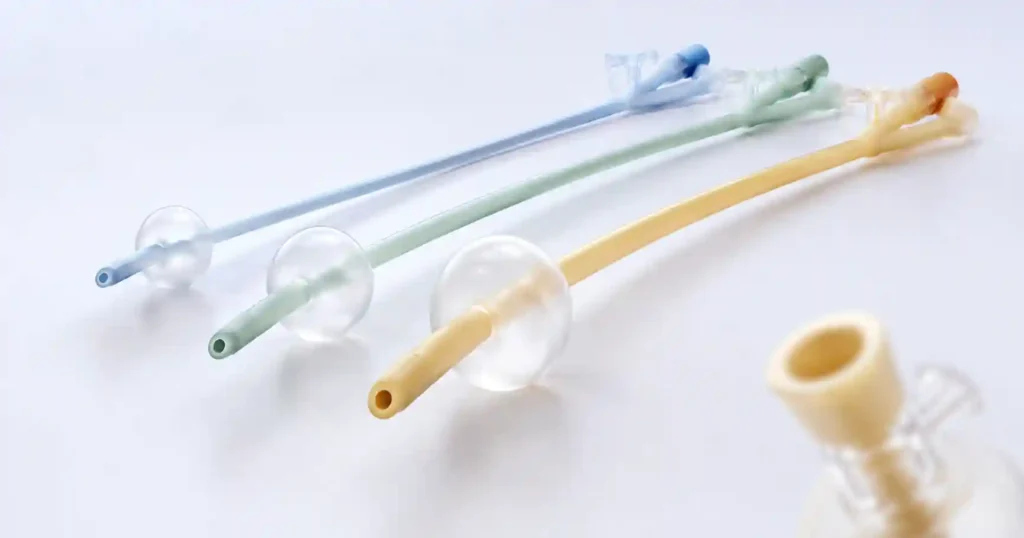
Empty the leg bag immediately before boarding, not at the gate an hour earlier. Request an aisle seat so you can reach a lavatory without climbing over two strangers. Pack a spare leg bag, a night bag, spare tubing straps and a small pack of wipes in your cabin bag — hold luggage goes missing and a catheter without a bag is a genuine emergency in a country where you do not speak the language. If the flight is over four hours, ask your nurse before you travel whether a larger-capacity bag is appropriate for you.
A nephrostomy or surgical drain
This is the one where I frequently say no. A nephrostomy is draining an obstructed kidney, and an obstructed kidney that stops draining becomes an infected obstructed kidney within hours. If the tube blocks or dislodges over the Atlantic, there is no intervention available until you land. Most airlines require medical clearance for a passenger travelling with an external drain in any case. If the tube is scheduled to come out in ten days, my advice is almost always to move the flight rather than the tube.
Medical Clearance and Insurance for Flying After Urological Surgery
Most airlines require a medical information form — commonly called a MEDIF — for passengers who had surgery within roughly ten days of travel, who need supplementary oxygen, or who are travelling with a drain or external device. The form has to be completed by a doctor and returned to the airline’s medical desk, and clearance can take several working days. Contact the airline at least two weeks before departure. This cannot be arranged at the check-in counter, and staff at the gate have no authority to override it.
Travel insurance is the quieter problem. Almost every policy requires you to declare recent surgery and any ongoing treatment. An undeclared operation gives the insurer grounds to refuse a claim, and a medical repatriation from a mid-range destination runs well into five figures in US dollars. Call the insurer, declare the procedure and the date, declare any device still in place, and get the confirmation in writing. If they load the premium, pay it — that surcharge is the cheapest part of this entire calculation.
Ask your surgeon’s office for a short fit-to-fly letter and carry it. It should name the procedure and the date, list any device still inside you, list your current medications including any anticoagulant, and state explicitly that you do not require in-flight oxygen. Ask for it at your post-operative appointment, not the day before you travel — a request that lands on a Friday afternoon will not be answered before your Sunday flight.
Do Not Board — Get Assessed First
Any of the following means the airport is the wrong destination. Go to an emergency room and tell them you have had recent urological surgery.
- Fever above 38°C (100.4°F) or shaking chills, particularly within 72 hours of stone or prostate surgery
- Passing blood clots, or being unable to pass urine at all
- A catheter that has drained nothing for two hours despite you drinking normally
- A nephrostomy or drain that has stopped draining, or redness spreading around the tube site
- New pain, swelling or tenderness in one calf
- Breathlessness, chest pain, or coughing blood — call emergency services rather than driving
Frequently Asked Questions
How long after urological surgery can I fly long-haul?
For endoscopic work — flexible cystoscopy, stent removal, an uncomplicated ureteroscopy — 24 to 72 hours is usually enough even for a longer flight. After surgery inside the abdomen or pelvis, the UK Civil Aviation Authority’s ten-day threshold is a floor rather than a target, and I generally want four to six weeks before a long-haul flight following robotic or open pelvic surgery. Ask your surgeon to confirm against your own operation note.
Can I fly with a ureteral stent still in place?
Yes. A stent is not a contraindication to flying. Cabin pressure does not act on it and it will not migrate. The difficulty is symptomatic rather than mechanical: stent colic, urgency and blood in the urine are miserable at altitude with no urologist on board. Log your symptoms with the ureteral stent symptom tracker for a week before you travel, and keep your prescribed painkillers in your cabin bag.
Will cabin pressure or airport security affect my urinary catheter?
Neither will damage it. Pressure changes do not meaningfully affect a catheter balloon, and scanners do not interact with silicone or latex. What causes real trouble is a full leg bag during a long taxi delay. Empty the bag immediately before boarding, request an aisle seat, and carry a spare leg bag, a night bag and a doctor’s letter naming the device in your cabin luggage.
Do I need airline medical clearance before flying after urological surgery?
Often, yes. Most carriers require a medical information form if you had surgery within about ten days of travel, need oxygen, or are travelling with an external drain. Contact the airline’s medical desk at least two weeks before departure, because the form must be completed by a doctor and processed, and clearance takes several working days. It cannot be sorted out at the gate.
Does flying raise my clot risk after prostate surgery?
It does, though from a low base. The World Health Organization’s WRIGHT project found travel of four hours or more roughly doubles venous thromboembolism risk, with an absolute risk near 1 in 6,000 in healthy travellers. After pelvic surgery you are not starting from a healthy baseline, and the first four weeks carry most of the post-operative clot risk. That overlap is precisely why I ask men to wait.
References
- UK Civil Aviation Authority. Surgical conditions: guidance for health professionals. CAA
- UK Civil Aviation Authority. Abdominal surgery: aeromedical medical standards. CAA Aeromedical
- Centers for Disease Control and Prevention. Air Travel. CDC Yellow Book 2024. CDC
- Centers for Disease Control and Prevention. Deep Vein Thrombosis and Pulmonary Embolism. CDC Yellow Book 2026. NCBI Bookshelf
- World Health Organization. WHO Research Into Global Hazards of Travel (WRIGHT), Phase I results. 2007. WHO
- Tikkinen KA, Cartwright R, Gould MK, et al. EAU Guidelines on Thromboprophylaxis in Urological Surgery. European Association of Urology; 2022 (archived as a discontinued topic, 2024). EAU
- Tikkinen KA, Craigie S, Agarwal A, et al. Procedure-specific risks of thrombosis and bleeding in urological cancer surgery: systematic reviews and meta-analyses. Eur Urol. 2018;73(2):242-251. PubMed
Dr. Muhammad Khalid
MBBS · FCPS (Urology) · MCPS (General Surgery) · CHPE · CRSM · IMC #539472
Specialist urologist with 11+ years of clinical experience across tertiary teaching hospitals. Trained at Lady Reading Hospital and Khyber Teaching Hospital, Peshawar. Author or co-author of five peer-reviewed international publications, including in Cureus and the World Journal of Surgery. Procedural expertise: URS, PCNL, RIRS, TURP, TURBT, and major open urological surgery. Full profile →
This article is for educational purposes only and does not constitute medical advice. Always consult your physician or urologist for diagnosis and treatment decisions specific to your condition.