Foley Catheter Sizes Explained: Why Bigger Isn’t Better
Most people assume a leaking catheter needs a bigger one. After eleven years of urology practice I can tell you the opposite is usually true — and Foley catheter sizes are where that misunderstanding starts.

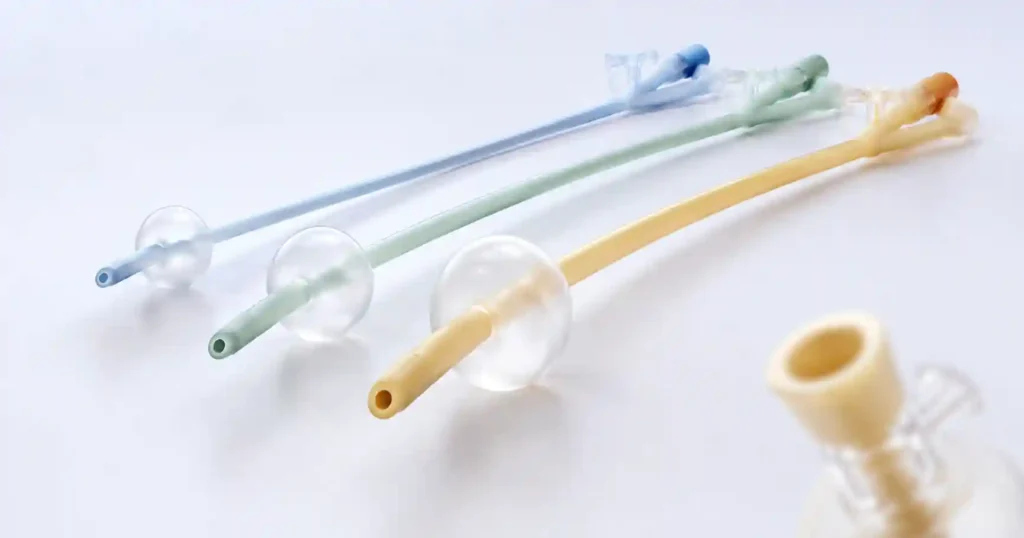
Foley catheter sizes are printed on the inflation port as a number followed by “Fr” — 14 Fr, 16 Fr, 18 Fr — and almost every patient I meet has the same instinct about that number: bigger must drain better. It does not. The French gauge measures the outside of the tube, not the channel inside it, so a larger number buys you more urethral contact without necessarily buying you more flow. That single misunderstanding is behind a large share of the catheter problems I am asked to fix in clinic: leakage that gets “treated” by upsizing, pain that gets blamed on the bladder, and strictures that trace back to a catheter two sizes larger than the man ever needed. This guide explains what the number actually means, what size a urologist genuinely picks and why, and what to do when your catheter leaks. For the wider picture on recovery and catheter care, see our Urological Surgery & Recovery Hub.
Key Takeaways
- One French equals one third of a millimeter of outer diameter, so 12 Fr is 4.0 mm and 24 Fr is 8.0 mm across the outside of the tube.
- The routine adult size for clear urine with no debris and no bleeding is 12-14 Fr — not 16 or 18, which are sizes reserved for cloudy urine, grit or clots.
- Leakage around the outside of a catheter is usually bladder spasm, blockage or constipation, and upsizing the catheter or the balloon typically makes it worse.
- At the same French size a silicone catheter has a wider drainage channel than a latex one, so material can matter more than the number on the port.
What the French Gauge Number Actually Measures
The French gauge — written Fr, F or FG, and called Charrière or Ch in most of Europe — is a scale of external diameter. One French equals one third of a millimeter. To go the other way, multiply millimeters by three: a tube 5 mm across the outside is a 15 Fr [3].
So a 16 Fr catheter is 5.3 mm (about 0.21 inch) wide on the outside. That is the part of the number people fixate on, and it is the least useful part clinically. What actually drains urine is the internal lumen, and the lumen is whatever is left after you subtract the wall thickness — which varies by material. This is why a bigger French number does not reliably mean a bigger drainage channel [3].
The outer diameter still matters enormously, just not for the reason patients assume. Every extra millimeter of outer diameter is a millimeter more pressure on the urethral lining and on the tiny paraurethral gland ducts that open along it. Chronic pressure on those ducts is one of the mechanisms by which an indwelling catheter produces inflammation and, over months, scar tissue. The American Urological Association identifies iatrogenic causes as the leading etiology of urethral stricture in men, and notes that affected patients frequently have a history of painful or traumatic catheterization [1]. The European Association of Urology describes the same mechanism: a difficult or traumatic insertion causes bleeding and extravasation, and fibrosis follows [2]. Roughly one in nine strictures that eventually need reconstructive urethroplasty follows urethral catheterization [3].
If you have had repeated difficult catheterizations, that history is worth raising directly with a urologist — read more in our guide to urethral stricture symptoms and treatment.
Foley Catheter Sizes: The Chart From 12 Fr to 24 Fr
Adult Foley catheters run from about 10 Fr to 24 Fr, with pediatric sizes below that at 6-10 Fr. Each size carries an international color code moulded into the balloon inflation port, which is how staff identify a catheter at a glance without unwrapping it [3]. The color is a convenience, not the authority — the size is also printed on the port, and the printed number is what you should read.
| French size | Outer diameter | Port color | Where it is typically used |
|---|---|---|---|
| 12 Fr | 4.0 mm | White | Routine adult drainage, clear urine |
| 14 Fr | 4.7 mm | Green | The commonest adult size; standard in most insertion trays |
| 16 Fr | 5.3 mm | Orange | Slightly cloudy urine, light bleeding, mild debris |
| 18 Fr | 6.0 mm | Red | Moderate grit or debris, bleeding with moderate clots |
| 20 Fr | 6.7 mm | Yellow | Heavy bleeding requiring flushing or irrigation |
| 22 Fr | 7.3 mm | Purple | Three-way irrigation after prostate or bladder surgery |
| 24 Fr | 8.0 mm | Blue | Heavy clot burden; rarely appropriate for routine drainage |
Two cautions about reading a chart like this. First, the color convention on intermittent self-catheters is a different scheme from the indwelling Foley code above — if you self-catheterize, do not transfer these colors across. Second, the right-hand column describes where a size is used, not where it should be started. Nobody begins at 18 Fr because 18 Fr sounds thorough.
Going home with a catheter? Get the recovery guide that covers sizing, leakage, blockage and when to call
Enter your email below to receive Dr. Khalid’s complete Urology Surgery Recovery Guide as a free, printable PDF.
How a Urologist Actually Chooses Your Catheter Size
The governing principle is short and it is guideline-backed on both sides of the Atlantic. The US Centers for Disease Control and Prevention states that unless clinically indicated otherwise, the smallest bore catheter consistent with good drainage should be used, specifically to minimize bladder neck and urethral trauma [4]. The EAUN guideline carries the same recommendation and then does something more useful: it ties size selection to what the urine actually looks like, rather than to the patient’s sex or build [3].
| What the urine looks like | Catheter size | What is driving the choice |
|---|---|---|
| Clear, no debris or grit, adult of very small build | 10 Fr | Minimizing urethral contact in a narrow urethra |
| Clear, no debris, no grit, no bleeding | 12-14 Fr | The routine adult default for both men and women |
| Slightly cloudy, light bleeding, small clots, mild grit | 16 Fr | Enough lumen to carry light sediment without blocking |
| Moderate to heavy grit or debris | 18 Fr | Blockage risk now outweighs the trauma cost of a wider tube |
| Bleeding with moderate clots | 18 Fr | Clots will occlude a narrower lumen |
| Heavy bleeding, flushing or irrigation needed | 20-24 Fr | Usually a three-way catheter for continuous irrigation |
Notice what is absent from that table: sex. There is no separate male size and female size in the diameter column — the difference between men and women is length, not gauge, and I come back to that below. The other thing worth naming is that a small-lumen catheter can occasionally buckle in a long male urethra during insertion, and in that specific situation a slightly larger Charrière may be easier to pass [3]. That is an insertion problem with an insertion solution, not a reason to keep a larger catheter in place for months.
Why a Bigger Catheter Leaks More, Not Less
Urine escaping alongside the catheter rather than through it is called bypassing, and it happens to somewhere between 40% and 67% of people with an indwelling catheter [3]. It is the single most common reason patients ask for a bigger tube, and it is almost always the wrong response, because bypassing is a symptom rather than a diagnosis. The four things that actually cause it are catheter blockage, bladder spasm, constipation pressing on the drainage lumen, and — fourth on the list — a catheter that is too large [3].
The mechanism is straightforward once you picture it. The bladder is a muscle, and a foreign object sitting on the trigone provokes it to contract. A wider catheter provokes it harder. When the detrusor squeezes, pressure inside the bladder briefly exceeds what the bladder neck can hold, and urine takes the path of least resistance — the space around the outside of the tube. Upsizing increases the stimulus that caused the spasm. So does putting more water in the balloon, which is the other common reflex: a larger balloon does not stop leakage and does raise the risk of a pressure ulcer at the bladder neck [3].
What to do instead, in order: ask whether the catheter is draining at all, since blockage from encrustation is the commonest single cause and affects 40-50% of long-term catheter users [3]. Then ask about bowels — constipation is treatable and it is a genuine cause. Then ask your urologist or catheter nurse specifically whether an anticholinergic for bladder spasm is appropriate, and whether a smaller catheter with a smaller balloon should be tried at the next change. Give any one of those changes at least two weeks before judging it.
In My Practice
The referral I see most often is a man in his seventies whose district nurse has been stepping the catheter up a size at every change because of leakage — 14, then 16, then 18, sometimes 20 with a 30 mL balloon. By the time he reaches me he has a wide-bore catheter, a persistently spastic bladder, a meatus that has started to split on the underside, and the leakage is worse than when the sequence started. Almost every time, the fix is to go back down to 14 Fr with a 10 mL balloon, treat the constipation nobody asked about, and add an anticholinergic.
If your catheter has been upsized more than once for leakage, that pattern itself is the finding — ask for a urology review rather than another size increase.
Balloon, Length and Material Matter As Much As the Number
The balloon. Your port is marked with two numbers, such as 14/10 — the French size, then the balloon volume in milliliters. Routine catheters carry a 5-10 mL balloon and are inflated exactly as the manufacturer specifies, no more and no less; under-inflation can occlude the drainage eyes and over-inflation irritates the bladder wall and provokes spasm [3]. The 30 mL balloon you sometimes see is a different device with a different job: it is designed to apply pressure as a hemostat after prostate or bladder surgery, and the EAUN is explicit that it should not be used for routine drainage [3].
The length. Standard catheters are 41-45 cm (about 16-18 inches). Shorter 25 cm catheters exist for women’s comfort and discretion. A short catheter must never be used in a man — the balloon would inflate inside the urethra rather than the bladder, and the result is severe trauma [3]. If you are a man who has been given a catheter that looks noticeably shorter than your last one, check the packaging before anything is inflated.
The material. This is where the French number becomes genuinely misleading. Silicone has a thinner wall than latex, so at identical French size a silicone catheter offers a wider drainage channel [3]. If your catheter keeps blocking, switching material can buy you the flow you were hoping to get from an upsize, without the extra millimeter against the urethra. Latex is intended for short-term use under 14 days; silicone is the long-term choice, with catheter changes up to a manufacturer-set maximum of about 12 weeks [3]. If you are managing a catheter indefinitely, our guide to living well with a long-term catheter covers the practical routine in detail.
When to Call Your Urologist About Catheter Size
These are not “wait and see at the next change” problems. Contact your urology team or catheter nurse the same day if any apply:
- No urine in the bag for two hours despite normal fluid intake — assume blockage, not reduced output.
- The catheter has been upsized twice or more for leakage without anyone assessing bowels, blockage or bladder spasm.
- Visible splitting or soreness on the underside of the meatus, which is early pressure injury from an oversized or badly secured catheter.
- Heavy fresh bleeding or clots appearing after a routine change — this may need a three-way catheter and irrigation rather than a bigger two-way.
- The catheter falls out with the balloon still inflated. Do not attempt to reinsert it yourself; this needs assessment, and if you cannot pass urine afterward, go to the emergency room. Our guide to postoperative urinary retention explains what happens next.
Frequently Asked Questions
What size Foley catheter is standard for an adult man?
For clear urine with no debris, grit or bleeding, the standard is 12-14 Fr, and 14 Fr is what most commercially prepared insertion trays contain. Foley catheter sizes are not assigned by sex — 16 Fr and above are reserved for cloudy urine, sediment or clots, not for men by default. Men and women differ in required catheter length, not diameter.
Does a bigger Foley catheter drain better?
Not reliably. The French number is the outer diameter, while flow depends on the inner lumen, and the lumen depends on wall thickness. A silicone catheter has a thinner wall than a latex one, so a 16 Fr silicone can give you a wider drainage channel than an 18 Fr latex. If blockage is the problem, changing material is often the better move than changing size.
My catheter is leaking around the outside — do I need a larger size?
Usually the opposite. Leakage alongside the catheter is called bypassing, it affects 40-67% of catheter users, and its commonest causes are blockage, bladder spasm and constipation. A wider catheter or a fuller balloon irritates the bladder more and tends to worsen the leak. Ask for blockage, bowels and spasm to be assessed before anyone reaches for a bigger tube. Our guide to catheter care and infection prevention at home covers the daily routine that prevents most blockages.
What does the color on the catheter’s inflation port mean?
It is an international size code moulded into the balloon port so staff can identify a catheter without unwrapping it — white is 12 Fr, green 14, orange 16, red 18, yellow 20, purple 22 and blue 24. Treat it as a shortcut, not the source of truth: the size is also printed on the port, and intermittent self-catheters use a different color scheme entirely.
Why does my catheter port say 16/30?
The first number is the French size and the second is the balloon volume in milliliters. A 30 mL balloon is a post-surgical device intended to apply pressure and control bleeding after prostate or bladder surgery — it is not meant for routine long-term drainage. If you are at home with a stable catheter and your port reads 30, that is worth querying at your next review.
References
- American Urological Association. Urethral Stricture Disease: AUA Guideline. 2016, amended 2023. AUA
- European Association of Urology. EAU Guidelines on Urethral Strictures: Definition, Epidemiology, Aetiology and Prevention. 2025. EAU
- Geng V, Lurvink H, Pearce I, Vahr Lauridsen S. Indwelling Catheterisation in Adults: Urethral and Suprapubic. Evidence-based Guidelines for Best Practice in Urological Health Care. European Association of Urology Nurses; 2024. EAUN
- Centers for Disease Control and Prevention. Guideline for Prevention of Catheter-Associated Urinary Tract Infections. 2009. CDC
Dr. Muhammad Khalid
MBBS · FCPS (Urology) · MCPS (General Surgery) · CHPE · CRSM · IMC #539472
Specialist urologist with 11+ years of clinical experience across tertiary teaching hospitals. Trained at Lady Reading Hospital and Khyber Teaching Hospital, Peshawar. Author or co-author of five peer-reviewed international publications, including in Cureus and the World Journal of Surgery. Procedural expertise: URS, PCNL, RIRS, TURP, TURBT, and major open urological surgery. Full profile →
This article is for educational purposes only and does not constitute medical advice. Always consult your physician or urologist for diagnosis and treatment decisions specific to your condition.