DJ Stent Pain: What Works and What Removal Feels Like
Almost every man I stent tells me the same thing — nobody warned him it would feel like this. Here is what DJ stent pain actually is, what genuinely reduces it, and what removal day involves.

DJ stent pain is the single most common complaint I hear in the two weeks after stone surgery — and almost always from a man who was told the stent was the easy part. The stone is gone. The operation went well. Then he spends fourteen days passing blood, running to the bathroom every forty minutes, and feeling a stab under his ribs every single time he empties his bladder. Nobody warned him. I want to be direct about why this happens, because the mechanism is not obvious and understanding it genuinely changes how you manage the week. A double-J stent is a soft plastic tube bridging two organs that were never designed to be connected. Almost everything you feel follows from that one fact. For the wider picture of what recovery looks like after stone surgery, see our Urological Surgery & Recovery hub. Below: what causes the pain, what reduces it according to trial data rather than ward folklore, and what removal day actually involves.
Key Takeaways
- More than 80% of patients with an indwelling ureteral stent report pain that interferes with daily activities, and 78% report bothersome urinary symptoms — this is the expected course, not a complication.
- The stab of flank pain you feel at the exact moment you urinate is urine refluxing back up the stent into your kidney, not a sign the stent has failed or moved.
- Alpha-blockers such as tamsulosin and antimuscarinics such as solifenacin both reduce stent symptom scores in randomized trials; combining the two adds little over tamsulosin alone.
- The 2026 AUA stone guideline states a stent is not required after uncomplicated ureteroscopy — if you were given one, ask your surgeon what the specific indication was.
What a DJ Stent Is — and Why Yours Was Placed
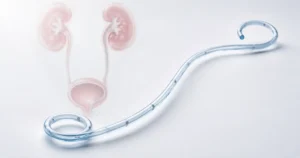
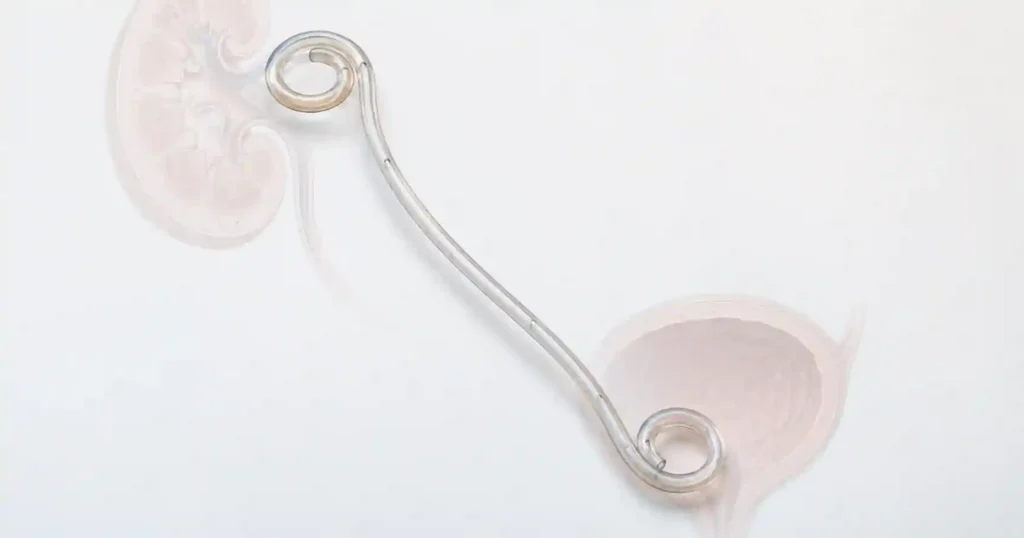
DJ stands for double-J, sometimes called a double-pigtail stent. It is a soft polymer tube roughly 4.7 to 6 French in diameter (about 1.6 to 2 mm) and 24 to 30 cm long (around 9.5 to 12 inches), with a curl at each end. One curl sits inside the renal pelvis — the funnel at the top of your ureter where urine collects. The other curls inside your bladder. The curls exist for one reason: to stop the tube sliding out at either end.
Its job is drainage. After a ureteroscopy or laser lithotripsy, the ureter swells where the scope and the stone fragments passed through. Swelling in a tube 3 to 4 mm wide can block it completely, and a blocked kidney behind a swollen ureter is a genuinely dangerous situation. The stent keeps a channel open regardless of how much the wall swells around it. It also passively dilates the ureter, which matters if a second procedure is planned.
Here is the part most patients are never told. The 2026 AUA guideline on surgical management of kidney and ureteral stones states that post-operative stent placement is not necessary after uncomplicated ureteroscopy [1]. Stenting is a clinical decision, not an automatic step. If you have one, there was a reason — a difficult access, a swollen or injured ureter, residual fragments, a solitary kidney, an infected system, or a planned second look. Ask your surgeon which of those applied to you at your first follow-up, because the answer determines how long the stent needs to stay in. The choice of procedure matters here too, and our breakdown of how URS, PCNL and RIRS differ covers which operations routinely need a stent afterwards and which do not.
Why DJ Stent Pain Happens, and Why It Moves Around
Patients describe three separate sensations and assume something is wrong because they do not feel like one coherent problem. They are three different mechanisms, and separating them is the most useful thing I can give you.
1. Urgency, frequency and burning: the bladder coil
The lower curl rests on the trigone, the triangular patch of bladder floor that carries the highest density of stretch receptors in the entire urinary tract. It is the part of the bladder that tells your brain you need to go. A plastic coil sitting on it produces a constant false signal: you feel full when you are not. That is why men with stents urinate small volumes very frequently and still feel unfinished afterwards.
2. The stab in the flank when you urinate: reflux
Normally, the ureter enters the bladder through a one-way tunnel that seals shut when the bladder squeezes. A stent props that valve permanently open. So when you contract your bladder to void, a portion of that pressure travels straight up the stent lumen and distends your renal pelvis. The result is a sharp pain between the lower ribs and the hip, lasting a few seconds, timed exactly to urination. It is uncomfortable and it is entirely mechanical.
3. The dull ache with movement: shaft friction
The stent shaft is fixed at both ends but your kidney moves several centimetres with every deep breath and with every change of posture. The tube rubs the ureteric lining as you walk, drive, or climb stairs. This produces a background ache and a reliable pattern most patients notice within days: the more active the day, the pinker the urine and the deeper the ache by evening.
The scale of this is well documented. In the validation cohort for the Ureteral Stent Symptom Questionnaire, 78% of patients reported bothersome urinary symptoms, more than 80% reported stent-related pain affecting daily activities, 32% reported sexual dysfunction, and 58% reported reduced work capacity [2]. That instrument, the USSQ, remains the standard measure for stent symptoms two decades after it was published [3]. If you feel wrecked by a stent, you are firmly in the majority.
What Actually Reduces DJ Stent Pain
Two drug classes have randomized evidence behind them, and most men are discharged without either.
Alpha-blockers. A meta-analysis of 16 randomized trials covering 1,489 patients found that alpha-blockers significantly reduced the USSQ urinary symptom score, pain index, general health score and sexual matters score compared with control [4]. They relax smooth muscle in the bladder neck and lower ureter, which blunts both the spasm and the reflux. Tamsulosin 0.4 mg once daily is the usual starting point.
Antimuscarinics. A 2025 network meta-analysis of 16 trials and 1,865 patients ranked solifenacin highest for reducing the urinary symptom score, with tamsulosin second; alfuzosin also outperformed placebo [5]. Solifenacin calms the detrusor muscle directly, targeting the urgency rather than the ureteric spasm.
Do not assume both is better than one. A meta-analysis of eight randomized trials in 1,087 patients found combined tamsulosin plus solifenacin was not superior to tamsulosin alone [6]. Start with one, give it 72 hours, and switch classes if it fails rather than stacking side effects.
For analgesia, a short course of an NSAID handles the flank component better than acetaminophen because the pain is driven by pelvic distension and prostaglandin-mediated inflammation. Acetaminophen is a reasonable background layer. Both assume you have normal kidney function on your post-operative bloods — check before you start an NSAID.
What to ask for, specifically: before you leave the ward or at your first phone contact, ask whether tamsulosin 0.4 mg daily or solifenacin 5 mg daily is appropriate for you for the duration of the stent, and ask for it in writing on the discharge summary. Do not wait until day four when you are already exhausted and phoning a nurse line. Track your symptom scores daily so you have something objective to report rather than “it’s bad.”
Score your symptoms daily with the Ureteral Stent Symptom Tracker (USSQ-based)Your DJ Stent Week: What's Normal, What Isn't, and When to Call
Enter your email below to receive Dr. Khalid’s complete Urology Surgery Recovery Guide as a free, printable PDF.
Living With a DJ Stent: The Tips That Change Your Week
These are the adjustments that actually move the needle, in the order I give them in clinic.
- Front-load your fluids. Aim for 2 to 2.5 litres a day (about 68 to 85 fl oz), but take most of it before 6 pm and taper sharply after 7 pm. Full-day hydration with a stent means being awake five times a night.
- Void before you feel full. Go every two hours by the clock rather than waiting for the urge. Lower bladder volume means lower voiding pressure, which means less reflux up the stent and a much smaller stab in the flank.
- Sit down to urinate for the first few days. It reduces abdominal straining, and straining is what drives pressure up the stent.
- Cap lifting at about 10 kg (22 lb) and avoid running, cycling and gym work until the stent is out. Vigorous movement increases both bleeding and the small risk of the stent migrating.
- Cut caffeine and alcohol. Both are direct bladder irritants layered on top of a bladder that is already being mechanically provoked.
- Expect intermittent pink urine for the entire dwell time. It should clear with rest and fluids. Thick clots that block your stream are a different matter — see the red flags below.
On sex: most men can resume after the first week if they feel able, but be aware that roughly a third report sexual dysfunction while a stent is in place, and if yours has an extraction string it needs to be secured to avoid traction. That is a conversation worth having openly rather than assuming something has gone wrong. For a deeper breakdown of managing the pain itself day to day, our guide to controlling kidney stone stent pain goes further than this article does.
In My Practice
I once had a man come to clinic on day nine after a routine ureteroscopy convinced his operation had failed. He had barely slept, his urine was pink every evening, and he had that sharp flank pain every time he urinated. He had not been given an alpha-blocker, and nobody had explained reflux to him. I drew the bladder, the valve and the stent on a piece of paper, started him on tamsulosin, and told him the pain when he urinated was pressure travelling backwards, not the stone coming back. He phoned two days later to say the drawing had helped more than the tablet.
Most stent distress is untreated symptoms plus an unexplained mechanism — fix both and the same stent becomes tolerable.
DJ Stent Removal: What Really Happens
There are two routes, and which one you get was decided in theatre before you woke up.
Route 1: the extraction string
Some surgeons leave a fine thread attached to the bladder coil, exiting at the tip of the penis and taped to the thigh. You remove the stent yourself, at home, on the date you were given. In a prospective series of 168 patients using routine self-removal, 79% removed the stent successfully at home, the mean dwell time was 5.2 days, the dislodgement rate was 3%, and 90% said they would do it again [7]. A systematic review of eight studies covering 1,279 patients found no overall difference in pain or urinary symptoms between stents with and without strings, but reported early dislodgement in close to 10% of the string group [8].
Technique matters. Pull steadily and continuously, not in jerks — the coil has to straighten out as it comes through, and stopping halfway is what makes it hurt. It takes two to three seconds. Do it standing over the toilet, and expect a brief sharp sensation and some blood in the next void.
Route 2: flexible cystoscopy
No string means a clinic appointment. Local anaesthetic lidocaine gel goes into the urethra and needs a genuine 10 minutes to work — if the nurse instils it and the doctor walks in after two minutes, ask to wait. A flexible scope goes in, a grasper catches the bladder coil, and the whole stent is withdrawn with the scope. Total time from scope in to scope out is usually two to five minutes. The moment the coil passes back through the urethra is sharp, and it is over in seconds.
Three things that make removal day easier: take an NSAID 30 to 60 minutes before your appointment; empty your bladder immediately beforehand; and plan for 24 to 48 hours of burning, urgency and pink urine afterwards, because the bladder and ureter both need time to settle. Some men also get a short-lived colicky pain a day or two after removal as a residual fragment passes down a ureter that no longer has a stent holding it open. Our detailed walkthrough of what ureteric stent removal feels like step by step covers the appointment itself in more depth.
Never let the date slip
A stent left in place encrusts. Mineral salts deposit on the polymer until the stent itself becomes a stone. The timeline is unforgiving: in a multicentre series of 57 forgotten stents, simple cystoscopic retrieval succeeded in 71.4% of stents left 6 to 12 months, but only 6.2% of those left 25 to 36 months — the rest required combinations of ureteroscopy, percutaneous surgery and lithotripsy across multiple admissions [9]. A separate two-centre series found an average of three separate procedures to clear one encrusted stent [10].
Put the removal date in your phone with an alarm the same day the stent goes in, and confirm the date in writing before you leave the hospital. This is the one part of stent care that is entirely within your control.
When Stent Symptoms Mean the Emergency Room
Ordinary stent discomfort plateaus. Symptoms that escalate need same-day assessment. Go to the ER immediately if you have:
- A temperature of 38°C (100.4°F) or higher, especially with shivering or shaking — a stented, potentially obstructed system with infection can progress to sepsis within hours
- Complete inability to pass urine
- Heavy bleeding with clots that block your stream
- Pain that your prescribed medication no longer controls at all
- Severe one-sided flank pain with vomiting, which can indicate stent blockage or migration
If your extraction string comes out accidentally or detaches, this is not an emergency — but call your urology department the same working day, because removal now requires cystoscopy and the appointment needs booking.
Frequently Asked Questions About DJ Stents
How long does DJ stent pain last after kidney stone surgery?
Most men feel the worst of it in the first 48 to 72 hours, then reach a plateau of manageable urgency and intermittent flank discomfort until removal. The pain should not build over time. If yours is escalating after day four, that points towards infection, stent migration or an unpassed fragment rather than ordinary irritation. Logging daily scores with the ureteral stent symptom tracker gives your urologist something concrete to act on.
Is it normal to see blood in my urine with a DJ stent in?
Yes, and it will keep recurring for as long as the stent is in place. The bladder coil rubs the lining every time the bladder contracts, so urine turns pink after walking, driving or straining, then clears with rest and fluids. What is not normal is passing thick clots that block your stream. Practical day-to-day management is covered in our guide to controlling stent pain after stone surgery.
Can I pull out my own DJ stent if it has a string?
Only if your surgeon instructed you to, and only on the date you were given. In a prospective series of 168 patients, 79 percent removed the stent successfully at home and 90 percent said they would do it again, though 3 percent dislodged it early. Pull steadily and continuously, never in jerks. Our walkthrough of what stent removal actually feels like covers the technique in detail.
Why does my flank hurt only at the moment I urinate?
Because the stent props open the one-way valve that normally stops urine flowing backwards from bladder to kidney. When you contract your bladder to void, part of that pressure travels up the stent and stretches your renal pelvis. That is the stab you feel between your lower ribs and hip. Voiding before your bladder feels full lowers the pressure. The type of stone surgery you had determines how long the stent must stay in.
What happens if a DJ stent is left in too long?
It encrusts, and eventually becomes a stone in its own right. In one multicentre series, simple cystoscopic retrieval worked for 71 percent of stents left 6 to 12 months but only 6 percent of those left 25 to 36 months. The rest needed several operations across multiple admissions. Set a phone alarm for your removal date the day the stent is placed, and check your post-operative recovery timeline.
References
- American Urological Association. Surgical Management of Kidney and Ureteral Stones: AUA Guideline. J Urol. 2026. AUA
- Joshi HB, Stainthorpe A, MacDonagh RP, et al. Indwelling ureteral stents: evaluation of symptoms, quality of life and utility. J Urol. 2003;169(3):1065-1069. PubMed
- Joshi HB, Newns N, Stainthorpe A, et al. Ureteral stent symptom questionnaire: development and validation of a multidimensional quality of life measure. J Urol. 2003;169(3):1060-1064. PubMed
- He F, Man LB, Li GZ, Liu N. Efficacy of alpha-blocker in improving ureteral stent-related symptoms: a meta-analysis of both direct and indirect comparison. Drug Des Devel Ther. 2016;10:1783-1793. PubMed
- Moon YJ, Chung DY, Kim DK, et al. The beneficial effects of alpha-blockers, antimuscarinics, beta 3-agonist, and PDE5-inhibitors for ureteral stent-related discomfort: a systematic review and meta-analysis. Medicina (Kaunas). 2025;61(2):232. PubMed
- Chen YB, Gao L, Jiang Q, et al. Tamsulosin monotherapy is effective in reducing ureteral stent-related symptoms: a meta-analysis of randomized controlled studies. Curr Med Sci. 2019;39(5):707-718. PubMed
- Liu J, Cundy TP, Parker N, et al. Implementing routine use of self-removed ureteric stents on extraction strings: prospective patient-reported outcome measures and complications. World J Urol. 2023;41(12):3759-3764. PubMed
- Oliver R, Wells H, Traxer O, et al. Ureteric stents on extraction strings: a systematic review of literature. Urolithiasis. 2018;46(2):129-136. PubMed
- Polat H, Yücel MÖ, Utangaç MM, et al. Management of forgotten ureteral stents: relationship between indwelling time and required treatment approaches. Balkan Med J. 2017;34(4):301-307. PubMed
- Thangavelu M, Abdallah MY, Isola OJ, Kotb A. Management of encrusted ureteral stents: two center experience. Arch Ital Urol Androl. 2022;94(3):305-310. PubMed
Dr. Muhammad Khalid
MBBS · FCPS (Urology) · MCPS (General Surgery) · CHPE · CRSM · IMC #539472
Specialist urologist with 11+ years of clinical experience across tertiary teaching hospitals. Trained at Lady Reading Hospital and Khyber Teaching Hospital, Peshawar. Author or co-author of five peer-reviewed international publications, including in Cureus and the World Journal of Surgery. Procedural expertise: URS, PCNL, RIRS, TURP, TURBT, and major open urological surgery. Full profile →
This article is for educational purposes only and does not constitute medical advice. Always consult your physician or urologist for diagnosis and treatment decisions specific to your condition.