Robotic Surgery in Urology: What It Really Changes
Robotic surgery in urology lowers blood loss, wound problems and hospital days — but randomized trials show it does not improve continence, erections, or cancer survival. Here is what actually changes.

Robotic surgery in urology gets sold to patients as a straight upgrade — smaller scars, less pain, better cancer control. Two of those three hold up under randomized trial data. The third does not. In 11 years of tertiary hospital urology, the question I am asked most often before a prostatectomy or a kidney operation is some version of “is the robot better?” It is the wrong question, and the framing does men real harm, because it pushes attention toward the machine and away from the factor that actually predicts their result. The honest answer is narrower and more useful than the marketing: the robotic platform reliably reduces blood loss, transfusion risk, wound problems and time in hospital. On the trial evidence available, it does not produce better continence, better erections, or better cancer survival than the same operation performed well through an open incision. This article walks through what each trial found, procedure by procedure, and what it means for the decision in front of you.
Key Takeaways
- In the only randomized trial comparing robotic and open radical prostatectomy, urinary and sexual function scores were statistically indistinguishable at 6, 12 and 24 months.
- Robotic radical cystectomy cut thromboembolic events from 8.3% to 1.9% and wound complications from 16.0% to 5.6%, with no difference in cancer recurrence.
- Robotic partial nephrectomy roughly halves blood loss and opioid requirement, but takes longer and keeps the kidney’s blood supply clamped about seven minutes longer.
- Kidney stones, TURP, HoLEP and TURBT are not robotic operations and never will be — they are performed from inside the urinary tract.
- Case-log data show the busiest 10% of US surgeons perform 41% of all robotic prostatectomies, which means most men are choosing a platform when they should be choosing a volume.
What Robotic Surgery in Urology Actually Is
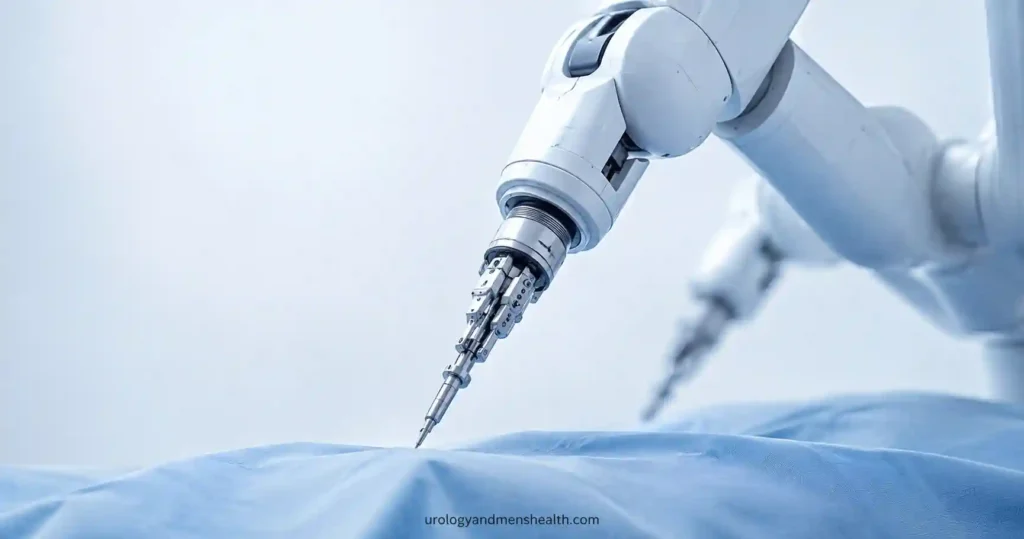
The single most common misunderstanding I correct in clinic is the belief that the robot operates. It does not. There is no autonomy, no algorithm deciding where to cut, and no scenario in which the machine proceeds without a surgeon driving every millimetre of movement. What patients call “the robot” is a telemanipulator: the surgeon sits at a console a few feet away, hands inside master controls, head inside a three-dimensional viewer, while four arms docked to ports in your abdomen reproduce those hand movements at a reduced scale.
Two features do the actual work. The first is instrument wristing — the tips articulate through seven degrees of freedom, roughly matching a human wrist, where a conventional laparoscopic instrument is a rigid stick that pivots at the abdominal wall. The second is motion scaling with tremor filtration: a 3 cm movement of the surgeon’s hand becomes a 1 cm movement of the instrument, and physiological hand tremor is filtered out entirely. In a space the size of the male pelvis, where the urethral sphincter and the neurovascular bundles sit within millimetres of the prostate, that combination is genuinely useful.
There is a trade-off that rarely appears in hospital brochures: the surgeon loses touch. Current systems give almost no haptic feedback, so tissue tension and suture tightness have to be judged visually rather than felt. Experienced robotic surgeons compensate by reading tissue deformation on screen, but it is a learned substitute, not an equivalent. For the wider picture of how these operations sit alongside each other, our urological surgery and recovery hub maps every procedure we cover.
Which Urological Operations Are Done Robotically
Urology adopted robotics faster and more completely than any other surgical specialty. Case-log data from the American Board of Urology showed robotic prostatectomy rising from 22% of all radical prostatectomies in 2003 to 85% by 2013, a 376% increase over a decade [6]. That figure has only gone up since.
The operations genuinely performed robotically share one feature: they happen inside the abdomen or pelvis and require reconstruction — sewing something back together in a confined space.
- Radical prostatectomy — removal of the prostate for cancer, with reconstruction of the bladder-to-urethra join
- Partial nephrectomy — removing a kidney tumor and repairing the kidney, the standard of care for most cT1 renal masses
- Radical nephrectomy — whole-kidney removal for larger tumors
- Radical cystectomy with urinary diversion — bladder removal for muscle-invasive cancer, increasingly with the new bladder or conduit built entirely inside the abdomen
- Pyeloplasty — reconstruction of a blocked kidney drainage system
- Bladder diverticulectomy and ureteric reimplantation — reconstructive work in the deep pelvis
Just as important is what is not robotic, because patients frequently arrive expecting it to be. Kidney stone surgery — ureteroscopy, PCNL, shockwave lithotripsy — reaches the stone through the urethra, the ureter or a small flank tract, so an abdominal robotic arm has nothing to contribute. Prostate surgery for benign enlargement (TURP, HoLEP) is done through the urethra. Bladder tumor resection is likewise endoscopic, as our guide to the TURBT procedure for bladder cancer sets out in detail.
One genuine source of confusion is worth naming. Aquablation for an enlarged prostate is marketed as robotic — and it is, in that a robotically controlled waterjet executes a surgeon-mapped resection plan. But it is delivered through the urethra by a completely different device. If a hospital tells you your BPH procedure is “robotic,” ask which system, because the two technologies share a marketing word and nothing else.
Robotic vs Open Prostatectomy: What the Randomized Trials Show
For a technology adopted this widely, the randomized evidence is remarkably thin — essentially one trial. Between 2010 and 2014, a team in Brisbane randomized 326 men with clinically localized prostate cancer to robot-assisted or open radical retropubic prostatectomy and followed them for two years [1][2].
The functional results are the part every man wants and almost nobody is told. Urinary function scores did not differ significantly at 6 weeks, 12 weeks, 6 months, 12 months or 24 months. Neither did sexual function scores, measured on both the EPIC sexual domain and the IIEF questionnaire, at any of those time points. Two years after surgery, the robotic group scored 91.3 on urinary function and the open group 90.9 — a gap with no clinical meaning whatsoever.
Where the robot did separate was perioperative safety. Postoperative complications occurred in 4% of robotic patients versus 9% of open patients, and intraoperative adverse events in 2% versus 8% [1]. At 24 months, biochemical recurrence was recorded in 3% of the robotic group versus 9% of the open group — but the trial authors specifically warned against reading that as an oncological advantage, because postoperative management and additional cancer treatment were not standardized between arms [2]. Imaging evidence of progression showed no significant difference.
The investigators’ own conclusion is the sentence I repeat to patients most often: the benefit of the robotic approach should be understood as being largely about its minimally invasive nature, and men should choose an experienced surgeon they trust rather than a specific surgical approach. The AUA/ASTRO localized prostate cancer guideline takes the same position, treating the approach as a shared decision rather than a recommendation [7]. Our radical prostatectomy recovery timeline covers what the weeks after either version look like in practice.
In My Practice
A man arrived at clinic with a printout of a private hospital’s robotic surgery page and a single question: could I guarantee he would get the robot. He had not asked how many prostatectomies his surgeon performed each year, what that surgeon’s positive-margin rate was, or whether his MRI showed disease sitting against the neurovascular bundle on the left. We spent the whole consultation on those three things instead. He had his operation robotically in the end — but he chose it for reasons that predict an outcome, rather than for the console.
The platform is a fair question to ask; it is simply never the first one.
Going in for urological surgery? Get the recovery guide I give my own patients
Enter your email below to receive Dr. Khalid’s complete Urology Surgery Recovery Guide as a free, printable PDF.
Robotic Kidney and Bladder Surgery: Where the Advantage Is Real
Outside the prostate, the picture is more interesting — and in bladder surgery, more favorable to the robot.
Kidney: a genuine trade-off in both directions
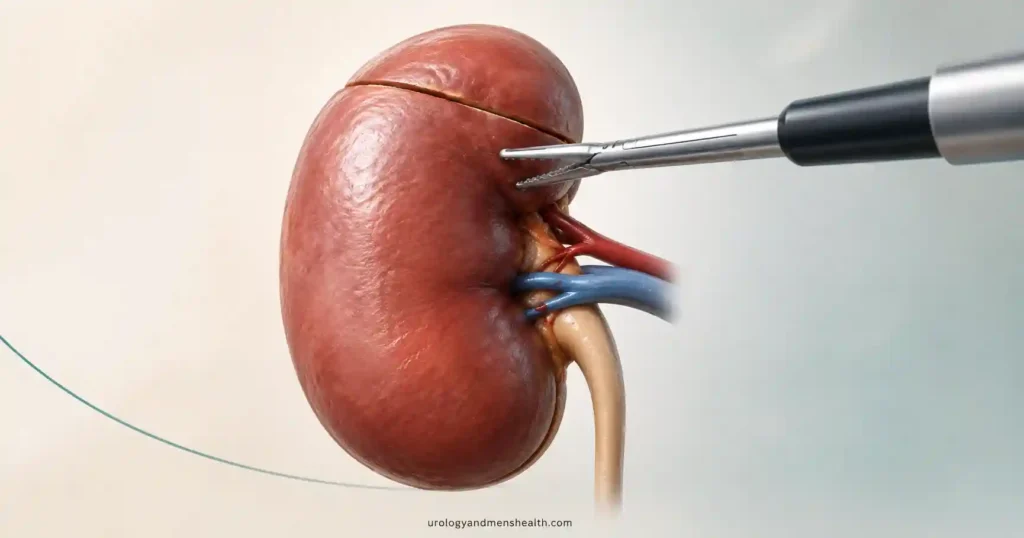
The ROBOCOP II trial randomized 50 patients with suspected localized kidney cancer to robotic or open partial nephrectomy [5]. Robotic surgery produced substantially less bleeding — 149 mL of blood loss (about 5 fl oz) versus 361 mL (about 12 fl oz) — and markedly less pain, with only 16% of robotic patients needing opioids compared with 46% after open surgery. Overall complication burden was lower.
But the open operation won on two measures that matter to a surgeon. It was faster (112 versus 130 minutes), and — more relevantly for your kidney — warm ischemia time was 8.7 minutes open versus 15.4 minutes robotic. That is the period the renal artery is clamped and the kidney has no blood supply. In this trial postoperative kidney function came out the same either way, but in a man with one kidney or pre-existing chronic kidney disease, an extra seven minutes of clamp time is a real consideration to raise with your surgeon.
The EAU renal cell carcinoma guideline is explicit that for a cT1 tumor the decision that changes your outcome is partial versus radical nephrectomy — preserving kidney tissue — irrespective of the surgical approach [8]. In other words: fight for the partial operation, not for the platform.
Read next: when a kidney has to come out completely — and what life looks like afterwardsBladder: the strongest case for the robot in all of urology
Radical cystectomy is the most physically punishing operation in urology, and it is where a less invasive route should matter most. Two trials tested it properly.
The RAZOR trial randomized 350 patients across 15 US centers and found two-year progression-free survival of 72.3% after robotic cystectomy versus 71.6% after open — formally non-inferior [3]. Cancer control, in other words, is not compromised.
The iROC trial then asked a better question: does it make recovery easier? Across nine UK centers, 338 patients were randomized to robotic cystectomy with the urinary diversion built entirely inside the body, or open surgery [4]. Robotic patients spent a median of 2.2 more days alive and out of hospital within the first 90 days. Thromboembolic complications fell from 8.3% to 1.9%. Wound complications fell from 16.0% to 5.6%. Quality of life and measured disability were better at 5 and 12 weeks, though the gap had closed by 6 months. Cancer recurrence and mortality were identical at 18 months.
Those are the most convincing numbers in this article. A four-fold reduction in blood clots and a three-fold reduction in wound problems in a frail cancer population is not a marketing claim — it is a reason to travel to a center that does this operation robotically and does it often.
The Real Benefits of Robotic Surgery in Urology — and the Limits
Put the trial data side by side and the picture is consistent across organs. The robot changes how you get through the operation. It does not change what the operation does to you.
Supported by randomized data: less blood loss and lower transfusion risk; fewer wound complications; fewer thromboembolic events after major pelvic surgery; shorter hospital stay; less opioid requirement; faster return to baseline function in the first 6 to 12 weeks.
Not supported by randomized data: better urinary continence recovery; better erectile function recovery; better cancer-specific survival; lower positive surgical margin rates. If a consultation includes any of these four claims presented as an established benefit of the robot, that is a claim ahead of its evidence, and you are entitled to ask what it is based on.
Two further limits deserve mention. Robotic surgery requires the abdomen to be inflated with carbon dioxide and the patient positioned steeply head-down for hours, which is poorly tolerated by some men with severe lung disease, raised intracranial pressure, or significant heart failure — a legitimate anesthetic reason to be offered the open operation. And extensive previous abdominal surgery with dense adhesions can make the robotic approach slower and riskier than an open one.
Compare the surgical routes for your condition side by side before your consultationRecovery After Robotic Urological Surgery
Robotic prostatectomy recovery is where expectations most often go wrong, because men extrapolate from the small incisions. Five port scars of 8 to 12 mm each look trivial. Inside, the same prostate has been removed and the same urethra sewn to the same bladder neck.
A realistic sequence after robotic radical prostatectomy: home on day 1 or 2 with a catheter; catheter removal at 7 to 14 days depending on how the anastomosis looks; driving once you are off opioid analgesia and can perform an emergency stop without guarding, usually around 2 weeks; desk work at 2 to 3 weeks; no lifting above roughly 5 kg (about 11 lb) for 4 to 6 weeks; first PSA at 6 to 8 weeks. Continence typically improves over 3 to 12 months, and erectile recovery — if nerves were spared — over 12 to 24 months. Our guide to sexual recovery after prostate surgery sets out what is realistic at each stage and what to ask for if progress stalls.
After robotic partial nephrectomy, expect 1 to 3 days in hospital, a 4-week lifting restriction, and a repeat creatinine and eGFR at around 6 weeks. After robotic cystectomy, expect 5 to 8 days in hospital even with an uncomplicated course, and 3 months before you feel like yourself. Ask your team specifically when your stoma or neobladder education starts — begun before surgery, it shortens the whole recovery.
Whichever operation you have had, the practical planning question is what each week should look like. Our post-operative recovery timeline tool builds a week-by-week plan around your specific procedure.
When to Go to the ER After Robotic Surgery
Small incisions do not mean small complications. Go to the emergency room, or call your surgical team immediately, if you develop any of the following in the first six weeks:
- Fever above 38°C (100.4°F), or shaking chills
- Calf pain or swelling, or sudden breathlessness or chest pain — clots still occur in roughly 1 in 50 patients even after robotic pelvic surgery
- No urine draining into the catheter bag for 4 hours, or urine leaking around the catheter with abdominal pain
- A distended, hard abdomen with vomiting and no passage of gas beyond 48 hours
- Increasing redness, swelling, or fluid discharge from any port site
- Sudden severe abdominal or shoulder-tip pain, particularly with dizziness — this can indicate internal bleeding
Cost, Access, and Why the Surgeon Matters More Than the Robot
Robotic systems cost millions to buy and hundreds of thousands annually to maintain, with disposable instruments adding meaningfully to every case. In systems where you pay directly, that difference can be passed on. It is a reasonable thing to ask about in writing before you consent.
But the number that should worry you more is volume. In that American Board of Urology dataset, the median certifying urologist logged just eight robotic prostatectomies in six months, while the busiest 10% of surgeons performed 41% of all robotic cases [6]. General urologists — not urologic oncologists — performed 57.8% of all radical prostatectomies. The technology is now near-universal; proficiency with it is not.
So take four specific questions into your consultation, and write the answers down:
- How many of this exact operation do you personally perform each year? Not the hospital’s figure — the surgeon’s.
- What is your own positive surgical margin rate for organ-confined disease? A surgeon who audits their work will know this number without checking.
- What proportion of your patients are pad-free at 12 months? Ask for their series, not published literature.
- If the robotic approach becomes difficult, at what point do you convert to open, and who does that operation?
A surgeon who answers all four without defensiveness is the one to have. The console is a tool in their hands; it is not a substitute for the hands.
Frequently Asked Questions
Is robotic surgery in urology better than open surgery for prostate cancer?
For cancer control and long-term function, no. The Brisbane randomized trial found the same urinary and sexual function scores at 24 months whether men had robotic or open radical prostatectomy, and imaging evidence of progression did not differ. What the robot reliably changes is blood loss, transfusion risk and hospital stay. Compare the surgical routes side by side with our urology surgery comparison tool before your consultation.
Does robotic prostatectomy give better erections and continence than open surgery?
Not on the trial evidence. EPIC and IIEF-5 scores were statistically indistinguishable between the robotic and open groups at 6 weeks, 12 weeks, 12 months and 24 months. Nerve-sparing technique, your erectile function before surgery, and your surgeon’s annual case volume drive those outcomes far more than the platform does. Our guide to sex after prostate surgery sets out realistic recovery timelines.
Why can’t kidney stones be treated with robotic surgery?
Stones are treated from inside the urinary tract, not from outside it. Ureteroscopy, PCNL and shockwave lithotripsy reach the stone through the urethra, the ureter or a small flank tract, so a robotic arm working in the abdomen adds nothing. Confusingly, some procedures done through the urethra are robotic — Aquablation for BPH uses a robotically controlled waterjet — which is an entirely different technology.
How long is the catheter in after robotic radical prostatectomy?
Most men go home with the catheter and return for removal 7 to 14 days later, depending on how the bladder-to-urethra join looked at the end of surgery and whether your surgeon requests a cystogram first. Catheter duration is broadly similar for robotic and open surgery. Our radical prostatectomy recovery timeline covers what each week afterwards involves.
Does robotic radical cystectomy reduce complications compared with open surgery?
Yes, for specific complications. The iROC trial found thromboembolic events in 1.9% of robotic cases versus 8.3% of open cases, and wound complications in 5.6% versus 16.0%. Patients also gained a median of 2.2 more days alive and out of hospital within 90 days. Cancer recurrence and mortality were the same. Use our post-operative recovery timeline to plan the first six weeks.
How many robotic cases should my surgeon have done?
Ask for their personal annual volume and their own outcome figures, not the hospital’s. US case-log data show the median certifying urologist logged only eight robotic prostatectomies in six months, while the busiest 10% performed 41% of all cases. Volume tracks with continence and margin results. Our guide to kidney removal surgery shows the same volume pattern in renal work.
References
- Yaxley JW, Coughlin GD, Chambers SK, et al. Robot-assisted laparoscopic prostatectomy versus open radical retropubic prostatectomy: early outcomes from a randomised controlled phase 3 study. Lancet. 2016;388(10049):1057-1066. PubMed
- Coughlin GD, Yaxley JW, Chambers SK, et al. Robot-assisted laparoscopic prostatectomy versus open radical retropubic prostatectomy: 24-month outcomes from a randomised controlled study. Lancet Oncol. 2018;19(8):1051-1060. PubMed
- Parekh DJ, Reis IM, Castle EP, et al. Robot-assisted radical cystectomy versus open radical cystectomy in patients with bladder cancer (RAZOR): an open-label, randomised, phase 3, non-inferiority trial. Lancet. 2018;391(10139):2525-2536. PubMed
- Catto JWF, Khetrapal P, Ricciardi F, et al. Effect of robot-assisted radical cystectomy with intracorporeal urinary diversion vs open radical cystectomy on 90-day morbidity and mortality among patients with bladder cancer: a randomized clinical trial. JAMA. 2022;327(21):2092-2103. PubMed
- Kowalewski KF, Neuberger M, Sidoti Abate MA, et al. Randomized controlled feasibility trial of robot-assisted versus conventional open partial nephrectomy: the ROBOCOP II study. Eur Urol Oncol. 2024;7(1):91-97. PubMed
- Oberlin DT, Flum AS, Lai JD, Meeks JJ. The effect of minimally invasive prostatectomy on practice patterns of American urologists. Urol Oncol. 2016;34(6):255.e1-255.e5. PubMed
- American Urological Association / ASTRO. Clinically Localized Prostate Cancer: AUA/ASTRO Guideline. AUA
- European Association of Urology. EAU Guidelines on Renal Cell Carcinoma. EAU
Dr. Muhammad Khalid
MBBS · FCPS (Urology) · MCPS (General Surgery) · CHPE · CRSM · IMC #539472
Specialist urologist with 11+ years of clinical experience across tertiary teaching hospitals. Trained at Lady Reading Hospital and Khyber Teaching Hospital, Peshawar. Author or co-author of five peer-reviewed international publications, including in Cureus and the World Journal of Surgery. Procedural expertise: URS, PCNL, RIRS, TURP, TURBT, and major open urological surgery. Full profile →
This article is for educational purposes only and does not constitute medical advice. Always consult your physician or urologist for diagnosis and treatment decisions specific to your condition.