Urodynamic Testing: What to Expect, Step by Step
Most men walk into urodynamic testing worried about the catheters. The part that actually decides your treatment is what the pressure tracing says about your bladder muscle — and whether surgery will help at all.

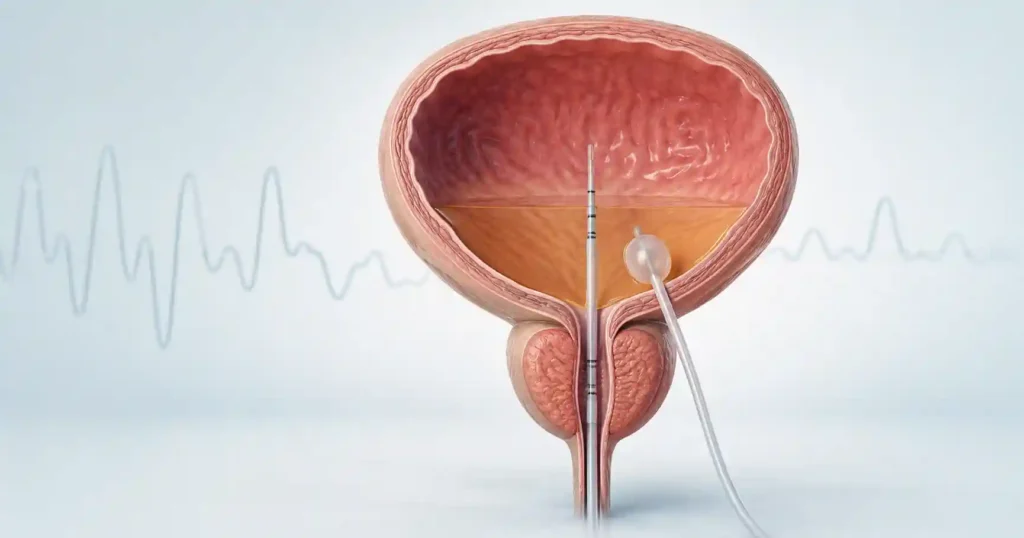
Urodynamic testing is the only investigation that can tell your urologist whether your bladder is struggling because something is blocking the way out, or because the bladder muscle itself has lost power. From the outside those two problems look identical — the same weak stream, the same hesitancy, the same feeling of never quite finishing. They need opposite treatments. Get it wrong and a man has an operation he did not need and wakes up with a stream no better than before.
Most men arrive at the urodynamics room worried about one thing: the catheters. That worry is reasonable, and I will describe exactly what goes where. But the discomfort lasts seconds and the information is the reason I asked for the test rather than booking you straight into theater. Below is what each line measures, what happens minute by minute, what the numbers on your report actually mean, and what to expect in the 48 hours afterward. For the wider picture on urological procedures and recovery, see our Urological Surgery & Recovery hub.
Key Takeaways
- Urodynamic testing exists to separate two conditions that feel the same: a blocked outlet and a weakened bladder muscle. Outlet surgery fixes the first and does almost nothing for the second.
- The pressure-flow study is the only measurement that can prove bladder outlet obstruction. A slow flow rate on its own cannot — a weak muscle produces the same slow stream.
- Leaving more than 100–150 mL (about 3–5 fl oz) behind after voiding means your bladder is not emptying completely.
- Stinging and pink-tinged urine for 24–48 hours after the test are expected. Fever, clots, or inability to pass urine at all are not — those need a same-day phone call.
What Urodynamic Testing Actually Measures
Urodynamic testing is not one test. It is a set of measurements taken in sequence during a single appointment, and each one answers a different question.
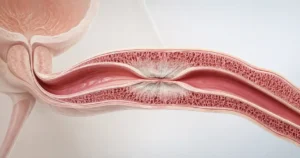
Uroflowmetry records how fast urine leaves. You void privately into a funnel sitting on a spinning disc or weight sensor. The output is your Qmax — peak flow in milliliters per second — plus the shape of the curve, which carries information the single number does not. A flat, plateau-shaped curve points toward a fixed narrowing such as a urethral stricture. A low, rounded curve fits either obstruction or a tired muscle, and cannot distinguish between them.
Post-void residual measures what is left behind, either with a handheld ultrasound scanner or by draining through the catheter once it is in place.
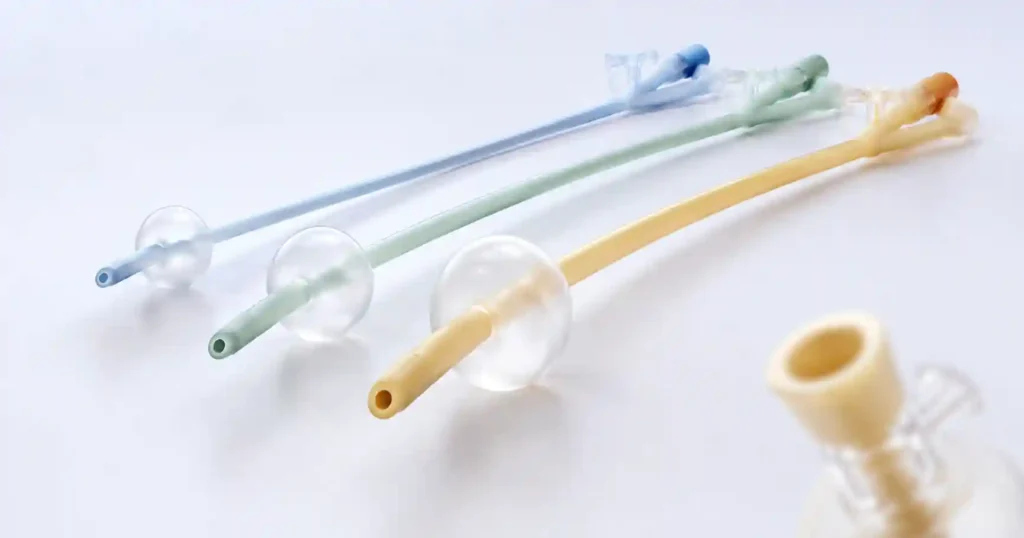
Filling cystometry is where the two lines come in. A thin dual-lumen catheter — typically 6 to 7 French, narrower than a drinking straw — passes through the urethra into the bladder. A second small balloon-tipped line sits in the rectum. The bladder line reads total pressure inside the bladder. The rectal line reads abdominal pressure: your coughing, your straining, your gut. The machine subtracts one from the other, and what remains is detrusor pressure — the pressure your bladder muscle alone is generating. Think of recording a soloist in a noisy hall by placing a second microphone in the audience and subtracting the crowd.
The pressure-flow study is the voiding phase, with both lines still in place. This is the measurement that earns the whole appointment, because it pairs pressure and flow at the same instant. High pressure with low flow means the outlet is blocking you. Low pressure with low flow means the muscle is not pushing.
Electromyography uses sticky surface electrodes near the anus to check whether your pelvic floor relaxes when your bladder contracts. When those two fall out of step — detrusor-sphincter dyssynergia — the cause is almost always neurological.
Video-urodynamics adds X-ray contrast in place of saline and a fluoroscopy screen, so the bladder is watched as well as measured. It is reserved for neurological bladder disease, incontinence after prostate cancer surgery, and suspected reflux or bladder diverticulum.
It matters just as much what the test cannot do. It does not look for cancer — that needs a camera and imaging. It does not diagnose infection — that needs a urine culture. It does not measure how much your symptoms bother you — that needs a symptom score. And a single normal study does not rule out an overactive bladder: the AUA/SUFU urodynamics guideline states plainly that the absence of detrusor overactivity on one study does not exclude it as the cause of urgency symptoms [1].
Why Your Urologist Ordered Urodynamic Testing
This is not a routine test, and you should know that before you consent to it. The UPSTREAM trial randomized 820 men with bothersome urinary symptoms across 26 hospitals to standard non-invasive assessment or standard assessment plus urodynamics. At 18 months the symptom scores were no better in the urodynamics group, and the surgery rate barely moved — 38% versus 36%. The authors concluded that routine use in uncomplicated symptoms has a limited role and that the test should be used selectively [3].
So if you have been offered it, something about your case sits outside “uncomplicated.” The AUA 2026 LUTS/BPH guideline and the EAU 2026 male LUTS guideline converge on a similar list of situations where a pressure-flow study changes the plan [4][5]:
- Your symptoms and your flow rate disagree. You are badly bothered, but your Qmax is above 15 mL/s — a figure that makes obstruction unlikely.
- You voided less than 150 mL (about 5 fl oz) on the flow test. Below that volume the reading is not interpretable and has to be repeated properly.
- A large residual, or an episode of retention. Formal pressure measurement is the way to work out whether that residual comes from a blockage or a failing muscle.
- Storage symptoms dominate. If urgency and urge leakage bother you more than the weak stream, and someone has offered you outlet surgery, the tracing tells you how much of that urgency will still be there afterward.
- Neurological history. Multiple sclerosis, spinal cord injury, Parkinson’s disease, prior stroke, or long-standing diabetes with neuropathy.
- Age well under 50 or well over 80. At both extremes the assumption that the prostate is the culprit fails more often.
- Previous pelvic radiotherapy, radical prostatectomy, or an outlet operation that did not work. Also standard before a male sling or artificial sphincter for incontinence after prostate treatment.
If your bother is mostly urgency and frequency rather than a weak stream, score it before your appointment using the validated OAB symptom score and bring the number with you. A written score changes the consultation from “it’s pretty bad, doctor” into something your urologist can compare against the tracing.
Related read: when an enlarged prostate genuinely needs surgery — and when it does notWhat Happens During Urodynamic Testing, Step by Step
Before you arrive
Arrive with a comfortably full bladder — full enough to void on request, not painfully distended. There is no fasting, no sedation, and no reason you cannot drive yourself home.
Two things are worth doing in the week beforehand. First, complete a three-day bladder diary: every time you pass urine, roughly how much, every leak, and every drink. Handed over at the door, it is the single most useful piece of paper in the room. Second, telephone the unit and ask specifically whether to pause your alpha blocker or bladder relaxant for the study. Practice differs — some units want a drug-free tracing, others want to see how you perform on treatment — and the answer changes what your results mean. Take all your other regular medicines as normal.
If you have had a urinary infection in the previous two weeks, call ahead rather than turning up. Active infection makes the bladder irritable, corrupts the tracing, and gets the test postponed after you have already been catheterized.
The appointment itself
Flow test and residual (5 minutes). You void privately into the flowmeter. Your bladder is scanned immediately afterward to measure what is left.
Catheter placement (1–2 minutes). Local anesthetic gel goes into the urethra first and is given a moment to work. The urethral line goes in, then the small rectal line. The genuinely uncomfortable part is roughly ten to twenty seconds as the urethral catheter passes the prostate. Men who have had a flexible cystoscopy will recognize the sensation — this catheter is considerably thinner than the camera.
Filling (10–20 minutes). Warm saline runs in at somewhere between 10 and 50 mL per minute. You will be asked to report three things as they happen: the first time you feel anything, the first time you would normally head for a bathroom, and the point where you could not hold on much longer. You will also be asked to cough at intervals — that is a quality-control check confirming both lines are reading properly, and the International Continence Society standard treats it as mandatory rather than optional [2]. Some units add provocation: running water, standing up, bouncing on your heels.
Voiding (5 minutes). You void on command with both lines in place. This is awkward rather than painful. A meaningful number of men simply cannot go under those conditions — say so straight away rather than straining, because straining contaminates the pressure reading. Staff will step out, dim the lights, and give you time.
The lines come out immediately afterward. The invasive portion runs 30 to 45 minutes; budget an hour for the whole visit.
Bladder Testing and Overactive Bladder: What Your Results Mean and What Comes Next
Enter your email below to receive Dr. Khalid’s complete OAB & Incontinence Guide as a free, printable PDF.
Reading Your Urodynamics Report: The Numbers That Matter
Urodynamics reports are written for urologists and read like machine output. Here is what to look for, in the order it appears.
- Voided volume. If it is under 150 mL (about 5 fl oz), treat the flow figures with caution — that reading is not reliable [2].
- Qmax. Above 15 mL/s makes obstruction unlikely. Below 10 mL/s is consistent with obstruction or a weak muscle, and on its own settles nothing.
- Post-void residual. Above 100–150 mL (about 3–5 fl oz) means incomplete emptying [6]. Above 300 mL puts you in a different management category altogether.
- Maximum cystometric capacity. Usually 400–600 mL (about 14–20 fl oz). A capacity of 200 mL tells you why you are in the bathroom every hour.
- Compliance. How much the bladder stretches per unit of pressure rise. Normal is above 30 mL/cmH2O. A stiff, low-compliance bladder transmits pressure upward toward the kidneys, and a detrusor leak point pressure above 40 cmH2O is the long-established threshold for renal risk.
- Detrusor overactivity. Involuntary contractions during filling. This is the finding that explains urgency — and it predicts urgency that persists after outlet surgery, which is exactly the conversation you want to have beforehand rather than after.
- Bladder outlet obstruction index — detrusor pressure at peak flow minus twice the flow rate. Above 40 means obstructed. Between 20 and 40 is equivocal. Below 20 means not obstructed.
- Bladder contractility index — detrusor pressure at peak flow plus five times the flow rate. Above 150 is strong, 100 to 150 is normal, below 100 is an underactive muscle.
The two indices together are the answer you came for. Obstruction index above 40 with contractility of 100 or more means a real blockage and a muscle with enough left in it to benefit — the best possible candidate for a TURP or laser enucleation. Obstruction index below 20 with contractility under 100 means no blockage and a tired muscle, and outlet surgery will disappoint you. Everything in between is a judgment call made with your symptom score and your priorities in the room.
If your report flags a large residual, the post-void residual risk estimator puts your own number into context against the thresholds urologists actually act on.
Ask for a printed copy of the report with those figures on it, not just a verbal summary in clinic. The interview study nested inside UPSTREAM found that information gaps before, during and after urodynamics were the commonest complaint from men who had the test — and the way results were explained varied widely between units [7]. You are entitled to your own numbers.
In My Practice
The tracing I think about most belonged to a man in his late sixties who had been on tamsulosin for four years and was already booked for a TURP. His flow was 8 mL/s and his prostate measured 65 mL, so everybody in the pathway had assumed obstruction — including me, before the study. His pressure-flow result came back with an obstruction index of 11 and a contractility index of 74. No blockage at all. A bladder muscle that had quietly given up years earlier. We cancelled the operation, taught him clean intermittent self-catheterization twice a day, and his residual and his infections both settled.
A big prostate and a slow stream are circumstantial evidence; the pressure-flow tracing is the only thing that convicts.
After Urodynamic Testing: Side Effects and Red Flags
Expect stinging when you pass urine for 24 to 48 hours, faintly pink urine for a day or two, and a mild ache low in the abdomen. Drinking an extra liter (about 34 fl oz) across the first day dilutes the urine and shortens the stinging. None of this needs antibiotics.
Symptomatic infection afterward is uncommon. The best prospective figure available comes from a cohort of 232 women undergoing urodynamics, in which 4.3% developed a symptomatic urinary infection — low enough that routine antibiotics before the test are not standard practice for otherwise healthy patients [8]. No equivalent male-only prospective series exists, so read that number as indicative rather than exact; the NIDDK describes the infection risk after catheter-based urodynamics as slight [6].
Call the Unit Same Day
These are not part of normal recovery from urodynamic testing:
- Temperature of 38°C (100.4°F) or higher, or shaking chills
- Unable to pass any urine for more than 6 to 8 hours, with a full, painful lower abdomen
- Bright red bleeding, or blood clots in the urine
- Burning that is getting worse rather than better past 48 hours, with cloudy or foul-smelling urine
- Pain in the flank or lower back with fever — this suggests infection has tracked upward
Complete inability to void after the test is acute retention and needs a catheter the same day, not a wait-and-see approach. Retention after a procedure covers what happens next and how long a catheter usually stays in.
Before you leave the unit, book the results conversation. When it happens, ask two direct questions: does this tracing show obstruction, and does my bladder muscle have enough power to benefit from surgery. Ask for your Qmax, residual, obstruction index and contractility index in writing, and aim to have that conversation within two weeks — the tracing is a snapshot, and decisions made on it are best made while it is current.
Frequently Asked Questions
Does urodynamic testing hurt?
Urodynamic testing is uncomfortable rather than painful. The catheter is thinner than a drinking straw and local anesthetic gel goes in first; the sharp part lasts roughly ten to twenty seconds as it passes the prostate. Filling feels like a progressively full bladder. Voiding with the lines in is more awkward than sore. Men who have had a flexible cystoscopy generally rate urodynamics as easier.
Why do I need urodynamic testing if my flow rate is already slow?
Because a slow flow has two entirely different causes that need opposite treatments. A blocked outlet produces high bladder pressure and low flow. A weakened bladder muscle produces low pressure and low flow. Uroflowmetry measures only the flow, so it cannot separate them. Add a large residual and the ambiguity gets worse, which is why the residual figure needs pressure data alongside it to interpret.
Can urodynamic testing tell me whether a TURP will work?
It gives the best available prediction. An obstruction index above 40 with a contractility index of 100 or more identifies the man most likely to be pleased with outlet surgery. An index below 20 with weak contractility identifies the man who will not be. It is a probability, not a guarantee — and it should be weighed alongside how much your symptoms bother you and the options in the BPH treatment pathway.
What does it mean if urodynamics shows my bladder is underactive?
It means the detrusor muscle is not generating enough pressure to empty efficiently, with no blockage to blame. Management shifts away from surgery toward timed voiding, double voiding, treating anything contributing such as constipation or anticholinergic medication, and clean intermittent self-catheterization if the residual stays high. If urgency coexists, scoring it with the OAB symptom score helps separate the storage problem from the emptying problem.
How long do side effects last after urodynamic testing?
Stinging on urination usually settles within 24 to 48 hours and pink-tinged urine within a day or two. Extra fluid intake on the first day shortens both. What is not normal is fever, clots, worsening burning past 48 hours, or complete inability to void — that last one is acute retention and needs a catheter the same day rather than overnight observation at home.
References
- Winters JC, Dmochowski RR, Goldman HB, et al. Urodynamic studies in adults: AUA/SUFU guideline. J Urol. 2012;188(6 Suppl):2464-2472. AUA
- Rosier PFWM, Schaefer W, Lose G, et al. International Continence Society Good Urodynamic Practices and Terms 2016: urodynamics, uroflowmetry, cystometry, and pressure-flow study. Neurourol Urodyn. 2017;36(5):1243-1260. PubMed
- Drake MJ, Lewis AL, Young GJ, et al. Diagnostic assessment of lower urinary tract symptoms in men considering prostate surgery: a noninferiority randomised controlled trial of urodynamics in 26 hospitals (UPSTREAM). Eur Urol. 2020;78(5):701-710. PubMed
- American Urological Association. Management of Lower Urinary Tract Symptoms Attributed to Benign Prostatic Hyperplasia: AUA Guideline. 2026. AUA
- European Association of Urology. Management of Non-neurogenic Male LUTS — Diagnostic Evaluation. EAU Guidelines, 2026. EAU
- National Institute of Diabetes and Digestive and Kidney Diseases. Urodynamic Testing. NIDDK
- Selman LE, Ochieng CA, Lewis AL, Drake MJ, Horwood J. Recommendations for conducting invasive urodynamics for men with lower urinary tract symptoms: qualitative interview findings from a large randomized controlled trial (UPSTREAM). Neurourol Urodyn. 2019;38(1):320-329. PubMed
- Nóbrega MM, Auge APF, de Toledo LGM, et al. Bacteriuria and urinary tract infection after female urodynamic studies: risk factors and microbiological analysis. Am J Infect Control. 2015;43(10):1035-1039. PubMed
Dr. Muhammad Khalid
MBBS · FCPS (Urology) · MCPS (General Surgery) · CHPE · CRSM · IMC #539472
Specialist urologist with 11+ years of clinical experience across tertiary teaching hospitals. Trained at Lady Reading Hospital and Khyber Teaching Hospital, Peshawar. Author or co-author of five peer-reviewed international publications, including in Cureus and the World Journal of Surgery. Procedural expertise: URS, PCNL, RIRS, TURP, TURBT, and major open urological surgery. Full profile →
This article is for educational purposes only and does not constitute medical advice. Always consult your physician or urologist for diagnosis and treatment decisions specific to your condition.