Nocturia in Men: Causes, Diagnosis & Treatment
Waking up to pee? It might not be your prostate. Discover the real causes of nocturia, a simple 3-day diagnostic test, and targeted treatments.

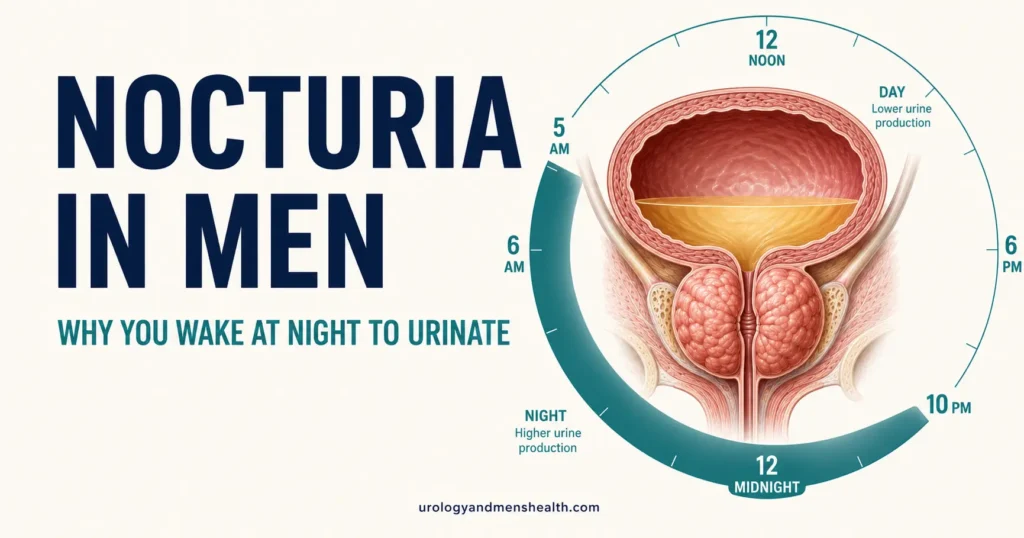
Nocturia in men — waking up two or more times a night to urinate — is one of the most under-diagnosed problems I see in clinic. Most men assume it’s the prostate. In reality, only about a third of nocturia cases are driven primarily by an enlarged prostate. The rest come from the kidneys producing too much urine at night, an overactive bladder, untreated sleep apnea, heart failure, diabetes, or the timing of common medications. Treating the wrong cause is why so many men stay tired for years despite taking a prostate pill. This is a short, structured tour through what’s actually happening, the simple 3-day test that points to the answer, and the treatments that work for each underlying driver. For the full overview of related conditions, see our Prostate Health Hub.
Key Takeaways
- Waking up two or more times a night to urinate meets the clinical definition of nocturia and warrants investigation, not reassurance.
- Only about one third of men with nocturia have a primary prostate cause — kidneys, sleep apnea and the heart explain most of the rest.
- A 3-day bladder diary calculating the Nocturnal Polyuria Index is the single most useful test, and it costs nothing.
- Desmopressin works powerfully for nocturnal polyuria but requires sodium monitoring in men over 65 — it is not a casual prescription.
What Counts As Nocturia — And When Is It a Problem?
The International Continence Society defines nocturia as waking up one or more times during the main sleep period to urinate, with each episode preceded and followed by sleep. Clinically, one episode a night is common and rarely matters. Two or more episodes is where the evidence shows measurable impact on sleep quality, daytime function, falls in older men, and even cardiovascular risk over the long term [1].
The cut-off matters because the threshold of “normal” shifts with age. A 35-year-old waking twice nightly has a clear pathology. A 75-year-old waking twice may be experiencing age-related changes in circadian arginine vasopressin secretion — still treatable, but the differential diagnosis is different. Either way, the threshold for investigation is the same: two or more episodes a night, most nights, for more than a month.
What I tell patients in the first consultation: if you are waking that often, your body is telling you something specific. The job of the workup is to find which of six possible mechanisms is generating the signal — because the right treatment depends entirely on which one.
The Six Real Causes of Nocturia in Men
Nocturia is a symptom, not a diagnosis. There are six clinically distinct drivers, and most men have more than one operating at the same time. Sorting them is what changes outcomes.
1. Reduced functional bladder capacity (BPH and OAB)
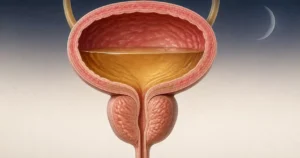
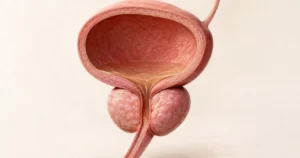
This is what most men — and most primary care doctors — assume is the cause. An enlarged prostate creates outflow obstruction, the bladder muscle thickens in response, and the functional capacity drops. The bladder fills to a smaller volume before triggering the urge to void. The same end result happens in overactive bladder syndrome, where the detrusor muscle contracts before the bladder is full. In both cases, voided volumes at night are small — typically under 200 mL per episode.
2. Nocturnal polyuria (the kidneys make too much urine at night)
This is the cause most often missed. Normally, the kidneys produce about a third of daily urine at night because the hormone arginine vasopressin (AVP) concentrates urine during sleep. In nocturnal polyuria, that night-time concentration fails. The kidneys produce more than 33% of the 24-hour urine output between bedtime and waking [2]. The voided volumes are large — typically over 250 mL per episode. The prostate is irrelevant to this mechanism; treating it does nothing.
3. Obstructive sleep apnea (OSA)
OSA causes nocturia through a mechanism most patients find counterintuitive. Repeated airway collapse generates negative intrathoracic pressure, which the heart interprets as fluid overload. The atria release atrial natriuretic peptide (ANP), which signals the kidneys to dump sodium and water — at night. Studies show up to 50% of men with moderate-to-severe OSA have nocturia, and CPAP therapy resolves it in the majority [3]. If you snore, your partner reports apneas, and you wake unrefreshed despite sleeping eight hours, a sleep study comes before a prostate workup.
4. Peripheral edema redistribution (heart failure, venous insufficiency)
Fluid that accumulates in the legs during the day from heart failure, venous insufficiency, or simply prolonged standing redistributes into the circulation when the patient lies flat. The kidneys then offload that volume through the night. The diagnostic clue is ankle swelling at bedtime that has resolved by morning. The treatment is upstream — diuretic timing (taken at noon, not at bedtime), compression stockings worn during the day, and optimization of the underlying cardiac condition.
5. Uncontrolled diabetes and diabetes insipidus
High blood glucose pulls water into the urine via osmotic diuresis — the classic “polyuria” of poorly controlled diabetes mellitus. Diabetes insipidus, a rarer condition where the AVP signaling itself is broken, does the same thing through a different pathway. A fasting glucose and HbA1c at the first visit catches the common one; serum and urine osmolality catches the rare one.
6. Medication and fluid timing
The least glamorous cause, and the easiest to fix. Diuretics taken in the evening, calcium channel blockers (which cause leg edema that then redistributes at night), SSRIs that affect AVP, and the simple habit of large evening fluid intake all generate nocturia. Coffee and alcohol within four hours of sleep are independent contributors. Before any prescription, I review every medication and fluid timing — and a meaningful number of men resolve their nocturia by moving their furosemide from 6 PM to noon.
One of the most satisfying moments in clinic is when a man comes in convinced he needs prostate surgery for waking five times a night. We do the 3-day bladder diary. His Nocturnal Polyuria Index is 56% — well above the 33% threshold. He has loud snoring and a thick neck. We send him for a sleep study. He has moderate sleep apnea. Six weeks of CPAP and he’s down to one trip a night. His prostate, IPSS 12 at baseline, never needed touching. Nocturia is the symptom; the diagnostic question is always which mechanism is generating it.
The lesson: never let a patient — or yourself — accept “it’s the prostate” without doing the diary first.
The 3-Day Bladder Diary: The Test That Changes Everything
The single most useful test in nocturia evaluation costs nothing and is done at home. The patient records every void over three consecutive 24-hour periods, noting time, volume measured with a household measuring jug, and whether it was a day-time or night-time void. The American Urological Association and the European Association of Urology both recommend this as the first-line diagnostic [4].
From the diary, three numbers determine the diagnostic path:
- 24-hour urine volume. Total urine output in 24 hours. Above 40 mL per kg of body weight (around 2,800 mL for an 70 kg / 154 lb man) suggests global polyuria — drink less, or screen for diabetes.
- Nocturnal Polyuria Index (NPi). Volume voided during sleep divided by 24-hour volume. Above 33% confirms nocturnal polyuria. This is the number that redirects the workup away from the prostate.
- Maximum voided volume. The largest single void of the three days. Under 200 mL suggests reduced functional bladder capacity — likely BPH or OAB.
A bladder diary takes 15 minutes a day for 3 days. It is the highest-yield diagnostic test in modern urology, and almost nobody does it before being prescribed an alpha-blocker. If your doctor has not asked for one, ask why.
Weak stream and night-time trips wearing you down? Download Dr. Khalid’s BPH & Enlarged Prostate Guide.
Enter your email below to receive Dr. Khalid’s complete BPH & Enlarged Prostate Guide as a free, printable PDF.
When the Prostate Is the Cause: BPH and Nocturia
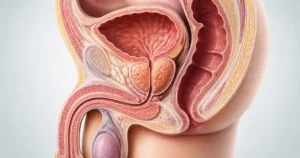
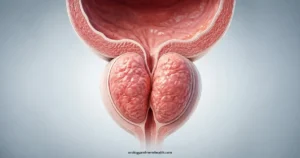
An enlarged prostate causes nocturia through two mechanisms working in parallel. First, the obstructed urethra prevents complete bladder emptying — so the residual volume sits in the bladder and the next void comes sooner. Second, chronic obstruction makes the bladder muscle thicken and become overactive, contracting at smaller filling volumes. Both effects compress the time between voids, day and night.
The diagnostic signature of BPH-driven nocturia is specific: small voided volumes (under 200 mL) at night, an IPSS score above 8, a normal NPi (under 33%), and usually obstructive symptoms during the day — hesitancy, weak stream, the feeling of incomplete emptying. If those four boxes are ticked, the prostate is the target. If they are not, treating the prostate will disappoint everyone.
The starting workup includes the IPSS questionnaire — you can calculate your own score using our IPSS prostate symptom score calculator before your appointment — a uroflowmetry test, and a post-void residual ultrasound. The post-void residual danger estimator helps interpret the residual urine number in context. Together, these tell the urologist whether to start with medication (an alpha-blocker like tamsulosin, possibly combined with a 5-alpha-reductase inhibitor if the prostate is large) or to consider surgery directly.
For the full discussion of tamsulosin and its side effects — including the retrograde ejaculation and dizziness many men aren’t warned about — see our dedicated article. Alpha-blockers reduce nocturia by about one episode per night on average [5], which is meaningful for some men and disappointing for others. The size of the effect depends almost entirely on whether BPH was the right diagnosis.
Treatments by Cause: The Step-by-Step Ladder
Treatment for nocturia follows from the diary, not from the symptom. The same patient with three night-time voids will follow completely different pathways depending on the diagnostic numbers.
Step 1: Behavior and lifestyle (always first)
Limit fluid intake after 6 PM to a single cup of water with any evening medication. No coffee, tea, or alcohol within four hours of sleep. If there is leg swelling at bedtime, wear medical-grade compression stockings (20-30 mmHg) during the day and elevate the legs above heart level for two hours in the early evening — that mobilizes the fluid before bed rather than during sleep. Long periods of sitting also worsen pelvic congestion and bladder symptoms, so stand and move every hour. These steps alone reduce nocturia by half an episode per night on average — and they cost nothing.
Step 2: Treat the underlying driver
If the diary shows nocturnal polyuria with daytime sleepiness, snoring, or a partner reporting apneas, request a polysomnography sleep study. CPAP therapy, where indicated, often resolves the nocturia within weeks. If there is ankle edema, ask your primary care doctor to review the timing of your diuretic — moving furosemide from 6 PM to noon typically halves night-time voids in heart failure patients. Optimize blood glucose if HbA1c is above 7%. Review every medication for nocturia-promoting effects.
Step 3: BPH-directed medication (only if BPH is confirmed)
If the diary, IPSS, and uroflow point to BPH, an alpha-blocker (tamsulosin 0.4 mg, alfuzosin 10 mg, or silodosin 8 mg at bedtime) reduces nocturia by about one episode per night within four weeks. If the prostate volume is above 40 mL, adding finasteride or dutasteride targets the underlying enlargement but takes 3-6 months to take effect.
Step 4: OAB-directed medication
If the diary shows small volumes but no obstructive signs, the diagnosis is likely overactive bladder. Anticholinergics (solifenacin, tolterodine) or beta-3 agonists (mirabegron) reduce night-time episodes by about half an episode per night. Beta-3 agonists avoid the dry mouth and constipation of anticholinergics — useful in older men, where anticholinergic burden is also linked to cognitive decline.
Step 5: Desmopressin for confirmed nocturnal polyuria
Desmopressin (low-dose, sublingual 25-50 mcg for women, 50-100 mcg for men) is the only medication that directly treats nocturnal polyuria. It works powerfully — typical reductions are 1-1.5 episodes per night, which is roughly double the effect of an alpha-blocker. The catch is hyponatremia: in men over 65, the risk of dangerously low sodium can exceed 10% if not monitored [6]. Baseline sodium, a recheck at day 4-7, day 30, and every 3-6 months thereafter is non-negotiable. Desmopressin is not a prescription to ask for casually — but for the right patient with a confirmed NPi over 33%, it transforms sleep.
Step 6: Surgery (TURP, HoLEP) for refractory BPH-driven cases
When medication fails in a man with confirmed BPH and large prostate volumes, surgical relief of the obstruction reduces nocturia by 1-2 episodes per night in the majority of properly selected patients. Surgery is not a treatment for nocturia in isolation — it is a treatment for BPH, and the nocturia improvement is a downstream effect of removing the obstruction.
⚠ When to See a Doctor Urgently
Most nocturia is a slow-evolving problem that can be worked up at a routine appointment. But certain combinations warrant urgent evaluation. See your primary care doctor or urologist within a week if you have: nocturia plus ankle swelling and shortness of breath (possible heart failure), nocturia plus blood in the urine (possible bladder or kidney cancer — see our guide on PSA grey zone results if PSA is also elevated), nocturia plus unintentional weight loss and fatigue (possible diabetes or malignancy), or nocturia plus witnessed apneas and severe daytime sleepiness. Sudden onset of nocturia in a man who previously slept through is also worth a same-week appointment — it is more likely to have a treatable medical cause than slowly worsening nocturia.
The Connection to High Blood Pressure and Cardiovascular Risk
Nocturia is not a benign nuisance. Multiple large cohort studies have shown that men with two or more episodes per night have measurably higher rates of falls, depression, and — striking but underappreciated — cardiovascular mortality. The mechanism is partly fragmented sleep, which itself drives blood pressure and metabolic dysfunction, and partly the shared underlying drivers: untreated sleep apnea, heart failure, and uncontrolled hypertension. Men with nocturia and elevated BP should read our guide on how high blood pressure damages the kidneys, because the same nocturnal sodium and water dysregulation that causes nocturia often signals early kidney involvement.
If you are over 50, waking twice nightly, and your blood pressure is creeping up, treat the nocturia as a cardiovascular signal — not just a urinary one. The same lifestyle and medication adjustments that fix night-time waking also lower long-term cardiac risk.
The Hormonal Triangle: Sleep, Testosterone, and Nocturia
One pattern I see often: a man in his 50s with low energy, weight gain around the middle, two to three night-time voids, and a partner reporting heavy snoring. He has, in clinical terms, the sleep apnea-nocturia-testosterone triangle. OSA fragments sleep and suppresses the pulsatile testosterone release that normally happens during REM. Low testosterone in turn worsens visceral fat, which worsens OSA, which worsens nocturia. Each piece reinforces the others.
If this pattern fits you, do not start testosterone replacement before the sleep study. Treating OSA first often raises testosterone enough that replacement becomes unnecessary — and starting TRT in a man with untreated OSA can worsen the apnea. Our deep dive on low testosterone symptoms in men over 40 covers the workup order in detail.
Frequently Asked Questions About Nocturia in Men
Is waking once a night to urinate considered nocturia?
Technically yes — the International Continence Society defines nocturia as one or more night-time voids preceded and followed by sleep. But clinically, one episode per night is common and rarely associated with measurable harm. The threshold that triggers a workup is two or more episodes most nights, particularly when sleep feels unrefreshing or daytime function suffers. If you wake once at 6 AM and easily fall back asleep, that is not the same problem as waking three times between midnight and 6 AM. For a structured self-assessment, our IPSS calculator includes nocturia frequency as a scored item.
Why do I have nocturia in men if my prostate is normal?
Because the prostate is only one of six possible causes. If your urologist has confirmed your prostate is not significantly enlarged and your post-void residual is normal, the workup needs to shift to the other five drivers — nocturnal polyuria (most common in this scenario), undiagnosed sleep apnea, peripheral edema with night-time redistribution, diabetes, or medication timing. A 3-day bladder diary with calculation of the Nocturnal Polyuria Index is the next step. If the NPi exceeds 33%, the kidneys are the problem, not the prostate.
What is the difference between nocturia and nocturnal polyuria?
Nocturia is the symptom — waking to urinate at night. Nocturnal polyuria is one specific cause of that symptom, defined by the kidneys producing more than 33% of the 24-hour urine output during the main sleep period. You can have nocturia without nocturnal polyuria (for example, from BPH causing reduced bladder capacity), and you can have nocturnal polyuria as an isolated finding before it becomes symptomatic. The distinction matters because the treatments are different — alpha-blockers for the first, behavior change plus possibly desmopressin for the second.
Can drinking less water at night cure my nocturia?
It helps, but rarely cures nocturia on its own. Stopping fluid intake four hours before bed typically reduces night-time voids by 0.3-0.5 episodes per night on average — meaningful for a man waking twice, modest for a man waking five times. If a simple change in evening fluid timing cures the problem, it was a behavioral nocturia, not a medical one. Most men with two or more nightly episodes have a medical driver that fluid restriction will not address alone.
How is nocturia diagnosed if I’m under 50 and otherwise healthy?
The same way it is diagnosed at any age — start with a 3-day bladder diary, an IPSS questionnaire, a urinalysis to rule out infection or glycosuria, and a serum glucose. In younger men, the differential leans more toward sleep apnea (especially with weight gain or snoring), psychogenic polydipsia (drinking large volumes habitually), and untreated diabetes. A normal physical exam and bladder diary essentially rules out BPH-driven nocturia under 45 — so the workup correctly skips the prostate-focused tests an older man would need.
Is desmopressin safe for older men with nocturia?
Safe when used correctly, dangerous when used casually. Desmopressin works powerfully for nocturnal polyuria — but in men over 65, the risk of hyponatremia (dangerously low blood sodium) can exceed 10% without monitoring. Standard practice is to check baseline sodium, recheck at day 4-7, again at day 30, and every 3-6 months thereafter. Sodium below 135 mmol/L should trigger dose reduction or discontinuation. The newer low-dose sublingual formulation (25 mcg for women, 50 mcg for men) has a lower hyponatremia risk than the older oral tablets and is the preferred option in men over 65 when desmopressin is appropriate.
References
- Bosch JLHR, Weiss JP. The prevalence and causes of nocturia. Journal of Urology. 2010;184(2):440-446. PubMed
- Hashim H, Blanker MH, Drake MJ, et al. International Continence Society (ICS) report on the terminology for nocturia and nocturnal lower urinary tract function. Neurourology and Urodynamics. 2019;38(2):499-508. PubMed
- Miyazato M, Tohyama K, Touyama M, et al. Effect of continuous positive airway pressure on nocturnal urine production in patients with obstructive sleep apnea syndrome. Neurourology and Urodynamics. 2017;36(2):376-379. PubMed
- Sandhu JS, Bixler BR, Dahm P, et al. Management of Lower Urinary Tract Symptoms Attributed to Benign Prostatic Hyperplasia (BPH): AUA Guideline Amendment 2023. Journal of Urology. 2024;211(1):11-19. AUA Guideline
- Gravas S, Cornu JN, Gacci M, et al. EAU Guidelines on Management of Non-Neurogenic Male Lower Urinary Tract Symptoms (LUTS). European Association of Urology, 2024. EAU Guideline
- Han J, Jung JH, Bakker CJ, et al. Desmopressin for treating nocturia in men. Cochrane Database of Systematic Reviews. 2017;10(10):CD012059. Cochrane Review
Dr. Muhammad Khalid
MBBS · FCPS (Urology) · MCPS (General Surgery) · CHPE · CRSM · IMC #539472
Specialist urologist with 11+ years of clinical experience across tertiary teaching hospitals. Trained at Lady Reading Hospital and Khyber Teaching Hospital, Peshawar. Author or co-author of five peer-reviewed international publications, including in Cureus and the World Journal of Surgery. Procedural expertise: URS, PCNL, RIRS, TURP, TURBT, and major open urological surgery. Full profile →
This article is for educational purposes only and does not constitute medical advice. Always consult your physician or urologist for diagnosis and treatment decisions specific to your condition.