Micropenis vs Buried Penis: A Urologist Explains
Most men who ask me about micropenis vs buried penis have neither. The difference comes down to a single measurement — and how that measurement is taken changes the answer completely.

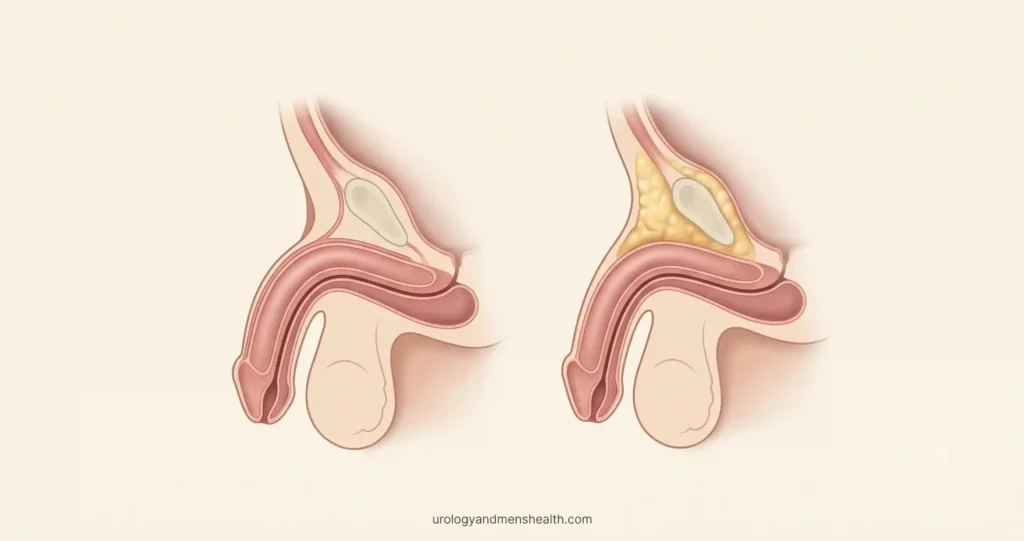
Micropenis vs buried penis is a distinction almost nobody gets right on their own, and it decides everything that happens next. One is a rare developmental diagnosis with a defined numerical cutoff. The other is a mechanical problem — a normally sized shaft hidden behind fat, scar, or swelling — and it is far more common in adult men. The third possibility, and by a wide margin the most likely, is that nothing is wrong at all and the measurement was simply taken the wrong way. In eleven years of urology practice I can count confirmed adult micropenis cases on one hand. What I see instead, week after week, is a suprapubic fat pad being measured along with the penis, or a man comparing himself against numbers that were never real to begin with. This article gives you the correct measurement method, the actual population data, and the point at which a urology referral is genuinely warranted. For the wider picture, see our Sexual Health Hub.
Key Takeaways
- Micropenis is defined by a bone-pressed stretched penile length more than 2.5 standard deviations below the mean — roughly 8.5 cm (3.3 in) in adults — not by how the penis looks in a mirror.
- Pooled data from up to 15,521 men put mean stretched length at 13.24 cm (5.2 in) and mean erect length at 13.12 cm (5.2 in), well below what most men assume is average.
- Buried penis in adults is a fat, scar, or lymphedema problem — the shaft underneath is usually a normal length, and the consequences are hygienic and urinary, not cosmetic.
- The AUA’s position is that suspensory ligament division for length and fat injection for girth have not been shown to be safe or effective.
Micropenis vs Buried Penis: The Answer Is in How You Measure
There is only one measurement that matters clinically, and it is called bone-pressed stretched penile length. You take it with the penis flaccid. Press the end of a rigid ruler firmly into the pubic bone above the base of the penis, pushing through the soft tissue until the ruler stops against bone. Stretch the flaccid penis forward to gentle resistance — not painfully — and read the measurement at the tip of the glans, excluding any foreskin overhang.
Stretched length is used rather than erect length because it is reproducible in a clinic room and tracks erect length closely. In the original measurement study that still underpins surgical counseling, stretched length correlated with erect length more reliably than flaccid length did [3].
Here is why the technique decides the diagnosis. If you rest the ruler on the skin surface instead of pressing to bone, every centimeter of fat sitting over the pubic bone is subtracted directly from your result. A man with a 4 cm (1.6 in) suprapubic fat pad measures 4 cm shorter than he actually is. That is the entire explanation for the man who measures 9 cm at home and 13 cm on my examination couch. Nothing about him changed except the ruler’s starting point.
What Normal Penis Size Actually Is
The most useful dataset available is a 2015 systematic review published in BJU International, which pooled clinician-taken measurements from up to 15,521 men and built size nomograms from them [1]. Every measurement in it was taken by a health professional using a standard procedure. None of it is self-reported.
- Mean flaccid length: 9.16 cm (3.6 in)
- Mean stretched length: 13.24 cm (5.2 in), standard deviation 1.89 cm
- Mean erect length: 13.12 cm (5.2 in)
- Mean erect circumference: 11.66 cm (4.6 in)
Two things in that list surprise almost every man who reads it. First, mean erect length is essentially identical to mean stretched length — which is precisely why urologists measure stretched. Second, the average is a little over five inches, not the six or seven that circulates online. Those larger figures come from self-reported surveys, and self-reporting inflates.
Because the standard deviation is 1.89 cm, roughly two-thirds of men fall between 11.35 cm and 15.13 cm (4.5 to 6.0 in) stretched. A measurement of 11.5 cm is not a problem to be solved. It is a normal number sitting slightly left of center.
Low Testosterone Testing Guide: Which Blood Tests to Ask For and When
Enter your email below to receive Dr. Khalid’s complete Low Testosterone: Testing & Treatment Guide as a free, printable PDF.
Micropenis: The Actual Medical Definition
Micropenis is a numerical diagnosis, made on a normally formed penis whose stretched length falls more than 2.5 standard deviations below the population mean for age [2]. Applied to the pooled adult data above, that threshold works out to approximately 8.5 cm (3.3 in). Older reference series place the adult line closer to 9.3 cm. The exact figure shifts with the reference population, which is one reason the diagnosis belongs to a clinician with a ruler rather than to a website.
What causes it
Penile length is set by androgen exposure during fetal development and infancy. Micropenis therefore reflects a failure somewhere along the hypothalamic-pituitary-gonadal axis during that window [2]. The categories are:
- Hypogonadotropic hypogonadism — the hypothalamus or pituitary fails to signal, so the testes are never told to produce testosterone. Kallmann syndrome is the classic example.
- Hypergonadotropic hypogonadism — the signal arrives but the testes cannot respond, as in gonadal dysgenesis or anorchia.
- Partial androgen insensitivity — testosterone is produced normally but tissue receptors respond poorly.
- Syndromic causes — micropenis appearing as one feature of a broader congenital syndrome.
Why adult first presentation is rare
All of those causes declare themselves in infancy or at puberty, which is when micropenis is normally identified. A man reaching adulthood with a genuinely sub-threshold measurement and no prior diagnosis is uncommon — and needs an endocrine workup rather than reassurance. Ask specifically for a morning total testosterone drawn before 10 a.m., LH, FSH, and prolactin, with karyotyping if the hormone pattern points that way, and request the results within two weeks so the pattern can be interpreted rather than filed.
If your concern is really about energy, libido, and body composition rather than anatomy, start by working through the symptom pattern properly — our guide to what low testosterone actually looks like after 40 covers which symptoms carry diagnostic weight and which do not.
Check your symptom pattern first: Low Testosterone Symptom Quiz →Buried Penis in Adults: A Normal Penis You Cannot See
Adult-acquired buried penis is the diagnosis most men who worry about micropenis actually have, and it is a structural condition rather than a size one. The shaft is a normal length. It is simply covered. The recognized causes are obesity with a heavy suprapubic fat pad and abdominal pannus, scarring after circumcision, lichen sclerosus, genital lymphedema, and post-surgical cicatrix, with obesity by far the most common driver in adults [4].
This matters far more than appearance. Once the penis is fully entrapped, hygienic voiding becomes impossible. Urine dribbles into the surrounding skin folds instead of clearing the body, and the resulting chronic moisture drives inflammation, skin breakdown, and repeated infection. Left long enough, the penile skin fibroses and the functional loss becomes permanent [5]. Men in this position also report difficulty with intercourse, recurrent balanitis, and real difficulty being catheterized if they ever need it.
In My Practice
The consultation almost never opens with the real problem. A man books in asking whether his penis has shrunk, and it takes ten minutes before he mentions that his underwear is wet by lunchtime and he has been treated for three skin infections in the last year. That second set of facts is the diagnosis; the first is the symptom he was willing to say out loud.
If a man describes urine soaking into surrounding skin rather than clearing the body, assume buried penis and examine standing — supine examination hides it completely.
There is also a compounding loop worth understanding: excess adipose tissue converts testosterone to estradiol and suppresses the gonadal axis, so the same weight that conceals the penis also lowers the hormone that supports erectile function. We cover that mechanism in detail in our piece on how obesity, testosterone, and erectile dysfunction feed into each other.
When the Measurement Is Normal but the Distress Is Real
A 2016 study in Body Image measured men with body dysmorphic disorder centered on penis size, men with size anxiety but no dysmorphic disorder, and controls. Most men in all three groups underestimated their own size, and the gap between perceived size and ideal size widened progressively across the groups even though measured length did not differ in the way the men expected [8].
That finding splits this population cleanly, and the split changes what helps. For most men, accurate information plus an accurate measurement resolves the concern within a single consultation. For a smaller group, it does not — and no measurement ever will, because the belief is not responsive to evidence.
The practical line I use: if the preoccupation occupies more than an hour a day, drives repeated mirror-checking or measuring, or causes you to avoid changing rooms, swimming, or sex, then the target for treatment is the preoccupation itself. Ask your primary care doctor for a referral for cognitive behavioral therapy assessment, and do it before you consult any surgeon. Cosmetic procedures performed on body dysmorphic disorder reliably make the condition worse, because the dissatisfaction relocates rather than resolves. If you are unsure whether what you are noticing is anatomical or not, our guide to which penile changes warrant a urologist lists what is worth examining.
Treatment: What Works, What Is Investigational, and What Can Cause Harm
Confirmed micropenis
Testosterone therapy given in infancy and early childhood can produce meaningful growth, which is why early diagnosis carries so much weight [2]. In adults the same treatment corrects hormone deficiency and its symptoms but does not add length to a fully developed shaft. Management in adulthood is directed at the underlying endocrine cause, fertility where relevant, and psychological support.
Buried penis
Weight reduction is the first intervention and it works mechanically: reduce the suprapubic fat pad and visible length returns, because it was never lost. Where fibrosis, lymphedema, or scarring is established, weight loss alone will not correct it. Surgical repair is then tailored to the anatomy and typically combines escutcheonectomy or panniculectomy to remove the overhanging fat, scrotoplasty, and split-thickness skin grafting where penile skin has been destroyed [4][5]. Quality-of-life gains after properly selected surgery are consistently reported, and they are gains in voiding, hygiene, and infection rate as much as in appearance.
Enlargement in a normal penis
This is where men get hurt. The AUA’s standing position is that subcutaneous fat injection to increase girth and division of the suspensory ligament to increase length have not been shown to be safe or efficacious [6]. A systematic review covering 16 studies and 1,192 men undergoing aesthetic augmentation found a pooled complication rate of 14.6%, poor methodological quality throughout the literature, and concluded that these procedures remain investigational [7].
For context on how narrow the legitimate surgical window is: the original counseling guidance recommended that only men with a flaccid length below 4 cm (1.6 in), or a stretched or erect length below 7.5 cm (3 in), be considered candidates for lengthening at all [3]. Almost nobody who searches for this meets that threshold.
Traction devices, vacuum pumps, and oral supplements have no evidence of producing permanent length gain in normal anatomy, and supplements sold for this purpose are unregulated and periodically found to contain undeclared PDE5 inhibitors.
See a Urologist Without Delay If
These findings are not size concerns — they are structural or dermatological problems that get worse with time.
- You cannot see the tip of the penis while standing, or urine soaks into the surrounding skin instead of clearing the body
- Repeated skin infection, ulceration, or breakdown in the genital skin folds
- White, thickened, sclerotic patches on the foreskin or glans, or a foreskin that has become non-retractile — this pattern suggests lichen sclerosus, which carries a long-term malignancy risk and needs biopsy
- New penile shortening in adulthood, especially with pain or a palpable firm lump along the shaft
- A weak, deflected, or spraying urinary stream, or difficulty emptying the bladder
- Sudden swelling of the penile or scrotal skin
Frequently Asked Questions
What is the fastest way to tell micropenis vs buried penis at home?
Measure bone-pressed stretched length. Press a rigid ruler firmly into your pubic bone until it stops against bone, stretch the flaccid penis to gentle resistance, and read to the tip of the glans excluding foreskin. If that number is normal but the penis looks short when you stand, the answer is buried penis, not micropenis. If the result is unclear on repeat measurement, get an in-person exam — our guide covers which penile changes warrant a urologist.
Does losing weight actually uncover a buried penis?
Often, yes. The suprapubic fat pad sits directly over the base of the shaft, so every centimeter of fat lost above the pubic bone returns visible length that was always there. Weight loss will not reverse established scarring or skin fibrosis, and severe cases still need surgical repair. Excess weight also suppresses testosterone, which compounds the problem — see how obesity and testosterone interact.
Can low testosterone in adulthood cause a micropenis?
No. Micropenis is a developmental diagnosis reflecting androgen deficiency during fetal growth and infancy, when penile length is determined. Testosterone that falls in adult life reduces erection quality, libido, and testicular volume, but it does not shrink a fully developed shaft into the micropenis range. If you have other symptoms alongside the size concern, work through the low testosterone symptom quiz before requesting blood tests.
Can Peyronie’s disease make the penis shorter?
Yes, and it is the most common cause of genuine adult shortening I see in clinic. Fibrous plaque in the tunica albuginea contracts along one surface, pulling the erect penis into a curve and taking length with it. The shortening is acquired, usually noticed over months, and often accompanied by pain or a palpable lump — covered in detail in our Peyronie’s disease guide.
Is a stretched length of 11 cm (4.3 inches) abnormal?
It is below average and well inside the normal range. Pooled data put mean stretched length at 13.24 cm (5.2 in) with a standard deviation of 1.89 cm, so 11 cm sits about 1.2 standard deviations below the mean — the same distance from average as a man of below-average height. It is nowhere near the micropenis threshold. Hormone testing is warranted only if you also have other symptoms of low testosterone.
References
- Veale D, Miles S, Bramley S, Muir G, Hodsoll J. Am I normal? A systematic review and construction of nomograms for flaccid and erect penis length and circumference in up to 15,521 men. BJU Int. 2015;115(6):978-86. PubMed
- Hatipoğlu N, Kurtoğlu S. Micropenis: etiology, diagnosis and treatment approaches. J Clin Res Pediatr Endocrinol. 2013;5(4):217-23. PubMed
- Wessells H, Lue TF, McAninch JW. Penile length in the flaccid and erect states: guidelines for penile augmentation. J Urol. 1996;156(3):995-7. PubMed
- Flynn KJ, Vanni AJ, Breyer BN, Erickson BA. Adult-acquired buried penis classification and surgical management. Urol Clin North Am. 2022;49(3):479-93. PubMed
- Fuller TW, Theisen KM, Shah A, Rusilko PJ. Surgical management of adult acquired buried penis. Curr Urol Rep. 2018;19(3):22. PubMed
- American Urological Association. Penile Augmentation Surgery — AUA Position Statement. Reaffirmed October 2018. AUA
- Vyas KS, Abu-Ghname A, Banuelos J, Morrison SD, Manrique O. Aesthetic augmentation phalloplasty: a systematic review of techniques and outcomes. Plast Reconstr Surg. 2020;146(5):995-1006. PubMed
- Veale D, Miles S, Read J, et al. Relationship between self-discrepancy and worries about penis size in men with body dysmorphic disorder. Body Image. 2016;17:48-56. PubMed
Dr. Muhammad Khalid
MBBS · FCPS (Urology) · MCPS (General Surgery) · CHPE · CRSM · IMC #539472
Specialist urologist with 11+ years of clinical experience across tertiary teaching hospitals. Trained at Lady Reading Hospital and Khyber Teaching Hospital, Peshawar. Author or co-author of five peer-reviewed international publications, including in Cureus and the World Journal of Surgery. Procedural expertise: URS, PCNL, RIRS, TURP, TURBT, and major open urological surgery. Full profile →
This article is for educational purposes only and does not constitute medical advice. Always consult your physician or urologist for diagnosis and treatment decisions specific to your condition.