Sleep Apnea and Testosterone: Why You Wake Up to Urinate
Most men who wake three times a night to urinate blame the prostate. Often the cause is sleep apnea — and the same apnea is quietly flattening the overnight testosterone surge.

Sleep apnea and testosterone sit on the same clock, and so does your bladder. Most men who come to my clinic waking three or four times a night to urinate arrive convinced the problem is their prostate, because that is what they have read and that is what gets checked first. In a substantial minority, the prostate is not the problem at all. Their airway is closing during sleep, their heart is releasing a hormone that instructs the kidneys to make urine, and the same broken sleep is flattening the overnight testosterone surge that should be happening around the first cycle of deep sleep. So they wake up to urinate. They also wake up tired, flat, and less interested in sex. Then they are handed a prostate pill or a testosterone gel, and neither one touches the cause. This article covers what obstructive sleep apnea does to night-time urination and to male hormones, what CPAP fixes, what it does not fix, and how to work out which problem you actually have.
Key Takeaways
- Sleep apnea causes nocturia through overproduction of urine, not bladder irritation. Negative chest pressure stretches the heart, atrial natriuretic peptide is released, and the kidneys excrete more sodium and water overnight.
- CPAP reliably reduces night-time voids. A 2015 meta-analysis of five trials in 307 patients found significant drops in both nocturia frequency and nocturnal urine volume.
- CPAP does not reliably raise testosterone. A 2019 meta-analysis of 12 studies in 388 men found no significant change in total testosterone, whether the men started out hypogonadal or eugonadal.
- Testosterone therapy can worsen overnight oxygen desaturation in obese men with severe untreated apnea, at least during the first two months. Treat the breathing first.
- Three nights with a measuring jug will separate a prostate problem from a sleep problem faster than any scan.
How sleep apnea makes you urinate at night
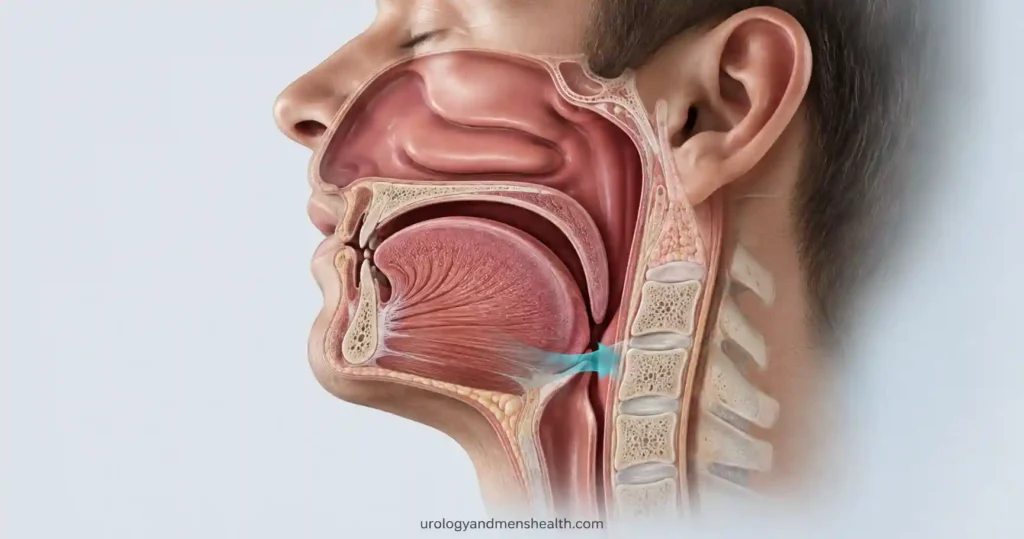
When your upper airway collapses during sleep, you keep trying to breathe against a closed pipe. Your diaphragm and chest wall pull hard, and the pressure inside your chest drops sharply below normal. That negative pressure acts like suction on the heart. The atria stretch, and stretched atrial tissue does one specific thing: it releases atrial natriuretic peptide, a hormone whose job is to tell the kidneys to dump sodium and water. It also suppresses vasopressin, the hormone that normally concentrates your urine overnight, and damps down the renin-angiotensin-aldosterone system that would otherwise hold fluid in [1].
The result is nocturnal polyuria — genuine overproduction of urine while you are asleep. This is a completely different mechanism from an overactive or obstructed bladder. Your bladder is behaving normally. It is simply being filled faster than it can hold. This distinction is the single most useful thing on this page, and it is one of the reasons a man with normal urine flow and a normal-sized prostate can still be up four times a night.
The AUA/SUFU overactive bladder guideline defines nocturnal polyuria as producing more than 20% to 33% of your total 24-hour urine output during sleep, with the lower threshold applying to younger men and the higher one to older men [2]. The guideline also notes the practical tell: voids caused by nocturnal polyuria tend to be normal or large in volume, while voids caused by storage problems such as an overactive bladder in men tend to be repeated and small. Volume is the discriminator, and almost nobody measures it.
If you snore, have been told you stop breathing, or wake unrefreshed, run your numbers through the BP and sleep apnea screening tool before you accept a prostate explanation. Untreated apnea also drives blood pressure and cardiovascular risk, which is why it sits across several areas covered in our Men’s Wellness Hub.
Sleep apnea and testosterone: what happens to your hormones overnight
Testosterone in men is not produced at a steady rate through the day. It rises during sleep, peaks in the early morning, and falls through the afternoon. That overnight rise is tied to sleep architecture itself, particularly the first consolidated stretch of deep sleep and the onset of the first REM period. Break the sleep, and you blunt the rise.
The cleanest demonstration of this is not a sleep apnea study at all. Leproult and Van Cauter, publishing in JAMA in 2011, restricted healthy young men to five hours of sleep per night for one week and measured daytime testosterone before and after. Levels fell by roughly 10% to 15% [4]. That is a week of short sleep in healthy twenty-somethings. Obstructive sleep apnea does something worse: it fragments sleep hundreds of times a night and adds repeated drops in blood oxygen on top.
There is a complication, and it matters enormously for how you treat this. Obesity is the dominant shared cause of both problems. Visceral fat contains aromatase, the enzyme that converts testosterone into estradiol, and the resulting estradiol feeds back on the pituitary to suppress luteinising hormone. The same visceral fat and neck fat narrow the airway. So when a man has apnea and low testosterone together, obesity is frequently the upstream driver of both, and the apnea itself may be less of an independent cause than it appears. I have written about that hormonal loop in detail in the article on how obesity lowers testosterone and drives erectile dysfunction.
One more thing before anyone books a blood test. Under the AUA testosterone deficiency guideline, the diagnosis requires a genuinely low total testosterone level plus symptoms or signs — not a number alone, and not a questionnaire alone [8]. Symptom scores are useful for deciding whether to test, which is what the low testosterone symptom quiz is for, but they do not make the diagnosis.
Why CPAP fixes the nocturia but usually not the testosterone
This is where most online content gets it wrong, and where I have to disappoint men who have read that a CPAP machine will restore their hormones.
On nocturia, CPAP works. A 2015 systematic review and meta-analysis pooled five clinical trials covering 307 patients and found that treating obstructive sleep apnea with CPAP produced significant reductions in both the number of night-time voids and the volume of urine passed overnight, alongside the expected improvements in sleepiness and apnea-hypopnea index [3]. That fits the mechanism exactly: stop the airway collapsing, and you stop the atrial stretch that was driving the natriuretic response.
On testosterone, CPAP does not deliver. A 2019 meta-analysis in Frontiers in Endocrinology pooled 12 studies, including two randomised controlled trials, covering 388 men with obstructive sleep apnea. CPAP use produced no significant change in total testosterone (mean difference 1.08, 95% CI −0.48 to 2.64), and no significant change in free testosterone, SHBG, LH, FSH or prolactin. A subgroup analysis separating men who were hypogonadal at baseline from those who were eugonadal found the same null result in both groups. The authors concluded that strategies other than CPAP should be used to manage low testosterone in men with apnea [5].
Read that carefully, because it also argues against the simple story that apnea directly causes hypogonadism. If apnea were the direct cause, removing it should reverse it. The more likely explanation is that obesity drives both conditions in parallel, which is why weight reduction — not the machine — is what moves testosterone in this population.
The traffic also runs the other way. In an 18-week randomised placebo-controlled trial, obese men with severe obstructive sleep apnea who received near-conventional doses of testosterone undecanoate had a worse oxygen desaturation index by about 10 events per hour and more time spent with oxygen saturation below 90% at the seven-week mark, compared with placebo. By 18 weeks the difference was no longer significant, and the effect did not depend on the man’s starting testosterone level [6]. So testosterone therapy in a man with severe untreated apnea appears to make his breathing measurably worse for the first couple of months. That is a real risk window, and it is the reason I sequence the treatments rather than starting both at once.
Low testosterone: what to test, when to test it, and what the numbers actually mean
Enter your email below to receive Dr. Khalid’s complete Low Testosterone: Testing & Treatment Guide as a free, printable PDF.
Prostate or sleep apnea? How to tell the difference
You can settle this at home in three nights with a plastic measuring jug and a notebook. Record the time and the measured volume of every void, day and night, for three full 24-hour periods. Include the first morning void in your night-time total, because that urine was produced while you were asleep.
Then do the arithmetic. Divide your night-time volume by your total 24-hour volume. If you are over 65 and the answer exceeds 33%, or under 65 and it exceeds 20%, you have nocturnal polyuria, and the cause is upstream of your bladder [2]. The pattern usually looks like two or three voids of 250 to 400 mL (roughly 8 to 13 fl oz each). An outlet or storage problem looks completely different: four or five voids of 100 to 150 mL, often with urgency, and usually with daytime frequency to match.
- Points toward sleep apnea: loud habitual snoring, witnessed pauses in breathing, waking with a dry mouth or headache, unrefreshing sleep, daytime sleepiness, neck circumference above 40 cm (about 16 inches), BMI above 35, treatment-resistant high blood pressure.
- Points toward the prostate or bladder: weak or hesitant stream, straining, incomplete emptying, daytime urgency, small void volumes, dribbling after finishing.
- Points toward neither: two litres of fluid after 8pm, alcohol in the evening, an evening diuretic dose, or ankle swelling that redistributes when you lie flat.
The formal screening instrument is STOP-Bang: snoring, tiredness, observed apnea, blood pressure, BMI over 35, age over 50, neck circumference over 40 cm, and male sex. A 2015 meta-analysis of 17 studies in 9,206 patients found that a score of 3 or more had a sensitivity of 90% for any apnea, 94% for moderate-to-severe apnea and 96% for severe apnea in sleep clinic populations. The probability of severe apnea climbed from 25% at a score of 3 to 75% at a score of 7 or 8 [7]. As a screening tool it is designed to rule out rather than rule in, which is exactly what you want before committing to a sleep study.
In My Practice
A 54-year-old came to me after two years on tamsulosin and six months of testosterone gel, still waking four times a night and still exhausted. His flow rate was normal, his prostate measured 32 mL, and his post-void residual was negligible. What settled it was the diary: his night-time voids averaged 320 mL and accounted for 41% of his daily output. His wife had been telling him he stopped breathing at night for the better part of a decade. His home sleep study returned an apnea-hypopnea index of 41. Six weeks into CPAP he was down to one void a night. His testosterone, incidentally, had not moved.
When the night-time volumes are large, the prostate is rarely the answer, however convincing the story around it sounds.
If the diary points to small-volume voids instead, the differential shifts entirely toward the outlet and the bladder, which is covered in depth in the article on why men wake at night to urinate. And because apnea also drives resistant hypertension through the same nocturnal mechanism, the cardiovascular side of this is worth reading too.
The blood pressure angle: how untreated apnea keeps your readings high overnightWhat to do next: the testing sequence I use
Order matters here, because testing in the wrong sequence produces answers you then act on incorrectly.
- This week — measure. Three consecutive days of a frequency-volume chart with actual measured volumes in millilitres. Not an estimate. Bring the sheet to your appointment; it changes the consultation more than any single test.
- This week — score. Complete STOP-Bang. If you score 3 or higher, ask your primary care doctor specifically for a home sleep apnea test and push for it within 4 to 6 weeks. Ask for in-lab polysomnography instead if you have heart failure, significant lung disease, or take regular opioids, because home testing underperforms in those groups.
- Before 11am, twice. If you have low libido, low energy, or erectile difficulty alongside the apnea symptoms, request two fasting total testosterone samples drawn on separate mornings between 7am and 11am. A single result is not a diagnosis. If the level is below 300 ng/dL (10.4 nmol/L), ask for LH, FSH, SHBG and prolactin to be added, per the AUA framework [8].
- Months 1 to 6 — treat the breathing and the weight. If apnea is confirmed, get on CPAP and use it for more than four hours a night. Target a 7% to 10% reduction in body weight over six months. Then re-measure testosterone. A meaningful proportion of men no longer meet the threshold for deficiency once these are addressed.
- If you are already on testosterone. Do not stop it on your own. Tell the prescriber about the snoring or witnessed apnea and ask for a sleep study before the next dose escalation, given the desaturation signal in the first two months of therapy [6].
Nocturia in a man over 40 is rarely a single-cause problem, and it is a reasonable trigger for a wider check of blood pressure, glucose, lipids and prostate assessment. The sequence for that is set out in the 40+ men’s health checklist.
Red Flags — Do Not Wait
Book urgent medical review, or attend the emergency room, if any of the following apply alongside your night-time urination:
- Falling asleep at the wheel, at traffic lights, or during conversations. Stop driving and seek assessment the same week.
- Witnessed apneas with choking or gasping arousals, especially with morning headaches and blood pressure that will not come down on three medications.
- Breathlessness when lying flat, or ankle swelling that worsens through the day — this pattern suggests heart failure rather than a urological cause.
- New nocturia with heavy thirst and unexplained weight loss, which points to undiagnosed diabetes.
- Visible blood in the urine at any point, with or without pain.
Frequently Asked Questions
Can sleep apnea really be the reason I wake up three times a night to urinate?
Yes, and the mechanism is well described. When your airway closes, the chest generates strong negative pressure, the heart chambers stretch, and atrial natriuretic peptide is released, which instructs the kidneys to excrete sodium and water. The result is genuine overnight urine overproduction, not an irritable bladder. Check your risk with the BP and sleep apnea screening tool before assuming the prostate is at fault.
Will CPAP raise my testosterone?
Probably not on its own. A 2019 meta-analysis of 12 studies in 388 men found no significant change in total testosterone after CPAP, whether the men started out hypogonadal or eugonadal. CPAP reliably cuts nocturia and daytime sleepiness, which is reason enough to use it. If your testosterone is genuinely low, weight reduction and a proper endocrine workup do more than the machine. Start by scoring your symptoms with the low testosterone symptom quiz.
Is it safe to start testosterone therapy if I have sleep apnea?
The relationship between sleep apnea and testosterone runs both ways. In a placebo-controlled trial, obese men with severe apnea given testosterone had a worse oxygen desaturation index at seven weeks, although the difference had disappeared by eighteen weeks. My rule is to treat the apnea and address weight first, then reassess the hormone level. In most of these men, obesity is the shared driver of both problems.
How do I know whether my nocturia is from my prostate or from sleep apnea?
Measure the volumes. Three nights with a measuring jug settles it faster than any scan. Large voids of 250 mL or more that together exceed a third of your daily output point to nocturnal polyuria and a sleep or cardiac cause. Repeated small voids of 100 to 150 mL point to a bladder or prostate storage problem instead. The two patterns need completely different treatment.
If my nocturia is from an enlarged prostate, is treating sleep apnea pointless?
No, because the two frequently coexist and each makes the other look worse. A man with moderate prostate obstruction and untreated apnea is producing too much urine overnight into a bladder that already empties poorly. Treating only one leaves half the problem in place. Bladder retraining and urgency management still apply to the storage side while the apnea is being addressed.
References
- Umlauf MG, Chasens ER. Sleep disordered breathing and nocturnal polyuria: nocturia and enuresis. Sleep Med Rev. 2003;7(5):403-411. PubMed
- Cameron AP, Chung DE, Dielubanza EJ, et al. The AUA/SUFU Guideline on the Diagnosis and Treatment of Idiopathic Overactive Bladder. J Urol. 2024. AUA
- Wang T, Huang W, Zong H, Zhang Y. The efficacy of continuous positive airway pressure therapy on nocturia in patients with obstructive sleep apnea: a systematic review and meta-analysis. Int Neurourol J. 2015;19(3):178-184. PubMed
- Leproult R, Van Cauter E. Effect of 1 week of sleep restriction on testosterone levels in young healthy men. JAMA. 2011;305(21):2173-2174. PubMed
- Cignarelli A, Castellana M, Castellana G, et al. Effects of CPAP on testosterone levels in patients with obstructive sleep apnea: a meta-analysis study. Front Endocrinol. 2019;10:551. PubMed
- Hoyos CM, Killick R, Yee BJ, Grunstein RR, Liu PY. Effects of testosterone therapy on sleep and breathing in obese men with severe obstructive sleep apnoea: a randomized placebo-controlled trial. Clin Endocrinol (Oxf). 2012;77(4):599-607. PubMed
- Nagappa M, Liao P, Wong J, et al. Validation of the STOP-Bang questionnaire as a screening tool for obstructive sleep apnea among different populations: a systematic review and meta-analysis. PLoS One. 2015;10(12):e0143697. PubMed
- Mulhall JP, Trost LW, Brannigan RE, et al. Evaluation and management of testosterone deficiency: AUA guideline. J Urol. 2018;200(2):423-432. AUA
Dr. Muhammad Khalid
MBBS · FCPS (Urology) · MCPS (General Surgery) · CHPE · CRSM · IMC #539472
Specialist urologist with 11+ years of clinical experience across tertiary teaching hospitals. Trained at Lady Reading Hospital and Khyber Teaching Hospital, Peshawar. Author or co-author of five peer-reviewed international publications, including in Cureus and the World Journal of Surgery. Procedural expertise: URS, PCNL, RIRS, TURP, TURBT, and major open urological surgery. Full profile →
This article is for educational purposes only and does not constitute medical advice. Always consult your physician or urologist for diagnosis and treatment decisions specific to your condition.