Ashwagandha Testosterone Claims: What the Trials Show
The ashwagandha testosterone trials are real, and the increase is real — it is just far smaller than the marketing implies. Here is what a 50 to 100 ng/dL rise does, and does not, change.

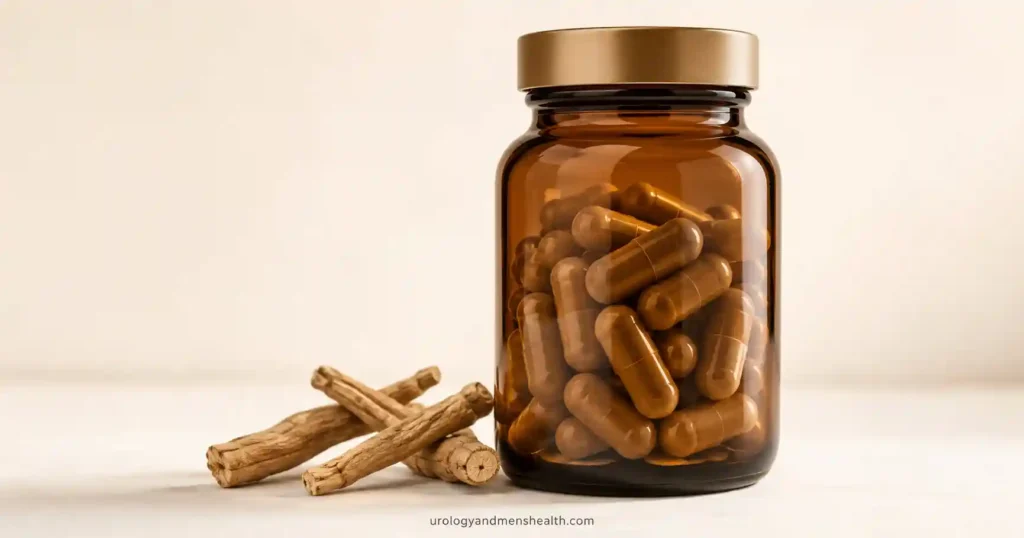
The ashwagandha testosterone claim is one of the few supplement stories that survives contact with the medical literature, which is why it deserves a careful answer rather than a dismissive one. There are randomized, placebo-controlled trials in men. Several of them found a genuine increase. That is more than can be said for most of what sits on the shelf beside it.
But “a real increase” and “an increase that changes how you feel” are different statements, and the distance between them is where most men lose their money and, sometimes, six months they should have spent finding the actual cause of their fatigue. I see men in clinic every month who have been taking 600 mg a day since winter and have never once had a morning testosterone drawn.
Below is what the trials measured, how large the effect is in numbers you can compare to your own blood test, who it appears to work in, what dose the positive studies used, and the safety signal that has built since 2019. For the wider picture on supplements and screening after 40, start with our Men’s Wellness Hub.
Key Takeaways
- Pooled randomized trial data put the average testosterone increase from ashwagandha at roughly 57 ng/dL (about 2.0 nmol/L) in men, which is real but around a fifth of what prescribed testosterone therapy delivers.
- The effect is most consistent in overweight, stressed, or resistance-training men aged 40 to 70, and considerably smaller in men whose levels were already in the normal range.
- Most trials that measured symptoms alongside hormones did not show the hormone change translating into better energy, mood, or sexual function.
- The positive trials used 300 mg of standardized root extract twice daily for 8 to 12 weeks, and NIH’s LiverTox rates ashwagandha a likely cause of drug-induced liver injury, so jaundice or severe itching within 2 to 12 weeks of starting means stop immediately.
Why Ashwagandha Became the Internet’s Testosterone Supplement
Ashwagandha is the root of Withania somnifera, a shrub used in Ayurvedic medicine for centuries as a general tonic. Its active compounds are a family of steroidal lactones called withanolides, and the modern interest in it is built on one proposed mechanism: it appears to lower cortisol.
That mechanism is not marketing invention. A 2026 meta-analysis of 23 randomized placebo-controlled trials covering 1,706 adults found a significant reduction in circulating cortisol with ashwagandha supplementation [2]. Cortisol and testosterone sit on opposing ends of the same regulatory system. Chronically elevated cortisol suppresses gonadotropin-releasing hormone from the hypothalamus, which reduces luteinizing hormone output from the pituitary, which reduces the signal reaching the Leydig cells in the testes that manufacture testosterone. Lower the cortisol pressure on that axis and, in theory, the signal recovers.
The problem this is supposed to solve is real. The American Urological Association defines testosterone deficiency as a total testosterone consistently below 300 ng/dL (10.4 nmol/L) on at least two separate early-morning blood draws, combined with symptoms such as reduced libido, fatigue, poor concentration, or changes in erectile function [1]. Both halves matter. A low number with no symptoms is not a diagnosis, and symptoms with a normal number point somewhere other than the testes.
What made ashwagandha stand out from the rest of the supplement aisle is that somebody actually ran the trials. Most of what is sold for male hormone support has never been tested against a placebo in men at all. That is the bar it clears, and it is a low bar, but clearing it is why we are having this conversation instead of dismissing it in one line. Our review of what the evidence supports across common men’s supplements puts that in context.
What the Ashwagandha Testosterone Trials Actually Found
Four trials carry most of the weight, and they are worth reading individually because they studied very different men.
Young men in resistance training
Wankhede and colleagues randomized 57 untrained men aged 18 to 50 to 300 mg of ashwagandha root extract twice daily or placebo for 8 weeks, alongside a supervised resistance program. Testosterone rose by 96.2 ng/dL (3.3 nmol/L) in the ashwagandha group against 18.0 ng/dL in the placebo group. Bench press one-rep max improved by 46.0 kg (about 101 lb) versus 26.4 kg (about 58 lb), and body fat fell further [3]. This is the single most-quoted result, and it is also the least generalizable, because these were young men adding a novel training stimulus.
Overweight men aged 40 to 70
Lopresti and colleagues ran a crossover trial in overweight men aged 40 to 70 with mild fatigue, using a concentrated extract delivering 21 mg of withanolide glycosides daily for 8 weeks. Testosterone rose 14.7% more than placebo and DHEA-S rose 18% more. The finding that gets left out of the marketing is the rest of the result: there were no statistically significant between-group differences in cortisol, estradiol, fatigue, vigor, or sexual well-being [4]. The hormone moved. The men did not report feeling different from the men on placebo.
Men with reduced sexual desire
A 2022 trial of 50 men with low sexual desire used 300 mg twice daily for 8 weeks and reported both a significant improvement in sexual function scores and a testosterone increase of roughly 67 ng/dL (2.3 nmol/L) over placebo, with no change in prolactin [5]. A separate 12-week trial in overweight adults aged 40 to 75 found significant increases in free testosterone and luteinizing hormone in the men taking ashwagandha, though it missed its primary endpoint of perceived stress entirely [6].
Men with low sperm counts
A pilot study in 46 oligospermic men used 675 mg daily in three divided doses for 90 days and reported a 167% increase in sperm concentration, a 53% increase in semen volume, and a 57% increase in motility [7]. Those percentages sound enormous because the starting point was very low, moving an average count from about 9.6 million/mL to 25.6 million/mL. It is a pilot study with 21 men in the treatment arm and it has not been replicated at scale, so treat it as a signal worth further study rather than a fertility treatment.
Pulling all of it together, the 2026 meta-analysis found ashwagandha increased testosterone in men by a mean difference of 57.43 ng/dL (about 2.0 nmol/L), with no equivalent effect in women [2]. That number is the one to hold onto.
What a 57 ng/dL Increase Means If Your Testosterone Is 240
Here is the arithmetic that supplement marketing avoids. If your morning total testosterone is 275 ng/dL, an average 57 ng/dL rise takes you to 332 and moves you across the AUA’s 300 ng/dL diagnostic line. That is a meaningful shift. If your morning testosterone is 180 ng/dL, the same rise takes you to 237 and you remain firmly deficient, having spent three months and a hundred dollars getting nowhere. And if you are already at 450 ng/dL, you were never going to notice anything, because the symptoms you are attributing to testosterone are being caused by something else.
For scale: prescribed testosterone therapy typically raises total testosterone by several hundred ng/dL. Ashwagandha and testosterone therapy are not competing options. They are different orders of magnitude.
The quality of the underlying literature also deserves a plain statement. A systematic review of 32 randomized trials across 13 herbs found that only 9 of the 32 studies showed a statistically significant testosterone increase, only 6 of the 32 were judged at low risk of bias, and half of them studied men under 40 who were unlikely to be deficient in the first place [8]. Ashwagandha and fenugreek came out as the two with the most consistent signal, which tells you as much about the weakness of the field as it does about the strength of ashwagandha.
So the practical question is not “does ashwagandha increase testosterone.” It probably does, a little. The question is whether your number is close enough to the threshold for a small push to matter, and you cannot know that without a blood test. If you have symptoms and no baseline, read how low testosterone actually presents in men over 40 before you buy anything.
Check your symptom pattern first: Low Testosterone Symptom Quiz →In My Practice
The version of this I see most often is not a man who has been harmed by ashwagandha. It is a man in his mid-forties, six months into daily dosing, who tells me he cannot really say whether it helped. When I ask what his testosterone was before he started, there is a pause. There was no before. He has no baseline, so the only two things he can compare are his memory of how he felt in January and how he feels now, and neither is a measurement. What those six months actually cost him was the untreated sleep apnea and the fifteen pounds that were driving the fatigue in the first place.
Get the morning blood test before the supplement, not after it, or you will never know what the supplement did.
Low Testosterone: How to Get Tested Properly Before You Treat It
Enter your email below to receive Dr. Khalid’s complete Low Testosterone: Testing & Treatment Guide as a free, printable PDF.
Ashwagandha Dosage for Men: What the Positive Trials Used
If you decide to run a trial on yourself, run the one that was actually studied rather than whatever the bottle in front of you happens to contain.
- Dose: 300 mg of root extract twice daily, or a concentrated extract delivering approximately 21 mg of withanolide glycosides per day. Those are the two regimens behind the positive male trials.
- Form: Root extract, not root powder. A 1,000 mg capsule of unstandardized ground root can contain a small fraction of the active withanolide content of a standardized 300 mg extract. The milligram number on the front of the bottle is close to meaningless on its own.
- Standardization: The label should state a withanolide percentage or an absolute withanolide content per serving. If it does not, you have no idea what you are taking.
- Duration: 8 to 12 weeks. Every trial that detected a hormone change ran for at least 8 weeks. Nothing supports an effect within days.
- Third-party testing: Look for USP, NSF, or Informed Choice verification. In the United States the FDA does not review supplement products for potency or purity before they reach the shelf, so the manufacturer’s word is the only assurance you get unless somebody independent has checked.
Then measure it properly. Get a total testosterone drawn between 8 and 10 a.m. before you start, and a second one at the same laboratory using the same assay after 8 to 12 weeks. Testosterone varies substantially day to day, so a single reading at each end is weak evidence, but it is far better than the nothing most men have.
Compare the evidence quality: Saw Palmetto for BPH — Scam or Science? →Ashwagandha Side Effects: Liver Injury, Thyroid, and Who Should Avoid It
For most men ashwagandha causes nothing worse than mild gastrointestinal upset or drowsiness. The reason it needs a proper safety section anyway is that the serious adverse event is rare, delayed, and easy to attribute to something else.
Drug-induced liver injury
NIH’s LiverTox database, maintained by NIDDK, assigns ashwagandha a likelihood score of B, meaning it is regarded as a likely cause of clinically apparent liver injury [9]. The pattern is consistent across reported cases: onset 2 to 12 weeks after starting, a cholestatic or mixed biochemical picture, and a presentation dominated by jaundice and severe itching rather than abdominal pain. A case series drawn from Iceland and the US Drug-Induced Liver Injury Network described exactly this in five patients, with jaundice and pruritus persisting 5 to 20 weeks and liver tests normalizing within one to five months of stopping [10].
Fatal cases and cases requiring transplant have been reported, though almost entirely in people with pre-existing cirrhosis or advanced chronic liver disease [9]. If that describes you, do not take it at all.
Stop Taking It and Get Liver Tests If You Notice
Any of the following within the first three months of starting ashwagandha means stop the supplement that day and contact your primary care doctor for liver function tests (ALT, AST, ALP, bilirubin) within one week:
- Yellowing of the whites of the eyes or the skin
- Urine that is persistently dark, like strong tea, despite drinking normally
- Pale or clay-colored stools
- Persistent itching over the body without a visible rash
- Discomfort under the right side of the ribcage
- New nausea with unusual fatigue and loss of appetite
Thyroid effects
The 2026 meta-analysis found no effect on TSH or T3 but a modest increase in T4 [2]. That is unlikely to matter to a man with normal thyroid function. It matters if you are taking levothyroxine, if you have Graves’ disease, or if you have subclinical hyperthyroidism, because you may be adding an unmeasured variable to a dose that was carefully titrated. Tell whoever manages your thyroid before you start.
Who should not take ashwagandha
- Men on androgen deprivation therapy for prostate cancer. The entire point of that treatment is to suppress testosterone. Deliberately taking something marketed to raise it works against the therapy, and your oncologist will not have been told about it.
- Men with cirrhosis or advanced chronic liver disease, per the LiverTox guidance above.
- Men on immunosuppressants after a transplant or for autoimmune disease, given ashwagandha’s proposed immune-stimulating activity and the absence of interaction data.
- Men on sedatives, benzodiazepines, or alcohol in quantity, since ashwagandha has additive sedative effects.
- Anyone scheduled for surgery within two weeks, for the same sedative reason. Tell your anesthetist regardless.
And one thing that is not a contraindication but is worth saying plainly: if your fatigue, low libido, and poor concentration have lasted more than three months, ask your doctor for a morning total testosterone, a full blood count, ferritin, HbA1c, TSH, and a sleep apnea screen before you spend another season on capsules. In my clinic, sleep apnea and undiagnosed metabolic disease account for far more of these presentations than primary testicular failure does.
Frequently Asked Questions
Does ashwagandha increase testosterone enough to matter clinically?
In pooled trial data the average increase is about 57 ng/dL (2.0 nmol/L). If your morning total testosterone is 275, that could move you above the AUA’s 300 ng/dL cut-off. If it is 180, it will not come close. The honest answer is that ashwagandha shifts the number modestly, and the trials have not consistently shown that shift changing symptoms. Check how low testosterone actually presents and get a baseline before deciding.
How long does ashwagandha take to raise testosterone?
Every trial that detected a change dosed for 8 to 12 weeks. Nothing in the ashwagandha testosterone literature supports an effect within days or a few weeks. If you are going to try it, commit to a full 8 weeks, then repeat a morning total testosterone at the same laboratory that ran your baseline. If you have no baseline, start with the symptom assessment and a blood test instead.
What ashwagandha dosage for men was used in the testosterone studies?
The two most-cited male trials used 300 mg of root extract twice daily, or a concentrated extract delivering about 21 mg of withanolide glycosides per day. Total withanolide content matters far more than the milligram figure on the front of the bottle, because a cheap 1,000 mg unstandardized root powder can contain a fraction of the active compound found in a standardized 300 mg extract. The same standardization problem affects saw palmetto products.
Can ashwagandha damage your liver?
Rarely, yes. NIH’s LiverTox database rates it a likely cause of clinically apparent liver injury, typically appearing 2 to 12 weeks after starting and presenting with jaundice, dark urine, and severe itching rather than pain. It resolves in most men within one to five months of stopping. Do not take it if you have cirrhosis or advanced liver disease. The same caution applies across other men’s supplements sold without third-party testing.
Should I take ashwagandha instead of testosterone therapy?
No, because they are not in the same category. Prescribed testosterone therapy raises levels by several hundred ng/dL and is started after two low early-morning readings combined with symptoms. Ashwagandha moves the number by roughly a fifth of that, with no long-term outcome data. If you have confirmed testosterone deficiency, ask a urologist about treatment rather than self-treating for months while symptoms continue.
References
- Mulhall JP, Trost LW, Brannigan RE, et al. Evaluation and Management of Testosterone Deficiency: AUA Guideline. J Urol. 2018;200(2):423-432. AUA
- Fornalik M, Malkiewicz A, Adamczak D, et al. Hormonal Modulation with Withania somnifera: Systematic Review and Meta-Analysis of Randomized-controlled Trials. Planta Med. 2026;92(8):790-805. PubMed
- Wankhede S, Langade D, Joshi K, et al. Examining the effect of Withania somnifera supplementation on muscle strength and recovery: a randomized controlled trial. J Int Soc Sports Nutr. 2015;12:43. PubMed
- Lopresti AL, Drummond PD, Smith SJ. A Randomized, Double-Blind, Placebo-Controlled, Crossover Study Examining the Hormonal and Vitality Effects of Ashwagandha in Aging, Overweight Males. Am J Mens Health. 2019;13(2):1557988319835985. PubMed
- Chauhan S, Srivastava MK, Pathak AK. Effect of standardized root extract of ashwagandha on well-being and sexual performance in adult males: A randomized controlled trial. Health Sci Rep. 2022;5(4):e741. PubMed
- Smith SJ, Lopresti AL, Fairchild TJ. Efficacy and safety of a novel standardized ashwagandha root extract in adults experiencing high stress and fatigue: a randomized, double-blind, placebo-controlled trial. J Psychopharmacol. 2023;37(11):1091-1104. PubMed
- Ambiye VR, Langade D, Dongre S, et al. Clinical Evaluation of the Spermatogenic Activity of the Root Extract of Ashwagandha in Oligospermic Males: A Pilot Study. Evid Based Complement Alternat Med. 2013;2013:571420. PubMed
- Smith SJ, Lopresti AL, Teo SYM, Fairchild TJ. Examining the Effects of Herbs on Testosterone Concentrations in Men: A Systematic Review. Adv Nutr. 2021;12(3):744-765. PubMed
- Ashwagandha. In: LiverTox: Clinical and Research Information on Drug-Induced Liver Injury. Bethesda (MD): National Institute of Diabetes and Digestive and Kidney Diseases; updated December 3, 2024. NIDDK LiverTox
- Bjornsson HK, Bjornsson ES, Avula B, et al. Ashwagandha-induced liver injury: A case series from Iceland and the US Drug-Induced Liver Injury Network. Liver Int. 2020;40(4):825-829. PubMed
Dr. Muhammad Khalid
MBBS · FCPS (Urology) · MCPS (General Surgery) · CHPE · CRSM · IMC #539472
Specialist urologist with 11+ years of clinical experience across tertiary teaching hospitals. Trained at Lady Reading Hospital and Khyber Teaching Hospital, Peshawar. Author or co-author of five peer-reviewed international publications, including in Cureus and the World Journal of Surgery. Procedural expertise: URS, PCNL, RIRS, TURP, TURBT, and major open urological surgery. Full profile →
This article is for educational purposes only and does not constitute medical advice. Always consult your physician or urologist for diagnosis and treatment decisions specific to your condition.