Sleep Apnea and High Blood Pressure: The Nocturia Link
Most men who wake three times a night blame their prostate. In a large share of them the real driver is sleep apnea — and the same apneas are pushing their blood pressure up while they sleep.

Sleep apnea and high blood pressure show up together so reliably that in clinic I treat one as a prompt to hunt for the other. The bridge between them is usually a symptom that lands in urology first: waking two, three, four times a night to urinate. Most men arrive convinced the prostate is the problem. Sometimes it is. But when the nighttime voids are large rather than small and urgent, when the blood pressure has crept upward despite two medications, and when a partner describes snoring that stops and restarts, the airway is the more likely driver. This distinction changes what gets treated. An alpha blocker will not reverse an overnight sympathetic surge, and it will not stop the kidneys overproducing urine at 3 a.m. For the wider picture of how pressure damages the urinary system, start with our Blood Pressure and Kidney Health Hub. Below is the mechanism, the way I separate airway-driven from prostate-driven nocturia, and what treatment actually shifts.
Key Takeaways
- Obstructive sleep apnea sits alongside primary aldosteronism as one of the two most common identifiable causes of high blood pressure, and it is found in as many as 40% to 80% of people with hypertension.
- Nighttime voids that are large in volume, not small and urgent, point toward nocturnal polyuria from apnea rather than bladder outlet obstruction from the prostate.
- The mechanism is mechanical: breathing against a closed airway stretches the right atrium, which releases atrial natriuretic peptide and drives the kidneys to make urine overnight.
- CPAP lowers systolic blood pressure by around 2.5 mmHg on average, with roughly another 1.5 mmHg for every additional hour per night of use.
- A STOP-Bang score of 3 or higher detects 93% of moderate to severe sleep apnea and should trigger a sleep study, not a wait-and-see plan.
How Sleep Apnea and High Blood Pressure Are Actually Connected
Every time the upper airway collapses during sleep, oxygen falls and carbon dioxide climbs. Chemoreceptors in the carotid body read that combination as a threat and fire the sympathetic nervous system. Blood vessels constrict, heart rate rises, and blood pressure spikes sharply in the seconds around the arousal that reopens the airway.
In moderate to severe apnea that cycle repeats 15 to 60 times per hour, every hour of the night. The damage is not any single spike. It is that sympathetic tone stops resetting. The vasculature is being held in a partly constricted state around the clock, and daytime readings drift up to match.
There is a second signature worth knowing. Blood pressure normally falls 10% to 20% overnight — the nocturnal dip. Men with untreated apnea frequently lose that dip entirely, and some reverse it, running higher asleep than awake. On a 24-hour ambulatory monitor this pattern is often the first objective hint that the airway is involved.
The scale of the overlap is not marginal. The American Heart Association’s 2021 scientific statement puts obstructive sleep apnea at roughly 34% of middle-aged men, rising to as high as 40% to 80% among people with hypertension, heart failure, coronary disease or atrial fibrillation [1]. The 2025 AHA/ACC hypertension guideline names it alongside primary aldosteronism as one of the two most common forms of secondary hypertension — meaning high blood pressure with a specific, treatable cause sitting underneath it [2].
The organ that absorbs most of that pressure is the kidney. Sustained hypertension thickens the small renal arterioles and scars the filtering units long before creatinine moves out of the normal range, which is exactly how blood pressure damages the kidneys silently for years.
What the 2025 hypertension guideline changed about risk scoring and secondary causesWhy Sleep Apnea Makes You Get Up to Urinate
This is the part that surprises most patients, and it is pure mechanics rather than anything to do with the bladder.
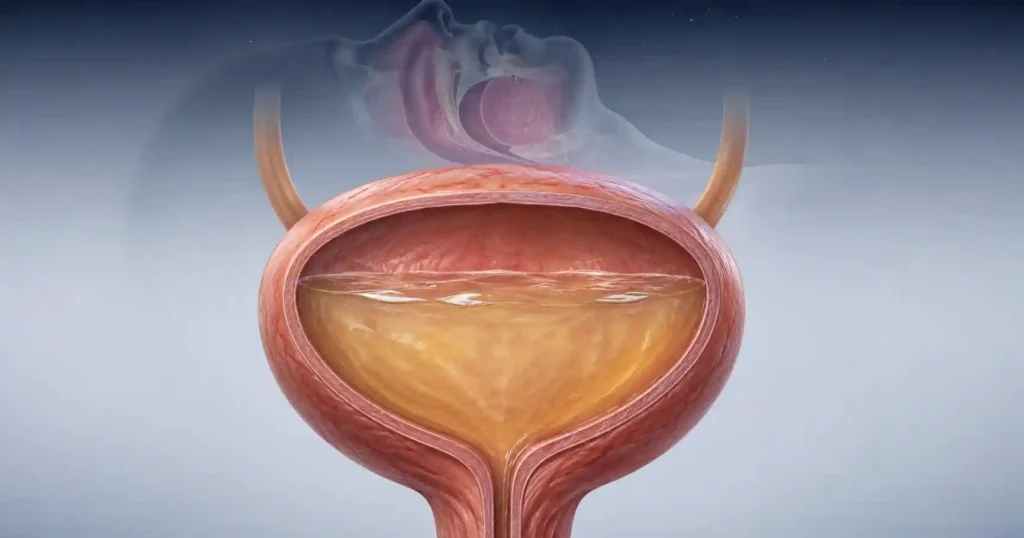
When the airway is blocked, the chest wall keeps trying to expand. Expanding a sealed chest generates strongly negative pressure inside the thorax — think of pulling the plunger on a capped syringe. That suction pulls blood back toward the heart faster than usual, and the right atrium stretches to accommodate it.
Stretched atrial muscle releases atrial natriuretic peptide (ANP). ANP is the body’s fluid-offload hormone: it instructs the kidney to excrete sodium, and water follows the sodium out. It also suppresses antidiuretic hormone, which is the hormone that normally concentrates urine overnight so you can sleep through. Both effects push in the same direction.
The result is nocturnal polyuria — the kidneys manufacture too much urine during the hours you are asleep. The AUA defines this as more than 33% of the 24-hour urine output produced overnight in older adults, and more than 20% in younger men, and lists sleep apnea explicitly among the medical conditions that cause it [3].
That definition is the whole diagnostic pivot, because it is about volume, not frequency. A prostate that obstructs the outlet produces small, incomplete, urgent voids. A heart that is dumping ANP produces normal or large voids — 250 mL or more (about 8 fl oz) — because the bladder is genuinely filling. Same complaint from the patient, opposite physiology, opposite treatment.
Nocturia has a long differential beyond these two, and it is worth understanding the full range of reasons men wake at night to urinate before settling on a cause.
Nighttime urination and rising blood pressure: get the screening steps and risk-reduction plan
Enter your email below to receive Dr. Khalid’s complete Men’s Cardiovascular Risk Reduction Guide as a free, printable PDF.
Prostate or Airway? How I Tell the Difference
Four things separate them, and none of them require imaging.
1. Measure the volumes, do not count the trips
Ask for a three-night frequency-volume chart: a measuring jug, and the time and volume of every void for 72 hours including daytime. Add the overnight volumes and divide by the 24-hour total. Above 33% in a man over 60, or above 20% under 60, and you are dealing with nocturnal polyuria. This single sheet of paper redirects more management decisions than any test I order.
2. Ask the person sleeping next to you
Men systematically underreport their own snoring and never witness their own apneas. The partner’s account of loud snoring punctuated by silences that end in a gasp carries more diagnostic weight than the patient’s own history. Morning headache, dry mouth on waking, and unrefreshing sleep despite adequate hours all point the same way.
3. Score it with STOP-Bang
STOP-Bang scores eight yes/no items: snoring, tiredness, observed apneas, high blood pressure, BMI above 35, age above 50, neck circumference above 40 cm (about 16 inches), and male sex. A score of 3 or more carries 93% sensitivity for moderate to severe apnea, and a score of 5 to 8 places a man in the high-risk group [4]. Note that three of those eight points are automatic for most men in a urology waiting room, which is precisely why the score is a screening trigger and not a diagnosis.
4. Look at how the blood pressure is behaving
Blood pressure that stays above target on three agents including a diuretic, readings that are highest first thing in the morning, or an ambulatory monitor showing a lost nocturnal dip — any of these alongside nocturia should send the workup toward the airway rather than toward a larger dose of tamsulosin.
In My Practice
A 58-year-old came to me for a third opinion on nocturia. He had been on an alpha blocker for fourteen months with no change, his IPSS was moderate, and his prostate was 34 mL on ultrasound — nowhere near large enough to explain waking four times. What caught my attention was his blood pressure: 156/96 on three medications, and he mentioned almost as an afterthought that he had fallen asleep at a red light the previous month. His three-night chart came back with 46% of his output happening overnight, in voids of 300 to 400 mL. His sleep study showed an apnea-hypopnea index of 41.
When the voided volumes are large and the blood pressure is resistant, the prostate is a bystander and the airway is the diagnosis until proven otherwise.
When This Needs Urgent Attention
Book an urgent appointment rather than waiting for a routine sleep clinic slot if any of the following apply:
- You have fallen asleep, or come close to it, while driving or operating machinery — this needs same-week medical review and a conversation about whether you should be driving at all.
- Blood pressure readings at or above 180/120 mmHg, confirmed on a repeat reading after five minutes of rest.
- Waking with chest tightness, palpitations or a racing irregular pulse — nocturnal arrhythmia is more common in untreated apnea.
- Ankle swelling with breathlessness lying flat, which suggests heart failure is contributing to the overnight fluid shift.
- Nighttime voids accompanied by visible blood in the urine, which is a separate problem requiring its own workup regardless of the apnea.
What Actually Lowers Both the Blood Pressure and the Nighttime Voids
CPAP: modest on paper, meaningful in the right patient
Be clear-eyed about the numbers. Across 51 randomized trials and 4,888 patients, CPAP reduced systolic pressure by 2.5 mmHg and diastolic by 2.0 mmHg compared with no treatment. Each additional hour per night of average use bought a further 1.5 mmHg systolic [5]. That is a dose-response relationship, and it is why four hours a night is the adherence threshold that matters — CPAP left in the cupboard delivers zero.
Two and a half millimetres of mercury will not replace an antihypertensive. But the 2025 AHA/ACC guideline still recommends CPAP for adults with resistant hypertension and moderate to severe apnea, and recommends weight loss combined with CPAP for those who also carry excess weight [2]. In resistant hypertension the effect size runs larger than the pooled average, and the arrhythmia and stroke risk reduction is a separate reason to treat.
The nocturia response is faster and more obvious
This is the outcome patients actually notice. A meta-analysis of CPAP trials measuring urinary outcomes found significant reductions in both the number of nighttime voids and the overnight urine volume after treatment [6]. Physiologically this makes sense: restore the airway, remove the negative intrathoracic pressure, stop stretching the right atrium, and ANP release falls back toward normal.
Give it four to eight weeks of consistent use before judging. Repeat the three-night frequency-volume chart at that point rather than relying on recollection — men who improve from four voids to two usually underestimate the change.
What to change alongside it
- Weight reduction of 5% to 10%. Ask your doctor for a specific target in kilograms or pounds and a review date. Fat deposition around the pharynx and the abdomen both worsen apnea; losing it improves airway calibre and blood pressure independently.
- Move diuretics to the morning or early afternoon. A furosemide or thiazide dose taken after 4 p.m. guarantees overnight urine production regardless of what the airway is doing. Ask your prescriber whether your dosing time can shift.
- Stop alcohol at least three to four hours before bed. Alcohol relaxes the pharyngeal dilator muscles and deepens each obstructive event, and it suppresses antidiuretic hormone directly. It worsens both halves of this problem at once.
- Try positional therapy if your study shows supine-predominant apnea. Many men have an apnea-hypopnea index several times higher on their back. Ask specifically whether your sleep report separates supine from non-supine events.
- Cap fluids after 7 p.m. at around 250 mL (about 8 fl oz) — useful, but understand it treats the symptom, not the cause. If the polyuria is ANP-driven, restricting fluid will not fix it.
Track the response objectively rather than by impression. Two weeks of paired morning and evening readings in a blood pressure log with trend analysis will show whether the nocturnal pattern is correcting, and gives your doctor something better than a single clinic reading to act on.
What not to do
Do not accept an alpha blocker as the endpoint of the conversation when the voided volumes are large. Do not accept a desmopressin prescription for nocturnal polyuria without an apnea assessment first — treating the urine output while leaving the airway untreated addresses the least dangerous half of the problem. And do not let a normal prostate size close the case. The two conditions coexist frequently enough that finding one does not exclude the other.
Frequently Asked Questions
Can sleep apnea cause high blood pressure if I am not overweight?
Yes. The link between sleep apnea and high blood pressure is not limited to men with obesity. A recessed jaw, a long soft palate, enlarged tonsils or a narrow oropharynx all produce obstruction at normal body weight. BMI is only one of eight STOP-Bang items for exactly this reason. If you snore with witnessed pauses and your pressure is climbing, ask for a sleep study and review your wider cardiovascular and kidney risk regardless of your weight.
How do I know whether my nocturia is from my prostate or from sleep apnea?
Measure the volumes over three nights rather than counting trips. Prostate obstruction produces small, urgent, incomplete voids with a weak stream. Apnea-driven nocturnal polyuria produces normal or large voids of 250 mL (about 8 fl oz) or more, because the bladder is genuinely full. If more than a third of your daily output happens overnight, look at the airway. The broader causes of nocturia in men are worth reviewing too.
Will CPAP stop me getting up at night?
Often it reduces it substantially, but rarely to zero if other causes coexist. Pooled trial data show CPAP significantly lowers both the number of nighttime voids and the volume of urine produced overnight. Give it four to eight weeks of use above four hours per night, then repeat a three-night frequency-volume chart to measure the change objectively. If nothing shifts, ask to be reassessed with a combined blood pressure and apnea screen.
How much does CPAP actually lower blood pressure?
Around 2.5 mmHg systolic and 2.0 mmHg diastolic on average, with roughly another 1.5 mmHg systolic for each extra hour of nightly use. That is modest as a standalone number and does not replace medication. It matters most in resistant hypertension, where the effect runs larger. Confirm the change yourself with two weeks of readings in a structured blood pressure log rather than a single clinic measurement.
Should I ask for a sleep study or see a urologist first?
Do both, and do not let either wait on the other. Ask your primary care doctor for a home sleep apnea test if your STOP-Bang score is 3 or higher, and separately ask your urologist for a three-night frequency-volume chart and a PSA and prostate assessment appropriate to your age. If the pressure is also resistant, request an assessment for kidney involvement including eGFR and urine albumin-to-creatinine ratio.
References
- Yeghiazarians Y, Jneid H, Tietjens JR, et al. Obstructive Sleep Apnea and Cardiovascular Disease: A Scientific Statement From the American Heart Association. Circulation. 2021;144(3):e56-e67. doi:10.1161/CIR.0000000000000988
- American College of Cardiology / American Heart Association Joint Committee on Clinical Practice Guidelines. 2025 Guideline for the Prevention, Detection, Evaluation and Management of High Blood Pressure in Adults. Circulation. 2025. doi:10.1161/CIR.0000000000001356
- American Urological Association / SUFU. Diagnosis and Treatment of Idiopathic Overactive Bladder (Non-Neurogenic) in Adults: AUA/SUFU Guideline Amendment. J Urol. 2019. AUA
- Chung F, Abdullah HR, Liao P. STOP-Bang Questionnaire: A Practical Approach to Screen for Obstructive Sleep Apnea. Chest. 2016;149(3):631-638. doi:10.1378/chest.15-0903
- Bratton DJ, Gaisl T, Wons AM, Kohler M. CPAP vs Mandibular Advancement Devices and Blood Pressure in Patients With Obstructive Sleep Apnea: A Systematic Review and Meta-analysis. JAMA. 2015;314(21):2280-2293. doi:10.1001/jama.2015.16303
- Wang T, Huang W, Zong H, Zhang Y. The Efficacy of Continuous Positive Airway Pressure Therapy on Nocturia in Patients With Obstructive Sleep Apnea: A Systematic Review and Meta-Analysis. Int Neurourol J. 2015;19(3):178-184. doi:10.5213/inj.2015.19.3.178
Dr. Muhammad Khalid
MBBS · FCPS (Urology) · MCPS (General Surgery) · CHPE · CRSM · IMC #539472
Specialist urologist with 11+ years of clinical experience across tertiary teaching hospitals. Trained at Lady Reading Hospital and Khyber Teaching Hospital, Peshawar. Author or co-author of five peer-reviewed international publications, including in Cureus and the World Journal of Surgery. Procedural expertise: URS, PCNL, RIRS, TURP, TURBT, and major open urological surgery. Full profile →
This article is for educational purposes only and does not constitute medical advice. Always consult your physician or urologist for diagnosis and treatment decisions specific to your condition.