Wrist vs Arm Blood Pressure Monitor: Which Is Accurate?
The wrist vs arm blood pressure monitor question is not really about brands. It is about where the cuff sits relative to your heart — and that decides whether your doctor can trust your numbers.

The wrist vs arm blood pressure monitor decision looks like a shopping question. It is a physics question, and the answer changes what your doctor does with your numbers. I see the consequence of this constantly: a man arrives for a kidney or prostate consultation, produces three months of home readings, and those readings have quietly driven a medication decision that was never checked against a properly taken measurement. Wrist devices are not fraudulent. They are more sensitive to how you hold your arm than most men realize, and that sensitivity is large enough to move a systolic reading across a treatment threshold. This article covers what actually differs between the two device types, the narrow set of situations where a wrist cuff is the better choice, and the two errors that matter more than the wrist-versus-arm question itself. For the wider picture on measurement and control, see our Blood Pressure Hub.
Key Takeaways
- An upper-arm cuff is the default home device; a wrist cuff is a fallback, mainly for men whose arm circumference no available cuff fits.
- In unsupervised home use, wrist readings ran about 5.6% higher systolic than arm readings — roughly 8 mmHg at a systolic of 140.
- Wrist height drives most of that error: every centimeter the wrist sits below your heart adds about 0.8 mmHg the cuff reports as your systolic.
- A cuff two sizes too small overestimated systolic by nearly 20 mmHg — a larger error than the entire wrist-versus-arm gap.
Wrist vs Arm Blood Pressure Monitor: What Actually Differs
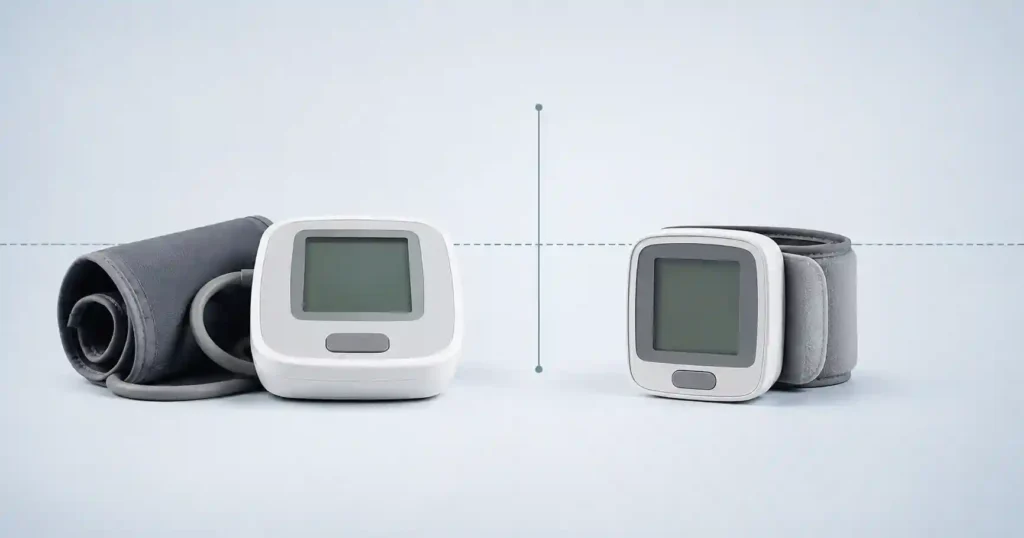
Both device types work the same way. A cuff inflates, blocks the artery underneath it, then deflates while a sensor reads the pressure oscillations that appear as blood starts pushing through again. An algorithm converts those oscillations into a systolic and diastolic number. Nothing about that process is unique to the upper arm.
The difference is what sits under the cuff. An arm cuff compresses the brachial artery, which is wide and lies deep between the muscles of the upper arm. A wrist cuff compresses the radial artery, which is narrower and sits just under the skin. A narrower, more superficial vessel produces a smaller, less stable oscillometric signal, so the algorithm has less to work with.
The second difference is the one that causes real trouble. Blood in your arm behaves like water in a column. Pressure at any point in that column depends on how far below the heart it sits. Roughly 0.8 mmHg is added for every centimeter of drop. Your upper arm barely moves relative to your heart when you sit down. Your wrist can travel 20 to 30 cm (8 to 12 inches) depending on whether you rest it on a desk or hold it to your chest. That is a 16 to 24 mmHg swing produced by nothing but posture.
Manufacturers know this. Better wrist devices include a position sensor that refuses to measure until the cuff is roughly level with the heart. Cheaper ones simply take the reading wherever your wrist happens to be.
Why Guidelines Default to the Upper Arm
The 2025 AHA/ACC hypertension guideline moved home monitoring from a useful extra to a central part of diagnosis and treatment adjustment [1]. That elevation only works if the numbers coming from your kitchen table mean something. The guideline is also explicit that cuffless estimates — smartwatches, rings, fingertip sensors — should not be used to diagnose or steer treatment until their accuracy improves [1].
The evidence against routine wrist use comes from watching real people rather than lab subjects. A population study of 721 adults compared an upper-arm device and a wrist device in two settings. Under supervision in the office, wrist systolic readings ran about 2.5% lower than arm readings. At home, unsupervised, the same wrist device ran about 5.6% higher systolic and 5.4% higher diastolic [2]. The device did not change between settings. The supervision did.
Put that in numbers you can act on. At a true systolic of 140 mmHg, a 5.6% inflation reads as roughly 148. That is the difference between a doctor watching and a doctor adding a third tablet. If you are not certain what the thresholds are, our breakdown of what your blood pressure numbers actually mean sets them out.
STRIDE BP, which maintains one of the two major validated-device registries, states the position plainly: wrist devices are generally not recommended, because their accuracy in practice is inferior to upper-arm devices and correct use is harder to sustain [4].
Home BP Monitoring Done Right: Which Device to Buy and How to Log Readings Your Doctor Can Use
Enter your email below to receive Dr. Khalid’s complete Men’s Cardiovascular Risk Reduction Guide as a free, printable PDF.
When a Wrist Monitor Is the Right Choice
A wrist device used properly beats an arm device that stays in a drawer. There are men for whom the wrist is the correct answer, and telling them otherwise simply ends their monitoring.
- Arm circumference beyond available cuffs. If your mid-arm measurement sits above the range of every cuff you can buy, an over-stretched arm cuff will read high. A validated wrist device is more honest.
- Lymphedema, a dialysis fistula, or a mastectomy on that side. Inflating a cuff over these is either unsafe or forbidden.
- Genuine pain on arm inflation. Some men with neuropathy or a recent fracture cannot tolerate the arm cuff. Discomfort itself raises the reading.
- Conical upper arms. A steeply tapered arm prevents an even cuff seal no matter which size you choose.
There are also men in whom I would not trust a wrist reading at all. Atrial fibrillation makes oscillometric detection unreliable, and the effect is worse at a small peripheral artery. Peripheral arterial disease, Raynaud’s phenomenon, and advanced wrist arthritis all degrade the radial signal or prevent correct positioning. If any of these apply, the reading should be taken in a clinic or with ambulatory monitoring rather than at home.
The Positioning Errors That Make Wrist Readings Useless
If you are going to use a wrist device, the technique is not optional garnish. It is the measurement.
- Wrist at heart level, every time. Sit upright, bend the elbow, and rest the cuffed wrist flat against your breastbone. Do not lay the forearm on a desk — that drops the wrist roughly 20 cm and inflates systolic by about 16 mmHg.
- Support the elbow. Holding the arm up with your own muscle contracts them and raises the reading. Prop the elbow on the opposite hand or an armrest.
- Keep the wrist straight. Flexing or extending the joint compresses the radial artery under the cuff.
- Sit still for five minutes first, back supported, feet flat, legs uncrossed. Crossed legs alone raise systolic measurably.
- Do not talk during the measurement. Speech raises systolic within seconds.
- Empty your bladder first. A full bladder pushes readings up, and it is a recurring problem in men with an enlarged prostate who rarely empty completely.
Take two readings a minute apart, morning and evening, for seven consecutive days, then discard day one and average the rest. That is the protocol your doctor needs, and a single reading — from any device — answers nothing. The Blood Pressure Log & Trend Tracker does the averaging and produces a printable summary you can hand over at the appointment.
In My Practice
A man in his late fifties came to me for a hematuria workup and, unprompted, put his home blood pressure log on my desk — three months of wrist readings averaging 158/96. His family doctor had already added a third tablet. I asked him to show me exactly how he took a reading. He strapped the cuff on, laid his forearm flat on the desk, and pressed start. His wrist was sitting at roughly belly-button height. The arm cuff in my clinic, taken properly after five minutes of rest, read 138/84.
Before anyone adds a third antihypertensive, someone should watch the patient take one reading — the technique, not the tablet count, is often the problem.
Cuff Size and Validation Beat the Wrist-vs-Arm Debate
Here is the part most buying guides skip. The wrist-versus-arm gap is real, but it is smaller than the error produced by an arm cuff that does not fit. The Cuff(SZ) randomized crossover trial measured this directly: using a regular-sized cuff on adults who needed a larger one overestimated systolic by up to 19.5 mmHg, while using a regular cuff on those who needed a smaller one underestimated by about 3.6 mmHg [3]. A man who buys an upper-arm monitor and never checks the cuff range has not solved anything.
Do this before your next reading. Measure the circumference of your upper arm at its midpoint, halfway between the shoulder tip and the elbow, with the arm hanging relaxed. Check that number against the range printed on the cuff itself — every cuff carries one. When you wrap it, the cuff edge should fall within the two range markers, and the artery index line should sit over the inside of your arm.
Then confirm the device has actually been tested. Most monitors sold online have never passed an independent validation protocol. Two registries list the ones that have: ValidateBP in the United States [5] and STRIDE BP internationally [4]. If the model is not on either list, the accuracy claim on the box is a marketing statement.
This matters more than it sounds for anyone with declining kidney function. Blood pressure is the main modifiable driver of progressive kidney damage, and a 10 mmHg measurement error decides whether treatment is intensified now or reviewed in a year. If your eGFR is already drifting, our guide to CKD stages and what they mean explains what those numbers are tracking.
Which home monitors are worth buying — and how to check the cuff range before you orderWhen a Home Reading Needs Same-Day Attention
A single high home reading is usually technique. Repeat it correctly after five minutes of rest, on an upper-arm cuff if one is available. But do not sit on the following.
- A confirmed reading at or above 180/120 mmHg with chest pain, breathlessness, weakness on one side, slurred speech, sudden vision change, or severe headache — go to the emergency room now.
- A confirmed reading at or above 180/120 mmHg without those symptoms — contact your doctor the same day for medication review, not next month.
- New blood in your urine, sharply reduced urine output, or ankle swelling alongside high readings — ask for kidney function bloods and a urine protein test within a week.
- Dizziness or fainting on standing after a dose increase — ask your doctor to check standing and sitting readings before the next change.
Frequently Asked Questions
Is the wrist vs arm blood pressure monitor difference big enough to change my treatment?
Yes. In the population study of 721 adults, unsupervised home wrist readings ran about 5.6% higher systolic than arm readings. On a systolic of 140 mmHg that is roughly 8 mmHg — enough to move you across a treatment threshold or trigger an extra tablet. If you want to understand where those thresholds sit, read our breakdown of what your blood pressure numbers actually mean.
Can I use a wrist monitor if my arm is too big for a standard cuff?
Yes, and this is the main situation where I accept one. If no upper-arm cuff on the market fits your mid-arm circumference, a validated wrist device used correctly gives better information than an arm cuff that is too small and inflating your readings. Measure your arm before assuming nothing fits — see our review of home monitors for men.
Why does my wrist monitor read higher than the machine at my doctor’s office?
Almost always position, not the device. Resting your forearm on a desk puts the wrist well below heart level, and the extra blood column adds pressure the cuff reports as your systolic. Hold the wrist against your breastbone instead. Then log a full week of morning and evening readings in the blood pressure log and trend tracker before drawing any conclusion.
My kidney function is already borderline — does monitor choice matter more for me?
More, not less. Blood pressure is the main driver of kidney damage in men, and an error of 10 mmHg either way changes whether your treatment is intensified or left alone for another year. If your eGFR is already falling, use an upper-arm device and take the reading seriously — our guide to CKD stages explains what those numbers track.
Do smartwatches that claim to measure blood pressure count as wrist monitors?
No. Smartwatches and rings estimate blood pressure without inflating a cuff, and the 2025 AHA and ACC guideline advises against relying on them for diagnosis or treatment decisions. A wrist monitor with an inflating cuff is a different device class and can be validated. Record cuff readings in the blood pressure log and trend tracker and leave the watch out of it.
References
- Jones DW, Ferdinand KC, Taler SJ, et al. 2025 AHA/ACC/AANP/AAPA/ABC/ACCP/ACPM/AGS/AMA/ASPC/NMA/PCNA/SGIM Guideline for the Prevention, Detection, Evaluation, and Management of High Blood Pressure in Adults. Circulation. 2025. doi:10.1161/CIR.0000000000001356. AHA Journals
- Casiglia E, Tikhonoff V, Albertini F, Palatini P. Poor reliability of wrist blood pressure self-measurement at home: a population-based study. Hypertension. 2016;68(4):896-903. PubMed
- Ishigami J, Charleston J, Miller ER 3rd, Matsushita K, Appel LJ, Brady TM. Effects of cuff size on the accuracy of blood pressure readings: the Cuff(SZ) randomized crossover trial. JAMA Internal Medicine. 2023;183(10):1061-1068. PubMed
- STRIDE BP. Validated devices for home blood pressure monitoring. STRIDE BP
- US Blood Pressure Validated Device Listing. ValidateBP
Dr. Muhammad Khalid
MBBS · FCPS (Urology) · MCPS (General Surgery) · CHPE · CRSM · IMC #539472
Specialist urologist with 11+ years of clinical experience across tertiary teaching hospitals. Trained at Lady Reading Hospital and Khyber Teaching Hospital, Peshawar. Author or co-author of five peer-reviewed international publications, including in Cureus and the World Journal of Surgery. Procedural expertise: URS, PCNL, RIRS, TURP, TURBT, and major open urological surgery. Full profile →
This article is for educational purposes only and does not constitute medical advice. Always consult your physician or urologist for diagnosis and treatment decisions specific to your condition.