Testicular Torsion vs Epididymitis: How to Tell Fast
Sudden testicle pain that wakes you from sleep is testicular torsion until proven otherwise. Here is how I separate testicular torsion vs epididymitis in the first ninety seconds — and why the clock matters more than the label.

Testicular torsion vs epididymitis is the one scrotal decision where being wrong costs a testicle. Both present as a painful, swollen testicle in a man who is frightened and wants an answer. One is a surgical emergency measured in hours. The other is an infection treated with antibiotics and a scrotal support. In clinic and on call, I have seen men lose a testicle because a first assessment settled on the infection, and I have seen men rushed to theatre for what turned out to be a straightforward epididymitis — and I would make that second mistake every time rather than the first. This article walks through the specific features I use to separate the two: how fast the pain started, where the testicle is sitting, what the cremasteric reflex is doing, and what the surrounding symptoms are telling you. For the wider picture on scrotal and urinary infections, see our UTIs and Infections Hub.
Key Takeaways
- Torsion pain arrives abruptly and reaches maximum intensity within minutes; epididymitis pain builds over one to three days.
- A high-riding testicle lying horizontally with an absent cremasteric reflex is the combination that sends a man straight to theatre, imaging or no imaging.
- Fever, burning on urination, or urethral discharge favor epididymitis — but their absence does not confirm torsion, and their presence does not exclude it.
- Salvage is roughly 90% when the cord is untwisted within 12 hours, about 54% between 13 and 24 hours, and around 18% beyond 24 hours.
- Short episodes of severe one-sided pain that resolve on their own are intermittent torsion until proven otherwise and need a urology appointment, not reassurance.
Testicular Torsion vs Epididymitis: What Is Actually Going Wrong
These two conditions share a symptom and share almost nothing else. Understanding the mechanism is what makes the clinical differences make sense, rather than something you have to memorize.
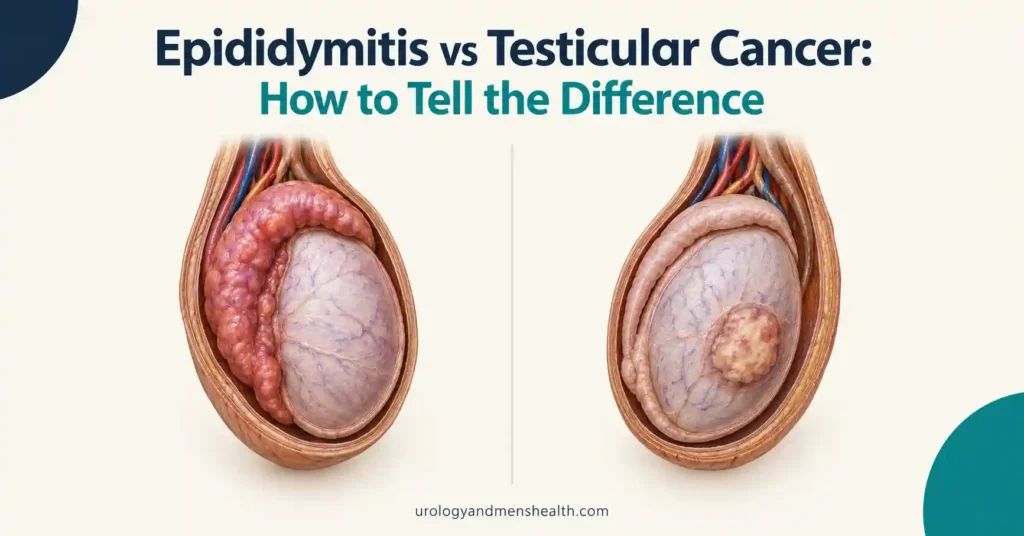
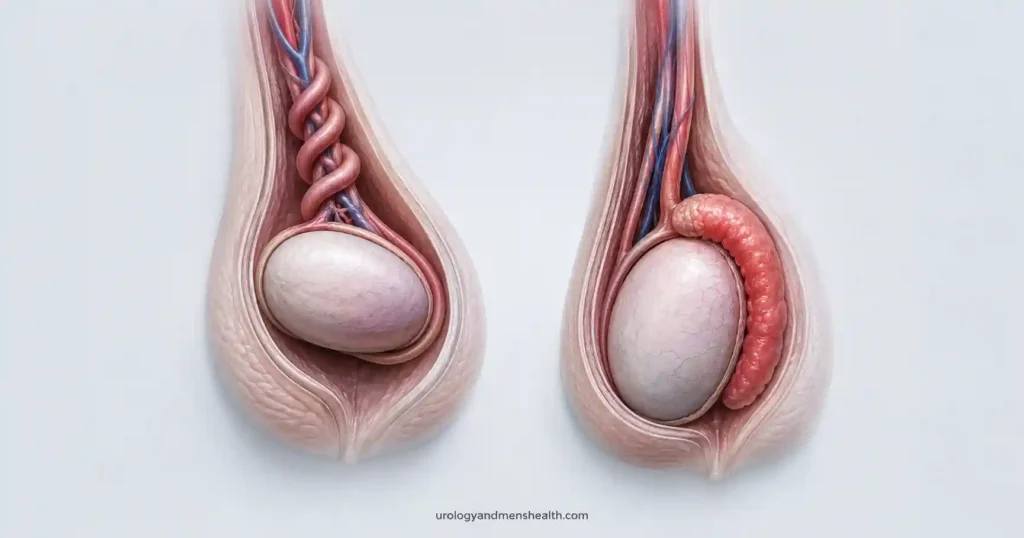
Testicular torsion is mechanical. The testicle hangs from the spermatic cord, which carries its artery, its vein, and its vas deferens. In most men the testicle is anchored to the inside of the scrotum along its back surface, which stops it from spinning. In roughly one man in eight that anchoring is incomplete — the testicle hangs free inside the tunica vaginalis like a clapper inside a bell. That configuration is called a bell-clapper deformity, and it is usually present on both sides. When such a testicle rotates, the cord twists on itself and the blood supply is choked off. Think of it as kinking a garden hose: the water stops the moment the kink forms, and it stays stopped until someone untwists it. Nothing you swallow will fix a kinked hose.
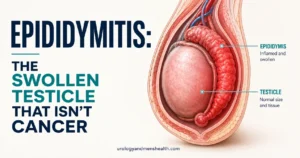
Epididymitis is inflammatory. The epididymis is a coiled tube sitting along the back of the testicle where sperm mature. When bacteria travel backwards up the urinary and reproductive tract, that tube becomes inflamed, swollen, and exquisitely tender. In sexually active men under 35 the organisms are usually chlamydia or gonorrhea. In older men, and in anyone with an enlarged prostate, a catheter, or recent instrumentation, the organisms are usually the enteric bacteria that also cause urinary infections. Blood supply is intact throughout. The tissue is angry, not dying.
That distinction is why the treatments have nothing in common. One needs a surgeon within hours. The other needs the right antibiotic for ten days.
How Fast Did It Start? The Most Useful Question I Ask
If I could ask a man with sudden testicle pain only one question, it would be this: how long did it take to go from no pain to the worst pain?
Torsion answers in minutes. Men describe waking from sleep, or standing up from a chair, or finishing a gym set, and being doubled over within five or ten minutes. A large share of torsions happen during sleep or on waking, because the cremaster muscle contracts during REM sleep and can spin a poorly anchored testicle. Nausea and vomiting follow quickly — the testicle shares nerve supply with the gut, so ischemia there produces the same visceral response as an abdominal catastrophe. Some men feel the pain in the lower abdomen or groin before they notice anything in the scrotum at all, which is one of the ways torsion gets mislabeled as a strain or a hernia.
Epididymitis answers in days. The pain typically starts as a dull ache at the back of the testicle and escalates over 24 to 72 hours until the whole scrotum on that side is swollen and hot. Because the underlying problem is infection, other symptoms usually arrive alongside it: burning on urination, needing to pass urine frequently, urethral discharge, or a fever. Those urinary features are the strongest single pointer toward infection, which is why the pattern overlaps with other male urinary infections — our guide to urinary tract infection in men and when it needs investigating covers that overlap in detail.
Where the timing rule breaks down
Two situations defeat the timing question, and both catch people out. The first is torsion that has already been going on for a day or two — by then the initial spike is history, the man reports “it has hurt since Tuesday,” and the story sounds chronic. The second is intermittent torsion, where the cord twists and spontaneously untwists. That produces severe pain lasting twenty minutes to an hour, complete resolution, and a man who reasonably concludes it was nothing. It is not nothing. It is a warning shot.
In My Practice
A 26-year-old came to us at 4am with pain that had started around 10pm the previous evening. He had already been seen at an out-of-hours service, where he was given a diagnosis of epididymitis and a prescription for doxycycline. What made me override that note was one line in his own account: the pain had gone from nothing to unbearable while he was watching television, and he had vomited twice within the hour. No fever, no burning, no discharge. We took him to theatre without waiting for an ultrasound. The cord was rotated 540 degrees. The testicle pinked up after detorsion and survived — at eighteen hours from onset, that was luck as much as judgment.
Antibiotics given for scrotal pain do not buy time, and a prior clinician’s diagnosis is not a reason to stop asking how the pain began.
What the Examination Shows: Position, Reflex, and the Prehn Sign
Examination is where the two conditions separate most reliably, and it is the reason a phone consultation cannot settle this question. Four findings carry most of the weight.
- Testicle position. A torsed testicle sits higher than its partner, because twisting the cord shortens it. It often lies horizontally rather than vertically. Comparing the two sides side by side takes about three seconds and is frequently the finding that settles the matter.
- Cremasteric reflex. Stroking the inner thigh normally makes the cremaster muscle contract and the testicle rise by a centimeter or so. In torsion that reflex is usually absent on the affected side, because the twisted cord contains the muscle fibers that produce it. In epididymitis it is normally preserved. The European Association of Urology notes that absence of this reflex is a highly sensitive sign for torsion, though it is not specific enough to stand alone [2].
- Where the tenderness is. Early epididymitis is tender in a discrete band along the back of the testicle, with the testicle itself relatively comfortable. Torsion is tender throughout. Once epididymitis has been present for two or three days the swelling becomes global and this distinction disappears, which is another argument for being seen early.
- The Prehn sign. Lifting the scrotum classically eases the pain of epididymitis and does nothing for torsion. I want to be blunt about this one: it is unreliable in both directions, it has been the basis of a great many missed torsions, and no man should use it at home to decide whether to go to hospital.
The TWIST score — and why it is not a home test
Emergency departments increasingly use the Testicular Workup for Ischemia and Suspected Torsion score, developed by Barbosa and colleagues in 2013 [4]. It assigns points for testicular swelling, a hard testis, a high-riding testis, an absent cremasteric reflex, and nausea or vomiting, producing a total out of seven. Low scores let a department rule torsion out; high scores justify going straight to surgery without imaging. A 2022 systematic review in the Journal of Urology confirmed the original stratification performs well and meaningfully reduces reliance on ultrasound [5].
Three of those five items require a clinician’s hands, so TWIST is not something you can score on yourself in a bathroom. What you can assess are the patient-reportable components — how suddenly it started, how severe it is, whether you have vomited, whether you have had prior episodes — and how those map onto urgency.
Work through the patient-reportable features with the Acute Testicular Pain Triage ToolThe 6-Hour Rule Is Both True and Misleading
Every medical student learns that a torsed testicle must be untwisted within six hours. That figure is useful as a target and misleading as a deadline, and both halves of that statement matter to a man reading this at 2am.
A 2019 systematic review by Mellick and colleagues pooled outcomes across the published case series and reported testicular survival of 90.4% when treatment occurred within the first 12 hours, 54.0% between 13 and 24 hours, and 18.1% beyond 24 hours [3]. Survival was still being recorded past 48 hours in a small proportion of cases. The authors’ point was explicitly that the commonly taught six-to-eight-hour window understates what is salvageable and can encourage therapeutic nihilism.
Read that curve properly. It does not mean the clock is forgiving — it means the clock is steep and there is no point at which the answer becomes “too late, stay home.” If your pain started thirty hours ago, you still go. And “survival” in those figures means the testicle was not removed; it does not guarantee normal size, normal sperm production, or normal testosterone output afterwards, all of which decline with longer ischemia.
Go to an Emergency Room Now If
Any one of these features means an emergency department, not a morning appointment and not a phone call to a pharmacy. Do not eat or drink on the way, in case you need a general anesthetic.
- Testicle pain that went from nothing to severe in under an hour
- Testicle pain accompanied by vomiting or feeling faint
- One testicle sitting visibly higher than the other, or lying sideways
- Sudden testicle pain in a boy or man under 25, regardless of how it looks
- Scrotal pain after a groin injury that has not settled within an hour
- Scrotal pain with a spreading redness, crepitus, or a black patch of skin — this raises the possibility of a necrotizing infection
If you are trying to judge whether this is the same pain you have felt before, our detailed walkthrough of the six-hour testicular torsion emergency and what happens on arrival covers the presentation from the moment you reach triage.
What Happens Next: Surgery for One, Antibiotics for the Other
Once a diagnosis is reached, the two pathways diverge completely.
If it is torsion
The treatment is urgent scrotal exploration. The surgeon opens the scrotum, untwists the cord, wraps the testicle in warm swabs, and waits a few minutes to see whether color returns. If it does, the testicle is stitched to the scrotal wall so it cannot rotate again. The other testicle is fixed at the same operation, because the bell-clapper anatomy that allowed the first side to twist is almost always present on both. If the testicle does not recover, it is removed — leaving dead tissue in place risks damage to the remaining testicle through an immune response.
Ultrasound has a place here, but a limited one. Color Doppler is accurate in experienced hands, and both the American Urological Association teaching material and EAU guidance treat it as a useful adjunct [1]. But EAU is unambiguous that the clinical decision rests on examination and that imaging must not delay intervention [2]. Partial torsion of 180 degrees or less can preserve enough flow to produce a reassuring scan. When a surgeon’s assessment and a scan disagree, the surgeon wins.
If it is epididymitis
Treatment is antibiotics chosen by the likely organism, not by guesswork. The 2021 CDC sexually transmitted infection treatment guidelines set out three scenarios [6]: for epididymitis most likely caused by chlamydia or gonorrhea, ceftriaxone 500 mg intramuscularly once plus doxycycline 100 mg twice daily for 10 days; where enteric organisms are also in play, ceftriaxone plus levofloxacin 500 mg daily for 10 days; and where enteric organisms alone are likely, levofloxacin 500 mg daily for 10 days. Alongside that: rest, scrotal elevation, ice, and anti-inflammatories. Sexual partners need testing and treatment when an STI organism is identified.
Ask specifically for a urine sample to be sent for culture and, if you are sexually active, for a nucleic acid amplification test for chlamydia and gonorrhea before antibiotics are started. Expect the pain to begin easing within 48 to 72 hours. If it has not improved by day three, go back — that timeline is your safety net against a missed torsion or an abscess. Swelling itself can take four to six weeks to settle fully, and that is normal. Our detailed guide to epididymitis and the swollen testicle, including recovery expectations covers the full course.
One last thing worth doing once the acute episode is behind you: learn what your own testicles normally feel like. Men who examine themselves regularly notice changes far earlier, and a painless lump is a completely different problem that also rewards early detection. The testicular self-exam walkthrough takes about two minutes.
Frequently Asked Questions
How do doctors tell testicular torsion vs epididymitis apart in the emergency room?
We weigh five examination findings: testicular swelling, a hard testis, a high-riding testis, an absent cremasteric reflex, and nausea or vomiting. That combination is the TWIST score, and a high score sends a man straight to exploration without waiting for imaging. Three of those items need a clinician’s hands, but the patient-reportable parts can be worked through first using the acute testicular pain triage tool.
Does a normal scrotal ultrasound rule out testicular torsion?
No. Color Doppler ultrasound is accurate in trained hands, but blood flow can still be detected in partial torsion of 180 degrees or less, and in a cord that has intermittently untwisted before the scan. European Association of Urology guidance is explicit that imaging must not delay exploration when history and examination point to torsion. If you want the full emergency picture, read what happens in the first six hours of torsion.
I had sudden testicle pain that resolved on its own after twenty minutes. Do I still need to be seen?
Yes, and within about two weeks. Brief episodes of severe one-sided pain that resolve completely are the signature of intermittent torsion, where the cord twists and untwists. Each episode is a rehearsal for the one that does not release. This pattern is an accepted indication for planned surgical fixation of both testicles. If the pain instead returns as a dull ache with burning urination, that shifts toward epididymitis.
Can antibiotics treat testicular torsion?
No. Torsion is mechanical — the cord is twisted and the blood supply is cut off, and no antibiotic reaches tissue that has no circulation. This matters because urgent care clinics sometimes treat sudden scrotal pain as an infection empirically, particularly when a man also has urinary symptoms of the kind covered in our guide to urinary infection in men. If you were given antibiotics and the pain has not eased within a few hours, go to an emergency room rather than finishing the course.
Can testicular torsion happen after age 30?
Yes. Torsion peaks between ages 12 and 18, but I have operated on men in their thirties and forties. Adults tend to present later, usually because they assume the pain is a muscle strain or an infection, and that delay is why salvage rates in adults are worse than in adolescents. Knowing your own baseline anatomy shortens that delay — the testicular self-exam walkthrough covers what normal should feel like.
References
- American Urological Association. Medical Student Curriculum: Acute Scrotum. AUA Education. AUA
- Radmayr C, Bogaert G, Bujons A, et al. EAU/ESPU Guidelines on Paediatric Urology: Acute Scrotum. European Association of Urology. 2025. EAU
- Mellick LB, Sinex JE, Gibson RW, Mears K. A Systematic Review of Testicle Survival Time After a Torsion Event. Pediatr Emerg Care. 2019;35(12):821-825. PubMed
- Barbosa JA, Tiseo BC, Barayan GA, et al. Development and initial validation of a scoring system to diagnose testicular torsion in children. J Urol. 2013;189(5):1859-1864. DOI
- Qin KR, Qu LG. Diagnosing with a TWIST: Systematic Review and Meta-Analysis of a Testicular Torsion Risk Score. J Urol. 2022;208(1):62-70. DOI
- Workowski KA, Bachmann LH, Chan PA, et al. Sexually Transmitted Infections Treatment Guidelines, 2021: Epididymitis. MMWR Recomm Rep. 2021;70(4):1-187. CDC
Dr. Muhammad Khalid
MBBS · FCPS (Urology) · MCPS (General Surgery) · CHPE · CRSM · IMC #539472
Specialist urologist with 11+ years of clinical experience across tertiary teaching hospitals. Trained at Lady Reading Hospital and Khyber Teaching Hospital, Peshawar. Author or co-author of five peer-reviewed international publications, including in Cureus and the World Journal of Surgery. Procedural expertise: URS, PCNL, RIRS, TURP, TURBT, and major open urological surgery. Full profile →
This article is for educational purposes only and does not constitute medical advice. Always consult your physician or urologist for diagnosis and treatment decisions specific to your condition.