Blood in Semen: Causes, Red Flags, and When to Worry
Almost every man who finds blood in semen assumes cancer. In eleven years of urology practice that has almost never been the answer — but age 40 is where my approach changes completely.

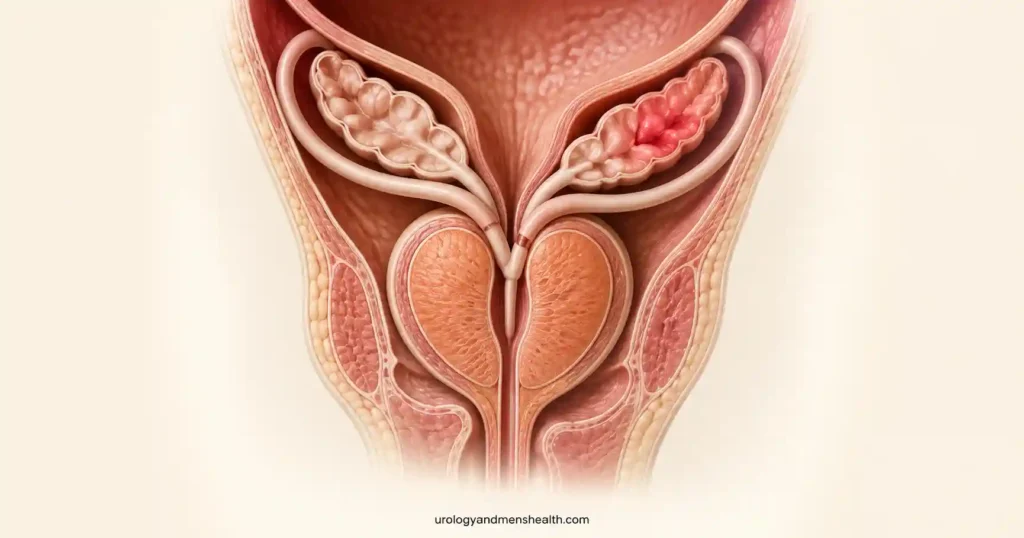
Blood in semen is one of the few urological symptoms that gets a man into my clinic within days rather than months. It looks catastrophic. Rust-brown, pink, or streaked red ejaculate reads, to almost every man who sees it, as cancer. In eleven years of urology practice I can count on one hand the times it actually was. The medical term is hematospermia, and the single most useful thing I can tell you at the outset is that the bleeding almost never comes from where men assume it does. It does not come from the testicles. It comes from the seminal vesicles and the prostate — two structures that supply well over 90% of ejaculate volume and sit against a dense network of thin-walled veins that rupture easily and seal themselves just as easily. If you want the wider context on how this fits with other male reproductive symptoms, start with our Sexual Health Hub. What follows is the framework I use in clinic: what causes it, why age 40 changes my approach entirely, which features earn an investigation, and how long you should expect this to last.
Key Takeaways
- In men under 40, blood in semen is almost never cancer — a US claims analysis found one malignancy among 15,106 men under 40, a rate of 0.01%.
- Around half of all cases never get a cause identified even after investigation, and close to 89% of those resolve on their own without treatment.
- Over 40, the picture changes: pooled hospital series report malignancy in roughly 5% of cases, almost all prostate cancer — which is why a rectal exam and PSA come before any scan.
- After a prostate biopsy, blood in semen is expected rather than abnormal — it was still present in about a third of men four weeks later.
What Blood in Semen Looks Like — and Where the Bleeding Comes From
The appearance tells you roughly how old the blood is, and very little else. Bright red streaking means fresh bleeding, usually within the last day. Rust, brown, or coffee-colored ejaculate means the blood has been sitting in the seminal vesicles for days to weeks and is oxidizing — this is the most common appearance men actually describe to me, and it is the more reassuring of the two.
The volume is almost always trivial. A quantity of blood far too small to matter physiologically will discolor an entire ejaculate, because ejaculate volume is only 2 to 5 mL (roughly half to one teaspoon). Men consistently overestimate how much blood they have lost. You are not losing a meaningful amount.
Before anything else, two things need excluding. The first is that the blood is your partner’s, not yours — this sounds obvious, and I have diagnosed it more than once. The second is that you are not actually passing blood in your urine as well, which is a different problem with a different workup. A simple urinalysis settles that, and it is the first test I order regardless of your age.
The Causes of Hematospermia I Actually See in Clinic
Ranked by how often they turn out to be the answer, rather than by how frightening they sound:
- No identifiable cause — about half of all cases. A 2021 systematic review found no apparent etiology in 51.8% of patients even after workup [1]. This is not a failure of investigation. It reflects the fact that a small vein in a seminal vesicle can rupture and reseal without leaving anything to find.
- Infection and inflammation — roughly one in five. Prostatitis, seminal vesiculitis, urethritis, and epididymitis. In sexually active men, chlamydia is the organism I most often catch when I actually look for it. This group is worth identifying because it is the group that responds to treatment.
- After a procedure. Prostate biopsy is by far the commonest, followed by vasectomy, transrectal ultrasound, shockwave lithotripsy for stones, and prostate brachytherapy or radiotherapy.
- Stones. Calculi in the prostate or the seminal vesicles are a recognized and under-diagnosed cause, and show up on imaging when someone thinks to look.
- Cysts and duct obstruction. Prostatic utricle cysts, seminal vesicle cysts, and ejaculatory duct obstruction — the usual finding in the younger man with genuinely recurrent bleeding over years.
- Systemic causes. Severely uncontrolled hypertension, anticoagulant therapy, chronic liver disease, and inherited bleeding disorders such as von Willebrand disease.
- Malignancy — rare, and heavily age-dependent. Almost entirely prostate cancer, almost entirely over 40.
If your bleeding comes with perineal ache, pain on ejaculation, or a dragging discomfort behind the scrotum, the inflammatory group is where I would look first.
When pelvic pain and blood in semen travel together: chronic prostatitis and CPPS explainedBlood in semen and abnormal results: get the Male Fertility & Semen Analysis Guide
Enter your email below to receive Dr. Khalid’s complete Male Fertility & Semen Analysis Guide as a free, printable PDF.
The Age-40 Rule: When Blood in Semen Needs a Real Workup
Age 40 is the line where my approach changes, and it is worth understanding why rather than simply accepting it.
Under 40, with a single self-limited episode and no other symptoms, the yield of investigation is close to zero. The US claims analysis found exactly one malignancy — a testicular cancer — across 15,106 men under 40 who presented with hematospermia [2]. That is 0.01%. What I do instead is a urinalysis, a testicular examination, an STI screen if you are sexually active, and a specific instruction: come back if it is still happening in six weeks.
At 40 and over, or at any age if the bleeding persists beyond a month or keeps recurring, I do a digital rectal examination and check a PSA. The systematic review reached the same conclusion — a rectal exam and a PSA level are sufficient to identify most proven causes, and imaging adds little in the first instance [1].
Here is the part most articles skip, and it matters if you are trying to work out how worried to be. The published malignancy rates disagree wildly, and the disagreement is informative. Unselected US claims data put cancer diagnosis at 0.11% among men aged 40 and over with hematospermia [2]. Hospital referral series report around 5.4% [1]. Both figures are correct. The referral series only counted men who were already worrying enough to be sent to a urologist and investigated, which is a heavily pre-selected group. If you are reading this having noticed blood once, the 0.11% figure describes you better than the 5.4% one.
One practical caution on the PSA. If you have an active prostate or urinary infection, a PSA drawn in that window will be falsely elevated and will generate an unnecessary MRI or biopsy referral. Ask for the PSA to be deferred until at least four to six weeks after any infection has been treated. If you already have a result and want to understand where it sits for your age before your appointment, run it through our age-adjusted PSA interpreter rather than comparing it to a single generic cutoff.
In My Practice
The case I still think about was a 34-year-old who came in convinced he had prostate cancer after three episodes over two months. His PSA was 0.6, his rectal exam was normal, and everything pointed to reassurance. What stopped me was his blood pressure — 194/118 mmHg on repeat, in a man who had never had it checked. The hematospermia settled within three weeks of starting antihypertensives and never returned.
Severe uncontrolled hypertension is a recognized cause of hematospermia, and in a young man with no other explanation it is the one systemic cause I will not sign off without excluding.
Red Flags: When Blood in Semen Is Not Something to Wait Out
Most hematospermia can be observed. These features change that, and each one changes it for a mechanically different reason.
Get Assessed — Do Not Wait This Out
Book a urology appointment rather than watching and waiting if any of the following apply to you:
- Visible blood in your urine as well. This shifts the problem out of the seminal tract and into the urinary tract, where the cancer yield is genuinely higher and the workup is different.
- Age 40 or over with bleeding that has continued beyond one month, or that keeps returning. Persistence and recurrence are the two features that separate the men worth investigating from the men worth reassuring.
- Fever with perineal, rectal, or lower back pain. This suggests acute bacterial prostatitis or a seminal vesicle abscess and needs same-week antibiotics, not observation.
- Pain on ejaculation, burning on urination, or a discharge. These point to infection or duct obstruction, both treatable once identified.
- A firm lump you can feel in a testicle. Rare as a cause, but it is the one presentation where delay carries real cost. Request a scrotal ultrasound within two weeks.
- Blood pressure repeatedly above 160/100 mmHg. Ask for a formal BP assessment, not a single clinic reading.
- New bleeding while taking warfarin, apixaban, rivaroxaban, or a similar anticoagulant. Ask for an INR or a review of your dosing before assuming it is coincidental. Do not stop the medication yourself.
How Hematospermia Is Treated — and How Long It Takes to Settle
There is no treatment for hematospermia itself. There is only treatment of whatever is causing it, and observation of everything else.
When a cause is found and treated, the bleeding stops in about three-quarters of men [1]. In practice that usually means a course of doxycycline 100 mg twice daily or a fluoroquinolone when infection is suspected, blood pressure control when it is not, or a review of anticoagulation with the prescribing doctor.
When no cause is found, 88.9% resolve spontaneously [1]. That is the number I quote to men who want to know whether waiting is a real plan. It is.
If you have just had a prostate biopsy
Expect it, and expect it to outlast every other kind of post-biopsy bleeding. Pooled biopsy data show hematospermia in 84% of men in the first week, 66% at two weeks, and still 32% at four weeks [4]. Mean duration in prospective series sits around three and a half weeks, or roughly six to eight ejaculations. Bright red blood beyond six weeks is worth reporting; brown discoloration up to eight weeks is not.
If it will not settle
For bleeding that persists past three months or recurs after a clear interval, MRI of the pelvis is the imaging study to request. The ACR Appropriateness Criteria identify MRI as the modality that actually visualizes the seminal vesicles, ejaculatory ducts, and prostate together, and it will pick up cysts, calculi, duct obstruction, and seminal vesicle hemorrhage that transrectal ultrasound misses [3]. Transurethral seminal vesiculoscopy is the next step in the small number of men in whom MRI finds a treatable lesion.
If a semen sample has been sent as part of your workup and you are staring at a report full of numbers, our breakdown of what each semen analysis parameter actually means covers how red and white cells are reported and which values matter clinically.
Frequently Asked Questions About Blood in Semen
How long does blood in semen last after a prostate biopsy?
Longer than most men are warned about. In pooled biopsy data, hematospermia was still present in about two-thirds of men at two weeks and roughly a third at four weeks, with a mean duration near three and a half weeks. The color fades from red to rust to brown as it clears. If it is still bright red beyond six weeks, tell your urologist.
Can blood in semen affect my fertility or harm my partner?
No on both counts. Hematospermia is a bleeding sign, not a sperm problem, and the blood is not transmissible or harmful during intercourse. If you are actively trying to conceive and want objective numbers rather than reassurance, ask for a formal semen analysis — our guide to male infertility and what actually gets tested covers what that workup includes.
Is blood in semen a sign of prostate cancer?
Rarely. In a US claims analysis of more than 40,000 men aged 40 and over with hematospermia, 0.11% were later diagnosed with a urologic cancer. Hospital referral series report higher rates, around 5%, because those men were already pre-selected for investigation. Cancer is worth excluding after 40 with a rectal exam and PSA — it is not the expected answer.
Why do I have blood in semen with no pain and no other symptoms?
That is the most common presentation there is. Around half of all hematospermia cases never get a cause identified even after full investigation, and painless isolated bleeding in a man under 40 is the classic benign pattern. The bleeding usually comes from a small vein in a seminal vesicle that has ruptured and will seal itself within a few weeks.
Should I stop ejaculating until the blood in semen clears?
There is no medical reason to. Abstaining does not speed healing and often delays it, because old blood sitting in the seminal vesicles has to be cleared out. Ejaculating normally lets you track whether the color is fading week to week, which is the single most useful observation you can bring back to your appointment. Our Semen Analysis Interpreter explains what the accompanying lab parameters mean.
References
- Madhushankha M, Jayarajah U, Abeygunasekera AM. Clinical characteristics, etiology, management and outcome of hematospermia: a systematic review. Am J Clin Exp Urol. 2021;9(1):1-17. PubMed
- Hakam N, Lui J, Shaw NM, et al. Hematospermia is rarely associated with urologic malignancy: analysis of United States claims data. Andrology. 2022. PubMed
- Expert Panel on Urologic Imaging. ACR Appropriateness Criteria: Hematospermia. J Am Coll Radiol. 2017;14(5S):S154-S159. American College of Radiology
- Loeb S, Vellekoop A, Ahmed HU, et al. Systematic review of complications of prostate biopsy. Eur Urol. 2013;64(6):876-892. European Urology
Dr. Muhammad Khalid
MBBS · FCPS (Urology) · MCPS (General Surgery) · CHPE · CRSM · IMC #539472
Specialist urologist with 11+ years of clinical experience across tertiary teaching hospitals. Trained at Lady Reading Hospital and Khyber Teaching Hospital, Peshawar. Author or co-author of five peer-reviewed international publications, including in Cureus and the World Journal of Surgery. Procedural expertise: URS, PCNL, RIRS, TURP, TURBT, and major open urological surgery. Full profile →
This article is for educational purposes only and does not constitute medical advice. Always consult your physician or urologist for diagnosis and treatment decisions specific to your condition.