Penile Rehabilitation After Prostatectomy: What Works
Most men leave surgery with a daily tablet and a promise that it will rehabilitate the nerves. The randomized trials found something more complicated. Here is what penile rehabilitation after prostatectomy can and cannot do.

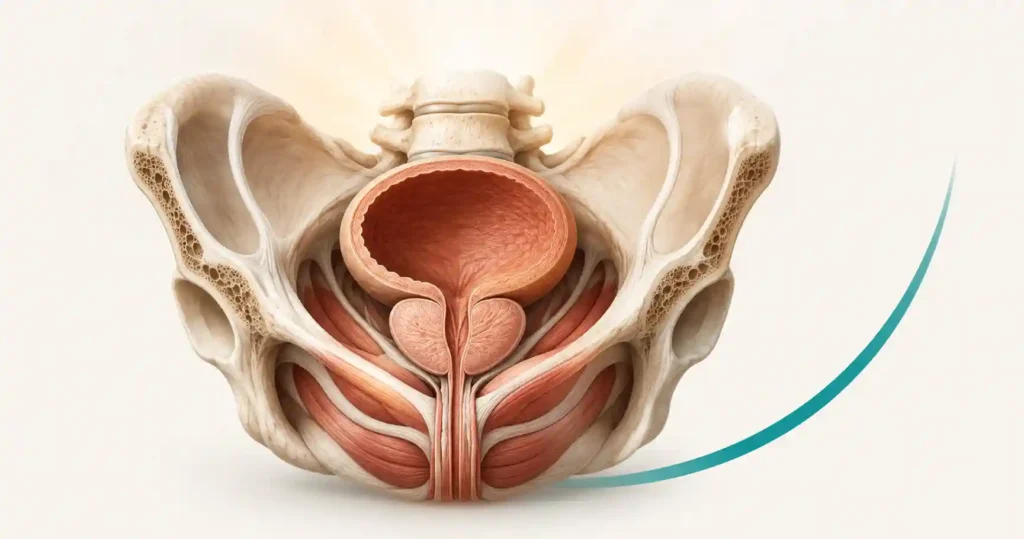
Penile rehabilitation after prostatectomy is one of the few areas in urology where standard clinic advice and the randomized trial evidence have quietly drifted apart. Most men leave their post-operative appointment with a prescription for a daily tablet and a sentence that sounds like a promise: take this, and it will help the nerves recover. The daily tablet is usually worth taking. The promise is not what the trials found. I have had this conversation several hundred times, and it almost always happens around six weeks after surgery — catheter long gone, PSA undetectable, and the man in front of me quietly terrified that nothing at all is happening. He wants to know whether he is doing it wrong, whether he has missed a window, and whether erections are coming back. This article gives the honest version. For the wider picture of what recovery after urological surgery involves, start with our Urological Surgery & Recovery hub.
Key Takeaways
- Penile rehabilitation does not repair cut or bruised cavernous nerves. It protects erectile tissue from oxygen starvation during the 12 to 24 months the nerves take to recover on their own.
- In the REACTT trial, 9 months of daily tadalafil did not improve unassisted erections after a drug-free washout: 20.9% recovered on daily dosing versus 19.1% on placebo.
- Daily tadalafil did reduce penile shortening by about 4 mm (roughly 1/6 inch) compared with placebo — a real benefit, but a different one from erection recovery.
- In every head-to-head trial, on-demand dosing performed at least as well as nightly dosing. Nightly is not automatically better.
- The strongest predictors of recovery are your age, your erectile function before surgery, and how much nerve was spared — not which protocol you follow.
What Penile Rehabilitation After Prostatectomy Actually Means
There are two entirely separate goals after prostate cancer surgery, and most of the confusion I see comes from men being given one and assuming they were given the other.
Treatment means producing a usable erection tonight. You take a tablet, you get a response or you don’t, and the result is measured in the next few hours.
Rehabilitation means something different: deliberately keeping blood flowing through the erectile tissue during the long period when the nerves are not firing, so that when the nerves do come back there is still healthy tissue for them to work with. It is measured in years, not hours, and it is preventive rather than performance-related.
The word “rehabilitation” is doing a lot of unearned work here. It implies you are rehabilitating a nerve, the way you rehabilitate a knee after ligament surgery. You are not. Nothing currently available in urology regenerates a cavernous nerve. What you are protecting is the muscle and connective tissue inside the penis, which deteriorates measurably when it stops receiving regular oxygenated blood.
One scope note before we go further: this article is about radical prostatectomy for prostate cancer, where the neurovascular bundles are at risk. If you had a TURP or HoLEP for a benign enlarged prostate, your nerves were never in the surgical field, and your sexual recovery follows a completely different pattern — that one is covered in our week-by-week guide to TURP recovery.
Why Erections Fail After Prostate Cancer Surgery
The nerves that produce an erection do not run inside the prostate. They run along its outer surface, posterolaterally, in two bundles roughly the thickness of dental floss, embedded in fat and small vessels. Removing the prostate means dissecting those bundles off a structure they are stuck to.
Even when both bundles are anatomically preserved, they take an injury. Retraction stretches them. Thermal energy from cautery nearby damages them. The blood supply feeding them is disturbed. The result is neuropraxia — the nerve is intact but temporarily not conducting, like a phone line that is physically connected but silent. Neuropraxia recovers, but slowly, over 12 to 24 months.
What happens to the tissue while you wait
Here is the part that explains why anyone bothers with rehabilitation at all. A healthy penis has three to five erections every night during REM sleep. You do not notice them, and they are not for sex — they exist to flush oxygenated blood through the erectile tissue. When the nerves stop firing, those night-time erections stop too, and the tissue inside the corpora cavernosa sits in a low-oxygen state month after month.
Low oxygen switches on a signaling protein called TGF-beta1, which drives smooth muscle cells to die off and be replaced by collagen — scar-type tissue. That matters mechanically. Smooth muscle is what expands to trap blood inside the penis; collagen does not expand. So the penis progressively loses its ability to hold blood even if the nerves later recover perfectly. Urologists call this veno-occlusive dysfunction, and patients call it “it starts and then goes soft.” The same collagen deposition explains the penile shortening many men notice in the first year.
So there is a genuine race: the nerves need one to two years to recover, and the tissue degrades during that time. Rehabilitation is an attempt to slow the second process so the first one still has something to work with [5]. That rationale is sound. Whether the interventions we have actually deliver on it is a separate question, and the answer is uncomfortable.
How much nerve was spared is the single biggest variable, and it is decided in the operating room, not afterwards. Our overview of robotic surgery in urology covers what nerve-sparing technique can and cannot guarantee.
What the Trials Actually Found
I am going to lead with the negative results, because they are the ones nobody tells you and they change how you should think about the whole protocol.
REACTT is the trial that should have settled this. Montorsi and colleagues randomized 423 men with normal pre-operative erections, all under 68, all undergoing bilateral nerve-sparing surgery, to one of three arms for nine months: tadalafil 5 mg daily, tadalafil 20 mg on demand, or placebo. Then they stopped all treatment for six weeks and measured what was left [1].
The proportion reaching a functional score after that drug-free period: 20.9% on daily tadalafil, 16.9% on demand, 19.1% on placebo. The odds ratio for daily dosing versus placebo was 1.1, p=0.675. Nine months of a daily drug produced no measurable advantage in unassisted erections over doing nothing.
REACTT was not the only trial to land there. Montorsi’s earlier vardenafil study randomized men to nightly vardenafil, on-demand vardenafil, or placebo — and the on-demand group did significantly better at nine months than either the nightly group or placebo [2]. Pavlovich and colleagues at Johns Hopkins ran a year-long double-blind trial of nightly versus on-demand sildenafil and found erectile recovery up to 12 months did not differ between the two schedules [3].
Three trials, three drugs, one consistent finding: nightly dosing has never beaten on-demand dosing for recovering your own unassisted erections. The 2018 AUA erectile dysfunction guideline states this directly — men should be told that early PDE5 inhibitor use after prostate cancer treatment may not improve spontaneous, unassisted erectile function [4].
What the same trials found in the other direction
None of that makes the tablets useless, and I want to be precise about what they do deliver.
While men in REACTT were actually taking daily tadalafil, their erectile function scores improved well past the threshold considered clinically meaningful, and significantly more than placebo. Daily dosing also reduced penile length loss: men on daily tadalafil lost about 4.1 mm (roughly 1/6 inch) less length than men on placebo at nine months [1]. So daily dosing buys you better erections while you are on it, and less structural shortening. Those are worth having. They are simply not the same as regrowing your own function, and you deserve to know which one you are being sold.
In My Practice
The men who do worst are not the ones with the worst nerve-sparing. They are the ones who were told the daily tablet would fix things, tried it for four months, saw no spontaneous morning erection, concluded it had failed, and stopped everything — including sexual activity with a partner. By the time I see them at nine or ten months, the nerves may well be recovering, but they have had no corporal blood flow for half a year and no sexual contact for longer, and now there is a relationship problem stacked on top of a tissue problem.
Setting the expectation correctly at week six prevents more damage than any single drug in the protocol.
Get the ED & Sexual Function Action Plan: what to try, in what order, after prostate surgery
Enter your email below to receive Dr. Khalid’s complete ED & Sexual Function Action Plan as a free, printable PDF.
The Rehabilitation Protocol I Use in Clinic
Given the evidence above, a fair question is why I still run a protocol at all. The answer is that the trials tested one narrow claim — that daily tablets improve drug-free erections — and disproved it. They did not test the whole package, and they did not measure the things that keep a man engaged in his own recovery. Here is what I actually ask patients to do.
1. Establish a baseline score before you start
Ask your urologist to record a formal erectile function score before surgery, or at your first post-operative visit if surgery has already happened. Memory is a terrible instrument here — men systematically under-rate month four and over-rate month one. Use the IIEF-5 erectile function self-assessment and repeat it at 3, 6, 12 and 18 months. A number you can compare beats an impression every time.
2. Start a PDE5 inhibitor early, at a dose that works
I start once the catheter is out and continence is stabilizing, usually week 3 to 6. Either schedule is defensible. If you want a daily background dose for tissue protection and length preservation, tadalafil 5 mg daily has the best supporting data. If cost or side effects are an issue, on-demand dosing at full strength is not the inferior option the marketing implies — request that your dose is titrated to the maximum tolerated rather than left at a starting dose, because under-dosing is the commonest reason these drugs get written off as ineffective.
3. Add a vacuum erection device at 4 to 6 weeks
This is the component most men skip and the one I argue hardest for. A vacuum device pulls arterial blood into the corpora mechanically, which means it works when the nerves do not. Used without the constriction ring for about ten minutes daily, it is a tissue-oxygenation exercise, not a sex aid. Used with the ring, it is a way to have intercourse in the meantime. The evidence base for it is thinner than for tablets, but the mechanism does not depend on nerve signaling, which is exactly the problem you have [5].
4. Keep having sexual activity, whatever the rigidity
Orgasm is carried by different nerves from erection. Almost every man can still climax after prostatectomy even with no rigidity at all, and orgasm produces genital blood flow. Expect a dry orgasm — the prostate and seminal vesicles are gone, so there is no ejaculate. Some men also leak urine at climax, which is called climacturia; it is common, it improves, and it is worth naming out loud rather than avoiding sex over.
5. Train the pelvic floor and treat the whole man
The AUA guideline is explicit that psychosocial support belongs in the rehabilitation strategy rather than alongside it [4]. Depression and relationship strain after prostate cancer surgery are common and directly suppress recovery. Ask for a referral to a pelvic floor physiotherapist within the first six weeks, and ask about psychosexual counselling for you and your partner if sex has stopped entirely for more than two months.
A Realistic Recovery Timeline, Month by Month
These are the numbers I give men in clinic, and they are deliberately conservative.
- Weeks 0 to 6: Catheter out, continence is the priority. Erections are not expected and their absence means nothing diagnostic. Start the protocol at the end of this window.
- Months 2 to 3: A minority of men get a first partial drug-assisted response. Most get nothing. This is the point where men abandon the protocol, and it is far too early to judge.
- Months 6 to 12: The steepest part of the recovery curve. Most of the measurable gain happens here. If you are going to see a spontaneous morning erection, this is usually when it first appears.
- Months 12 to 18: Continued but slowing improvement. Drug-assisted function typically arrives well before unassisted function.
- Months 18 to 24: The ceiling. What you have at 24 months is broadly what you keep, and this is the honest decision point for definitive treatment.
Three factors predict where on that range you land: age under 60, bilateral nerve-sparing rather than unilateral or none, and normal erectile function before surgery. A 52-year-old with excellent pre-operative function and both bundles preserved has a genuinely good outlook. A 68-year-old with borderline function beforehand and a wide non-nerve-sparing resection for locally advanced disease does not, and telling him otherwise wastes two years he could have spent on treatments that work now.
For the practical questions about when intercourse can resume and what to expect the first time, see our guide to how long after prostate surgery until sex.
When to Stop Waiting and Escalate
Patience is part of the protocol. Indefinite patience is not, and I have met too many men who spent three years waiting politely for something that was never going to arrive.
At 3 months with no drug-assisted response on a maximum tolerated oral dose, ask your urologist about intracavernosal injection therapy. Injections bypass the nerve pathway entirely and work in the large majority of post-prostatectomy men, including those the tablets do nothing for. The first dose should be given and titrated in clinic, never self-started at home.
If injections are declined or not tolerated, intraurethral alprostadil and vacuum device with constriction ring are the next rungs. Our ED treatment step-up pathway sets out the full sequence and what each step involves.
At 18 to 24 months with no useful function despite properly trialed injections, it is reasonable to discuss a penile implant. Satisfaction rates for implants in this population are among the highest in urology, and the men I see who regret them almost universally regret the delay, not the device.
Book a Urology Review, Do Not Wait It Out
Some things after prostatectomy are not part of normal recovery and need assessing rather than tolerating. Contact your urologist if you notice:
- A new bend, indentation or hourglass narrowing of the penis, or a firm lump you can feel through the shaft — post-prostatectomy Peyronie-type changes are treatable early and much harder later.
- Erections that are painful, or an erection that persists more than 4 hours after an injection — the second is a urological emergency and needs an emergency room, not a morning appointment.
- Progressive penile shortening beyond the first year rather than stabilizing.
- Urine leakage at orgasm that is stopping you having sex at all — there are specific pelvic floor and device solutions for this.
- Low mood, loss of interest, or a relationship breakdown you are managing alone. Ask for a referral at the next visit rather than the one after.
Frequently Asked Questions
How long should penile rehabilitation after prostatectomy continue?
Plan for at least 18 months and be prepared for 24. Cavernous nerve recovery is slow and uneven, and men who stop at six months because nothing has happened often quit just before the first drug-assisted responses appear. I review formally at 3, 6, 12 and 18 months using a score rather than an impression — the IIEF-5 self-assessment is what I use in clinic.
Does daily tadalafil help the nerves grow back after prostate surgery?
No. Nothing currently available regenerates cavernous nerves. The REACTT trial tested that exact claim and found no improvement in unassisted erections after a drug-free washout. What daily dosing does do is improve erections while you are taking it and reduce penile shortening. Both are worth having, but they are a different benefit from nerve recovery. Our guide to resuming sex after prostate surgery covers the first-year expectations.
Is a vacuum erection device worth using while the tablets are not working?
Yes, and it is the part of the protocol most men skip. The device draws blood into the erectile tissue mechanically, so it works even when the nerves are silent. Used without the constriction ring for about ten minutes daily it is a tissue-oxygenation exercise. Used with the ring it becomes a way to have intercourse now. Where it sits in the sequence is set out in our ED treatment step-up pathway.
My penis feels shorter since surgery. Is that permanent?
Some shortening in the first year is common and it is real, not imagined. It reflects collagen replacing smooth muscle in an organ that has stopped having night-time erections. In REACTT, men on daily tadalafil lost about 4 mm, roughly 1/6 inch, less length than men on placebo. Starting rehabilitation early limits it, and recovering erections partly reverses it. How much nerve was spared matters too — see our overview of robotic surgery in urology.
I had a TURP, not cancer surgery. Does any of this apply to me?
Very little of it. TURP and HoLEP treat benign enlargement from inside the urethra and do not go near the neurovascular bundles, so cavernous nerve injury is not the issue. The usual sexual change after those procedures is retrograde ejaculation, where semen passes backward into the bladder, and erections are typically unaffected. Our week-by-week TURP recovery timeline covers what to expect instead.
References
- Montorsi F, Brock G, Stolzenburg JU, et al. Effects of tadalafil treatment on erectile function recovery following bilateral nerve-sparing radical prostatectomy: a randomised placebo-controlled study (REACTT). Eur Urol. 2014;65(3):587-596. PubMed
- Montorsi F, Brock G, Lee J, et al. Effect of nightly versus on-demand vardenafil on recovery of erectile function in men following bilateral nerve-sparing radical prostatectomy. Eur Urol. 2008;54(4):924-931. PubMed
- Pavlovich CP, Levinson AW, Su LM, et al. Nightly vs on-demand sildenafil for penile rehabilitation after minimally invasive nerve-sparing radical prostatectomy: results of a randomized double-blind trial with placebo. BJU Int. 2013;112(6):844-851. PubMed
- Burnett AL, Nehra A, Breau RH, et al. Erectile Dysfunction: AUA Guideline. J Urol. 2018;200(3):633-641. AUA
- Nicolai M, Urkmez A, Sarikaya S, et al. Penile rehabilitation and treatment options for erectile dysfunction following radical prostatectomy and radiotherapy: a systematic review. Front Surg. 2021;8:636974. PMC
Dr. Muhammad Khalid
MBBS · FCPS (Urology) · MCPS (General Surgery) · CHPE · CRSM · IMC #539472
Specialist urologist with 11+ years of clinical experience across tertiary teaching hospitals. Trained at Lady Reading Hospital and Khyber Teaching Hospital, Peshawar. Author or co-author of five peer-reviewed international publications, including in Cureus and the World Journal of Surgery. Procedural expertise: URS, PCNL, RIRS, TURP, TURBT, and major open urological surgery. Full profile →
This article is for educational purposes only and does not constitute medical advice. Always consult your physician or urologist for diagnosis and treatment decisions specific to your condition.