UTI vs STI Symptoms in Men: How to Tell the Difference
UTI vs STI symptoms in men overlap almost completely — except in three places. Here is what I ask before ordering a single test, and why the wrong antibiotic makes the problem harder to find later.

UTI vs STI symptoms in men overlap so completely that the two are routinely mistaken for each other, including by clinicians working from a dipstick alone. Burning on urination, urgency, and discomfort at the tip of the penis can come from a bladder infection or from an infection of the urethral lining picked up sexually — and the treatments for those two problems share almost no overlap. Getting it wrong costs more than time. The wrong antibiotic can partly suppress symptoms, produce a false sense of resolution, and leave a sexual partner untreated for weeks. In clinic I work through three distinctions before ordering anything: whether there is discharge, the timing relative to sexual exposure, and where in the stream the pain sits. This article walks through each one, the tests that actually settle the question, and why a negative urine culture in a man with burning is one of the most useful results you can get. For the wider picture, see the UTIs and Infections Hub.
Key Takeaways
- Discharge from the tip of the penis is urethritis until proven otherwise — a bladder infection sits above the urethra and cannot produce it.
- A true bladder infection in a man under 50 is uncommon, and when it happens it usually points to an obstruction, a stone, or a prostate problem underneath it.
- Chlamydia accounts for fewer than half of nongonococcal urethritis cases, and roughly half of all cases yield no identifiable pathogen even after full testing.
- Nitrofurantoin, the most commonly prescribed bladder antibiotic, has no meaningful activity against chlamydia or Mycoplasma genitalium — which is why “UTI treatment” that fails is so often a missed urethral infection.
One Tube, Two Different Infections: Why the Confusion Happens
Urine and semen leave the body through the same channel. That single piece of anatomy is the reason two unrelated infections produce nearly identical sensations.
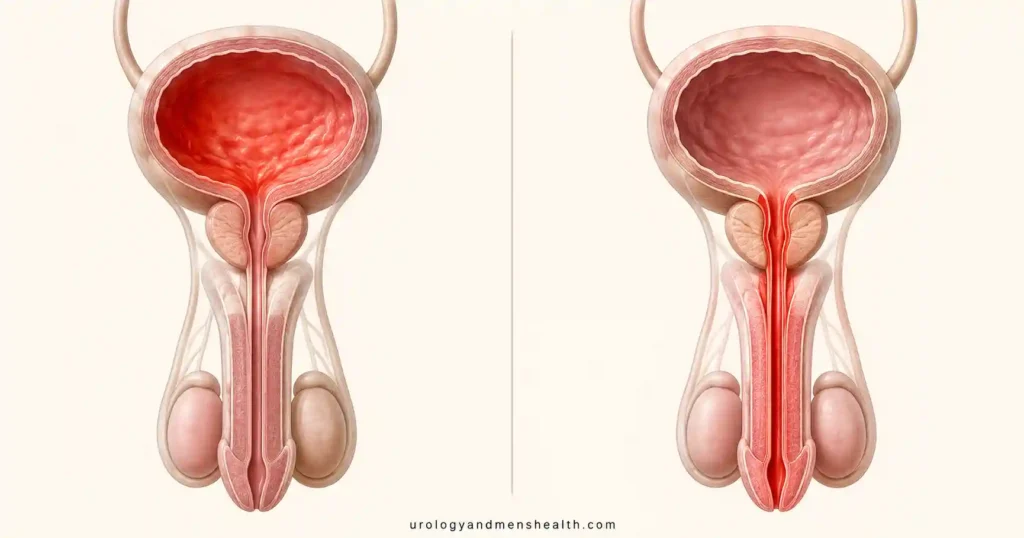
A urinary tract infection is an infection of the urine itself and the bladder lining that holds it. Bacteria multiply in stored urine, the bladder wall becomes inflamed, and every contraction of an irritated bladder registers as urgency and pressure. The urethra is downstream of all of this — it is simply the pipe the infected urine passes through on the way out. Burning happens because inflamed urine touches a normal urethra.
Urethritis is the reverse. The infection lives in the lining of the urethra itself, usually acquired sexually, and the urine passing through it is often completely sterile. Burning happens because normal urine touches an inflamed urethra.
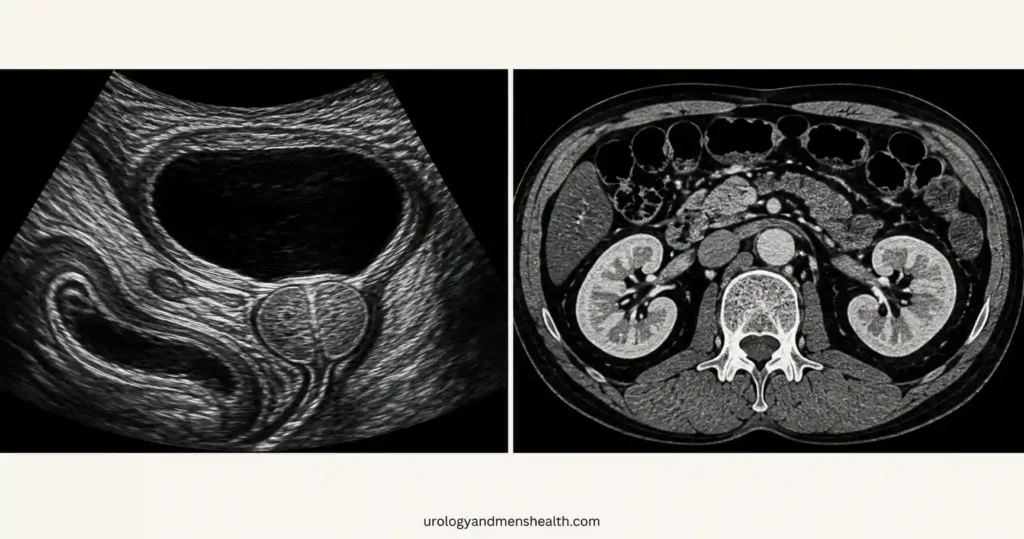
That distinction sounds academic until you look at the numbers. The male urethra runs roughly 20 cm (about 8 inches); the female urethra is closer to 4 cm (about 1.5 inches). Bacteria from the perineum have a long, unfavorable journey to reach a man’s bladder, which is why simple bladder infections are far less common in men and why every guideline body has historically treated a male urinary infection as something that needs an explanation rather than just a prescription [2]. Our full guide to urinary tract infection in men and when it should worry you covers that workup in detail.
A sexually acquired urethral infection has no such barrier. It is deposited directly onto the urethral lining. Anatomy protects the bladder; it does nothing for the urethra.
UTI vs STI Symptoms in Men: The Side-by-Side Difference
Three features separate the two patterns more reliably than anything else. None of them is perfect on its own, but together they get most men to the right test.
1. Discharge is the single strongest signal
Male urethral discharge — mucoid, cloudy, yellow, or frankly purulent — means the urethral lining is producing it. A bladder infection cannot. If you are seeing a stain on your underwear in the morning, or a bead of fluid at the meatus before your first urination of the day, that is urethritis and it needs sexually transmitted infection testing, not a bladder antibiotic [1].
The trap is that the absence of discharge proves nothing. Plenty of chlamydial urethritis presents with dysuria alone, particularly if you have urinated in the previous couple of hours and flushed the secretions away.
2. Where the burning sits in the stream
Men with urethritis usually describe the sharpest pain at the start of the stream, concentrated at or near the tip, sometimes with itching at the meatus between voids. Men with a bladder infection more often describe discomfort through the whole void, plus suprapubic pressure and a bladder that feels unfinished afterwards. Ask yourself where the sensation peaks — it is a question I get useful answers to far more often than “does it burn.”
3. Timing against sexual exposure
Gonococcal urethritis typically declares itself 2 to 7 days after exposure and tends to be loud — heavy discharge, pronounced burning. Chlamydia is slower and quieter, often 1 to 3 weeks out, and can be mild enough to dismiss. Mycoplasma genitalium can be slower still. A bladder infection has no relationship to when you last had sex; it relates to how well your bladder empties.
If you cannot draw a line from a new or untreated partner in the preceding month, that shifts probability toward the bladder. If you can, assume urethritis until a test says otherwise.
Work your own symptom pattern through the UTI vs STI Symptom Checker before your appointmentStill burning after a course of antibiotics? Get the Recurrent UTI Eradication Protocol
Enter your email below to receive Dr. Khalid’s complete Recurrent UTI Eradication Protocol as a free, printable PDF.
What Actually Causes Each One
Bladder infection: almost always a reason underneath
Escherichia coli causes the majority, as it does in women. What differs in men is that the organism rarely gets there without help. When I find a genuine bacterial cystitis in a man, I am looking for one of a short list of reasons:
- Incomplete emptying — most often an enlarged prostate leaving residual urine behind after every void. Stagnant urine is a culture medium.
- Bladder or kidney stones — a surface bacteria can colonize where antibiotics do not reach well.
- A catheter, current or recent.
- Prostatic involvement, which converts a simple infection into one needing weeks rather than days of treatment.
- Diabetes with poor glycemic control, which impairs both emptying and immune response.
- An unretractable or poorly cleaned foreskin in uncircumcised men.
The European Association of Urology restructured its infection classification in 2025, moving away from labeling every male urinary infection “complicated” by default and toward a system based on whether the infection stays localized to the bladder or shows signs of spreading systemically [2]. That change matters for you in one practical way: it does not remove the need to ask why a man got a bladder infection, it just stops that question from automatically triggering weeks of antibiotics. If you want to see where you sit on that risk profile, the UTI risk assessment for men maps the common drivers.
Urethritis in men: a wider list than most people expect
Gonorrhea and chlamydia are the two most people know about, but the CDC’s 2021 treatment guidelines make clear how incomplete that picture is. Among nongonococcal urethritis cases, Chlamydia trachomatis accounts for under half. Mycoplasma genitalium accounts for an estimated 10% to 25%, and Trichomonas vaginalis for 1% to 8% depending on population and region [1]. The 2021 European guideline on M. genitalium puts its share of non-chlamydial, non-gonococcal urethritis at 10% to 35% [3].
Herpes simplex, adenovirus, and Haemophilus species account for a further slice, several of them acquired through oral rather than penetrative contact — which is why men who tell me they “only” had oral sex are not describing a zero-risk exposure.
Then there is the part nobody enjoys hearing: even with full testing, no pathogen is identified in roughly half of urethritis cases [1]. Work sequencing the urethral microbiota in men with idiopathic urethritis has begun implicating organisms that standard panels simply do not look for [4]. A negative panel is not proof that nothing happened.
In My Practice
The pattern I see most often is a man in his late twenties who was given a few days of nitrofurantoin at an urgent care clinic for “a UTI,” felt marginally better, and came back a month later with the same burning and a urine culture that had grown nothing at all. Nobody had run a nucleic acid amplification test. His first-void urine came back positive for chlamydia. He had never had visible discharge, only stinging at the start of the stream, which he had taken as evidence that this could not be something he could pass on.
A negative urine culture in a man with burning is not reassurance — it is the strongest single clue that the problem is in the urethra rather than the bladder, and it should trigger sexually transmitted infection testing rather than a second course of the same antibiotic.
The Tests That Settle It — and What to Ask For
A dipstick cannot answer this question. Leukocyte esterase turns positive whenever white cells are present in urine, and white cells are present in both conditions. It confirms inflammation somewhere in the tract and tells you nothing about where or why.
Two tests run on the same sample settle it:
- Urine culture with colony count — asks whether an organism is growing in the bladder.
- Nucleic acid amplification testing (NAAT) for chlamydia and gonorrhea — asks whether a urethral pathogen is present. First-void urine is the preferred specimen in men, so no swab into the urethra is needed for the standard panel [1].
Ask for both together at the same visit. Running the culture first, waiting three days, then running the NAAT is the sequence that turns a one-week problem into a two-month one.
Two things that improve your test
Hold your urine for at least two hours before the sample. Frequent voiding washes urethral secretions and inflammatory cells out of the channel and is one of the more common reasons a genuine urethritis returns a clean-looking result. Give the first-void portion — the first 10 to 20 mL, not the midstream sample you would give for a bladder culture. Midstream is deliberately designed to skip past the urethra, which is exactly the tissue you are trying to sample.
On microscopy, 10 or more white blood cells per high-power field in spun first-void urine supports urethritis [1]. If you have visible skin changes, a lesion, or irritation confined to the meatus itself, that widens the differential further — our guide to penile problems that need a doctor covers what else belongs on the list.
Treatment: Why the Wrong Antibiotic Prolongs Both
This is where a misdiagnosis stops being an inconvenience.
Nitrofurantoin and fosfomycin work by concentrating in urine. That is precisely what makes them good bladder drugs and useless urethral ones — they sit in the fluid passing through, not in the tissue that is inflamed, and neither has meaningful activity against chlamydia or M. genitalium. A man treated this way often improves slightly, because flushing an irritated urethra with less concentrated urine feels better, then relapses two to four weeks later. That partial-response-then-relapse curve is one of the most reliable signatures of a missed urethral infection I see.
The CDC’s recommended regimen for nongonococcal urethritis is doxycycline 100 mg orally twice daily for 7 days. Gonorrhea is treated with a single intramuscular dose of ceftriaxone 500 mg for adults under 150 kg (about 330 lb), with doxycycline added unless chlamydia has been excluded [1]. Levofloxacin was dropped from the nongonococcal urethritis recommendations because of inferior efficacy, particularly against M. genitalium.
Two instructions matter as much as the drug. Every sexual partner from the preceding 60 days needs referral for evaluation and treatment, and you should abstain from sex until you and your partners have completed a full 7-day regimen and symptoms have resolved [1]. Skipping either step produces the reinfection loop that men mistake for treatment failure.
If symptoms persist after correct treatment, the most likely explanation is M. genitalium, which is where resistance testing earns its cost. Research comparing symptom resolution against laboratory clearance found that in M. genitalium urethritis, feeling better did not reliably mean the organism was gone — the two outcomes diverged in a way they did not for chlamydia [5]. If you were treated, felt fine, and symptoms returned, ask specifically for M. genitalium testing with macrolide resistance markers rather than accepting another empiric course.
A confirmed bladder infection in a man is a different problem entirely. It needs an agent with tissue and prostate penetration, a longer course than the three days a woman would be given, and an answer to the question of why it happened — post-void residual measurement, and imaging if stones are suspected.
When This Needs Same-Day Care
Most cases of burning can wait for a scheduled appointment. These cannot:
- Fever, chills, or shaking rigors — the infection has moved beyond the bladder or into the prostate. Go to an emergency room the same day.
- One-sided flank or back pain with fever — suggests the kidney is involved.
- Sudden testicular pain or swelling — untreated urethritis can travel to the epididymis, and sudden testicular pain also carries a torsion differential that is time-critical. Same-day assessment, not next week.
- Inability to pass urine at all despite a full bladder — this is acute retention and needs emergency drainage.
- Visible blood in urine that persists beyond a single void, or any ulcer, blister, or sore on the genitals.
- Burning plus joint pain and red, irritated eyes — this triad can follow chlamydial infection as reactive arthritis and needs urgent review.
Frequently Asked Questions
What is the single most reliable difference between UTI vs STI symptoms in men?
Discharge. A bladder infection does not produce fluid from the tip of the penis, because the infection sits above the urethra and drains only in urine. Any mucoid, cloudy, or yellow discharge, even a small stain on underwear in the morning, points to urethritis and should be tested as a sexually transmitted infection until proven otherwise. Run your symptom pattern through the UTI vs STI Symptom Checker before your appointment.
Can a urine dipstick tell a UTI and an STI apart in men?
No. Leukocyte esterase turns positive in both, because both produce white cells in urine. A dipstick tells you inflammation exists somewhere in the tract, not where or why. Settling the question needs a first-void urine sent for both culture and a nucleic acid amplification test for chlamydia and gonorrhea. Ask for both together. Our guide to UTI in men explains why culture alone misses so much.
I have burning but no discharge. Can it still be an STI?
Yes, and this is the presentation that gets missed most often. Chlamydia and Mycoplasma genitalium frequently cause burning with no visible discharge at all, particularly if you have urinated within the previous two hours. Hold urine for two hours before testing so secretions accumulate. Untreated urethritis can travel to the epididymis, which is why sudden testicular swelling deserves same-day assessment.
Can a man have a UTI and an STI at the same time?
Yes, and the combination is easy to under-treat. A urine culture growing E. coli does not exclude a coexisting chlamydial infection, because the two are detected by completely different tests. If you have risk factors for both, such as a new partner alongside an obstructing prostate, insist that both are run. Checking your background risk with the UTI risk assessment for men helps frame that conversation.
Why did my UTI antibiotic not clear the burning?
Because the two most common bladder antibiotics do not treat urethritis. Nitrofurantoin concentrates in urine but has no meaningful activity against chlamydia or Mycoplasma genitalium, and fosfomycin behaves the same way. Partial improvement followed by relapse two to four weeks later is a classic missed-urethritis pattern. If you also have skin changes or meatal irritation, our guide to penile problems that need a doctor covers what else to check.
References
- Centers for Disease Control and Prevention. Diseases Characterized by Urethritis and Cervicitis. Sexually Transmitted Infections Treatment Guidelines, 2021. CDC
- Bonkat G, Bartoletti R, Bruyère F, et al. EAU Guidelines on Urological Infections. European Association of Urology. 2025. EAU
- Jensen JS, Cusini M, Gomberg M, et al. 2021 European guideline on the management of Mycoplasma genitalium infections. J Eur Acad Dermatol Venereol. 2022;36(5):641-650. doi:10.1111/jdv.17972. PubMed
- Plummer EL, Ratten LK, Vodstrcil LA, et al. The Urethral Microbiota of Men with and without Idiopathic Urethritis. mBio. 2022;13(5):e0221322. doi:10.1128/mbio.02213-22. PubMed
- Toh E, Gao X, Williams JA, et al. Evaluation of Clinical, Gram Stain, and Microbiological Cure Outcomes in Men Receiving Azithromycin for Acute Nongonococcal Urethritis. Sex Transm Dis. 2022;49(1):67-75. doi:10.1097/OLQ.0000000000001509. PubMed
Dr. Muhammad Khalid
MBBS · FCPS (Urology) · MCPS (General Surgery) · CHPE · CRSM · IMC #539472
Specialist urologist with 11+ years of clinical experience across tertiary teaching hospitals. Trained at Lady Reading Hospital and Khyber Teaching Hospital, Peshawar. Author or co-author of five peer-reviewed international publications, including in Cureus and the World Journal of Surgery. Procedural expertise: URS, PCNL, RIRS, TURP, TURBT, and major open urological surgery. Full profile →
This article is for educational purposes only and does not constitute medical advice. Always consult your physician or urologist for diagnosis and treatment decisions specific to your condition.