Penile Implant Surgery: Success Rates & Recovery
Men ask me whether penile implant surgery is a last resort or a genuine cure. It is the only ED treatment that works on demand every time — and the only one you can never reverse.

Penile implant surgery is the only erectile dysfunction treatment I offer that carries a guarantee: it works on demand, every time, for as long as the device lasts. It is also the only one that cannot be reversed. Those two facts sit together uncomfortably, and almost everything men get wrong about implants comes from hearing the first without the second. An implant — properly, a penile prosthesis — is a device placed inside the two erection chambers of the penis. It replaces the hydraulic function those chambers have lost. It does not treat the underlying vascular or nerve problem; it bypasses it. The American Urological Association lists prosthesis implantation as an option every man with ED should be told about, alongside a frank discussion of what it costs him [1]. Below: who it suits, what the published numbers show, what recovery involves week by week, and the part men are rarely told — what it will not fix. For the full treatment ladder, see the Sexual Health Hub.
Key Takeaways
- A penile implant is permanent — placing the cylinders alters the erectile tissue itself, so natural erections do not return if the device is later removed.
- Pooled data from more than 20,000 men put device survival at about 87% at five years and 77% at ten years, with a median lifespan close to 20 years.
- Infection risk for a first-time implant using a modern antibiotic-coated device is roughly 1-2%, rising to about 2-3% in men with diabetes.
- The device makes the shaft rigid, not the glans. Sensation, orgasm and ejaculation are unchanged because no nerves are cut.
- Most surgeons activate the device at 4-6 weeks; daily cycling for the first 6-12 months protects both length and device function.
What a Penile Implant Actually Is
Your penis contains two parallel cylinders of spongy tissue called the corpora cavernosa. A natural erection happens when arteries flood these chambers with blood and the outer sheath traps it there. Every non-surgical ED treatment is an attempt to improve that process — tablets relax the arteries, injections force them open, a vacuum device pulls blood in mechanically.
An implant abandons the process entirely. The surgeon dilates each corpus cavernosum and slides a cylinder inside it. Rigidity now comes from the device, not from blood flow.
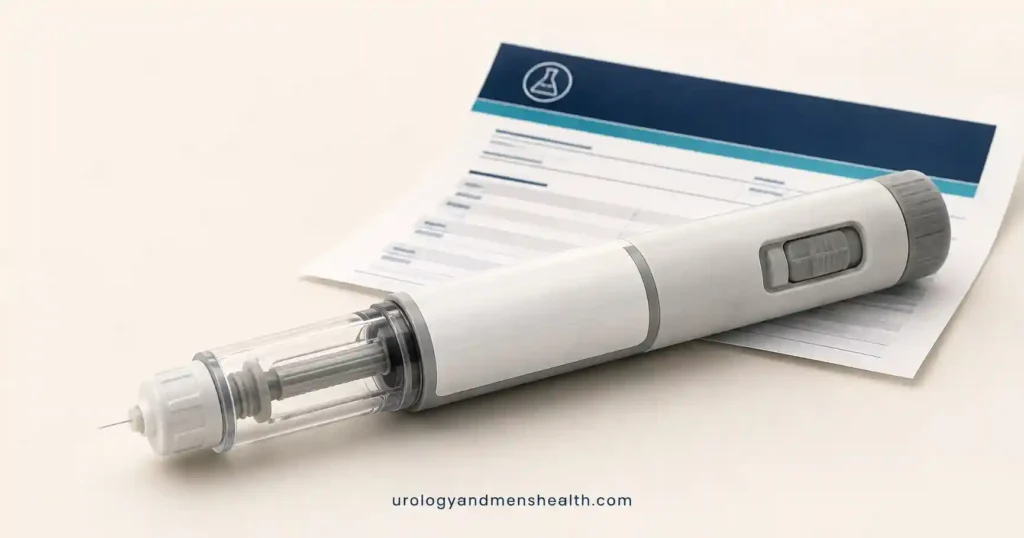
The three-piece inflatable device
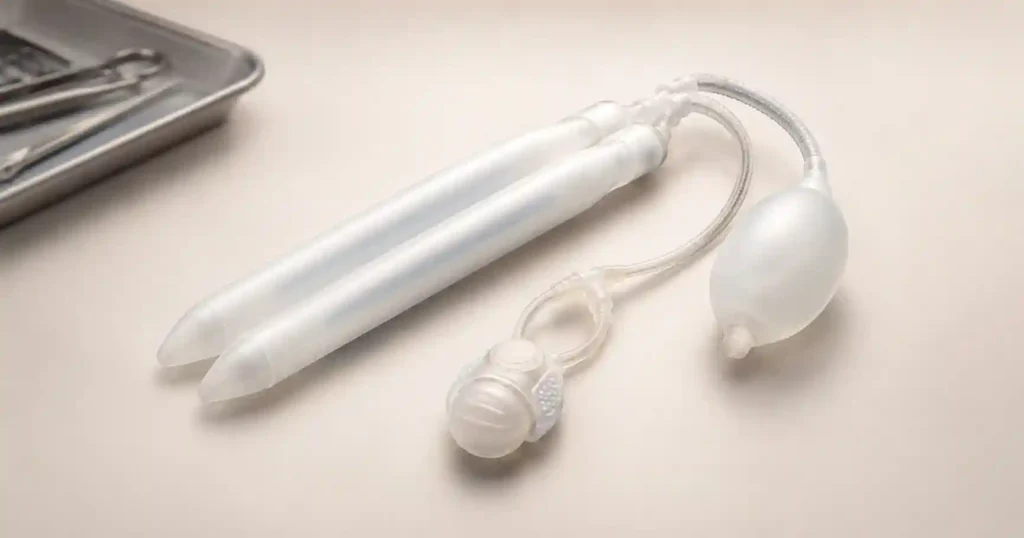
Over 90% of implants placed in the United States are three-piece inflatable devices. Two cylinders sit in the corpora. A small pump sits in the scrotum, alongside the testicles, where it is easy to reach and hard to see. A fluid reservoir sits behind the abdominal wall in the space behind the pubic bone.
Squeezing the scrotal pump moves saline from the reservoir into the cylinders. The penis becomes rigid within about 20 seconds. Pressing a release valve on the pump sends the fluid back, and the penis returns to a soft, natural-looking flaccid state.
The two-piece and semi-rigid alternatives
A two-piece device combines pump and reservoir into one scrotal unit. It gives less rigidity and less flaccidity, but avoids abdominal reservoir placement — useful in men with a kidney transplant or heavy scarring from previous pelvic surgery.
A semi-rigid (malleable) implant is a pair of bendable silicone rods. There is no pump and no fluid, so there is very little to break. The penis stays permanently firm and is simply bent downward when not in use.
Who Is a Candidate — and Who Should Wait
The AUA position is that men should be informed about implants — not that implants should be reserved as a punishment for failing everything else [1]. In practice, I consider a man a reasonable candidate when at least one of these is true:
- Maximum-dose oral therapy has failed. That means at least six to eight properly timed attempts at the full dose of two different PDE5 inhibitors, taken on an empty stomach, with sexual stimulation — not two half-hearted tries.
- Injections have failed or been rejected. An in-office injection test that produces no usable erection tells me the smooth muscle itself is exhausted.
- There is significant corporal fibrosis — scarring inside the erection chambers from prior priapism, an infected previous implant, or advanced Peyronie’s disease.
- The man wants a definitive answer. Wanting to stop planning sex around a tablet is a legitimate clinical reason, not impatience.
Before that conversation begins, I want an objective baseline. Score yourself honestly on the IIEF-5 erectile function questionnaire and bring the number — men consistently under-report at the first visit and over-report at the second. If you have not yet worked through tablets, vacuum therapy and injections in a structured order, start with the full urologist’s ED treatment protocol before you consider surgery.
Who should not have surgery yet
The AUA is explicit that prosthetic surgery should not be performed when there is an active systemic, skin or urinary tract infection [1]. A device is a foreign body; bacteria circulating at the time of implantation colonise it and you lose the implant.
Uncontrolled diabetes is a delay, not a refusal. Pooled analysis of the published series puts the infection risk in diabetic men at roughly 1.5 times that of non-diabetic men [5]. Ask your diabetes team for an HbA1c they are satisfied with, and ask your urologist to book the date once it is achieved rather than before.
Men still hoping for spontaneous recovery of erections should also wait. After a nerve-sparing radical prostatectomy, function can continue improving for up to two years, which is why penile rehabilitation after prostate surgery runs its full course before I raise the subject of an implant.
In My Practice
The question that tells me a man is not ready is never “how much does it hurt?” It is “and if I don’t like it, you can take it out?” I heard exactly that from a 58-year-old three days before a scheduled implant — a man who had been on tadalafil for six years and had never once tried an injection. We cancelled the date and ran an injection test in clinic instead. He responded. He is still using injections two years later and has not needed me since.
If a man has not tried every less permanent option, an implant is not the right answer yet — it is just the fastest one.
Before you commit to surgery: the ED treatment ladder, step by step
Enter your email below to receive Dr. Khalid’s complete ED & Sexual Function Action Plan as a free, printable PDF.
Inflatable vs. Malleable: How I Choose
There are no head-to-head randomised trials showing one device type is superior, and none comparing manufacturers [2]. The choice is about the man, not the hardware.
I lean inflatable when the man has normal hand strength and dexterity, wants a genuinely flaccid state between uses, and is concerned about concealment under clothing or in a changing room. The three-piece device gives the closest approximation to a natural erection and the closest approximation to a natural resting penis.
I lean malleable when hand function is limited — advanced arthritis, tremor, spinal cord injury, or significant obesity that makes a scrotal pump hard to locate. It also suits men with severe corporal fibrosis where narrow-diameter rods are easier to place, and men whose priority is the lowest possible mechanical failure rate.
Peyronie’s disease is a special case. When a man has both a disabling curve and ED that has not responded to medication, the AUA Peyronie’s guideline recommends an inflatable device specifically, because the surgeon can use the inflated cylinders to straighten the penis intraoperatively [6].
Not sure which rung you are on? Work through the step-up ED treatment pathway →What the Numbers Actually Say About Penile Implant Surgery
This is where implants earn their reputation, and where the marketing tends to round the figures upward.
Satisfaction
The EAU guideline summary reports prosthesis implantation as having one of the highest satisfaction rates of any ED treatment — 92-100% in patients and 91-95% in partners — with the important qualifier “with appropriate counselling” [2]. Single-centre real-world data runs more conservative. A 2019 Belgian series of 126 men interviewed at least a year after surgery found patient satisfaction of 83.2% and partner satisfaction of 85.4% [4]. That gap is not a contradiction; it is the cost of poor expectation-setting.
How long the device lasts
A 2022 systematic review and meta-analysis pooling 12 studies and 20,161 men put device survival at 93.3% at one year, 87.2% at five years, 76.8% at ten years, 63.7% at fifteen years and 52.9% at twenty years, giving a median device lifespan of roughly two decades [3]. Failure is usually a gradual loss of fluid rather than a sudden break, and replacement is a shorter operation than the original because the corporal spaces already exist.
Infection — the complication that matters
Before antibiotic-coated devices existed, infection rates for first-time implants sat around 3-5% in healthy men and higher in men with diabetes. Two coating technologies changed that: a minocycline-and-rifampin impregnated surface on one manufacturer’s device, and a hydrophilic surface on another that absorbs whatever antibiotic solution the surgeon dips it in. Published incidence across the modern literature now falls in the 0.3-2.7% range [5].
Two figures worth asking your surgeon about directly: revision and re-implantation carry a materially higher infection risk than a first-time procedure, and if a device does become infected, immediate removal with a washout protocol and same-session replacement salvages the situation in over 80% of cases [2] — but only if you present early.
Penile Implant Recovery, Week by Week
The operation itself takes about 60 to 90 minutes and is usually done as a day case or with a single overnight stay, under general or spinal anaesthesia.
- Days 0-3. Swelling and bruising of the penis and scrotum peak around day two or three. Ice packs for the first 48-72 hours, snug supportive underwear, and the penis taped or positioned pointing up toward the navel — this single manoeuvre does more to limit downward swelling than any medication. The device is left partly inflated in its factory position.
- Weeks 1-2. Pain eases substantially. Wound check with your surgeon. No lifting over 4.5 kg (10 lb), no cycling, no abdominal exercise. Do not attempt to inflate the device.
- Weeks 3-4. Light walking and gentle cardio resume. Some surgeons begin gentle cycling here; most wait.
- Weeks 4-6 — the activation visit. Your surgeon fully deflates the device for the first time and teaches you to work the pump. Expect this to feel awkward; almost nobody gets it on the first try, and you will not damage the device by fumbling [7].
- From week 6. Sexual activity is generally cleared once you can operate the pump confidently. Continue inflating and deflating daily for the first 6-12 months.
That last instruction is the one men skip, and it is the one with lasting consequences. If the cylinders sit deflated for months, a fibrous capsule forms around them and prevents full expansion afterwards. The result is a permanently shorter, less rigid erection from a device that was working correctly the whole time. Cycle daily, even in the months when there is no sexual activity.
When to Contact Your Surgeon Urgently
Prosthesis infection is time-critical. Early removal and salvage often preserves a functioning device; a delayed presentation almost never does. Contact your surgeon the same day — or attend the emergency room if you cannot reach them — if you develop any of the following in the first three months:
- Fever above 38°C (100.4°F), chills, or feeling systemically unwell
- Spreading redness, increasing rather than settling pain, or a hot swollen scrotum after the first week
- Any discharge, fluid or pus from an incision
- The device becoming fixed, tender, or impossible to deflate
- Any part of a cylinder becoming visible or palpable through the skin of the penis
Long term: carry an implant identification card, and tell any clinician before catheterisation, dental surgery or pelvic imaging that you have a penile prosthesis.
What a Penile Implant Will Not Fix
This is the section that determines whether a man ends up in the 92% or the 8%.
It will not make you longer. The device fills the corpora you have. It cannot extend them. In the Belgian series, 18.5% of men reported loss of penile length afterwards [4] — and most of that length was lost during the years of untreated ED beforehand, not on the operating table. The AUA advises documenting stretched flaccid penile length at the pre-operative examination precisely so the comparison is made against measurement rather than memory [1]. Ask for that measurement and write it down.
It will not inflate the glans. The cylinders sit in the corpora cavernosa. The head of the penis is supplied by a separate chamber, the corpus spongiosum, which the device does not touch. A rigid shaft with a soft glans — sometimes called floppy glans syndrome — surprises men who were not warned.
It will not change sensation, orgasm or ejaculation. No nerves are divided during the operation. Whatever you could feel before, you will feel after. If you have had a radical prostatectomy, orgasm will be dry — but that is the prostate surgery, not the implant.
It will not fix low desire. If testosterone is low, or the relationship difficulty is the cause rather than the consequence of the ED, a mechanical erection changes nothing. Get a morning total testosterone measured before surgery, not after.
And it cannot be undone. Dilating the corpora to place the cylinders permanently changes the tissue inside them. If the device is removed and not replaced, spontaneous erections do not return, and the scarring that follows makes any future implant technically harder. Take that fact to a second consultation before you sign anything.
Frequently Asked Questions
Will penile implant surgery make my penis shorter?
Most men do not lose length from the operation itself — they lost it earlier, during years of untreated ED when the corpora were rarely stretched. In one single-center series, about 18% of men reported perceived shortening afterward. I document stretched flaccid length before surgery so the comparison is made against a measurement rather than a memory, and daily cycling after activation helps preserve what you have.
Can a penile implant be removed so my natural erections come back?
No. Placing the cylinders requires dilating the corpora cavernosa, which permanently alters the erectile tissue inside them. If the device is removed and not replaced, spontaneous erections do not return, and the resulting scarring makes any future implant harder to place. This is why I insist men exhaust tablets, a vacuum device and intracavernosal injections first.
Will I still orgasm and ejaculate after penile implant surgery?
Yes, in almost all cases. The implant sits inside the corpora cavernosa and does not touch the pudendal nerve that carries sensation, nor the pathways that trigger ejaculation. Sensation and orgasm should feel the same as before. If you have already had a radical prostatectomy you will have a dry orgasm, but that is a consequence of the prostate surgery, not the device.
How many years does an inflatable penile prosthesis last?
Pooled data from 12 studies covering more than 20,000 men put device survival at roughly 87% at five years, 77% at ten years and 53% at twenty years, giving a median lifespan close to two decades. Failure is usually a slow loss of fluid rather than a sudden break, and replacement is a shorter operation than the original because the corporal spaces already exist.
Is a penile implant safe if I have diabetes?
Yes, but glycemic control matters. Pooled analysis puts infection risk in diabetic men at roughly 1.5 times that of non-diabetic men. I want an HbA1c your diabetes team considers stable before booking a date, and no active urinary, skin or systemic infection on the day. Well-controlled diabetes is not a barrier — uncontrolled diabetes is a delay, not a refusal.
Can anyone tell I have a penile implant?
Not when you are dressed, and rarely when you are not. A three-piece device is invisible in the flaccid state because the cylinders fully deflate. A partner will usually feel the pump in the scrotum if they go looking for it. Semi-rigid rods are more noticeable, because the shaft stays permanently firm and has to be bent downward against the body.
References
- Burnett AL, Nehra A, Breau RH, et al. Erectile Dysfunction: AUA Guideline. American Urological Association. 2018; amended 2020. AUA
- Salonia A, Bettocchi C, Capogrosso P, et al. EAU Guidelines on Sexual and Reproductive Health: Management of Erectile Dysfunction. European Association of Urology. 2025. EAU
- Miller LE, Khera M, Bhattacharyya S, et al. Long-Term Survival Rates of Inflatable Penile Prostheses: Systematic Review and Meta-Analysis. Urology. 2022;166:6-10. PubMed
- Jorissen C, De Bruyn H, Baten E, Van Renterghem K. Clinical Outcome: Patient and Partner Satisfaction after Penile Implant Surgery. Current Urology. 2019;13(2):94-100. PubMed
- Gon LM, de Campos CCC, Voris BRI, et al. A systematic review of penile prosthesis infection and meta-analysis of diabetes mellitus role. BMC Urology. 2021;21(1):35. PubMed
- Nehra A, Alterowitz R, Culkin DJ, et al. Peyronie’s Disease: AUA Guideline. American Urological Association. 2015; amended 2016. AUA
- Sexual Medicine Society of North America. What Is the Typical Recovery Process After Inflatable Penile Prosthesis Surgery? SMSNA Patient Resources. SMSNA
Dr. Muhammad Khalid
MBBS · FCPS (Urology) · MCPS (General Surgery) · CHPE · CRSM · IMC #539472
Specialist urologist with 11+ years of clinical experience across tertiary teaching hospitals. Trained at Lady Reading Hospital and Khyber Teaching Hospital, Peshawar. Author or co-author of five peer-reviewed international publications, including in Cureus and the World Journal of Surgery. Procedural expertise: URS, PCNL, RIRS, TURP, TURBT, and major open urological surgery. Full profile →
This article is for educational purposes only and does not constitute medical advice. Always consult your physician or urologist for diagnosis and treatment decisions specific to your condition.