Mirabegron (Myrbetriq) for Men: What to Expect From Your Bladder Pill
Most men I start on mirabegron ask the same three things: will it work, what will it do to my blood pressure, and can I take it with tamsulosin. Here are the straight answers.


Mirabegron, sold as Myrbetriq and now available as a generic, is the bladder medicine I prescribe most often to men with urgency, frequency and urge leakage. If you have just been handed a prescription, you probably want to know three things: will it work, what will it do to my blood pressure, and is it safe with the prostate pill I already take. The honest answers are: it helps most men moderately rather than dramatically, it raises blood pressure only slightly in most people but matters if yours is already high, and it can be combined with tamsulosin as long as your bladder empties properly first. This guide covers how mirabegron works, the 25 mg and 50 mg doses, the side effects that matter for men, how it compares with older anticholinergic pills like oxybutynin, and who should not take it. For the broader picture, see our Men’s Wellness Hub.
Key Takeaways
- Mirabegron starts at 25 mg once daily; the label allows an increase to 50 mg after 4 to 8 weeks if symptoms are not controlled.
- It is not recommended if your blood pressure is severely uncontrolled (180/110 mmHg or higher), so check your readings before starting and again in the first month.
- In men already on tamsulosin, adding mirabegron reduced daily toilet trips more than placebo in the PLUS trial, but urinary retention was more common, so have your post-void residual measured first.
- The 2024 AUA/SUFU guideline asks doctors to discuss dementia risk with anticholinergic bladder drugs; mirabegron works by a different route and is often chosen first in older men.
How Mirabegron Works in the Bladder
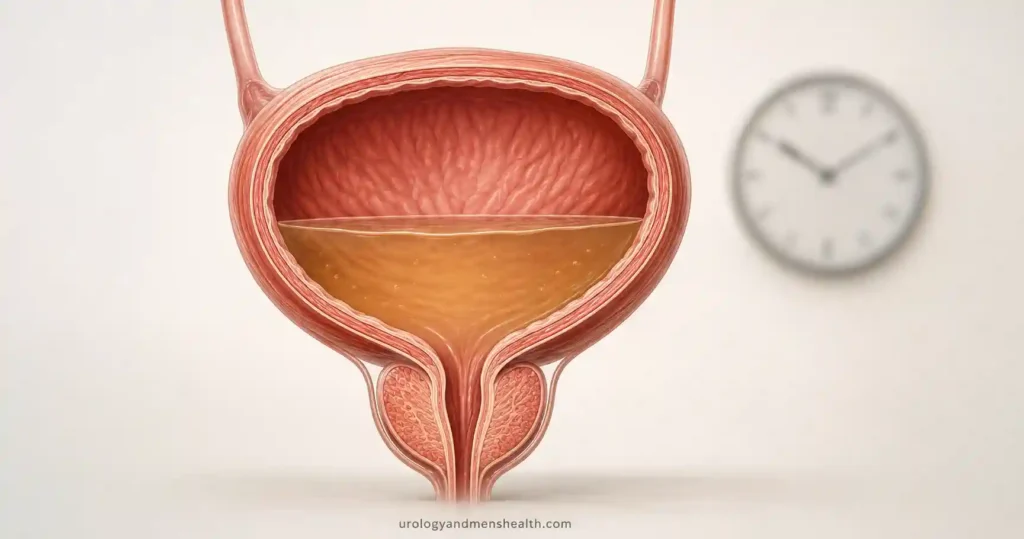
Your bladder wall is a muscle called the detrusor. In overactive bladder, it squeezes before the bladder is full, which you feel as a sudden urge you cannot postpone. Mirabegron is a beta-3 agonist: it switches on beta-3 receptors in the detrusor that tell the muscle to relax while the bladder is filling. A relaxed bladder holds more urine before it signals, so you go less often and the urge is less sudden.
The older group of bladder medicines, the anticholinergics (also called antimuscarinics) such as oxybutynin, solifenacin and tolterodine, work differently. They block the nerve signal that makes the bladder contract. That signal, acetylcholine, is also used by the brain, gut, salivary glands and eyes, which is why anticholinergics cause dry mouth, constipation and, in some people, foggy thinking. Mirabegron does not touch that system, which is the main reason many urologists now reach for it first.
Medication is the second step, not the first. The 2024 AUA/SUFU guideline recommends bladder training and behavioral changes for everyone with overactive bladder [1]. Our guide to bladder training for men shows how to do it alongside the tablet.
Mirabegron Dosage: 25 mg vs 50 mg
According to the FDA prescribing information, the starting dose for adults with overactive bladder is 25 mg once daily, and the dose may be increased to 50 mg once daily after 4 to 8 weeks [2]. The tablet is extended-release: swallow it whole with water, with or without food, and do not chew, split or crush it, because that releases the whole dose at once.
| Your situation | Usual dose | What to watch |
|---|---|---|
| Starting treatment | 25 mg once daily | Blood pressure in the first weeks; toilet trips per day |
| Not enough benefit after 4 to 8 weeks | May increase to 50 mg once daily | Blood pressure again after the increase |
| Severe kidney impairment (eGFR 15 to 29) | Maximum 25 mg once daily | Kidney function at follow-up |
| Kidney failure (eGFR below 15) or dialysis | Not recommended | Ask about non-drug options instead |
Do not judge it in the first week. The label notes that 25 mg is effective within 8 weeks, and that matches what I see: most men notice a difference around weeks 2 to 4, with the full effect by week 8. Keep a simple 3-day bladder diary before you start and again at week 6, counting trips, urgent episodes and leaks. Our overactive bladder symptom score turns that into a number you can bring to your follow-up.
If you are not sure where your kidney function sits, your eGFR is on your routine blood test. Our eGFR and CKD stage calculator shows which band you are in.
Mirabegron Side Effects That Matter for Men
Most men tolerate mirabegron well. The side effects worth understanding are the ones that come from how it works.
- A small rise in blood pressure. Beta-3 receptors also sit in blood vessels and the heart. In healthy-volunteer studies at 50 mg, systolic and diastolic pressure rose about 3.5 and 1.5 mmHg more than placebo; in patients with overactive bladder the difference was smaller, about 0.5 to 1 mmHg [2]. That is trivial for most men, but not for a man whose pressure is already poorly controlled.
- A faster heart rate. The same mechanism. Usually unnoticed, but mention palpitations to your doctor.
- Difficulty emptying the bladder. By relaxing the bladder, mirabegron can tip a man with a tight prostate outlet into retention. This is the side effect that matters most for men.
- Urinary infections, cold-like symptoms and headache. Among the more commonly reported effects in trials.
- Swelling of the face, lips, tongue or throat (angioedema). Rare, but listed in the label as a reason to stop the drug and seek urgent care.
What mirabegron largely avoids is the dry mouth, constipation and blurred vision typical of anticholinergics. Men switching from oxybutynin often notice that difference within days.
Stop and Get Help Today If
Call your doctor the same day, or go to the ER, if any of these happen after starting mirabegron:
- You cannot pass urine, or your lower belly is painfully full
- Swelling of your face, lips, tongue or throat, or difficulty breathing or swallowing
- Home blood pressure readings of 180/110 mmHg or higher, or a severe headache with high readings
- A racing or irregular heartbeat that does not settle
On mirabegron for overactive bladder? Get the men's OAB plan: what to track before your follow-up
Enter your email below to receive Dr. Khalid’s complete OAB & Incontinence Guide as a free, printable PDF.
Mirabegron With Tamsulosin for an Enlarged Prostate
Most men over 50 with urgency also have some prostate enlargement. The usual first medicine is an alpha-blocker such as tamsulosin, which relaxes the prostate and bladder neck to improve the flow. When the stream gets better but the urgency and frequency stay, the problem has shifted to the bladder, and that is where mirabegron fits. The 2024 AUA/SUFU guideline allows exactly this combination of an alpha-blocker with a beta-3 agonist in men with both conditions [1].
Two randomized trials tested it. In PLUS, 676 men already taking tamsulosin added mirabegron or placebo for 12 weeks; daily toilet trips fell by 2.00 with mirabegron versus 1.62 with placebo, and urgency episodes also improved. Urinary retention was more common in the mirabegron group, although changes in leftover urine and flow were not clinically meaningful overall [3]. In MATCH, 568 Japanese and Korean men on tamsulosin saw a similar modest benefit from adding mirabegron 50 mg [4].
What to ask for before adding it: a post-void residual, an ultrasound measure of urine left behind after you urinate. If a large volume stays behind, adding a bladder relaxant risks retention; our guide to post-void residual results explains the numbers. If tamsulosin itself is giving you trouble, see our page on tamsulosin side effects in men.
In My Practice
A 71-year-old man came to me on tamsulosin and oxybutynin. His stream was fine, but he was still racing to the toilet and his wife had noticed he was forgetting conversations and was badly constipated. His leftover urine after voiding was 60 mL, which is acceptable, and his blood pressure was well controlled. We stopped the oxybutynin and started mirabegron 25 mg. Six weeks later his diary showed fewer urgent trips, his bowels had settled, and his wife said he was sharper.
In an older man, I check leftover urine and blood pressure, then try a beta-3 agonist before an anticholinergic.
Mirabegron vs Oxybutynin and Other Anticholinergics
On symptom control, the two families perform similarly; the AUA/SUFU 2024 guideline gives both a strong recommendation [1]. The difference is safety. The same guideline asks clinicians to discuss the risk of dementia and cognitive impairment with patients taking or being prescribed anticholinergic bladder drugs. A 2022 white paper from the Society of Urodynamics, Female Pelvic Medicine and Urogenital Reconstruction concluded that use beyond three months is likely associated with a higher risk of new dementia, and that a beta-3 agonist is typically preferred first [5].
Not every study agrees. A large database analysis presented at the AUA 2024 meeting found that, in men specifically, anticholinergics were not linked to higher dementia risk than mirabegron [6]. All of this evidence is observational, so it shows association rather than proof. My practical reading: for a man over 65, or anyone already on other anticholinergic medicines, I start with mirabegron unless blood pressure or cost rules it out. Cost is less of a barrier than it was, because generic mirabegron extended-release tablets have been on the US market since 2024 [7].
Who Should Not Take Mirabegron
- Severely uncontrolled high blood pressure, defined in the label as 180/110 mmHg or higher. Get your pressure controlled first.
- Kidney failure or dialysis. Not recommended below an eGFR of 15.
- Severe liver impairment. Your prescriber will lower the dose or choose something else.
- A bladder that already does not empty well. Not an absolute bar, but it needs a post-void residual check and closer follow-up.
- Certain heart and mood medicines. Mirabegron slows the breakdown of drugs handled by the liver enzyme CYP2D6, such as metoprolol and some antidepressants, and it can raise digoxin levels. Give your pharmacist your full medicine list.
If tablets do not work or are not suitable, there are further options, from bladder Botox to nerve stimulation; our guide to overactive bladder treatment in men sets out the full ladder.
Frequently Asked Questions About Mirabegron
How long does mirabegron take to work for men with overactive bladder?
Most men notice fewer urgent trips within 2 to 4 weeks, and the prescribing information states that the 25 mg dose is effective within 8 weeks. Judge it at week 6 to 8 against a bladder diary you kept before starting, not on how you feel in the first few days. Our OAB symptom score makes that comparison easy.
Can I take mirabegron with tamsulosin?
Yes. The 2024 AUA/SUFU guideline allows an alpha-blocker such as tamsulosin to be combined with a beta-3 agonist in men with prostate and bladder symptoms. In the PLUS trial the combination reduced daily trips more than tamsulosin alone, but retention was more common, so ask for a post-void residual check first. Read about tamsulosin side effects as well.
Does mirabegron raise blood pressure?
Slightly, in most people. At 50 mg the average rise in overactive bladder patients was about 0.5 to 1 mmHg more than placebo, larger in healthy-volunteer studies. It is not recommended if your blood pressure is 180/110 mmHg or higher. Check home readings before starting and during the first month, and report any big jump to your doctor.
Is mirabegron safer than oxybutynin for memory in older men?
Mirabegron does not act on the acetylcholine system that anticholinergics like oxybutynin block, and the 2024 AUA/SUFU guideline asks doctors to discuss dementia risk with anticholinergics. Most evidence is observational and one 2024 analysis in men disagreed, but many urologists start older men on mirabegron first. Our OAB treatment guide covers all options.
What should I do if mirabegron 50 mg still does not control my urgency?
Ask your urologist to confirm the diagnosis with a post-void residual and, if needed, urodynamic testing, because an enlarged prostate or poor emptying can mimic overactive bladder. If it truly is overactive bladder, options include combining medicines or moving to bladder Botox or nerve stimulation. Our page on Botox for overactive bladder in men explains the next step.
References
- Cameron AP, Chung DE, Dielubanza EJ, et al. The AUA/SUFU guideline on the diagnosis and treatment of idiopathic overactive bladder. J Urol. 2024. AUA
- Myrbetriq (mirabegron extended-release tablets) prescribing information. US Food and Drug Administration. FDA
- Kaplan SA, Herschorn S, McVary KT, et al. Efficacy and safety of mirabegron versus placebo add-on therapy in men with overactive bladder symptoms receiving tamsulosin for underlying benign prostatic hyperplasia: a randomized, phase 4 study (PLUS). J Urol. 2020;203(6):1163-71. PubMed
- Kakizaki H, Lee KS, Yamamoto O, et al. Mirabegron add-on therapy to tamsulosin for the treatment of overactive bladder in men with lower urinary tract symptoms: a randomized, placebo-controlled study (MATCH). Eur Urol Focus. 2020;6(4):729-737. PubMed
- Zillioux J, Welk B, Suskind AM, Gormley EA, Goldman HB. SUFU white paper on overactive bladder anticholinergic medications and dementia risk. Neurourol Urodyn. 2022;41(8):1928-1933. DOI
- Sheyn D. Long-term dementia risk with use of anticholinergic versus beta-3-agonist pharmacotherapy for overactive bladder. AUA Annual Meeting 2024, reported by UroToday. UroToday
- Lupin Pharmaceuticals. Mirabegron extended-release tablets prescribing information. 2024. Lupin
Dr. Muhammad Khalid
MBBS · FCPS (Urology) · MCPS (General Surgery) · CHPE · CRSM · IMC #539472
Specialist urologist with 11+ years of clinical experience across tertiary teaching hospitals. Trained at Lady Reading Hospital and Khyber Teaching Hospital, Peshawar. Author or co-author of five peer-reviewed international publications, including in Cureus and the World Journal of Surgery. Procedural expertise: URS, PCNL, RIRS, TURP, TURBT, and major open urological surgery. Full profile →
This article is for educational purposes only and does not constitute medical advice. Always consult your physician or urologist for diagnosis and treatment decisions specific to your condition.