Living Well With a Long-Term Catheter: Urologist’s Guide
Most men with a long-term catheter are never told the things that actually decide how the next five years go — how to stop blockages before they start, why cloudy urine usually is not an infection, and the three signs that mean go to the ER tonight.

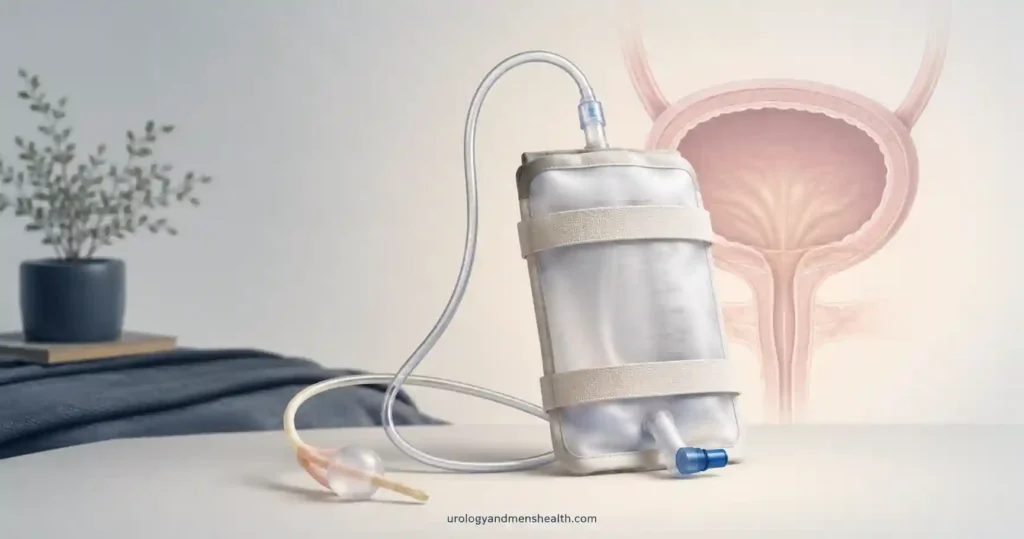
A long-term catheter is not a failure of treatment. It is a decision — usually the right one — made because the bladder can no longer empty safely on its own, and the alternative is kidney damage, repeated retention, or a life organized entirely around the next crisis. I look after men who have had an indwelling catheter for eight years and who ski, travel, and work full-time. I also see men three months in who have already been admitted twice. The difference between those two groups is almost never the underlying disease. It is whether anyone sat down and explained the three things that actually go wrong: blockage, skin and traction injury, and the misreading of cloudy urine as infection. This article covers what I tell my own catheter patients at their first review, and it sits inside our wider UTIs and Infections Hub.
Key Takeaways
- Cloudy, strong-smelling urine in a catheterized bladder is expected colonization, not infection — fever, rigors, new flank pain or new confusion are what define a catheter-associated UTI.
- Every long-term catheter becomes colonized with bacteria within about four weeks, and treating that colonization with antibiotics selects resistant organisms without preventing a single infection.
- Blockage is driven by urease-producing bacteria, mainly Proteus mirabilis, which raise urine pH and deposit mineral crystals inside the catheter lumen — this is predictable, and most blockers block on a repeatable schedule.
- Urine leaking around the outside of the catheter usually means the catheter is blocked or the bladder is spasming, not that the catheter is too small.
- A suprapubic catheter spares the urethra and is generally the better choice past the one-year mark in men, particularly those who are sexually active or wheelchair-dependent.
What Counts as a Long-Term Catheter, and Why the Route Matters
Clinically, a catheter becomes long-term once it has been in place for more than 28 days, or once the plan is indefinite rather than “until this settles.” That threshold is not arbitrary. It is roughly the point at which bacterial colonization becomes universal and the management questions change completely — from how do we get this out to how do we run this well for years.
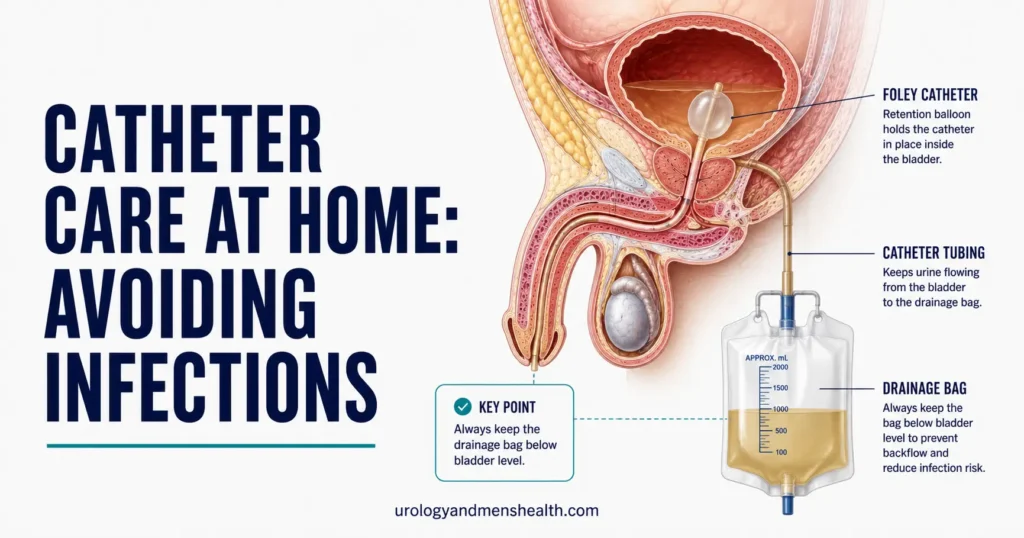
There are two routes. A urethral catheter passes up the penis, through the prostate, into the bladder. A suprapubic catheter goes through a small tract in the lower abdomen, about two finger-widths above the pubic bone, directly into the bladder dome. Both use the same self-retaining balloon design that Feneley and colleagues reviewed in the Journal of Medical Engineering and Technology in 2015, and which has barely changed in eighty years [6].
For anything expected to run past twelve months, I push most men toward a suprapubic catheter. The urethra was not designed to hold a foreign body permanently. A urethral catheter in place for years causes pressure erosion at the meatus, can produce a ventral urethral split, and drags the prostate into recurrent inflammation. The suprapubic route avoids all of that, keeps the penis free for sexual activity, and is far easier to change — you can be taught to do it yourself. The trade-offs are a surgically created tract, a small ongoing risk of granulation tissue at the stoma, and the fact that it does nothing to stop bladder spasms.
Size and material: smaller is usually better
The most common mistake I correct is a catheter that is too large. A 20 or 22 French catheter (roughly 6.7 to 7.3 mm in outer diameter) does not drain better than a 14 or 16 Fr (about 4.7 to 5.3 mm) — it just obstructs the paraurethral glands, worsens leakage around the catheter, and accelerates urethral erosion. Unless you are passing clots or debris, a 14 to 16 Fr all-silicone catheter with a 10 mL balloon is the default. Silicone has a wider internal lumen than latex for the same external size and tolerates twelve-week intervals; hydrogel-coated latex is a reasonable second choice if silicone is not tolerated. If you are unsure what you currently have, the catheter size and type selector walks through the variables I use when I set one up.
Cloudy Urine Is Not an Infection: The Distinction That Protects You
This is the single most consequential thing on this page. Every long-term catheter is colonized with bacteria. Not most. Every one, within about four weeks. Bacteria form a biofilm on the catheter surface within hours of insertion, and no amount of hygiene, cranberry, or antibiotics will clear them while the catheter remains in place.
That means a positive urine culture in a catheterized man tells you almost nothing on its own. The 2019 Infectious Diseases Society of America asymptomatic bacteriuria guideline is explicit that bacteriuria in a person with an indwelling catheter should not be screened for or treated [3]. The EAU 2026 urological infections guideline goes further and states that odorous or cloudy urine alone must not be used to separate catheter-associated asymptomatic bacteriuria from a genuine catheter-associated UTI, and that pyuria on a dipstick is not a sole indicator either [2].
So what does count? Per the IDSA catheter-associated UTI guideline, a genuine infection requires new systemic or localizing symptoms with no other explanation [1]:
- Fever or rigors — shaking chills are the most reliable single sign
- New flank pain or costovertebral angle tenderness — suggests the kidney is involved
- New suprapubic pain or pelvic discomfort that is not the familiar bladder spasm
- New confusion or a sudden functional decline, particularly in older men or those with spinal cord injury
- Acute onset of malaise with no other source
What does not count: smell, color, sediment, a positive dipstick, or a culture result from a bag sample. If you have any of the symptoms above, the correct sequence is change the catheter first, then send a culture from the fresh catheter, then start antibiotics. Culturing the old catheter samples the biofilm rather than the bladder and will send your doctor after the wrong organism. Ask for it in that order — it matters more than which antibiotic gets chosen.
The same guideline is equally clear that continuous prophylactic antibiotics do not reduce catheter-associated UTI and should not be used [2]. If you are on a rolling low-dose antibiotic purely because you have a catheter, that is a conversation to have at your next review. The background on how male urinary infection is assessed properly is covered in our guide to UTI in men and when to worry.
Check your personal infection risk factors with the UTI Risk Assessment for Men →Stop treating every cloudy bag as an infection — get the protocol I give catheter patients
Enter your email below to receive Dr. Khalid’s complete Recurrent UTI Eradication Protocol as a free, printable PDF.
Blockage: Why Catheters Clog, and How to Predict Yours
Roughly half of men on a long-term catheter are what we call blockers. The mechanism is specific and worth understanding, because understanding it is what lets you get ahead of it. David Stickler’s 2014 review in the Journal of Internal Medicine lays it out precisely: urease-producing bacteria, above all Proteus mirabilis, colonize the catheter and split urea into ammonia. Ammonia drives urine pH up. Once pH crosses a threshold, magnesium ammonium phosphate and calcium phosphate crystals precipitate out of the urine and into the biofilm lining the catheter lumen, progressively narrowing it until flow stops [4].
Two things follow from that. First, blockage is a chemistry problem, not a hygiene problem — men blame themselves for it constantly and they are wrong to. Second, because the crystallization rate is fairly constant for a given person, most blockers block on a repeatable schedule. If your catheter has failed at nine, ten and eight days, your catheter life is about nine days, and the answer is a planned change at seven — not another emergency at ten.
Keep a simple written log for three cycles: date of change, date of first leak or slowed flow, date of blockage. Bring it to your next appointment and ask specifically for a planned catheter change interval set two days short of your shortest recorded catheter life. That one intervention removes more emergency visits than anything else on this page. Stickler also notes that men with recurrent encrustation usually develop bladder stones, and that Proteus takes up residence inside those stones where antibiotics cannot reach it [4] — so if your catheter life is shortening month by month, ask for imaging of the bladder rather than another antibiotic course.
Bladder washouts are the standard response, and the honest answer on them is that the evidence is thin. The 2017 Cochrane review of washout policies in long-term catheterization found only seven small trials and concluded the evidence was not adequate to say whether washouts help or harm [5]. I still use acidic citric acid washouts in men with heavy encrustation, because in practice they extend catheter life for some — but I tell them plainly it is a pragmatic measure, not a proven one, and I stop it if it produces bladder spasm or blood.
In My Practice
A man in his sixties came to me having been admitted four times in five months, each time through the emergency department with a blocked catheter and each time discharged with a course of antibiotics for a urine culture nobody should have sent. When I asked him to write the dates down, the pattern was obvious within one page — he was blocking at day ten, every time, like clockwork. We moved him to a planned eight-day change with a citric acid washout at day four. He has not been admitted since.
A blocked catheter is almost always a scheduling failure rather than a medical mystery, and the log is what turns it into a solvable problem.
Leakage around the outside of the catheter, called bypassing, is the classic early warning. Men usually assume it means the catheter is too small and ask for a bigger one. It almost never does. Bypassing means either the catheter is partly blocked and urine is taking the path of least resistance, or the bladder is contracting hard against the balloon. Going up a size makes both worse. Check for blockage first; if the catheter is draining well, the answer is an anticholinergic or beta-3 agonist for bladder spasm, not a larger tube. If flow stops completely and does not restart, that is retention above an obstruction — the same physiology covered in our guide to acute urinary retention as an emergency.
When to Go to the ER Tonight
Do not wait for a routine appointment if any of the following happen. A blocked catheter with an obstructed, infected urinary tract can progress to sepsis within hours.
- No urine in the bag for two hours despite a full-feeling bladder, after checking for kinks and lowering the bag below bladder level
- Fever above 38C (100.4F) or shaking chills, with or without flank pain
- Severe lower abdominal pain and a distended, tender bladder that you can feel above the pubic bone
- Heavy fresh bleeding or clots in the tubing, or bleeding that will not settle
- The catheter has fallen out and cannot be replaced — a suprapubic tract can begin closing within a few hours, so this is a same-day problem, not a next-morning one
- Pounding headache, flushing, sweating above the injury level, and a spike in blood pressure if you have a spinal cord injury at T6 or above — this is autonomic dysreflexia and it is a medical emergency
The Weekly Routine That Keeps You Out of the Hospital
Hydration. Aim for urine output of about 2 liters a day (roughly 68 fl oz, or 8 to 9 cups). Dilute urine slows crystal precipitation and reduces the sediment load that clogs the eyelets. In practice that means drinking around 2.5 liters (about 85 fl oz) spread across the day, weighted toward the morning and early afternoon so your night bag is not overwhelmed. If you have heart failure or advanced kidney disease, get this target confirmed with your own physician before increasing intake.
Bag position. The drainage bag must stay below the level of the bladder at all times, including in a car, in bed, and while being helped to move. Urine that has sat in a bag is heavily colonized; letting it run backward into the bladder is one of the few genuinely preventable causes of symptomatic infection. Never rest the bag on the bed beside you, and never hang it on the bedrail above mattress level.
Keep the system closed. Every disconnection between catheter and bag is an entry point. Connect a night bag to the outlet tap of the leg bag rather than breaking the catheter-to-leg-bag junction, and leave that junction alone for the life of the leg bag. Change leg bags weekly and night bags daily unless your service specifies otherwise.
Hygiene. Soap and water once daily at the meatus or stoma, and after every bowel movement. That is the whole protocol. Antiseptic solutions, chlorhexidine, and antibiotic ointments to the meatus have never been shown to reduce infection and irritate the tissue. Do not use talc or barrier creams around a suprapubic stoma unless a wound nurse has specifically prescribed one.
Securement. This is the step most men skip and it causes the most permanent damage. The catheter must be anchored to the thigh or abdomen with a fabric strap or adhesive device, leaving a small loop of slack. An unsecured catheter transmits every movement of a heavy bag straight to the bladder neck and, in urethral catheters, produces the meatal splitting I see years later and cannot undo. Alternate sides to avoid pressure sores.
Bowels. Constipation is an underrated cause of both catheter bypassing and blockage — a loaded rectum compresses the bladder neck and drives spasm. If you are on opioids or largely immobile, get a laxative regimen set up deliberately rather than reactively.
Step-by-step home technique: our full urinary catheter care guide →Sex, Travel, Work, and Sleep With a Catheter
Sex. Men rarely raise this and I have learned to raise it first, because the assumption that a catheter ends sexual life is both common and wrong. With a suprapubic catheter the penis is entirely free; tape the tubing flat to the abdomen and nothing else changes. With a urethral catheter, intercourse is still possible — the catheter is folded back along the shaft and secured with a condom or tape, with generous lubricant — but it is more awkward, carries a real risk of urethral trauma, and is one of the better arguments for converting to suprapubic if you are sexually active. Erections still occur normally with either route; the catheter does not cause erectile dysfunction, though the underlying condition often does.
Sleep. Connect a 2 liter night bag (about 68 fl oz) to the leg bag outlet before bed and stand it in a container on the floor beside the bed. Do not swap to a bare night bag by disconnecting the leg bag each evening — that is a nightly breach of a closed system for no benefit.
Travel. Carry double what you think you need: spare leg bags, night bags, straps, gloves, and sterile saline. Keep supplies in hand luggage, not checked baggage. Carry a short letter from your urologist stating that you have an indwelling catheter and listing its type, size and change interval — it clears airport security quickly and it is invaluable if you need care abroad. Before a long flight, empty the bag immediately before boarding and drink to your usual target rather than restricting, because dehydration is what precipitates in-flight blockage.
Work. A leg bag worn on the calf under loose trousers is invisible in almost all clothing. The practical constraint is access to a private toilet to empty it every three to four hours, and a discreet place to store a spare. Most men return to full-time work without disclosing anything beyond needing regular short breaks.
Frequently Asked Questions
How often should a long-term catheter be changed?
Twelve weeks is the maximum for an all-silicone catheter, not a target. Your real interval is set by your own blocking pattern: log three cycles, then change two days before your shortest recorded catheter life. Men who never block can safely run to twelve weeks. Men who block at day ten should be changed at day eight. Catheter material and size influence this too, which the catheter size and type selector covers.
My urine is cloudy and smells strong. Do I need antibiotics?
Almost certainly not. Every long-term catheter is colonized with bacteria, and cloudiness, odor and sediment are expected consequences of that colonization rather than signs of infection. Antibiotics for these findings alone select resistant organisms without preventing anything. Treatment is warranted only with new fever, rigors, flank or suprapubic pain, or new confusion. Reviewing your personal risk factors with the UTI risk assessment for men is more useful than another culture.
Why does urine leak around the outside of my catheter?
Bypassing means one of two things: the catheter is partly blocked and urine is escaping around it, or the bladder is contracting hard against the balloon. It does not mean the catheter is too small, and going up a size makes both causes worse. Check drainage first. If flow stops entirely and your bladder feels distended, treat it as acute urinary retention and seek help the same day.
Can I have sex with an indwelling catheter in place?
Yes. With a suprapubic catheter the penis is unobstructed and you simply tape the tubing to the abdomen. With a urethral catheter, the tube is folded back along the shaft and secured with tape or a condom, using plenty of lubricant — workable but more awkward and carrying some risk of urethral trauma. If you are sexually active and expect to need the catheter beyond a year, raise conversion to suprapubic at your next review. Our home catheter care guide covers securement technique.
Is a suprapubic catheter better than a urethral one long-term?
For most men past twelve months, yes. It spares the urethra from pressure erosion and meatal splitting, leaves the penis free, is more comfortable to sit with, and is far easier to change at home. The trade-offs are a surgical tract, occasional granulation tissue at the stoma, and no effect on bladder spasm. It does not reduce bacterial colonization — the principles in our guide to UTI in men apply to both routes equally.
References
- Hooton TM, Bradley SF, Cardenas DD, et al. Diagnosis, prevention, and treatment of catheter-associated urinary tract infection in adults: 2009 International Clinical Practice Guidelines from the Infectious Diseases Society of America. Clin Infect Dis. 2010;50(5):625-663. PubMed
- European Association of Urology. EAU Guidelines on Urological Infections, 2026 edition. Section 3.8, Catheter-associated UTI. EAU
- Nicolle LE, Gupta K, Bradley SF, et al. Clinical Practice Guideline for the Management of Asymptomatic Bacteriuria: 2019 Update by the Infectious Diseases Society of America. Clin Infect Dis. 2019;68(10):e83-e110. PubMed
- Stickler DJ. Clinical complications of urinary catheters caused by crystalline biofilms: something needs to be done. J Intern Med. 2014;276(2):120-129. PubMed
- Shepherd AJ, Mackay WG, Hagen S. Washout policies in long-term indwelling urinary catheterisation in adults. Cochrane Database Syst Rev. 2017;3(3):CD004012. PubMed
- Feneley RCL, Hopley IB, Wells PNT. Urinary catheters: history, current status, adverse events and research agenda. J Med Eng Technol. 2015;39(8):459-470. PubMed
Dr. Muhammad Khalid
MBBS · FCPS (Urology) · MCPS (General Surgery) · CHPE · CRSM · IMC #539472
Specialist urologist with 11+ years of clinical experience across tertiary teaching hospitals. Trained at Lady Reading Hospital and Khyber Teaching Hospital, Peshawar. Author or co-author of five peer-reviewed international publications, including in Cureus and the World Journal of Surgery. Procedural expertise: URS, PCNL, RIRS, TURP, TURBT, and major open urological surgery. Full profile →
This article is for educational purposes only and does not constitute medical advice. Always consult your physician or urologist for diagnosis and treatment decisions specific to your condition.