Flomax for Kidney Stones: Does Tamsulosin Actually Help?
Flomax for kidney stones is one of the most prescribed and least explained drugs in stone care. The evidence says it helps a specific stone and does almost nothing for the rest. Here's which is which.

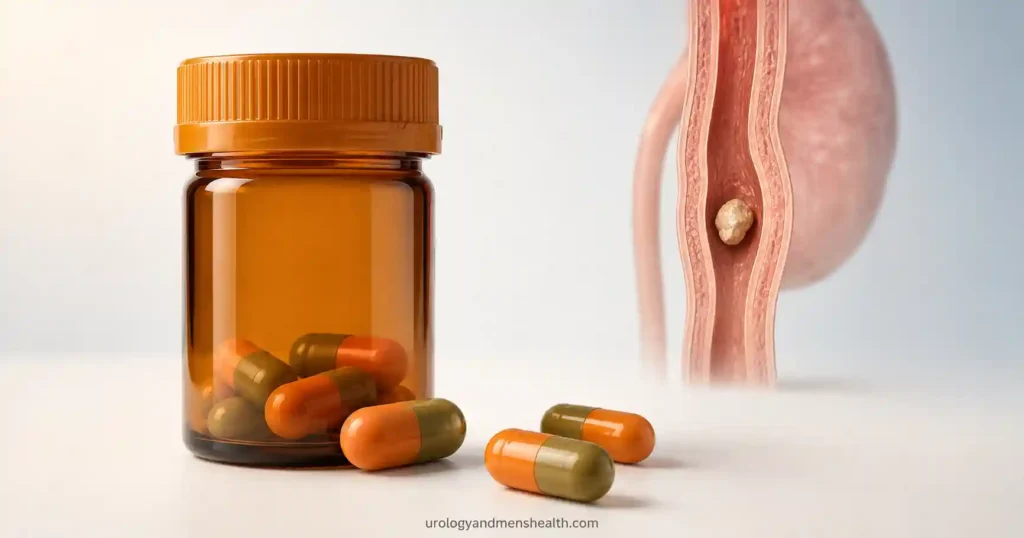
Flomax for kidney stones is one of the most commonly prescribed drugs in acute stone care, and one of the most commonly misapplied. Tamsulosin — sold as Flomax — relaxes smooth muscle in the lower third of the ureter, the segment where most stones get stuck. When a stone is large enough that ureteral spasm is holding it in place, relaxing that muscle genuinely shifts the odds of passing it. When the stone is 3 mm and already sliding, it changes very little. That single distinction is why two large placebo-controlled trials found no benefit, while the American Urological Association still gives this treatment its strongest possible recommendation. Both positions are defensible, and the reconciliation is stone size. Below I go through what the evidence actually supports, which stones respond, how long to give the drug before calling it a failure, and the side effects men are rarely warned about before they start. For the wider picture on stone management, see our Kidney Stones Hub.
Key Takeaways
- Tamsulosin works best for ureteral stones larger than 5 mm (about 1/5 inch); below that size, pooled trial data show no measurable benefit.
- The AUA 2026 stone guideline recommends roughly 30 days of alpha-blocker therapy for distal ureteral stones up to 10 mm, then repeat imaging — not indefinite treatment.
- The standard dose is 0.4 mg once daily, taken about 30 minutes after the same meal each day. In the US it is off-label for stones; the FDA approval covers prostate symptoms only.
- Retrograde ejaculation and intraoperative floppy iris syndrome are the two side effects most often missed — tell your eye surgeon if you have ever taken tamsulosin.
What Flomax for Kidney Stones Actually Does to Your Ureter
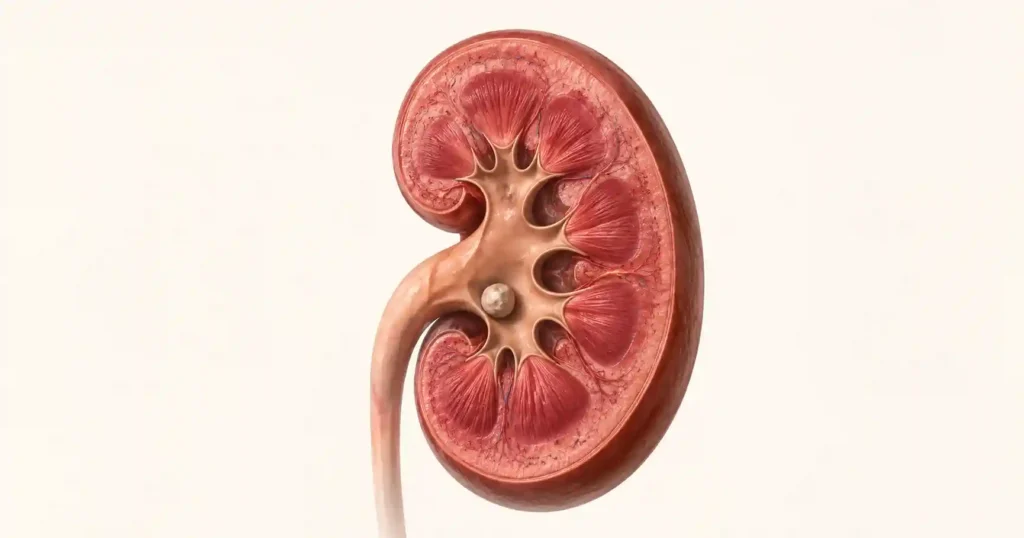
The ureter is not a passive drainpipe. It is a muscular tube that squeezes urine downward in waves, and when a stone lodges inside it, the muscle around that stone clamps down hard. Think of a hand cramping around an object you are trying to pull free — the tighter the grip, the less the object moves, and the more it hurts.
That clamping is driven by alpha-1 adrenergic receptors in the ureteral smooth muscle. Two subtypes matter here, alpha-1A and alpha-1D, and both are densest in the distal ureter — the final few centimeters before the stone enters the bladder. Tamsulosin blocks those receptors selectively. The result is lower resting muscle tone, weaker spasm around the stone, and lower pressure in the segment below it.
Be clear about what that does and does not mean. Tamsulosin does not dissolve the stone, does not shrink it, and does not push it. It removes an obstacle. If spasm was the thing preventing passage, the stone now has room to move. If the stone was simply too large to fit through the ureter regardless of muscle tone, no amount of relaxation will change the geometry.
This is also why the drug is prescribed under the label medical expulsive therapy, or MET, rather than as a stone treatment. It is a passage aid, not a cure.
The Evidence: Why Two Large Trials Said It Doesn’t Work
In 2015 the SUSPEND trial was published in The Lancet [2]. It randomized 1,167 adults across 24 UK hospitals to tamsulosin 400 micrograms, nifedipine 30 mg, or placebo for up to four weeks, with 1,136 analyzed. The result was flat: 80% of the placebo group needed no further intervention at four weeks, versus 81% on tamsulosin. The adjusted risk difference was 1.3%. For a drug that had been standard practice for a decade, that was a hard landing.
A year later an Australian multicenter trial published in Annals of Emergency Medicine reached a similar headline conclusion in 403 patients with distal stones of 10 mm or less [3]. Overall passage at 28 days was 87.0% with tamsulosin versus 81.9% with placebo — not statistically significant.
Then came the sentence most coverage skipped. In the prespecified subgroup of stones measuring 5 to 10 mm, passage was 83.3% with tamsulosin versus 61.0% with placebo — an absolute difference of 22.4%, with a number needed to treat of 4.5. Four or five men treated, one extra stone passed. That is a large effect by any standard in medicine.
The explanation for the contradiction is arithmetic. The median stone in the Australian trial was around 4 mm. Small stones pass on their own regardless of treatment, so enrolling mostly small stones dilutes a real effect in large stones down to statistical noise.
Two large syntheses confirm the pattern. The 2018 Cochrane review pooled 67 studies and 10,509 participants [4]. In the higher-quality placebo-controlled subset, alpha-blockers produced a risk ratio of 1.16 for stone clearance — about 116 extra clearances per 1,000 patients treated. The subgroup split was decisive: risk ratio 1.06 for stones of 5 mm or less (no benefit), versus 1.45 for stones larger than 5 mm. The 2016 BMJ meta-analysis of 55 randomized trials found the same shape — no significant benefit in smaller stones, a 57% higher chance of passage in larger ones — plus passage roughly 3.8 days faster, a 56% lower risk of needing surgery, and a 63% lower risk of hospital admission [5].
Which Stones Actually Respond — Size Is the Whole Answer
Two variables decide whether tamsulosin kidney stone passage therapy is worth taking: how big the stone is, and where it sits.
Stones under 5 mm
The EAU reports that a stone under 5 mm sitting in the distal ureter passes spontaneously about 89% of the time [6]. There is almost no room left for a drug to improve on that. Taking tamsulosin here is not dangerous, but you are accepting side effects for a benefit the data cannot detect. If your stone is in this range, the more useful question is how to support passage mechanically — fluids, pain control, and time.
Sizes and thresholds are laid out in detail in our stone size chart and treatment thresholds, which is worth reading alongside your CT report.
Stones 5 to 10 mm — the group that benefits
This is where the drug earns its place. Spontaneous passage rates fall sharply above 5 mm, spasm becomes the limiting factor, and every subgroup analysis across the trial literature shows a real effect. The AUA 2026 guideline gives alpha-blockers a Strong Recommendation with Grade A evidence for distal ureteral stones of 10 mm (about 2/5 inch) or less [1]. The EAU restricts its strong recommendation to distal stones larger than 5 mm [6]. Neither body is confused; they are drawing the line at slightly different points on the same curve.
Location: distal beats proximal
The receptors tamsulosin targets are concentrated low in the ureter, so the drug does most of its work there. For stones in the middle or proximal ureter measuring 10 mm or less, the AUA offers only a Conditional Recommendation, Grade B [1]. It is a reasonable trial, not a strong one.
Stones above 10 mm
Here medical expulsive therapy is the wrong tool. Spontaneous passage becomes unlikely, and a month spent waiting is a month of obstruction. These stones belong in a discussion about ureteroscopy or shockwave lithotripsy, not another prescription.
Estimate your own passage odds by stone size and position before you commit to a month of waiting →Passing a stone right now? Get the day-by-day timeline and the signs that mean stop waiting
Enter your email below to receive Dr. Khalid’s complete Passing a Kidney Stone: What to Expect as a free, printable PDF.
How to Take Tamsulosin, and the 30-Day Rule That Ends the Trial
The dose used in essentially every trial is 0.4 mg once daily. Take it at the same time each day, roughly 30 minutes after the same meal, because absorption shifts depending on whether the stomach is full. Some urologists use 0.8 mg for stones; the evidence supporting the higher dose in this setting is thin, and the side effect burden rises.
Worth knowing before you start: in the United States, tamsulosin is not FDA-approved for stone passage. Its approval covers urinary symptoms from an enlarged prostate. Prescribing it for a stone is legitimate, guideline-endorsed off-label use, but you should hear it from your doctor rather than discover it on the packaging.
What the timeline looks like
The EAU cites an average time to stone expulsion of about 17 days, with a usual range of 6 to 29 days [6]. The AUA sets the trial length at approximately 30 days, and specifically recommends repeat imaging afterward — either a CT scan, or an ultrasound combined with a plain KUB X-ray — to confirm whether the stone has actually gone [1].
Alongside the tamsulosin, three practical things matter. Take a scheduled anti-inflammatory such as ibuprofen or diclofenac as your primary pain control unless your kidney function or stomach rules it out — NSAIDs outperform opioids for renal colic and reduce ureteral edema. Drink to thirst rather than force-loading fluids, which does not push stones out and can worsen pain during obstruction. And strain every urination so the stone can be sent for composition analysis, which determines your prevention plan. Our guide on what genuinely speeds up stone passage covers the mechanics in more detail.
What failure looks like
If imaging at 30 days shows the stone still sitting in the same place, the trial is over. Another month of tamsulosin is not a plan. Ask your urologist directly: “Given this stone has not moved in 30 days, should we book ureteroscopy or shockwave lithotripsy, and how soon?” Obstruction sustained beyond roughly 4 to 6 weeks starts costing measurable function in that kidney, and the loss does not fully come back.
In My Practice
A pattern I see most weeks: a man arrives in clinic five or six weeks after his emergency room visit, still carrying the same 7 mm stone, still taking tamsulosin every morning, because nobody ever told him the trial had an end date. He assumed that continuing the tablet meant something was still happening. By the time he sits down, his kidney has been obstructed for over a month, and the conversation shifts from “let’s give it more time” to “we need to book a ureteroscopy this week.”
The 30-day mark is not a soft suggestion — it is the point where continued waiting starts costing kidney function rather than avoiding surgery.
Side Effects Men Are Rarely Warned About
The Cochrane placebo-controlled subset found that alpha-blockers slightly raise the risk of major adverse events — roughly 29 additional events per 1,000 people treated [4]. Small, but not zero. The more common issues are these.
Retrograde or reduced ejaculation
Tamsulosin relaxes the bladder neck as well as the ureter. With the bladder neck held open, semen can travel backward into the bladder rather than forward. Men notice either a much smaller ejaculate volume or nothing at all, followed by cloudy urine. It is the single most common reason men stop the drug, and it reverses within days to a couple of weeks after stopping. It does not damage sperm production or cause permanent infertility. The full profile is in our breakdown of tamsulosin side effects in men.
Dizziness and first-dose drops in blood pressure
Alpha blockade also relaxes blood vessels. Standing up quickly in the first few days can produce lightheadedness or, occasionally, a faint. Taking the first several doses at bedtime reduces this. If you take a PDE5 inhibitor such as sildenafil or tadalafil, or you are already on blood pressure medication, tell the prescriber — the combination can drop pressure further than either drug alone.
Intraoperative floppy iris syndrome
This is the one that catches people out. Alpha-1 receptors also sit in the iris dilator muscle. In men who have taken tamsulosin — even briefly, even years earlier — the iris can behave unpredictably during cataract surgery, raising the risk of complications. The effect does not reliably disappear when you stop the drug. If you have ever taken tamsulosin, tell your ophthalmologist before any eye surgery is scheduled. Surgeons can plan around it easily when they know; they cannot when they are surprised mid-procedure.
When Flomax Is the Wrong Answer
Medical expulsive therapy assumes one thing: that waiting is safe. In several situations it is not, and a prescription becomes a delay rather than a treatment.
- Infection above the obstruction. A blocked kidney with infected urine behind it is a surgical emergency, not a medication problem. It needs drainage with a stent or nephrostomy tube within hours.
- A single functioning kidney or obstruction on both sides. There is no reserve to fall back on. These patients get definitive treatment, not a waiting period.
- Rising creatinine or acute kidney injury. Falling function during a trial of passage ends the trial.
- Pain that will not settle. If full-dose anti-inflammatories are not holding the pain, or you are back in the emergency room a second time for the same stone, the stone is telling you it is not going to pass.
- Stones above 10 mm, or an impacted stone that has not moved on serial imaging.
- Pregnancy. Safety and efficacy data for alpha-blockers in pregnancy are limited; management follows a different pathway.
When to Stop Waiting and Go to the ER
Stop treating this as a home problem and get to an emergency department the same day if any of the following happens while you are waiting for a stone to pass:
- Fever above 38°C (100.4°F), shaking chills, or feeling unwell in a whole-body way alongside your stone pain — this combination suggests an obstructed, infected kidney and needs drainage within hours
- Pain that breaks through full-dose anti-inflammatories, or a second emergency visit for the same stone
- Vomiting that stops you keeping fluids or tablets down
- A noticeable drop in how much urine you are passing
- You have one working kidney, a transplanted kidney, or pain on both sides at once
Frequently Asked Questions
Does Flomax work for a kidney stone smaller than 5 mm?
Probably not to a degree you would notice. Distal stones under 5 mm pass on their own roughly 89% of the time, leaving almost no room for a drug to improve the odds. Both the Cochrane review and the BMJ meta-analysis found no significant benefit in this size band. Check your expected odds with our kidney stone passage calculator before assuming you need medication at all.
How long does Flomax take to pass a kidney stone?
Most stones that are going to pass do so within two to four weeks. The EAU cites an average expulsion time of about 17 days, with a usual range of 6 to 29 days. The AUA sets the trial at roughly 30 days followed by repeat imaging. If nothing has moved by then, more tamsulosin is not the answer — see our guide to what actually speeds up stone passage.
Why do doctors still prescribe Flomax for kidney stones if the big trials were negative?
Because those trials were negative on average, not in every subgroup. SUSPEND and the Australian trial both enrolled mostly stones under 5 mm, which pass regardless of treatment. Restrict the analysis to stones of 5 to 10 mm and the benefit reappears clearly. Guideline panels read the subgroups, not the headline. Stone size drives the decision — our stone size chart sets out the thresholds.
Will tamsulosin permanently change my ejaculation?
No. Reduced ejaculate volume, or semen travelling backward into the bladder, happens in a meaningful minority of men taking tamsulosin, and it reverses within days to a couple of weeks of stopping. It does not damage sperm production or cause lasting infertility. It matters more for men on long-term prostate therapy than for a 30-day stone course — the full side effect profile is here.
Can I take Flomax if my stone is in the upper ureter?
You can, but expect less from it. The AUA gives alpha-blockers only a conditional recommendation for mid and proximal ureteral stones, because the alpha-1 receptors the drug acts on are concentrated in the lower ureter. It remains a reasonable trial if your pain is controlled and kidney function is normal. If pain escalates or fever appears, work through our acute stone pain triage tool instead of waiting.
References
- American Urological Association. Surgical Management of Kidney and Ureteral Stones: AUA Guideline. 2026. AUA
- Pickard R, Starr K, MacLennan G, et al. Medical expulsive therapy in adults with ureteric colic: a multicentre, randomised, placebo-controlled trial. Lancet. 2015;386(9991):341-349. PubMed
- Furyk JS, Chu K, Banks C, et al. Distal ureteric stones and tamsulosin: a double-blind, placebo-controlled, randomized, multicenter trial. Ann Emerg Med. 2016;67(1):86-95.e2. PubMed
- Campschroer T, Zhu X, Vernooij RW, Lock MT. Alpha-blockers as medical expulsive therapy for ureteral stones. Cochrane Database Syst Rev. 2018;4(4):CD008509. PubMed
- Hollingsworth JM, Canales BK, Rogers MA, et al. Alpha blockers for treatment of ureteric stones: systematic review and meta-analysis. BMJ. 2016;355:i6112. PubMed
- European Association of Urology. EAU Guidelines on Urolithiasis. 2025. EAU
Dr. Muhammad Khalid
MBBS · FCPS (Urology) · MCPS (General Surgery) · CHPE · CRSM · IMC #539472
Specialist urologist with 11+ years of clinical experience across tertiary teaching hospitals. Trained at Lady Reading Hospital and Khyber Teaching Hospital, Peshawar. Author or co-author of five peer-reviewed international publications, including in Cureus and the World Journal of Surgery. Procedural expertise: URS, PCNL, RIRS, TURP, TURBT, and major open urological surgery. Full profile →
This article is for educational purposes only and does not constitute medical advice. Always consult your physician or urologist for diagnosis and treatment decisions specific to your condition.