Caffeine and Bladder Irritation: Why Coffee Sends You to the Bathroom
Most men blame coffee for urgency, but only a subset are genuinely caffeine-sensitive. Here's how I separate caffeine and bladder irritation from a prostate problem — and the four-week test that settles it.

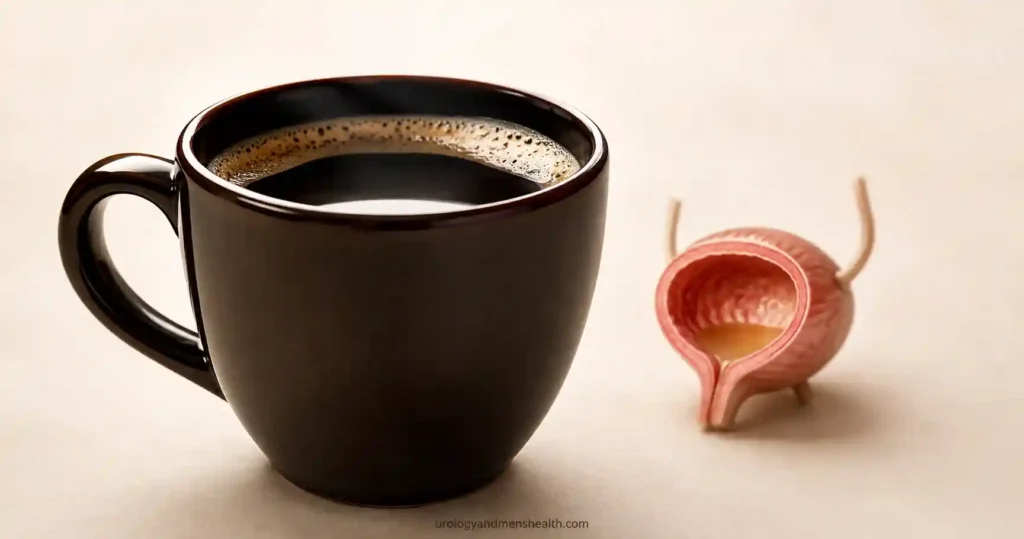
Caffeine and bladder irritation is one of the few subjects where men arrive at my clinic already certain of the answer. One man has cut coffee out completely and cannot understand why he still wakes three times a night. The next drinks five cups a day, has no urgency whatsoever, and wants to know whether he is quietly damaging his bladder. Both questions are reasonable, and the honest answer is more interesting than the advice they have read online. Caffeine does two separate things to your urinary tract, and they are constantly confused with each other. It increases how much urine your kidneys produce, and — separately — it makes the bladder report fullness earlier than it should. Some men are strongly affected by the second mechanism. A great many are not affected at all. Working out which group you belong to is the difference between a change worth making and giving up something you enjoy for nothing. For the wider picture on urinary symptoms in men, our Men’s Wellness Hub collects the related guides.
Key Takeaways
- Caffeine affects the bladder by two separate routes: it increases urine volume, and it lowers the filling volume at which your bladder signals fullness.
- In the Boston Area Community Health cohort, men drinking more than two cups of coffee daily had roughly double the odds of worsening urinary symptoms over five years, driven mainly by storage symptoms.
- Only a subset of men with urgency are genuinely caffeine-sensitive — a pooled analysis of seven observational studies found no overall link between coffee and urinary incontinence.
- A four-week reduction of 50 percent, with a three-day bladder diary before and after, is the only reliable way to find out whether you are in the responder group.
How Caffeine and Bladder Irritation Actually Work
The first mechanism is straightforward plumbing. Caffeine blocks adenosine receptors in the kidney, which increases blood flow through the glomerulus and reduces how much sodium the tubules reabsorb. Sodium pulls water with it. The result is more urine, produced faster. This is a volume problem, and it behaves like one: you make bigger voids, more often, for a few hours after the drink, without any particular sense of alarm.
The second mechanism is the one that actually bothers men, and it is a sensory problem rather than a volume problem. Caffeine appears to increase the excitability of the bladder wall and the sensory nerves in the bladder lining, so the organ starts reporting fullness at a smaller volume than it should.
A urodynamic study by Lohsiriwat and colleagues put numbers on this [4]. Twelve adults with overactive bladder symptoms underwent cystometry after a caffeine dose of 4.5 mg per kilogram — around 315 mg for a 70 kg man (about 154 lb), or three strong coffees. After caffeine, the volume at which they registered a first desire to void and a normal desire to void both fell significantly. Detrusor pressure during filling did not change, and flow rate and voided volume actually increased.
Read that carefully, because it is the single most useful fact in this article: caffeine did not weaken the bladder or obstruct it. It moved the alarm bell. The bladder still worked normally — it simply started complaining sooner.
The distinction changes what you should do. If your problem is volume, adjusting when you drink fixes most of it. If your problem is sensation, you need to reduce the caffeine dose itself and retrain the bladder’s tolerance for filling. Scoring your storage symptoms formally is the fastest way to see which pattern you have.
Score your urgency and frequency in two minutes with the OAB Symptom ScoreHow Much Caffeine Is Too Much for Your Bladder?
The FDA puts the general ceiling for healthy adults at 400 mg of caffeine per day [2]. That number is about cardiovascular and nervous system safety. It is not a bladder number, and men routinely misread it as permission.
The bladder-relevant figure comes from the Boston Area Community Health cohort, which followed 4,144 adults over five years [3]. Men who drank more than two cups of coffee daily had roughly double the odds of their lower urinary tract symptoms progressing compared with men who drank none — an odds ratio of 2.09 (95% confidence interval 1.29 to 3.40), with a significant dose-response trend. The effect fell specifically on storage symptoms: urgency, frequency, and getting up at night. It did not fall on voiding symptoms like a weak stream.
So the practical threshold for a man with storage symptoms sits well below the FDA ceiling — somewhere around 200 mg per day, which is two standard cups. Here is what that actually buys you, using FDA figures [2]:
- Brewed coffee, 240 mL (8 fl oz): 80 to 100 mg
- Green or black tea, 240 mL (8 fl oz): 30 to 50 mg
- Caffeinated soft drink, 350 mL (12 fl oz): 30 to 40 mg
- Energy drink, per 240 mL (8 fl oz): 40 to 250 mg
- Decaf coffee, 240 mL (8 fl oz): 2 to 15 mg
The trap is cup size. A 475 mL (16 fl oz) takeaway coffee is two cups, not one, and most men count it as one. Before you change anything, add up what you are genuinely drinking rather than what you believe you are drinking. If your total lands above 300 mg and your symptoms are urgency and frequency rather than a poor stream, you have found something worth testing. If your storage symptoms are severe enough to be reshaping your day, read our full guide to overactive bladder in men alongside this one.
Is It the Caffeine, the Acid, or Something Else in Your Drink?
Men who eliminate caffeine and see no improvement usually conclude the advice was wrong. More often they eliminated the wrong variable, because coffee is not one exposure — it is four at once: caffeine, acid, fluid volume, and heat.
Decaf is the cleanest diagnostic test you have. At 2 to 15 mg per cup [2], decaf delivers roughly a twentieth of the caffeine dose that altered bladder sensation in the urodynamic work. If you switch to decaf and your urgency is unchanged, caffeine was not your driver. That is genuinely useful information, and it costs you a week.
Carbonation is a separate offender. In the same Boston cohort, women with recently increased soda intake — particularly caffeinated diet soda — showed higher symptom scores and more urgency [3]. Carbonated drinks have been flagged as a risk factor for overactive bladder independently of their caffeine content.
Citrus is where the standard advice falls apart. Nearly every bladder-irritant handout tells men to avoid orange juice. In the Boston cohort, citrus juice intake was associated with 50 percent lower odds of symptom progression in men [3]. That is one observational finding and not a reason to start drinking juice therapeutically, but it should stop you from cutting out foods on the strength of a printed list.
Alcohol hits twice. It suppresses antidiuretic hormone, so your kidneys produce more urine overnight, and it fragments sleep architecture so you notice the bladder you would otherwise have slept through.
Change one variable at a time, for at least a week each. Men who cut coffee, soda, alcohol and citrus simultaneously and feel better have learned nothing they can act on long term.
Get the OAB & Incontinence Guide — a urologist's step-by-step protocol for urgency, frequency, and bladder retraining
Enter your email below to receive Dr. Khalid’s complete OAB & Incontinence Guide as a free, printable PDF.
Coffee, Nocturia, and Why Timing Beats Total Intake
For night waking specifically, when you drink caffeine matters more than how much.
Drake and colleagues gave healthy adults 400 mg of caffeine at bedtime, three hours before bedtime, and six hours before bedtime, with objective sleep monitoring at home [8]. All three timings significantly disrupted sleep compared with placebo. Even the six-hour dose measurably cut total sleep time — and the participants largely did not notice.
This matters for the bladder because of how night waking actually works. Waking to urinate is not usually the bladder overpowering deep sleep. It is far more often light, fragmented sleep letting you become aware of a bladder that is only moderately full. Add caffeine’s fluid load on top of caffeine’s sleep fragmentation and you have manufactured two trips to the bathroom that neither factor would have caused alone.
What to change, specifically: take your last caffeinated drink at least six hours before your usual bedtime — for a 10 p.m. sleeper, nothing after 4 p.m., and I would push that to 2 p.m. if you are over 50. Front-load your daily fluid so that most of it is consumed before 6 p.m., and taper in the final three hours rather than stopping abruptly, which only makes you thirsty at bedtime.
Be realistic about what this will fix. In men over 50, night waking usually has several overlapping drivers — nocturnal polyuria, prostate enlargement, sleep apnea, and leg fluid redistribution among them. Our guide to nocturia in men works through them in the order I assess them in clinic.
In My Practice
A 46-year-old software engineer came to me convinced he had a prostate problem. Six trips to the bathroom before lunch, urgency that made meetings uncomfortable, and nothing at all overnight. His three-day diary showed 620 mg of caffeine consumed before 11 a.m. — three large takeaway coffees and a pre-workout drink he had never counted as caffeine. He kept his two morning coffees, dropped the pre-workout and the third cup, and came back at four weeks down to three morning voids. His flow rate on repeat testing was identical to baseline, which told me his bladder had never been the problem.
When storage symptoms cluster into the same few hours of the day, every day, the cause is almost always something you drank rather than something structural.
The Four-Week Caffeine Trial I Give Patients
The 2024 AUA/SUFU guideline on idiopathic overactive bladder recommends that clinicians offer behavioral therapies — fluid management, caffeine reduction, dietary modification — to all patients with overactive bladder [1]. Notably, that guideline abandoned the old “first-line, second-line” step-therapy language, so caffeine reduction is now one option on a menu rather than a hoop you must jump through before anything else is offered.
The trial evidence behind it is a single randomized study. Bryant and colleagues randomized 95 consecutive adults with urinary symptoms to caffeine reduction education or usual care [5]. At one month, the reduction group had significantly improved urgency (p = 0.002) and frequency (p = 0.037). Small, unblinded, and now over two decades old — which is exactly why you should test it on yourself rather than assume it applies.
Here is the protocol I hand out:
- Days 1 to 3 — baseline diary. Measure every void with a jug, record the time and volume, log every drink with its caffeine content, and rate each urgency episode from 0 to 3. Three days, including one weekend day.
- Weeks 1 to 2 — cut by half, not to zero. Halving is what was actually tested. Going to zero adds withdrawal headache, which peaks at 24 to 48 hours and confounds your first week of results.
- Weeks 3 to 4 — hold steady. No further changes to fluid, alcohol, or medication during this window, or you will not know what did the work.
- Days 26 to 28 — repeat the diary. Same method, same measuring jug.
How to read the result. A meaningful response is at least two fewer daytime voids, or urgency episodes down by roughly a third. Anything less than that is noise. If the numbers have not moved, caffeine is not driving your symptoms — stop restricting it and get the underlying cause investigated instead.
This is not a marginal proportion of men. A 2023 analysis from the LURN network reviewed three-day diaries from 491 treatment-seeking adults, 277 of them men [6]. Participants with urgency incontinence were considerably more likely to abstain from caffeine altogether, but among those who did drink it, the dose was no different from people without incontinence. The authors’ conclusion is the one I repeat in clinic: only a subset of people with urgency are caffeine-sensitive at all. Separately, a meta-analysis of seven observational studies found no association between coffee or caffeine intake and urinary incontinence in either sex [7].
Whichever way your trial goes, the behavioral intervention with the strongest evidence behind it is not dietary at all.
Bladder training: the technique that outperforms dietary restriction for urgencyWhen Bladder Symptoms Have Nothing to Do With Coffee
The reason I dislike the blanket “avoid bladder irritants” handout is that it gives men something to do instead of getting diagnosed. Months disappear.
The pattern that should redirect you is storage symptoms combined with voiding symptoms. Urgency and frequency alone can plausibly be dietary. Urgency and frequency alongside a weak or intermittent stream, hesitancy before the flow starts, straining, or a sense of incomplete emptying points at the bladder outlet, not at your mug. In men over 50 that usually means an enlarged prostate obstructing flow, with the bladder muscle thickening and becoming overactive in response. No amount of decaf reverses that.
Quantify it before you speculate. The IPSS prostate symptom score is the validated instrument urologists use, and it separates storage from voiding symptoms in a way a diary cannot.
A urinary tract infection in a man is never dismissed as routine either. Unlike in women, male UTI implies an underlying reason — obstruction, incomplete emptying, stones, or a prostate source — and warrants a urine culture plus assessment of how well you empty.
Red Flags — Stop Adjusting Your Diet and Get Assessed
These findings need a doctor, not a change of beverage. Ask specifically for a urinalysis and urine culture, and for a post-void residual measurement by bladder ultrasound.
- Visible blood in the urine, even once, even painless — this needs urology referral for cystoscopy and CT urography, ideally within two weeks.
- New urgency or frequency in a current or former smoker — smoking is the dominant risk factor for bladder cancer and changes the threshold for investigation.
- Fever, flank pain, or shaking chills with urinary symptoms — go to the emergency room the same day.
- Inability to pass urine at all, with a painful lower abdomen — this is acute retention and needs catheterization the same day.
- Burning on urination lasting more than a few days, or any male urinary infection — request a urine culture before antibiotics are started.
- Unexplained weight loss, bone pain, or a rapidly rising symptom score over weeks rather than years.
Frequently Asked Questions
Will cutting out coffee completely fix bladder urgency?
Complete elimination has never been shown to beat halving your intake. The randomized trial behind this advice reduced caffeine by roughly half and still improved urgency and frequency at one month. Going to zero adds withdrawal headache, which muddies your first week of results. Cut by half, hold four weeks, then judge. If urgency persists, our guide to overactive bladder in men covers what comes next.
Why does decaf coffee still send me to the bathroom?
Decaf contains only 2 to 15 mg of caffeine per 240 mL (8 fl oz) cup, far below the dose that shifts bladder sensation. If decaf still triggers you, the driver is the fluid volume itself or the acidity of the brew, not caffeine. Score your storage symptoms with the OAB Symptom Score before you eliminate anything else from your diet.
Is caffeine and bladder irritation the same thing as overactive bladder?
No. Caffeine lowers the volume at which an otherwise normal bladder reports fullness, so the urgency has an identifiable trigger and settles when the trigger goes. Overactive bladder produces the same urgency with no dietary explanation and needs behavioral treatment in its own right. Bladder training has the strongest evidence base and works whether or not caffeine is involved.
How long should it take for bladder symptoms to improve after cutting caffeine?
One month. The trial that demonstrated benefit measured outcomes at four weeks, and that is the window I give patients. Run a three-day bladder diary before you start and repeat it at week four, so you are comparing numbers rather than impressions. If you are a man over 50 with a weak stream, complete the IPSS prostate symptom score as well.
Does coffee cause nocturia, or is waking at night something else?
Caffeine taken within six hours of bedtime measurably fragments sleep, and a fragmented sleeper notices a bladder that would otherwise not have woken him. That is a different problem from producing too much urine overnight. In men over 50, night waking usually has several overlapping causes — our guide to nocturia in men works through them in order.
References
- Cameron AP, Chung DE, Dielubanza EJ, et al. The AUA/SUFU Guideline on the Diagnosis and Treatment of Idiopathic Overactive Bladder. J Urol. Published online April 23, 2024. AUA
- US Food and Drug Administration. Spilling the Beans: How Much Caffeine is Too Much? Consumer Updates. 2024. FDA
- Maserejian NN, Wager CG, Giovannucci EL, Curto TM, McVary KT, McKinlay JB. Intake of caffeinated, carbonated, or citrus beverage types and development of lower urinary tract symptoms in men and women. Am J Epidemiol. 2013;177(12):1399-1410. PubMed
- Lohsiriwat S, Hirunsai M, Chaiyaprasithi B. Effect of caffeine on bladder function in patients with overactive bladder symptoms. Urol Ann. 2011;3(1):14-18. PubMed
- Bryant CM, Dowell CJ, Fairbrother G. Caffeine reduction education to improve urinary symptoms. Br J Nurs. 2002;11(8):560-565. PubMed
- Cameron AP, Helmuth ME, Smith AR, et al. Total fluid intake, caffeine, and other bladder irritant avoidance among adults having urinary urgency with and without urgency incontinence (LURN). Neurourol Urodyn. 2023;42(1):213-220. PubMed
- Sun S, Liu D, Jiao Z. Coffee and caffeine intake and risk of urinary incontinence: a meta-analysis of observational studies. BMC Urol. 2016;16(1):61. PubMed
- Drake C, Roehrs T, Shambroom J, Roth T. Caffeine effects on sleep taken 0, 3, or 6 hours before going to bed. J Clin Sleep Med. 2013;9(11):1195-1200. PubMed
Dr. Muhammad Khalid
MBBS · FCPS (Urology) · MCPS (General Surgery) · CHPE · CRSM · IMC #539472
Specialist urologist with 11+ years of clinical experience across tertiary teaching hospitals. Trained at Lady Reading Hospital and Khyber Teaching Hospital, Peshawar. Author or co-author of five peer-reviewed international publications, including in Cureus and the World Journal of Surgery. Procedural expertise: URS, PCNL, RIRS, TURP, TURBT, and major open urological surgery. Full profile →
This article is for educational purposes only and does not constitute medical advice. Always consult your physician or urologist for diagnosis and treatment decisions specific to your condition.